Dangerous Summer
eBook - ePub

Dangerous Summer

  1. 221 pages
  2. English
  3. ePUB (mobile friendly)
  4. Available on iOS & Android
eBook - ePub

Dangerous Summer

About this book

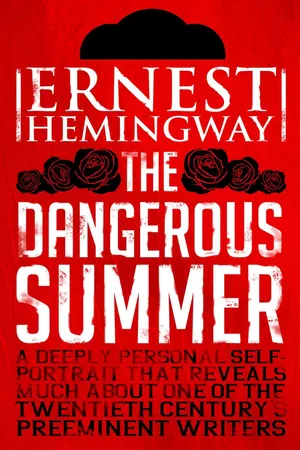
The Dangerous Summer is Hemingway's firsthand chronicle of a brutal season of bullfights. In this vivid account, Hemingway captures the exhausting pace and pressure of the season, the camaraderie and pride of the matadors, and the mortal drama—as in fight after fight—the rival matadors try to outdo each other with ever more daring performances. At the same time Hemingway offers an often complex and deeply personal self-portrait that reveals much about one of the twentieth century's preeminent writers.

Frequently asked questions

Yes, you can cancel anytime from the Subscription tab in your account settings on the Perlego website. Your subscription will stay active until the end of your current billing period. Learn how to cancel your subscription.
No, books cannot be downloaded as external files, such as PDFs, for use outside of Perlego. However, you can download books within the Perlego app for offline reading on mobile or tablet. Learn more here.
Perlego offers two plans: Essential and Complete
  • Essential is ideal for learners and professionals who enjoy exploring a wide range of subjects. Access the Essential Library with 800,000+ trusted titles and best-sellers across business, personal growth, and the humanities. Includes unlimited reading time and Standard Read Aloud voice.
  • Complete: Perfect for advanced learners and researchers needing full, unrestricted access. Unlock 1.4M+ books across hundreds of subjects, including academic and specialized titles. The Complete Plan also includes advanced features like Premium Read Aloud and Research Assistant.
Both plans are available with monthly, semester, or annual billing cycles.
We are an online textbook subscription service, where you can get access to an entire online library for less than the price of a single book per month. With over 1 million books across 1000+ topics, we’ve got you covered! Learn more here.
Look out for the read-aloud symbol on your next book to see if you can listen to it. The read-aloud tool reads text aloud for you, highlighting the text as it is being read. You can pause it, speed it up and slow it down. Learn more here.
Yes! You can use the Perlego app on both iOS or Android devices to read anytime, anywhere — even offline. Perfect for commutes or when you’re on the go.
Please note we cannot support devices running on iOS 13 and Android 7 or earlier. Learn more about using the app.
Yes, you can access Dangerous Summer by Ernest Hemingway in PDF and/or ePUB format, as well as other popular books in Literature & Literary Biographies. We have over one million books available in our catalogue for you to explore.

Information

1
It was strange going back to Spain again. I had never expected to be allowed to return to the country that I loved more than any other except my own and I would not return so long as any of my friends there were in jail. But in the spring of 1953 in Cuba I talked with good friends who had fought on opposing sides in the Spanish Civil War about stopping in Spain on our way to Africa and they agreed that I might honorably return to Spain if I did not recant anything that I had written and kept my mouth shut on politics. There was no question of applying for a visa. They were no longer required for American tourists.
By 1953 none of my friends were in jail and I made plans to take my wife Mary to the feria at Pamplona and then to proceed to Madrid to see the Prado and after that, if we were still at large, to continue on to Valencia for the bullfights there before getting our boat to Africa. I knew that nothing could happen to Mary since she had never been in Spain in her life and knew only the very finest people. Surely, if she ever had any trouble they would rush to her rescue.
We passed quickly through Paris and drove rapidly through France via Chartres, the Valley of the Loire, and the Bordeaux bypass to Biarritz where several people were poised waiting to join us in our passage of the frontier. We ate and drank well and set an hour to meet at our hotel at Hendaye Plage and all hit the frontier together. One of our friends had a letter from Duke Miguel Primo de Rivera, then Spanish Ambassador in London, which was supposed to be able to work wonders if I ran into difficulties. This cheered me vaguely.
It had been grim and rainy when we reached Hendaye and it was grim and cloudy in the morning so that you could not see the mountains of Spain for the heavy clouds and the mist. Our friends did not show for the rendezvous. I gave them an hour and then a half an hour more. Then we left for the frontier.
It was grim at the inspection post too. I took the four passports in to the police and the inspector studied mine at length without looking up. This is customary in Spain but never reassuring.
“Are you any relation of Hemingway the writer?” he asked, still without looking up.
“Of the same family,” I answered.
He looked through the pages of the passport and then studied the photograph.
“Are you Hemingway?”
I pulled myself up to modified attention and said, “A sus ordenes,” which means in Spanish not only at your orders but also at your disposal. I had seen it said and heard it said under many different circumstances and I hoped I had said it properly and in the right tone of voice.
Anyway he stood up, put out his hand and said, “I have read all your books and admire them very much. Let me stamp these and see if I can help you at the customs.”
So that was how we came back to Spain and it seemed too good to be true. Each time we were halted by the civil guard at the three checkpoints along the Bidassoa river I expected us to be detained or sent back to the frontier. But each time the guards examined our passports carefully and politely and waved us on cheerfully. We were an American couple, a cheerful Italian, Gianfranco Ivancich from the Veneto, and an Italian chauffeur from Udine, bound for the San Fermines at Pamplona. Gianfranco was an ex-cavalry officer who fought with Rommel and was a close and dear friend who had lived with us in Cuba while he was working there. He had brought the car up to meet us at Le Havre. The driver Adamo had ambitions of becoming an undertaker and funeral director. He has achieved them and if you ever die in Udine he is the man to handle you. No one ever asked him which side of the Spanish Civil War he fought on. For my own peace of mind on that first trip I sometimes hoped it was both. Getting to know him and appreciate his versatility which was Leonardian I believe it would be perfectly possible. He might fight on one side for his principles, on another for his country or the city of Udine, and if there were a third party he could always fight for his God or for the Lancia Company or the Funeral Directing Industry to all of whom he was equally and deeply devoted.
If you want to travel gaily, and I do, travel with good Italians. We were with two fine ones in a good well-seasoned Lancia climbing up out of the green Bidassoa valley with the chestnut trees close beside the road and the mist clearing as we climbed so I knew it would be clear after the Col de Velate when we would wind down into the high plateau of Navarre.
This is supposed to be about bullfighting but I took little interest in bullfighting then except to wish to show it to Mary and Gianfranco. Mary had seen Manolete fight in his last appearance in Mexico. It was a windy day and he drew the two worst bulls but she had liked the corrida, which was very poor, and I knew if she liked that one she would like bullfighting. They say that if you can stay away from bullfighting for a year you can stay away from it forever. That is not true but it has some truth in it and, except for fights in Mexico, I had been away for fourteen years. A lot of that time though was like being in jail except that I was locked out; not locked in.
I had read about, and trusted friends had told me about, some of the abuses that had come into bullfighting in the years of the domination of Manolete and after. To protect the leading matadors the bulls’ horns had been cut off at the points and then shaved and filed down so that they looked like real horns. But they were as tender at the point as a fingernail that has been cut to the quick and if the bull could be made to bang them against the planks of the barrera they would hurt so that he would be careful about hitting anything else with them. The same effect would be produced by hitting the iron-heavy canvas of the sheathing then used to armor the horses.
With the length of the horn shortened the bull lost his sense of distance too and the matador was in much less danger of being caught. A bull learns to use his horns on the ranch in the daily arguments, squabbles and sometimes serious fights with his brothers and he is more knowledgeable and skillful with them each year. So the managers of certain star matadors, who each had their strings of lesser matadors, tried to get the bull breeders to produce what we call the half-bull or medio-toro. This is a bull as little over three years as possible so he will not know how to use his horns too well. For him not to be too strong in the legs and so irreducible by the muleta, he should not have to walk too far from his pasture to water. For him to fill out to the required weight they want him grain-fed so that he will look like a bull, weigh out like a bull and come in fast like a bull. But really he is only a half-bull and the punishment softens him and leaves him manageable and, unless the matador takes very gentle care of him, he is helpless at the end.
He can wound you or kill you any time with one chopping stroke of even a shaved horn. Many people have been wounded by shaved horns. But a bull whose horns have been altered is at least ten times as safe to work and kill as a bull with his horns intact.
The average spectator cannot detect the shaved horn since he or she has had no experience with the horns of animals and does not see the slight gray-white raspiness. They look at the tips of the horns and they see a fine shining black point and they do not know that was made by rubbing the horn and polishing it with used crankcase oil. That gives a shaved horn a better sheen than saddle soap gives your scuffed shooting boots but to a trained observer it is as easy to detect as a flaw in a diamond is to a jeweler and you can detect it from a much greater distance.
The unscrupulous managers of the time of Manolete and the years after were also often the promoters, or linked with the promoters and with certain bull breeders. Their ideal for their matadors was the half-bull and many breeders concentrated on producing him in great quantities. They bred down in size for speed, for docility and easy rage and then they grained them up for weight to give the impression of size. They did not have to worry about horns. Horns could be altered and the public seeing the miracles that could be performed with such animals—men fighting backwards; men staring at the public instead of the bull, as he passed under their armpits; men kneeling in front of the ferocious animal and putting their left elbow to the bull’s ear while they pretended to speak to him on the telephone; men stroking his horn and throwing away their sword and muleta while they gazed at the public like ham actors with the bull still sick and bleeding and hypnotized—the public watching this circus business thought they were witnessing a new Golden Age of bullfighting.
If the unscrupulous managers had to accept real bulls with unaltered horns from honest breeders there was always a possibility that something could happen to the bulls in the dark passageways and the stone holding boxes of the bull ring where they are confined after being sorted out at noon the day of the corrida. So if you had seen a bull bright-eyed, fast as a cat, sound in all four legs at the apartado (or sorting out and putting the bulls in the holding boxes) and this bull should come out later weak in the hind legs, someone might have dropped a heavy sack of feed on the small of his back. Or if he wandered out into the ring like a sleepwalker and the matador could only try to work him through the bull’s daze so he had an animal that was disinterested and had forgotten what his great horns were for, then someone could have prodded him with a big horse syringe loaded with barbiturates.
Of course sometimes they had to fight the real bull with unaltered horns. The best fighters could do it but they did not like it because it was too dangerous. But they all did it a certain number of times each year.
So for many reasons, especially the fact that I had grown away from spectator sports, I had lost much of my old feeling for the bullfight. But a new generation of fighters had grown up and I was anxious to see them. I had known their fathers, some of them very well, but after some of them died and others lost out to fear or other causes I had resolved never to have a bullfighter for a friend again because I suffered too much for them and with them when they could not cope with the bull from fear or the incapacity that fear brings.
That year of 1953 we stayed outside of town in Lecumberri and drove to Pamplona twenty-five miles to arrive by six-thirty each morning for the running of the bulls through the streets at seven. We located our friends at the hotel in Lecumberri and we put in the usual rough seven days. After seven days of unrelenting festivity we all knew each other fairly well and we all liked each other, or most of us did, which meant it had been a good fiesta. At the start I had thought the Earl of Dudley’s gold-trimmed Rolls Royce just a touch pretentious. Now I found it charming. That was the way it was that year.
Gianfranco had joined one of the dancing and drinking cuadrillas made up of bootblacks and a few aspirant pickpockets, and his bed at Lecumberri saw little of him. He created minor history by going to sleep in the fenced-off runway through which the bulls enter the ring so he would be sure to be awake for the encierro and not miss it as he had one morning. He did not miss it. The bulls ran over him. All the members of his cuadrilla were very proud.
Adamo was in the ring each morning and wanted to be allowed to kill a bull but the management had other plans.
The weather was atrocious and Mary was soaked through at the fights and caught a heavy cold with fever that stayed with her through Madrid. The bullfights were not really good except for one historic thing. It was the first time we saw Antonio Ordóñez.
I could tell he was great from the first long slow pass he made with the cape. It was like seeing all the great cape handlers, and there were many, alive and fighting again except that he was better. Then, with the muleta, he was perfect. He killed well and without difficulty. Watching him closely and critically I knew he would be a very great matador if nothing happened to him. I did not know then he would be great no matter what happened to him and increase in courage and passion after every grave wound.
I had known his father Cayetano years before and had written a portrait of him and an account of his fighting in The Sun Also Rises. Everything that is in the bull ring in that book is as it was and how he fought. All the incidents outside the ring are made up and imagined. He always knew this and never made any protests about the book.
Watching Antonio with the bull I saw that he had everything his father had in his great days. Cayetano had absolute technical perfection. He could direct his subalterns, the picadors and the banderilleros, so that the entire handling of the bull, the three stages that lead to his death, was ordered and reasoned. Antonio was very much better so that every pass that he made with the cape from the time the bull came out and every move of the picadors and the placing of each pic thrust was intelligently directed toward preparing the bull for the last act of the bullfight: his domination by the scarlet cloth of the muleta which prepares him for his death by the sword.
In modern bullfighting it is not enough that the bull be simply dominated by the muleta so that he may be killed by the sword. The matador must perform a series of classic passes before he kills, if the bull is still able to charge. In these passes the bull must pass the body of the matador within hooking range of the horn. The closer the bull passes the man at the man’s invitation and direction the greater the thrill the spectator receives. The classic passes are all extremely dangerous and in them the bull must be controlled by the scarlet flannel the matador holds draped over a forty-inch stick. Many trick passes have been invented in which the man really passes the bull instead of having the bull pass him, or takes advantage of his passage, saluting him, in effect, as he passes rather than controlling and directing the moves of the bull. The most sensational of these saluting passes are done on bulls which charge on a straight line and the matador knowing there is comparatively no danger turns his back on the bull to start the pass. He could pass a street car in the same way but the public loves these tricks.
The first time I saw Antonio Ordóñez I saw that he could make all the classic passes without faking, that he knew bulls, that he could kill well if he wished to, and that he was a genius with the cape. I could see he had the three great requisites for a matador: courage, skill in his profession and grace in the presence of the danger of death. But when a mutual friend told me coming out of the ring after the fight that Antonio wanted me to come up to the Hotel Yoldi to see him I thought: Don’t start being friends with bullfighters again and especially not with this one when you know how good he is and how much you will have to lose if anything happens to him.
Fortunately I have never learned to take the good advice I give myself nor the counsel of my fears. So meeting JesĂșs CĂłrdoba, the Mexican bullfighter who was born in Kansas, speaks excellent English, and had dedicated a bull to me the day before, I asked him where the Yoldi was and he offered to walk over with me. JesĂșs CĂłrdoba was an excellent boy and a good and intelligent matador and I enjoyed talking with him. He left me at the door of Antonio’s room.
Antonio lay naked on the bed except for a hand towel as a fig leaf. I noticed the eyes first; the darkest, brightest, merriest eyes anybody ever looked into and the mischief urchin grin, and could not help seeing the scar welts on the right thigh. Antonio reached his left hand out, the right had been badly cut by the sword on his second kill, and said, “Sit down on the bed. Tell me. Am I as good as my father?”
So looking in those strange eyes, the grin gone now along with any doubt that we were going to be friends, I told him that he was better than his father and I told him how good his father was. Then we talked about the hand. He said he would fight with it in two days. It was a deep cut but had not severed any tendon or ligament. His telephone call came through that he had put in to his fiancée, Carmen, the daughter of Dominguín his manager and the sister of Luis Miguel Dominguín the matador, and I excused myself to get out of hearing distance of the phone. When the call was finished I said good-bye. We made an appointment to meet at El Rey Noble with Mary and have been friends ever since.
When we first saw Antonio fight, Luis Miguel Dominguín had retired. We met him first at Villa Paz, the ranch he had just bought near Saelices on the road from Madrid to Valencia. I had known Miguel’s father for many years. He had been a good matador at a time when there were two great matadors, and later a very able and astute businessman and he had discovered and managed Domingo Ortega. Dominguín and his wife had three sons and two daughters. All three sons had been matadors. Luis Miguel had been facile and talented in everything, was a great banderillero and what the Spanish call a torero muy largo; that is, he had an extensive repertoire of passes and elegant tricks, and could do anything with a bull and kill just as well as he wanted to.
It was DominguĂ­n, the father, who asked us to stop and see Luis Miguel at his newly purchased ranch and have lunch on our way to Valencia. Mary, Juanito Quintana, an old friend from Pamplona who was the model for the hotel keeper Montoya in The Sun Also Rises, and I came to the cool, darkened house after driving through the July heat of New Castille with the hot wind from Africa blowing the chaff in the air from the threshing floors along the road. Luis Miguel was a charmer, dark, tall, no hips, just a touch too long in the neck for a bullfighter, with a grave mocking face that went from professional disdain to easy laughter. Antonio Ordóñez was there with Carmen, Luis Miguel’s younger sister. She was very dark and beautiful with a lovely face and she was beautifully built. She and Antonio were engaged to be married that fall and you could see in everything they did and said how much they loved each other.
We inspected the animals, the poultry and stables and the gun room and I went into the cage of a wolf which had been recently trapped on the place and played with him which pleased Antonio. The wolf looked healthy and the odds were all a...

Table of contents

  1. Cover
  2. The Hemingway eBook Collection
  3. Map of Spain
  4. Introduction
  5. The Dangerous Summer
  6. 1
  7. 2
  8. 3
  9. 4
  10. 5
  11. 6
  12. 7
  13. 8
  14. 9
  15. 10
  16. 11
  17. 12
  18. 13
  19. Photos
  20. Glossary of Bullfight Terms
  21. Index
  22. About the Author
  23. Copyright