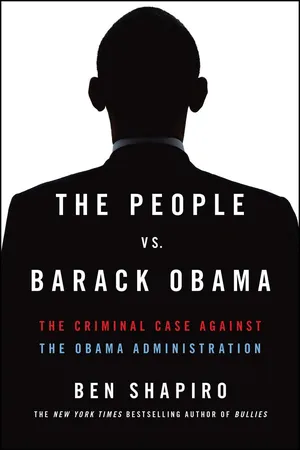
The People Vs. Barack Obama
eBook - ePub

The People Vs. Barack Obama

The Criminal Case Against the Obama Administration

  1. 304 pages
  2. English
  3. ePUB (mobile friendly)
  4. Available on iOS & Android
eBook - ePub

The People Vs. Barack Obama

The Criminal Case Against the Obama Administration

About this book

Now in paperback, New York Times bestselling author Ben Shapiro presents a comprehensive case against Barack Obama's abuses of power during his time in office. From the DOJ to the NSA, from the EPA to the Department of Health and Human Services, Barack Obama's administration has become a labyrinth of corruption and overreach touching every aspect of Americans' lives. The People vs. Barack Obama strips away the soft media picture of the Obama administration to reveal a regime motivated by pure, unbridled power and details how each scandal has led to dozens of instances of as-yet-unprosecuted counts of espionage, involuntary manslaughter, violation of internal revenue laws, bribery, and obstruction of justice.The story of the Obama administration is a story of abuse, corruption, and venality on the broadest scale ever to spring from the office of the presidency. President Obama may be the culmination of a century of government growth—but more important, he is the apotheosis of the imperial presidency. Obama chooses when to enforce immigration laws, delays his own Obamacare proposals when it is politically convenient to do so, micromanages the economy, attacks the Supreme Court, Congress, and the sovereign states. And he proclaims that he alone is the voice of the people while encroaching on their rights. In The People vs. Barack Obama, Ben Shapiro brings Obama into the people's court and addresses each of his abuses of power.
Frequently asked questions

Yes, you can cancel anytime from the Subscription tab in your account settings on the Perlego website. Your subscription will stay active until the end of your current billing period. Learn how to cancel your subscription.
No, books cannot be downloaded as external files, such as PDFs, for use outside of Perlego. However, you can download books within the Perlego app for offline reading on mobile or tablet. Learn more here.
Perlego offers two plans: Essential and Complete
  • Essential is ideal for learners and professionals who enjoy exploring a wide range of subjects. Access the Essential Library with 800,000+ trusted titles and best-sellers across business, personal growth, and the humanities. Includes unlimited reading time and Standard Read Aloud voice.
  • Complete: Perfect for advanced learners and researchers needing full, unrestricted access. Unlock 1.4M+ books across hundreds of subjects, including academic and specialized titles. The Complete Plan also includes advanced features like Premium Read Aloud and Research Assistant.
Both plans are available with monthly, semester, or annual billing cycles.
We are an online textbook subscription service, where you can get access to an entire online library for less than the price of a single book per month. With over 1 million books across 1000+ topics, we’ve got you covered! Learn more here.
Look out for the read-aloud symbol on your next book to see if you can listen to it. The read-aloud tool reads text aloud for you, highlighting the text as it is being read. You can pause it, speed it up and slow it down. Learn more here.
Yes! You can use the Perlego app on both iOS or Android devices to read anytime, anywhere — even offline. Perfect for commutes or when you’re on the go.
Please note we cannot support devices running on iOS 13 and Android 7 or earlier. Learn more about using the app.
Yes, you can access The People Vs. Barack Obama by Ben Shapiro in PDF and/or ePUB format, as well as other popular books in Politics & International Relations & American Government. We have over one million books available in our catalogue for you to explore.

COUNT 1

Images

ESPIONAGE


Whoever, with intent or reason to believe that it is to be used to the injury of the United States or to the advantage of a foreign nation, communicates, delivers, or transmits, or attempts to communicate, deliver, or transmit, to any foreign government, or to any faction or party or military or naval force within a foreign country, whether recognized or unrecognized by the United States, or to any representative, officer, agent, employee, subject, or citizen thereof, either directly or indirectly, any document, writing, code book, signal book, sketch, photograph, photographic negative, blueprint, plan, map, model, note, instrument, appliance, or information relating to the national defense, shall be punished by death or by imprisonment for any term of years or for life. . . . If two or more persons conspire to violate this section, and one or more of such persons do any act to effect the object of the conspiracy, each of the parties to such conspiracy shall be subject to the punishment provided for the offense which is the object of such conspiracy.
—18 U.S. CODE § 794


OPENING ARGUMENT

Their bodies were carried slowly off an American military jet by stiffly starched Marines in their dress blues. Their coffins were covered in American flags. And as they were loaded into the waiting hearses, which sat underneath an enormous star-spangled banner, the president of the United States and the secretary of state comforted one another. He wore a black suit and a striped tie; she wore a black pantsuit and a three-layered pearl necklace. Both wore solemn faces.
The president spoke first from the podium, flanked by the maternal-looking secretary of state. “Their sacrifice will never be forgotten,” he said. “We will bring justice to those who took them from us.” He continued, “The United States of America will never retreat from the world. We will never stop working for the dignity and freedom that every [person] deserves. . . . That’s the essence of American leadership. . . . That was their work in Benghazi, and that is the work we will carry on.”
“Four Americans, four patriots,” he concluded. “They loved this country. They chose to serve it, and served it well. . . . Their sacrifice will never be forgotten.”
Then the secretary of state stepped to the microphone. “Today we bring home four Americans who gave their lives for our country and our values,” she said. “To the families of our fallen colleagues, I offer our most heartfelt condolences and deepest gratitude . . . we will wipe away our tears, stiffen our spines, and face the future undaunted.”1
As the bodies of Ambassador Christopher Stevens, State Department employee Sean Smith, and former Navy SEALs Glen Doherty and Tyrone Woods lay before them, the president and secretary of state were already planning their own futures. President Barack Obama was planning a reelection campaign event in Washington, D.C.2 Secretary of State Hillary Clinton was already planning her 2016 run for the presidency.
They were both planning a cover-up. For the people responsible for taking the lives of those four brave Americans were not merely the Islamist terrorists of Benghazi, Libya. They were present in that Andrews Air Force Base hangar. They were speaking from the podium.

THE CHARGES

The crime of espionage is a difficult one to charge. Historically, the government has reserved espionage charges for agents of foreign countries acting in the interests of those countries. Kenneth Wayne Ford Jr. was sentenced under the Espionage Act for carrying six boxes of National Security Agency papers back to his house. Former CIA agent Jeffrey Alexander Sterling was charged under the Espionage Act for leaking national security information to New York Times reporter James Risen. And most famously, both Private First Class Bradley Manning of WikiLeaks fame and NSA leaker Edward Snowden were charged under the Espionage Act.
But these crimes pale in comparison to the espionage of the Obama administration itself. American law still places us at war with “nations, organizations, or persons [who] planned, authorized, or aided the terrorist attacks that occurred on September 11, 2001, or harbored such organizations or persons.” Obviously, that would include al-Qaeda and other assorted terrorist groups. But, as we will see, the Obama administration has completely reversed field, not only backing such groups, but supplying them with weaponry. One consequence of that supply chain, which likely ran through Benghazi, Libya: the caskets at Andrews Air Force Base.
That isn’t just illegal under the Espionage Act. Gunrunning is banned under multiple provisions of American law, including the Arms Control Export Act, which calls for a maximum sentence of twenty years.
Failing to protect U.S. diplomats abroad by refusing to arm protective forces—a situation that ended with Ambassador Chris Stevens’s body being carried through the streets of Benghazi—wasn’t just negligence, but part of an overall policy plan. That makes his death involuntary manslaughter, also known as negligent homicide. Typically, negligent homicide is governed by state statute, which is where Obama administration officials would be charged. Conviction for the crime requires three elements: someone was killed, the act leading to the death was inherently dangerous or recklessly disregarded human life, and the defendant knew that the conduct threatened the lives of others. Those elements describe Benghazi to a T.
And then the administration covered all of this up by silencing witnesses and threatening agents. Those are all predicate offenses under the RICO Act.
In contradiction to what you see on Law & Order, motive is not a necessary element to convict someone of a crime. Motive does, however, increase the probability that a jury will find a defendant guilty: it is important to understand just why someone in a position of power would break the law.
In this case, the motive is clear: the Obama administration’s vision of foreign policy required a defenseless presence in Libya, gunrunning to enemies of America, and, by consequence, the death of four brave Americans that fiery night of September 11, 2012.

PRESIDENT OBAMA’S “ARAB SPRING”

Shortly after taking office, President Obama traveled to Cairo, Egypt, to tell the Islamic world that the United States was turning over a new leaf. Obama had already made clear to Muslims around the world that he was not merely comfortable with Islam, he had a cultural affinity toward it; in March 2007, sycophant New York Times columnist Nicholas Kristof reported, “Mr. Obama recalled the opening lines of the Arabic call to prayer, reciting them with a first-rate accent. In a remark that seemed delightfully uncalculated (it’ll give Alabama voters heart attacks), Mr. Obama described the call to prayer as ‘one of the prettiest sounds on Earth at sunset.’ ” Obama campaigned, at least in part, on the basis of understanding Islam in a way that other candidates could not, given that he had studied the Koran while growing up in Indonesia.3
In Cairo, Obama took that cultural affinity to a whole new level. “I have come here to seek a new beginning between the United States and Muslims around the world; one based upon mutual interest and mutual respect; and one based upon the truth that America and Islam are not exclusive, and need not be in competition. Instead, they overlap, and share common principles—principles of justice and progress; tolerance and the dignity of all human beings,” Obama stated. “There must be a sustained effort to listen to each other; to learn from each other; to respect one another; and to seek common ground. As the Holy Koran tells us, ‘Be conscious of God and speak always the truth.’ . . . I know civilization’s debt to Islam. . . . Islam has always been a part of America’s story.” Then he added, “I consider it part of my responsibility as President of the United States to fight against negative stereotypes of Islam wherever they appear.”
In that speech, Obama also called for liberalization of rule in Muslim countries, regardless of who came to power. “America respects the right of all peaceful and law-abiding voices to be heard around the world, even if we disagree with them,” Obama said.4 To underscore that principle, the Obama administration reportedly coerced the Egyptian government, led by dictator and American ally General Hosni Mubarak, to invite members of the Muslim Brotherhood—the ideologically Islamist group that routinely works with terrorists around the Middle East—to the speech. “I can tell you that invitations have gone out to the full range of actors in Egyptian political society,” said Obama adviser Denis McDonough.5 Middle Eastern news networks reported that the administration actually told the Egyptian government that at least ten Muslim Brotherhood members had to be sitting in the audience for Obama’s rigmarole.6
Obama’s commitment to hitting the reset button with the Muslim world was accompanied by signals of American pullback from strategic alliances. Because he ran as an antiwar candidate, Obama now engaged in a precipitous pullout from Iraq that allowed the Iranian regime to fill the gap. He began making overtures to the Taliban in Afghanistan. “If you talk to Gen. [David] Petraeus, I think he would argue that part of the success in Iraq involved reaching out to people that we would consider to be Islamic fundamentalists, but who were willing to work with us because they had been completely alienated by the tactics of al Qaeda in Iraq,” Obama said in March 2009 to the New York Times. “There may be some comparable opportunities in Afghanistan and Pakistan.”7
When protests broke out in Iran in June 2009 over election fraud in the reelection of President Mahmoud Ahmadinejad, resulting in a mass crackdown allegedly including murder and rape, President Obama remained silent for several days before announcing that it was “up to Iranians to make decisions about who Iran’s leaders will be,” then stated that he believed that the Iranian government would “look into irregularities that have taken place.” Obama added that he was still seeking diplomacy with Iran. Even ten days later, Obama was still repeating that the United States had not decided on a real strategy for dealing with the protests in Iran.8 The United States had spent much of the Bush administration funneling money to antiregime groups in Iran. Obama undercut those groups.
Obama’s strategy of leading from behind while spouting platitudes about democracy culminated in the so-called Arab Spring—a massive Islamist uprising resulting in the overthrow of several pro-American regimes in favor of popular Islamist ones. The Islamist Winter led off with a self-immolation by a fruit vendor in Tunisia, which culminated in an uprising resulting in the ouster of dictator and American ally President Zine El Abidine Ben Ali in January 2011. The United States had provided Ben Ali some $347 million in aid since his rise to power in 1987. Ali had imposed stability and market reforms, despite his repressive regime.9
Initially, the United States said nothing about the protests in Tunisia, with Hillary Clinton announcing just three days before Ben Ali’s ouster, “We are not taking sides, but we are saying we hope that there can be a peaceful resolution.”10 Behind the scenes, though, the United States was signaling that Ben Ali should go. Internal U.S. government documents regarding Ben Ali had been released by WikiLeaks, and they showed that America wasn’t keen on its erstwhile ally. Recognizing the signals, the Tunisian revolutionaries seized their moment.
The left reacted to the news as though Ben Ali’s deposing were an unfettered good. Christopher Alexander of Foreign Policy wrote, “Once it became clear that the Islamists no longer posed a serious threat, many Tunisians became less willing to accept the government’s heavy-handedness.”11 Now the Obama administration responded with sunny optimism; Obama released a statement explaining that Americans “applaud the courage and dignity of the Tunisian people” and called for the new authorities “to respect human rights, and to hold free and fair elections in the near future that reflect the true will and aspirations of the Tunisian people.”12
Tunisia promptly elected an Islamist government led by the Ennahda Party, which had been banned by Ben Ali. Islamists began assassinating opposition leaders.13
The Arab Spring was under way.
A similar scenario played itself out in Egypt, where protests against longtime American ally Mubarak ended in the United States supporting his ouster. After initially doing nothing to support the protesters—Hillary simply called for restraint from “all parties,” and actually called the Egyptian government “stable,” saying it was “looking for ways to respond to the legitimate needs and interests of the Egyptian people”14—the United States ended up joyfully celebrating Mubarak’s resignation. Ignoring the rise of the Islamist role in the opposition, the rapes in Tahrir Square, the hints at repressions of Christians, Obama began applauding. “There are very few moments in our lives where we have the privilege to witness history taking place,” Obama cheered. “This is one of those moments; this is one of those times. The people of Egypt have spoken. Their voices have been heard and Egypt will never be the same. By stepping down, President Mubarak responded to the Egyptian people’s hunger for change.”15
Mubarak’s government was quickly replaced with an elected Islamist government under the oversight of Muslim Brotherhood president Mohammed Morsi, a terrorist supporter and ally. Later, certain reports would link Morsi and the Muslim Brotherhood directly to the attacks in Benghazi.16
The Obama administration was finally getting the hang of this thing. And so they helped bring the Islamist traveling road show to Syria, where thug Iranian ally Bashar Assad was in power. Up until the Syrian civil war broke out, the Obama admini...

Table of contents

  1. Cover
  2. Dedication
  3. Introduction: The Case Against The President
  4. Count 1: Espionage
  5. Count 2: Involuntary Manslaughter
  6. Count 3: Violation of Internal Revenue Laws
  7. Count 4: Unauthorized Disclosure of Information
  8. Count 5: Deprivation of Rights Under Color of Law
  9. Count 6: Bribery
  10. Count 7: Obstruction of Justice
  11. Conclusion
  12. Acknowledgments
  13. About Benjamin Shapiro
  14. Notes
  15. Index
  16. Copyright