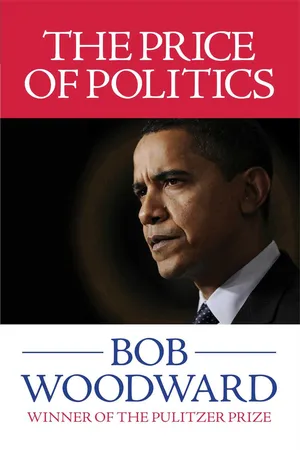
The Price of Politics
eBook - ePub

The Price of Politics

  1. 448 pages
  2. English
  3. ePUB (mobile friendly)
  4. Available on iOS & Android
eBook - ePub

The Price of Politics

About this book

Based on 18 months of reporting, Woodward's 17th book is an intimate, documented examination of how President Obama and the highest profile Republican and Democratic leaders in the United States Congress attempted to restore the American economy and improve the federal government's fiscal condition over three and one half years. Drawn from memos, contemporaneous meeting notes, emails and in-depth interviews with the central players, THE PRICE OF POLITICS addresses the key issue of the presidential and congressional campaigns: the condition of the American economy and how and why we got there. Providing verbatim, day-by-day, even hour-by-hour accounts, the book shows what really happened, what drove the debates, negotiations and struggles that define, and will continue to define, the American future.

Frequently asked questions

Yes, you can cancel anytime from the Subscription tab in your account settings on the Perlego website. Your subscription will stay active until the end of your current billing period. Learn how to cancel your subscription.
No, books cannot be downloaded as external files, such as PDFs, for use outside of Perlego. However, you can download books within the Perlego app for offline reading on mobile or tablet. Learn more here.
Perlego offers two plans: Essential and Complete
  • Essential is ideal for learners and professionals who enjoy exploring a wide range of subjects. Access the Essential Library with 800,000+ trusted titles and best-sellers across business, personal growth, and the humanities. Includes unlimited reading time and Standard Read Aloud voice.
  • Complete: Perfect for advanced learners and researchers needing full, unrestricted access. Unlock 1.4M+ books across hundreds of subjects, including academic and specialized titles. The Complete Plan also includes advanced features like Premium Read Aloud and Research Assistant.
Both plans are available with monthly, semester, or annual billing cycles.
We are an online textbook subscription service, where you can get access to an entire online library for less than the price of a single book per month. With over 1 million books across 1000+ topics, we’ve got you covered! Learn more here.
Look out for the read-aloud symbol on your next book to see if you can listen to it. The read-aloud tool reads text aloud for you, highlighting the text as it is being read. You can pause it, speed it up and slow it down. Learn more here.
Yes! You can use the Perlego app on both iOS or Android devices to read anytime, anywhere — even offline. Perfect for commutes or when you’re on the go.
Please note we cannot support devices running on iOS 13 and Android 7 or earlier. Learn more about using the app.
Yes, you can access The Price of Politics by Bob Woodward in PDF and/or ePUB format, as well as other popular books in Sciences sociales & Sociologie. We have over one million books available in our catalogue for you to explore.

Information

1

Two weeks before their inauguration, President-elect Barack Obama and Vice President–elect Joe Biden headed to Capitol Hill to meet with the Democratic and Republican leaders of the House and Senate. It was 3:15 p.m. on Monday, January 5, 2009, and Obama was fresh from a 12-day Hawaiian vacation.
The leaders gathered in the ornate LBJ Room of the Senate decorated with a painting celebrating the laying of the first transatlantic cable. In it, the allegorical figures of Europe and America joined hands in friendship across the ocean.
As if in that spirit, Obama called on the group to work together across the partisan divide to address the looming economic crisis.
ā€œAction on our part is urgent,ā€ he told them. Unemployment was at 7.2 percent and rising, and the economic situation was threatening to get worse with the financial system in full-blown crisis. He wanted the Congress to quickly pass an economic stimulus package in the range of ā€œ$800 billion to $1.3 trillion.ā€
It would include some tax cuts—sweet music to the Republicans— and some investment, such as spending on roads, buildings and other job-creating projects. In addition, he said, they had to ā€œbuild in medium- and long-term fiscal disciplineā€ to tame the growing federal deficit.
Looking at the four Republican leaders—the GOP was in the minority in both houses of Congress—Obama reached out.
ā€œI want everyone’s ideas,ā€ he said. ā€œBut we can’t get into political games.ā€
Nancy Pelosi, the California Democrat and speaker of the House, interjected, ā€œI come to Washington to work in a bipartisan manner.ā€
Both Republicans and Democrats stifled chuckles. Pelosi, a 12-term veteran of Congress and the first female speaker, was notably partisan in her leadership of the 257 House Democrats. She had been born into Democratic politics. Her father was a congressman from Maryland and both her father and brother served as mayor of Baltimore.
ā€œWe’re in a unique situation,ā€ said Harry Reid, the soft-spoken but combative Senate majority leader. The son of a miner, Reid had grown up in the tiny town of Searchlight, Nevada, without electricity or indoor plumbing. A former amateur boxer who had faced down organized crime bosses while chair of the Nevada Gaming Commission, Reid avoided declarations about bipartisanship, adding simply, ā€œI want to work.ā€
The Senate Republican Minority Leader Mitch McConnell spoke next. At 66, a veteran of five terms representing Kentucky in the Senate, McConnell was known for the ruthlessness with which he ruled the Senate Republican minority. He cut straight to his suggestions.
I like the idea of tax cuts, he said. But we should also take a look at the money the federal government pays to the states for programs like Medicaid, the health insurance program for the poor. Beloved by the Democrats, Medicaid cost the federal government more than $250 billion a year. Perhaps, he suggested, we should treat that money as loans instead of outright grants. Having to pay the money back would make the states more judicious in spending it, he said.
Obama seemed receptive. ā€œIf it works, we don’t care whose idea it is,ā€ he said evenly.
John Boehner, the leader of the House Republican minority, came next.
Tanned from many hours on the golf course, Boehner (pronounced BAY-ner) spoke in a casual Midwestern baritone roughened by years of incessant cigarette smoking. At age 59, he was beginning his 10th term as congressman from his largely suburban district in southwestern Ohio. The second of 12 children, Boehner had grown up working in a bar owned by his grandfather, and was the first person in his family to attend college, working his way through Xavier University in Cincinnati to earn a degree in business administration. The minority leader was a conservative and ardently pro-business, but not an ideologue. A force for moderation, who had forged agreements with Democratic icon Ted Kennedy on education, Boehner understood that the secret to getting anything done in Washington was the ability and willingness to cut deals.
Boehner knew how to tend to personal relationships and, unlike many of his colleagues, was not a workaholic. Informal and on the surface accessible to colleagues and press, he liked to tease fellow congressmen and staff, and enjoyed a glass or two of red wine at the Republican Capitol Hill Club in the evening.
A stimulus package would have to go through the congressional committees to ensure transparency, Boehner said, but he agreed they could not tolerate unnecessary delay. ā€œThe economy is in unprecedented turmoil.ā€
No one needed to spell out the political risks of passing a new stimulus bill, but Obama said he thought there was a lesson to be learned from TARP, the Troubled Asset Relief Program, which had passed in the last months of the Bush presidency. TARP was controversial and dauntingly complex, a $700 billion temporary bailout for the banks— money that was supposed to be paid back. ā€œIf the public doesn’t know what the money is for,ā€ the president-elect said, citing TARP, ā€œit’s a big problem.ā€
He pledged to personally sell the stimulus package to the American people as something that would help everyone. At the moment, Barack Obama, president-elect, was the most famous and possibly the most admired political figure in the world. The Republicans were a dispirited lot. Political writers were speculating that the GOP might devolve into a regional party representing mainly Southern whites as the Democrats ascended to permanent majority status. Obama held all the cards. How would he play his first hand?
ā€œThere will be times,ā€ he said cordially, ā€œwhen we will want to bulldoze each other.ā€
True, all knew.
ā€œThis isn’t one of those times,ā€ he said.
ā€œTime frame?ā€ asked Boehner.
ā€œHave to get it done before Presidents Day recess,ā€ Obama said, referring to a four-day break in the congressional schedule that was to begin in six weeks.
ā€œWe understand the gravity,ā€ added Vice President–elect Biden, suggesting that they could work seven days a week on the stimulus package.
Senators McConnell and Dick Durbin, the Democratic whip, joked that they would not work weekends.
What about the thousands of homeowners who owed more on their mortgages than their homes were worth? asked Durbin.
ā€œWe will not roll out an aggressive housing plan,ā€ Obama said, and it would not be part of the stimulus bill. The housing problem was massive and baffling, and none of them had solid ideas for fixing it.
Then Virginia Representative Eric Cantor spoke up. Cantor was the minority whip, and the title suited him—thin and taut, he was quick with stinging partisan sound bites and was a fast-rising figure in Republican national politics. He had trained as an attorney and worked in his family’s real estate firm in Richmond for a decade before entering politics in the early 1990s. Now he was the House Republicans’ vote counter and disciplinarian. He made it his business to be closely tied in to all the GOP House members and had especially strong links to the ultraconservative wing of the party.
ā€œFear is grasping the country,ā€ Cantor said, giving voice to something everyone in the room already knew. People were worried that they might lose their jobs. But there was a parallel concern that affected them all, ā€œA fear of Washington.ā€ It was a familiar Republican talking point.
ā€œWe need to do something bold that says we are not wasting their money,ā€ Cantor urged. There was little public confidence in government, so the only solution would be ā€œfull transparency.ā€
After the meeting, Obama approached the Republican House leaders, Boehner and Cantor. ā€œI’m serious about this,ā€ he told them. ā€œCome with your ideas.ā€
Steven Stombres, Cantor’s chief of staff, left the meeting with conflicting emotions. A former Army Reserve intelligence officer with a shaved head and a military bearing, Stombres was impressed. If this really was a bipartisan ā€œcoming togetherā€ it was precisely what the country needed at such a critical time, and as a citizen he found it genuinely inspirational. As a Republican, though, he was worried: If Obama followed through on this promise of political togetherness, Republicans would be in bad shape.
ā€œPhew,ā€ Cantor said afterward, ā€œwe may be in this minority for a while.ā€
After the meeting, Senator McConnell told reporters, ā€œI thought the atmosphere for bipartisan cooperation was sincere on all sides.ā€ The Republican leader said of Obama, ā€œI think he’s already been listening to the suggestions we’ve made.ā€
Reid and Pelosi seemed almost giddy. Pelosi announced that it was ā€œa new day in the capital.ā€
Obama’s stimulus package, meant to jump-start the failing economy, had been in the works for weeks. His chief economic advisers had been working on it since the election.
Larry Summers, the incoming head of the National Economic Council, which coordinates all administration economic policy, supported instant additional spending of hundreds of billions of dollars.
A former treasury secretary in Bill Clinton’s administration, the brusque Summers was better known for his brainpower than his people skills. He had hesitated to take the job as Obama’s NEC head, viewing it at first as a step down from his previous job running the Treasury Department. In the end, he had relented under the combination of pressure from Obama and the urging of friends, including former Federal Reserve Board Chairman Alan Greenspan, who assured him that the job could offer him more influence than he realized.
In Summers’s view, the economic problem was lack of demand: Not enough people were spending money on goods and services. The administration had to stimulate consumer spending. He later described it to others in simple terms: ā€œWe didn’t have jobs because we didn’t have demand. And if we didn’t get more demand, we weren’t going to get more jobs. And if we did get more demand, we would get more jobs.ā€
Worried about the cost of a stimulus package, Obama wondered what else could be done. What about accelerating job training, strengthening employment services, and reforming unemployment insurance?
Demand is the big elephant in the room, Summers insisted.
Obama didn’t like that answer, but finally came to accept it.
In the weeks before the election, Obama was interviewing candidates for the all-important post of treasury secretary. While in New York, he met with Timothy Geithner, the head of the Federal Reserve Bank of New York, who had been a key figure in stabilizing the U.S. economy after the 2008 financial crisis.
The two had not met before. Geithner, who was 47 but looked a decade younger, launched immediately into a well-rehearsed, five-point argument on why he should not be picked.
One, I promised my kids I wouldn’t move them again. Two, we’re at a moment of national crisis. I’m not a public figure. You need to have a public figure people have seen before in this context, because it matters hugely. Three, there are better-qualified people than me for this. Four, at some point the U.S. will have solved the financial crisis, and you’ll be left with a whole set of other challenges that I’ve not spent my life thinking about. And fifth, he said, I’m up to my neck in this crisis, as you know. And I’m going to carry with me all those decisions. And you may need to have some separation from those decisions. It’s harder for you if you choose me. Because I’m not going to walk away from them.
It was a brilliant case against himself—precisely the kind of analytical power that appealed to Obama. After the election, he picked Geithner.
Obama selected Peter Orszag as director of the White House Office of Management and Budget. Just a few weeks past his 40th birthday, Orszag was a summa cum laude graduate of Princeton with a Ph.D. in economics from the London School of Economics. He was tall, gangly and brilliant. Obama had plucked him from his position as head of the powerful and independent Congressional Budget Office, which Orszag had held for nearly two years.
Unlike Summers, Orszag and Geithner did not believe the need to increase demand trumped all other policy priorities. Both recognized the need for a stimulus, but resisted the idea of a package that might last for more than two years. They were facing contradictory policy requirements: spend more quickly, but address the long-term deficit of hundreds of billions of dollars per year.
In one early memo, the team advised Obama that there was no danger of too much stimulus, or spending too much money in the first year. The question was: How do you make it politically salable?
Once he accepted the need for a huge infusion of public spending, Obama began to see it as an opportunity—a chance to invest in projects like high-speed rail, visionary environmentalism and innovation-related projects.
ā€œA lot of that is going to take seven years to happen,ā€ Summers pointed out, splashing cold water on Obama’s big dreams. ā€œBig visionary things just take a long time.ā€
The Hoover Dam, which had employed thousands of workers during the Great Depression, had taken five years to build, Biden reminded them.
Obama wanted to pull the Band-Aid off fast, as he put it. ā€œLet’s do whatever needs to be done, but let’s not keep at this for five years.ā€ He made it clear he wanted to pivot as soon as possible from rescue to a broad kind of economic renewal. He thought and spoke in terms of FDR, and some in the White House wondered if he had Roosevelt envy.
Comprehensive health care reform, though, remained his priority. The world knew that from his campaign. What the world didn’t know was that his top advisers, led by incoming chief of staff Rahm Emanuel, disagreed, arguing that it would require too much effort. Survival had to come first.
But to Obama, health insurance for everyone as a new entitlement was the major unfulfilled task of the political movement of which he was a part and now led.
It was now or never, he said. So it would be now.
Later, Cantor approached Emanuel, who had been No. 3 in the House Democratic leadership before joining the incoming administration. Is this bipartisanship stuff for real? he wanted to know.
Wiry and intense, Emanuel was seen as something of a political bodyguard for the relatively inexperienced Obama. A veteran of the Clinton White House before his own election to Congress in 2000, he had a varied background. He had been a serious ballet dancer as a young man, and serve...

Table of contents

  1. Cover
  2. Also by Bob Woodward
  3. Title page
  4. Copyright page
  5. Contents
  6. Author’s Personal
  7. Note to Readers
  8. Cast of Characters
  9. Prologue
  10. Chapter 1–40
  11. Afterword
  12. Chapter Notes
  13. Acknowledgments
  14. Photography Credits
  15. Index
  16. List of Illustrations