
- 256 pages
- English
- ePUB (mobile friendly)
- Available on iOS & Android
eBook - ePub
About this book
From Chris Matthews, former host of MSNBC’s Hardball and NBC’s The Chris Matthews Show, and New York Times bestselling author of Bobby Kennedy, Jack Kennedy, and Tip and the Gipper, comes a definitive work on the lifeblood of America—its enduring spirit.
People have often wondered what makes America truly great. With a citizenry of vastly different races, religions, cultures, and ethnic backgrounds, what intangible bond unites and defines us as "Americans"? In his own inimitable style, Chris Matthews offers a portrait of a country born of contradictions. We are a people reluctant to fight, who become ferocious when threatened or attacked. We are a deeply practical nation, yet we stand as the world's great optimists. Inherently suspicious of governmental power, we still embrace our flag in times of danger. Fiercely independent, in love with freedom, and eager to face the future, we are like no other people on earth.
Matthews asserts that our greatest strength is a set of distinct notions that comprise our national character. The self-made man. The reluctant warrior. The lone hero. We celebrate them in our popular culture and throughout our history, from 1776 to 9/11. In American, Matthews explores the best America stands for and portrays our country as a beacon for the modern world—unafraid of challenges, moving ever forward, and ready and willing to prevail.
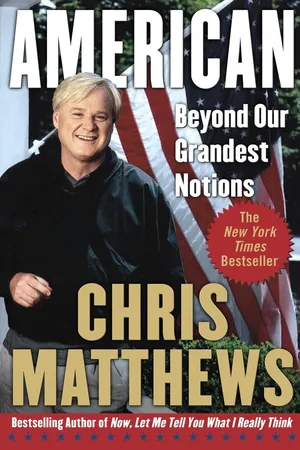
People have often wondered what makes America truly great. With a citizenry of vastly different races, religions, cultures, and ethnic backgrounds, what intangible bond unites and defines us as "Americans"? In his own inimitable style, Chris Matthews offers a portrait of a country born of contradictions. We are a people reluctant to fight, who become ferocious when threatened or attacked. We are a deeply practical nation, yet we stand as the world's great optimists. Inherently suspicious of governmental power, we still embrace our flag in times of danger. Fiercely independent, in love with freedom, and eager to face the future, we are like no other people on earth.
Matthews asserts that our greatest strength is a set of distinct notions that comprise our national character. The self-made man. The reluctant warrior. The lone hero. We celebrate them in our popular culture and throughout our history, from 1776 to 9/11. In American, Matthews explores the best America stands for and portrays our country as a beacon for the modern world—unafraid of challenges, moving ever forward, and ready and willing to prevail.
Frequently asked questions
Yes, you can cancel anytime from the Subscription tab in your account settings on the Perlego website. Your subscription will stay active until the end of your current billing period. Learn how to cancel your subscription.
No, books cannot be downloaded as external files, such as PDFs, for use outside of Perlego. However, you can download books within the Perlego app for offline reading on mobile or tablet. Learn more here.
Perlego offers two plans: Essential and Complete
- Essential is ideal for learners and professionals who enjoy exploring a wide range of subjects. Access the Essential Library with 800,000+ trusted titles and best-sellers across business, personal growth, and the humanities. Includes unlimited reading time and Standard Read Aloud voice.
- Complete: Perfect for advanced learners and researchers needing full, unrestricted access. Unlock 1.4M+ books across hundreds of subjects, including academic and specialized titles. The Complete Plan also includes advanced features like Premium Read Aloud and Research Assistant.
We are an online textbook subscription service, where you can get access to an entire online library for less than the price of a single book per month. With over 1 million books across 1000+ topics, weāve got you covered! Learn more here.
Look out for the read-aloud symbol on your next book to see if you can listen to it. The read-aloud tool reads text aloud for you, highlighting the text as it is being read. You can pause it, speed it up and slow it down. Learn more here.
Yes! You can use the Perlego app on both iOS or Android devices to read anytime, anywhere ā even offline. Perfect for commutes or when youāre on the go.
Please note we cannot support devices running on iOS 13 and Android 7 or earlier. Learn more about using the app.
Yes, you can access American by Chris Matthews in PDF and/or ePUB format, as well as other popular books in Politics & International Relations & Nationalism & Patriotism. We have over one million books available in our catalogue for you to explore.
Information
CHAPTER 1
A Self-Made Country

The truth was that Jay Gatsby of West Egg, Long Island sprang from his Platonic conception of himself.
F. SCOTT FITZGERALD, THE GREAT GATSBY
There was once an upscale menās shop in the Georgetown section of Washington, D.C., that featured a shiny metal nameplate over the door of its dressing room. It noted that the shop had been honored to have had among its patrons Mr. Cary Grant. It seemed that the gentleman had experienced some unusually warm weather during a visit to Washington and needed a lighter weight suit than heād brought along. It concluded the historic note by saying Mr. Grant had used this very same changing room to try on his unexpected purchase.
Why would a relatively posh menās store in a high-end neighborhood make such a big deal out of a movie star stripping down to his underwear on its premises? Why would a store serving the well-to-do and the sophisticated get so wobbly in the knees as to give this guy the āGeorge Washington Slept Hereā treatment?
The best answer is to see one of his movies.
In a whole string of roles from Topper, Bringing Up Baby, Holiday, and Gunga Din in the 1930s to His Girl Friday, The Philadelphia Story, and Notorious in the 1940s to To Catch a Thief, An Affair to Remember, and North by Northwest in the 1950s, Cary Grant was the very model of the debonair American gentleman. He was both democratic and aristocratic, a man so charming and self-assured that every woman wanted him, every man wanted to be like him. He was an acrobat in a business suit, a man of dignity with the subtle physicality of a clown, a regular guy knowing full well how fortunate he was to be wearing such an expensive, well-tailored suit.
āDo you know whatās wrong with you?ā one of his screen partners had pretended to scold him. āNothing.ā Director Alfred Hitchcock dared to say, āCaryās the only thing I ever loved in my whole life.ā
As a matter of fact, the man we know as Cary Grant loved the idea of becoming this world-class charmer so much that he decided early in his adulthood to do it. Born in Bristol, England, in 1904, Archibald Alexander Leach was the son of a tailorās presser. How he got from there to having his nameplate on a Georgetown menās shop is a great American story.
He began as a working-class English kid doing pantomimes at the theater. Then he got himself into music hall acts mimicking the popular singers of the day. He later picked up some magic tricks. The praise he was denied at home he earned at the theater. Stagestruck, he came to America. Here he picked up odd jobs, earning five dollars a day, ten dollars on Saturday and Sunday, as a stilt-walker on Coney Island.
By 1931, Archie Leach was what he wanted to beāa working American actor. Landing the part of Cary Lockwood in a Broadway play, he liked the characterās first name and decided to take it. He added āGrantā to make him sound more American.
Watching the great playwright-actor Noƫl Coward in Private Lives he decided to be Coward.
To achieve this transformation, he spent endless hours practicing how Coward walked, how he spoke, even his facial expressions. āI pretended to be somebody I wanted to be and I finally became that person,ā he would confess years later. āOr he became me. Or we met at some point.ā
At the age of twenty-seven, the man we would love as Cary Grant was born.
It wasnāt as easy as it appeared. āI cultivated raising one eyebrow, and tried to imitate those who put their hands in their pockets with a certain amount of ease and nonchalance. But at times, when I put my hand in my trouser with what I imagined was great elegance, I couldnāt get the blinking thing out again because it dripped from nervous perspiration.ā
What won Grant special devotion, however, was his refusal to deny who he was born. When we in the audience forgot about his background, he would remind us. āListen!ā he erupted in His Girl Friday, āthe last man who said that to me was Archie Leach just a week before his throat was cut.ā
āIt was a knowing wink to the audience, his audience, a secret shared with strangers,ā Grantās biographer Graham McCann noticed. āIt was the kind of gesture that would have endeared someone like Cary Grant to someone like Archie Leach. Cary Grant was not conceived of as the contradiction of Archie Leach but as the constitution of his desires.ā
We couldnāt imagine him ever dying, of course. This was especially true as he aged gracefully, giving up films to become an executive with FabergĆ©. āI donāt know how I consider death,ā he said. āSo many of my friends have been doing it recently. My only fear is that I donāt embarrass others.ā
He didnāt. Grant died at eighty-two during rehearsal for a touring one-man show featuring his old movie clips. āEverybody wants to be Cary Grant,ā the actor once admitted amid all the fawning. āEven I want to be Cary Grant.ā
Much like this beloved matinee idol, America itself is a confection. In the years after the Revolution, the Founding Fathers had a vision of a country and government they wanted. They then very consciously, not unlike Archie Leach, turned that vision into reality.
Confecting a Capital
On a June afternoon in 1791, two gentlemen on horseback looked down from Jenkinās Hill onto a stretch of Maryland flatland banking the Potomac River. One, an architect, had designed a new national capital for this spot. The other, a trained surveyor, was the new governmentās first president.
Both Pierre LāEnfant and George Washington were men of vision and optimism. They had settled on a grand plan indeed: a capital city fit not for what had been just thirteen seaboard colonies but for a vast continental power. Jenkinās Hill, which LāEnfant called a āpedestal waiting for a monument,ā would one day be called Capitol Hill. LāEnfantās blueprints would become the world capital bearing the name of his companion on horseback that day.
When you think about it, this country designed itself. Just as LāEnfant and Washington built a capital from scratch, so did Thomas Jefferson and James Madison and the others design a new kind of government on a blank page. And if it seemed precocious for a French-born architect whoād never before done anything like it to design a national capital, it was more precocious still for a group of men who had never done anything like it before to confect a country, to guarantee as āunalienableā a set of rights the world had never before recognized, to ensure not only its citizensā lives and liberty but also their right to pursue āhappiness.ā
And just as Washington and LāEnfant set wide bounds for the future growth of the new capitalās geography, the designers of the Constitution generously conceived the new nationās freedoms. Americans could decide who they wanted to be and try to become it. A country that had dared design itself based on its own grandest notions would not stand in the way of its citizens harboring and pursuing their own grand notions. America would be a place where a person could be who he or she wanted to be.
And it was to be a place were people thought big.
If LāEnfant could choose a āmonumental concept, with a capitol building and a āpresidentās houseā ā connected by a grand āpublic walkā to serve as the national seat for thirteen recently united colonies, then the American people could dare to be equally monumental in charting the contours and heights of their own lives.
Just as this new republic would, in Thomas Paineās words, ābegin the world over again,ā it would certainly be a spacious and adventurous home to those hoping to do that with their own lives and ambitions. America would be a country where anyone could grab a second chance.
Here, the way things are is not the way they have to be. They can be the way individual Americans want them to be.
The Great Gatsby
In a country open to such big notions, the popularity of F. Scott Fitzgeraldās The Great Gatsby should be no surprise. Itās the story of Jay Gatsby, a young soldier training for World War I who meets a beautiful young socialite named Daisy. He falls in love with her only to get a letter while he is serving in the trenches of France, telling him that she has married Tom Buchanan, a wealthy young man from Yale. At a practical level, heād known it was coming. Rich girls like Daisy didnāt marry poor boys like him.
An eternal romantic, our hero refused to accept the verdict. Back from the war, Gatsby makes the right connections and becomes a rich bootlegger. Whatever it takes to become the man Daisy Buchanan would marry, he is prepared to do.
Having enriched himself beyond his wildest dreams, Jay Gatsby now sets about pursuing the only happiness he knows. He buys a giant mansion on Long Island right across the bay from the home of Daisy and Tom Buchanan. From there he maps plans to win her back. He hosts loud and lavish parties open to all in the hope that she will show up at one. Finally, he makes the acquaintance and seeks the aid of his neighbor. Nick Carraway, who he discovers is Daisyās cousin.
Carraway, the storyās narrator, doesnāt know what to make of the man presiding over the garish mansion next door. āI would have accepted without question the information that Gatsby sprang from the swamps of Louisiana or from the Lower East Side of New York. That was comprehensible. But young men didnātāat least in my provincial inexperience I believe they didnātādrift coolly out of nowhere and buy a palace on Long Island Sound.ā
But Gatsby needed more than money: he needed to be someone who had always had it.
āIāll tell you Godās truth,ā he says to the skeptical Carraway. āIām the son of some wealthy people in the middle-westāall dead now. I was brought up in America but educated at Oxford because all my ancestors have been educated there for many years. It is a family tradition.ā
For Jay Gatsby, the dream Daisy inspired in him is as important as the woman herself. It isnāt what she felt, but what he felt.
āI wouldnāt ask too much of her,ā Nick warns him. āYou canāt repeat the past.ā
āYou canāt repeat the past?ā retorts an incredulous Gatsby. āWhy of course you can!ā
And: āIām going to fix everything just the way it was before. . . . Sheāll see.ā
This blind faith that he can retrofit his very existence to Daisyās specifications is the heart and soul of The Great Gatsby. Itās the classic story of the fresh start, the second chance.
āThe truth was that Jay Gatsby of West Egg, Long Island, sprang from his Platonic conception of himself,ā Fitzgerald wrote. āHe was the son of Godāa phrase which, if it means anything, means just thatāand he must be about His Fatherās Business, the service of a vast, vulgar, meretricious beauty. So he invented just the sort of Jay Gatsby that a seventeen year old boy would be likely to invent, and to this conception he was faithful to the end.ā
There was also Gatsbyās smile. āIt was one of those rare smiles with a quality of eternal reassurance in it, that you may come across four or five times in life. It facedāor seemed to faceāthe whole external world for an instant, and then concentrated on you with an irresistible prejudice in your favor. It understood you just so far as you wanted to be understood, believed in you as you would like to believe in yourself and assured you that it had precisely the impression of you that, at your best, you hoped to convey.ā
The reader, like Nick Carraway, comes to like this guy. We love his dream because we have, all of us, shared something very much like it. āGatsby was not a character,ā said the critic Alfred Kazin, ābut an idea of the everlasting self-creation that Americans have mastered.ā
Gatsby, for me, is undeniably the great American novel. We celebrate its hero and his āheightened sensitivity to the promises of life,ā his āextraordinary gift for hope,ā his āromantic readiness,ā because we as a country share every bit of it.
Grace Kelly
People think of Grace Kelly, the actress who became a European princess, as someone born to the role. In reality, Grace Patricia Kelly of East Falls, Philadelphia, was never a debutante, never applied for admission nor was received in Main Line society. She was a Roman Catholic and newly rich, a double bar to the ultra-restrictive social registry of that day.
But while she was never invited to make her debut by the Philadelphia Assemblies, she did possess an early claim to prominence: her father was a wealthy building contractor: āKelly for Brickworkā was a familiar sign at area job sites.
John B. āJackā Kelly was also a fa...
Table of contents
- Cover
- Dedication
- Acknowledgments
- Prologue
- Chapter 1: A Self-Made Country
- Chapter 2: The Constant Rebel
- Chapter 3: The Reluctant Warrior
- Chapter 4: Action
- Chapter 5: The Common Man
- Chapter 6: Underdogs
- Chapter 7: The Lone Hero
- Chapter 8: Pioneers
- Chapter 9: Optimism
- Chapter 10: American Exceptionalism
- Epilogue
- About the Author
- Notes
- Illustration Credits
- Index
- Copyright