
eBook - ePub
Born Reading
Bringing Up Bookworms in a Digital Age -- From Picture Books to eBooks and Everything in Between
- 336 pages
- English
- ePUB (mobile friendly)
- Available on iOS & Android
eBook - ePub
Born Reading
Bringing Up Bookworms in a Digital Age -- From Picture Books to eBooks and Everything in Between
About this book
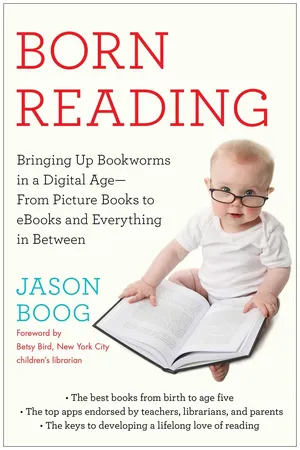
A program for parents and professionals on how to raise kids who love to read, featuring interviews with childhood development experts, advice from librarians, tips from authors and children’s book publishers, and reading recommendations for kids from birth up to age five.
Every parent wants to give his or her child a competitive advantage. In Born Reading, publishing insider (and new dad) Jason Boog explains how that can be as simple as opening a book. Studies have shown that interactive reading—a method that creates dialogue as you read together—can raise a child’s IQ by more than six points. In fact, interactive reading can have just as much of a determining factor on a child’s IQ as vitamins and a healthy diet. But there’s no book that takes the cutting-edge research on interactive reading and shows parents, teachers, and librarians how to apply it to their day-to-day lives with kids, until now.
Born Reading provides step-by-step instructions on interactive reading and advice for developing your child’s interest in books from the time they are born. Boog has done the research, talked with the leading experts in child development, and worked with them to compile the “Born Reading Essential Books” lists, offering specific titles tailored to the interests and passions of kids from birth to age five. But reading can take many forms—print books as well as ebooks and apps—and Born Reading also includes tips on how to use technology the right way to help (not hinder) your child’s intellectual development. Parents will find advice on which educational apps best supplement their child’s development, when to start introducing digital reading to their child, and how to use tech to help create the readers of tomorrow.
Born Reading will show anyone who loves kids how to make sure the children they care about are building a powerful foundation in literacy from the beginning of life.
Every parent wants to give his or her child a competitive advantage. In Born Reading, publishing insider (and new dad) Jason Boog explains how that can be as simple as opening a book. Studies have shown that interactive reading—a method that creates dialogue as you read together—can raise a child’s IQ by more than six points. In fact, interactive reading can have just as much of a determining factor on a child’s IQ as vitamins and a healthy diet. But there’s no book that takes the cutting-edge research on interactive reading and shows parents, teachers, and librarians how to apply it to their day-to-day lives with kids, until now.
Born Reading provides step-by-step instructions on interactive reading and advice for developing your child’s interest in books from the time they are born. Boog has done the research, talked with the leading experts in child development, and worked with them to compile the “Born Reading Essential Books” lists, offering specific titles tailored to the interests and passions of kids from birth to age five. But reading can take many forms—print books as well as ebooks and apps—and Born Reading also includes tips on how to use technology the right way to help (not hinder) your child’s intellectual development. Parents will find advice on which educational apps best supplement their child’s development, when to start introducing digital reading to their child, and how to use tech to help create the readers of tomorrow.
Born Reading will show anyone who loves kids how to make sure the children they care about are building a powerful foundation in literacy from the beginning of life.
Frequently asked questions
Yes, you can cancel anytime from the Subscription tab in your account settings on the Perlego website. Your subscription will stay active until the end of your current billing period. Learn how to cancel your subscription.
No, books cannot be downloaded as external files, such as PDFs, for use outside of Perlego. However, you can download books within the Perlego app for offline reading on mobile or tablet. Learn more here.
Perlego offers two plans: Essential and Complete
- Essential is ideal for learners and professionals who enjoy exploring a wide range of subjects. Access the Essential Library with 800,000+ trusted titles and best-sellers across business, personal growth, and the humanities. Includes unlimited reading time and Standard Read Aloud voice.
- Complete: Perfect for advanced learners and researchers needing full, unrestricted access. Unlock 1.4M+ books across hundreds of subjects, including academic and specialized titles. The Complete Plan also includes advanced features like Premium Read Aloud and Research Assistant.
We are an online textbook subscription service, where you can get access to an entire online library for less than the price of a single book per month. With over 1 million books across 1000+ topics, weâve got you covered! Learn more here.
Look out for the read-aloud symbol on your next book to see if you can listen to it. The read-aloud tool reads text aloud for you, highlighting the text as it is being read. You can pause it, speed it up and slow it down. Learn more here.
Yes! You can use the Perlego app on both iOS or Android devices to read anytime, anywhere â even offline. Perfect for commutes or when youâre on the go.
Please note we cannot support devices running on iOS 13 and Android 7 or earlier. Learn more about using the app.
Yes, you can access Born Reading by Jason Boog in PDF and/or ePUB format, as well as other popular books in Education & Education Theory & Practice. We have over one million books available in our catalogue for you to explore.
Information
Chapter 1

Before Your Baby Is Born
When the doctors finally let me hold my daughter Olive in the delivery room, she was wailing at the top of her lungs. All throughout my wifeâs pregnancy, I would lie beside her and sing âTiny Bubblesâ to our baby before she went to sleep. It was the champagne anthem that ended The Lawrence Welk Showâmy late grandmotherâs favorite song and the first tune my wife and I played at our wedding reception.
At some point, I changed the lyrics:
Tiny Olive, in my arms
Makes me happy,
Makes me want to go home.
So I sang that song in the delivery room, holding my swaddled caterpillar for the first time. Olive looked at me with her deep hazel eyes, staring like she had known me for a long, long time.
Experts affirm that it wasnât just my imagination: babies can hear sounds in utero, and newborns can emerge from the womb responding to sounds they heard before birth. Something as simple as reading to your child in utero can have a profound effect on his or her future. Education and child development expert Gordon Wells explained how important this in-utero reading time is for children: âThere seems to be quite a lot of evidence that the fetus responds to the audio as well as the physical environment. And that the sound of mother reading [or, in my case, a father singing] is preparing the child to continue that experience after they are born.â
Beyond all the developmental and educational benefits of interactive reading with your child, the most important advantage is that the time you spend together is helping you create a stronger bond. That bond can start immediately at birthâor, if youâre a goof like me, even earlier.
In this chapter, weâll talk about some of the things you can do to influence your childâs love of reading from the beginning of his or her lifeâor in some cases, decisions you can make even before birth to help put him or her on a path toward readership. These are fun, empowering decisions for any parent. But I discovered that you also have to think about how you will limit certain experiences in your childâs life. If you take the time to read to your child in utero, you might as well tackle some of these tough conversations early as well.
One of the first decisions youâre going to have to make as a parentâideally, itâs something you should start thinking about before your child is even bornâis how early, and how often, he or she will be exposed to digital media and devices.
Introducing Digital Devices: How Much Is Too Much?
Early in my adventures as a new parent, I uncovered one of the most controversial videos I ever shared with my online readers at GalleyCat. I watched it over and over on YouTube, fascinated at first, but I felt uneasy the more I watched it.
A cute baby in a sundress plays with an iPad. She squeals with pure joy, realizing that she can actually control something in the world. She shuttles icons, flips the iPad, and spins pictures in a thrilling series of motions. This adorable baby instantly grasps motions that take some adults weeks to learn: the double-fingered swipe to make an image bigger, the single click to open a new application, or even the casual flip that changes the orientation.
The video cuts to the same baby on a deck someplace sunny and warm, where she struggles with a hefty print edition of Vogue magazine. She tries all the same swipes and button pushes on the static magazine cover, but nothing changes. The pictures stay the same and the text never rotates as she tilts the pages.
The video undoubtedly demonstrates the power and innovation of Apple engineers, and the babyâs parent posted a short manifesto about the future of reading at the end of the video: âFor my one-year-old daughter, a magazine is an iPad that does not work. It will remain so her whole life. Steve Jobs had coded a part of her OS.â
Those parents intended the video as a tribute to the late Steve Jobs, a man who did indeed change the world. The millions of iPads he sold to parents donât matter in the long run; his profound triumph lay in the video. Jobs managed to change the way the children of those iPad owners interact with the world. Our children will never know a world without a tablet computer, smartphone, or laptop. And that means the decisions about how, and when, to expose them to these devices begin immediately.
Jobs rewired an entire generation of adults to spend ever-increasing amounts of time in front of screens. In my own life, thanks to work, smartphones, and digital books, I spend hundreds of hours in front of screens every year. And of course, while this transition happened during most of our lives, our children will live their entire lives in a world both enhanced and dominated by digital devices. As a new dad, I realized very quickly that despite all my noble ideas about reading print books, Olive will likely spend her whole life seamlessly toggling between digital and print worldsâindeed, she may not even perceive the difference as starkly as I do. After all, she has been exposed to digital technology since the very first moments of her life.
Within moments of Oliveâs birth, I was taking pictures of her cradled in her motherâs arms. Minutes later, I was calling my parents on my cell phone and emailing them photographs. With smartphones, tablets, and digital cameras, we have documented every developmental milestone or important moment of her life.
When I rocked Olive for hours during her colicky first few months, I would read digital books on my Kindle. While hanging out with her on sleepy mornings before work, I would make silly videos for my family about this little creature in my lifeâdressing her in funny hats or signs.
All this device usage happened before Olive was coordinated enough to reach out and grab my phone. Once her fingers worked, Olive seemed to instinctively understand how touchscreen devices worked. By the time she figured out how to grab things with her bitty fingers, the smartphone was the very first thing she wanted.
From that moment onward, all parents begin an epic tug-of-war that will last until that baby grows up and goes to college. It will happen with any device: an iPod, iPad, smartphone, or even a TV remote.
When a device plays a big role in your life, your children will want to use it too. Look in most kidsâ toy boxes and you will find toy phones, dead cell phones, or even toy computers that play insipid songs and imitate the real thing that adults use all day long.
How much time should children spend with these devices? Parents have debated this question for years. Throughout this book you will get recommendations from experts about using devices, but no one has the hard and fast facts. Kindles, iPads, iPhones, and other digital devices are simply too newâresearchers are only beginning to measure their effects on the infant brain. We know that too much TV can be bad developmentally, but these are different kinds of devices.
The truth is that child development experts and pediatricians still do not have enough research to tell us definitively how much is too much when it comes to screen time. Parents operate with little or no guidance from doctors about using the mobile devices that have quickly swallowed huge chunks of our lives. While we wait for the official research about the effects of touchscreens on growing brains, we will still have to make these decisions for our families in the meantime.
These devices will be a part of your childâs life, there is no way to avoid it. Many of the crucial decisions you will make about your childrenâs reading and media usage should be made (or at least considered) before theyâre even born. In the absence of data, I think we should be more cautious. We laugh about our grandparentsâ bad parenting decisions now: dry cleaning bags on kidsâ heads, cigarettes in the house, letting kids watch six straight hours of television. Someday our descendants will roll their eyes at our own parenting decisions. What mistakes are we making that we donât even realize yet? We hardly understand the effects of apps on growing brains. But itâs an area of robust research, and experts are starting to gather information to share with those of us who want to make up our own minds.
Professional Guidelines about Device Usage: What Do the Experts Say?
In 2011, the American Academy of Pediatrics (AAP) released a strict set of guidelines, urging parents to not let children younger than two years old consume any sort of media, from television to smartphones to iPads. The recommendations aimed at extending âunplugged play,â a cognitive stepping stone every bit as valuable as learning how to walk or speak.
The AAP dispatch explained: âPediatricians should explain to parents the importance of unstructured, unplugged play in allowing a childâs mind to grow, problem-solve, think innovatively, and develop reasoning skills. Unstructured play occurs both independently and cooperatively with a parent or caregiver. The importance of parents sitting down to play with their children cannot be overstated.â
At the very least, parents should set strict media limits, to make sure the child devotes enough time to âunplugged play.â The AAP even recommends that children older than two years spend less than two hours a day in front of a screen. If you compare that to the staggering amount of time adults like me spend working in front of screens, these guidelines seem nearly impossible to enforce. Thatâs why you should think about these philosophical questions months before your baby ever touches an iPad.
A team of AAP doctors summarized a yearâs worth of research into the dangers of excessive screen time for children in a frightening paragraph: âTime spent watching television is associated with a number of negative health behaviors and outcomes among children, including overweight, irregular sleep, insufficient consumption of fruits and vegetables, and disordered eating. Excessive television viewing has detrimental effects on prosocial behaviors, such as spending time with parents and siblings, doing homework, or engaging in creative play, and is linked with getting lower grades, getting into trouble, and feeling sadness and boredom.â
Yikes. If smartphones and tablets are not used in the proper context, we are basically giving kids televisions they can carry anywhere they want. While researchers donât have enough data to make many conclusions, parents should not underestimate the dangers posed by too much screen timeâno matter what device they use.
University of Washington professor of pediatrics Dimitri Christakis explained in an online interview: âThe newborn brain triples in size in the first two years of life, and it does this in direct response to external stimulation.â Every time I get sick of reading the same book over and over or just want to watch television instead of offering a bedtime story, I think about my babyâs growing brain. Especially during those first few years, reading to your baby really does make a difference. Christakis concluded: âWhen a television is on, or a screen is on, the child is engaged in watching that program, and the parent is talking to their child 80 percent less of the time. That talking time is really critical for a childâs language development, because hearing the words and hearing their parents talking to them is helping them understand the language and grow their communication skills. Making use of those times when youâre busy doing something else is really valuable time for your child.â
Even though the research is only beginning, any parent can clearly see the powerful sway these devices hold over a child. So whatâs a parent to do? While experts donât agree 100 percent on what exactly the best practices are for device use for and around children, a few guidelines do emerge.
Think carefully about how early (and how often) to introduce devices.
Some groups believe we should keep devices out of our kidsâ hands until after elementary school. The Alliance for Childhood published a huge report called âFoolâs Gold,â calling for an âimmediate moratorium on the further introduction of computers in early childhood and elementary education, except for special cases of students with disabilities. Such a time-out is necessary to create the climate for the above recommendations to take place.â
The Waldorf Education approach to early education actively discourages the use of devices with young kids. The educational philosophy developed from the work of Austrian philosopher and teacher Rudolf Steiner. Steiner founded a revolutionary school in the 1920s, developing a curriculum years before television or computers. His philosophies spread to 900 Waldorf schools in 83 different countries.
The school has a strict policy about devices inside the classroom, and many teachers discourage computer use in the home as well. The movementâs official page makes the policy clear: âWaldorf teachers feel the appropriate age for computer use in the classroom and by students is in high school. We feel it is more important for students to have the opportunity to interact with one another and with teachers in exploring the world of ideas, participating in the creative process, and developing their knowledge, skills, abilities, and inner qualities. Waldorf students have a love of learning, an ongoing curiosity, and interest in life. As older students, they quickly master computer technology, and graduates have successful careers in the computer industry.â
In an online interview, Washington pediatrician Don Shifrin noted that âtwo-thirds of kids ages 4 to 7 have already used an iPhone or an iPod Touch,â a staggering statistic if you consider how relatively new these devices are.
Even the people building digital experiences for children struggle with the question of how much time to spend on a device. App designer Christoph Niemann shared his own family device usage guidelines for his children: âI donât want [my son] to have something like that in his room, where he can drag it out in the middle of the night and play for two hours. The first thing is basically that they can only do it with their brothers, together. I donât want this to be a solitary thing. The second thing is limiting time, extremely.â Whatever you and your family decide, the general rule, say experts, is to monitor your kidsâ time on and access to electronic devices. Unfettered access is generally not recommended.
End each day with a book, not a device.
In practice, most parents will allow their children some sort of monitored or restricted device usage. But there is one important principle that nearly every expert agrees upon. Keep the device outside of the bedroom. Shifrin advises parents: âMedia in childrenâs and even teenagersâ bedrooms is a detriment to their health, their family health, their ability to connect with the family, their ability to get information unfiltered into their brains and also the ability to go to sleep.â
As parents, we can make a commitment to end our childâs day with a print book, rather than a cartoon or digital book in the bedroom. Keeping devices and eBooks out of the bedroom will build better sleep habits and put your child on a healthier course as they grow up. You can model the behavior with your own device usage, by setting (and keeping!) your own digital boundaries inside the house. No devices at the dinner table, anyone?
Be mindful of what other toys are in the house.
This is also a great time to think about commercialism in your childâs life. H...
Table of contents
- Cover
- Dedication
- Foreword by Betsy Bird, New York City childrenâs librarian
- Introduction: The Born Reading Playbook, or How to Use This Book
- Chapter One: Before Your Baby Is Born
- Chapter Two: First Year of Life
- Chapter Three: Reading with a One-Year-Old
- Chapter Four: Reading During the Terrible Twos
- Chapter Five: Three-Year-Old Readers
- Chapter Six: Learning with Four-Year-Old Readers
- Chapter Seven: Kindergarten and Beyond
- Conclusion: How Born Readers Can Thrive with Common Core Standards
- Reading List
- App List
- Acknowledgments
- About Jason Boog
- Bibliography
- Index
- Copyright