
- 256 pages
- English
- ePUB (mobile friendly)
- Available on iOS & Android
eBook - ePub
About this book
Former Congresswoman Gabrielle Giffords and her husband, astronaut Mark Kelly, share their impassioned argument for responsible gun ownership.
After the 2011 Tucson shooting that nearly took her life, basic questions consumed Gabby Giffords and her family: Would Gabby survive the bullet through her brain? Would she walk again? Speak? Her hard-won recovery, though far from complete, has now allowed her and Mark to ask larger questions that confront us as a nation: How can we address our nation’s epidemic of gun violence? How can we protect gun rights for law abiding citizens, while keeping firearms out of the hands of criminals and the mentally ill? What can we do about gun trafficking and other threats to our communities?
Enough goes behind the scenes of Gabby and Mark’s creation of Americans for Responsible Solutions, an organization dedicated to promoting responsible gun ownership and encouraging lawmakers to find solutions to gun violence, despite their widespread fear of the gun lobby. As gun owners and strong supporters of the Second Amendment, Gabby and Mark offer a bold but sensible path forward, preserving the right to own guns for collection, recreation, and protection while taking common-sense actions to prevent the next Tucson, Aurora, or Newtown. Poll after poll shows that most Americans agree with Gabby and Mark’s reasonable proposals.
As the book follows Gabby and Mark from the halls of Congress to communities across the country, it provides an intimate window into the recovery of one of our nation’s most inspiring public figures and reveals how she and her husband have taken on the role of co-advocates for one of the defining issues of our time.
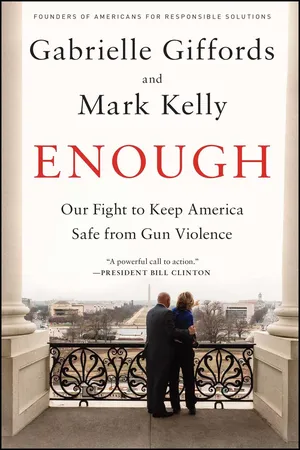
After the 2011 Tucson shooting that nearly took her life, basic questions consumed Gabby Giffords and her family: Would Gabby survive the bullet through her brain? Would she walk again? Speak? Her hard-won recovery, though far from complete, has now allowed her and Mark to ask larger questions that confront us as a nation: How can we address our nation’s epidemic of gun violence? How can we protect gun rights for law abiding citizens, while keeping firearms out of the hands of criminals and the mentally ill? What can we do about gun trafficking and other threats to our communities?
Enough goes behind the scenes of Gabby and Mark’s creation of Americans for Responsible Solutions, an organization dedicated to promoting responsible gun ownership and encouraging lawmakers to find solutions to gun violence, despite their widespread fear of the gun lobby. As gun owners and strong supporters of the Second Amendment, Gabby and Mark offer a bold but sensible path forward, preserving the right to own guns for collection, recreation, and protection while taking common-sense actions to prevent the next Tucson, Aurora, or Newtown. Poll after poll shows that most Americans agree with Gabby and Mark’s reasonable proposals.
As the book follows Gabby and Mark from the halls of Congress to communities across the country, it provides an intimate window into the recovery of one of our nation’s most inspiring public figures and reveals how she and her husband have taken on the role of co-advocates for one of the defining issues of our time.
Frequently asked questions
Yes, you can cancel anytime from the Subscription tab in your account settings on the Perlego website. Your subscription will stay active until the end of your current billing period. Learn how to cancel your subscription.
No, books cannot be downloaded as external files, such as PDFs, for use outside of Perlego. However, you can download books within the Perlego app for offline reading on mobile or tablet. Learn more here.
Perlego offers two plans: Essential and Complete
- Essential is ideal for learners and professionals who enjoy exploring a wide range of subjects. Access the Essential Library with 800,000+ trusted titles and best-sellers across business, personal growth, and the humanities. Includes unlimited reading time and Standard Read Aloud voice.
- Complete: Perfect for advanced learners and researchers needing full, unrestricted access. Unlock 1.4M+ books across hundreds of subjects, including academic and specialized titles. The Complete Plan also includes advanced features like Premium Read Aloud and Research Assistant.
We are an online textbook subscription service, where you can get access to an entire online library for less than the price of a single book per month. With over 1 million books across 1000+ topics, weâve got you covered! Learn more here.
Look out for the read-aloud symbol on your next book to see if you can listen to it. The read-aloud tool reads text aloud for you, highlighting the text as it is being read. You can pause it, speed it up and slow it down. Learn more here.
Yes! You can use the Perlego app on both iOS or Android devices to read anytime, anywhere â even offline. Perfect for commutes or when youâre on the go.
Please note we cannot support devices running on iOS 13 and Android 7 or earlier. Learn more about using the app.
Yes, you can access Enough by Gabrielle Giffords,Mark Kelly in PDF and/or ePUB format, as well as other popular books in Politics & International Relations & City Planning & Urban Development. We have over one million books available in our catalogue for you to explore.
Information
CHAPTER ONE
THE LINE IN THE SAND
Gabby and I never imagined weâd be working alongside each other, day in, day out, on a single issue like reducing gun violence.
When Gabby and I first met and fell in love, she was a rising star in Arizona politics and headed toward three successful runs for Congress representing a district stretching across southeastern Arizona. She lived in Tucson when she wasnât in Washington. I was an astronaut working out of Houston when I wasnât in space. Sometimes we would do the circuit clockwiseâDC to Houston to Tucsonâand sometimes counterclockwiseâTucson to Houston to Washington, DC. We were in constant motion. It was a complicated arrangement, but we had settled into a routine.
This routine was shattered when Gabby was shot on January 8, 2011. For months afterward we spent our lives in hospitals, doctorsâ offices, and a rehabilitation center. Gabby survived her traumatic brain injury, and, slowly but surely, began to recover.
On May 16, 2011, Gabby was well enough to fly to Florida and see me off for my final space shuttle mission and my second as commander. That June I retired from NASA, posting a message online: âFrom the day I entered the United States Merchant Marine Academy in the summer of 1982 to the moment I landed Space Shuttle Endeavour three weeks ago, it has been my privilege to advance the ideals that define the United States of America.â
Seven months later, though she was making steady progress, Gabby decided to step down from Congress. A little more than a year after she was shot, we were both out of government service and ready to re-create our lives as private citizens, together.
***
Early on in her recovery, while staying at a rehabilitation hospital in Houston, Gabby felt a strong pull to get back to Tucson. Under the circumstances, I was ready to leave Houston, too. After years of commuting, our decision to stay in the same place was one small positive outcome of Gabbyâs injury. We agreed to move back to Tucson and began looking for houses in the summer of 2012.
Gabby loved the grittier parts of her hometown. She often referred to herself as âa woman of the people.â When she returned to Tucson in 1996 to help manage her familyâs tire company, she chose to live in Barrio Viejo, a neighborhood near historic downtown Tucson.
âHow about if we look in the foothills?â I asked.
âNot my style,â she responded.
On one of my first house-hunting trips, I visited a house in a small development just east of the University of Arizona, near the Reid Park Zoo. I walked into a foyer with tile floors and stepped into a great room with vaulted ceilings, expansive walls, and a view to the pool in the backyard. To the left was this perfect kitchen with room for a table by the windows. To the right, down a hall, were three bedrooms. Gabby could navigate the place well. There were few steps. She could swim in the pool and take walks in the neighborhood.
I had a feeling Gabby would like this place.
That night Gabby came to check it out. She stepped inside, looked around, walked into the kitchen and out back to the pool. She seemed noncommittal. We had a way of communicating that didnât always require many words. Her eyes showed doubt, I thought.
âI have ten more houses I want to look at tomorrow,â I said.
âNo,â she said. âThis is it.â What I had read as doubt was actually the glint of determination.
***
By August we were ready to move in, with plenty of help. Gabbyâs mom, Gloria, pitched in, along with our friend Suzy Gershman. We furnished the living room with knickknacks and furniture we had each accumulated over the years. We lined the shelves with our favorite books.
Those expansive walls provided plenty of space for paintings that formerly crowded the walls of Gabbyâs condo. There are few material objects that hold Gabbyâs interest. Paintings top the list, along with an old motorcycle and a couple of Vespa scooters that donât run anymore. Tucson artist Jim Waid had loaned two large paintings to Gabby for her congressional offices. One, a colorful splash of red flower petals and vines and orange peppers against a backdrop of blues and greens, had hung on her DC office wall until she resigned. Without telling Gabby, I bought both paintings and surprised her with them when we were in Houston. Now we hung one on the wall facing the family room and the other in the dining room. Above the fireplace, we placed a huge mural by Rudans, an artist who had once lived near Gabby in the barrio.
Nelson, Gabbyâs yellow Lab, swam in the pool and lounged on the cool stone patio. My younger daughter, Claire, moved in with us and enrolled in high school.
Once again, our lives fell into a nice routine. On most days I would rise before Gabby, drive Claire to school, then return to work at home. Since retiring from NASA and the Navy, I was consulting for an aerospace company and giving some speeches. I was also working on a couple of childrenâs books. I was on the road a good amount, so I treasured my days in Tucson. Gabby and I would have breakfast together, and then I might take a hike in Sabino Canyon. We would cook dinner together and relax in front of the TV. Iâm embarrassed to admit this, but we watched sixty-something episodes of Glee in a single month.
Gabby worked every day at breaking through barriers to her complete recovery. Physical therapy twice a week. Occupational therapy once a week. Speech therapy three times a week. She was constantly reading newspapers, books, and magazines. Communicating with friends, fans, and former constituents. Stretching. Walking twenty minutes or more every day. Doing yoga.
The bullet that passed through the left side of Gabbyâs brain caused significant paralysis to the right side of her body. She had no use of her right arm, and her right leg was mostly paralyzed. She had to learn to walk again. She learned to write and use her iPad with her left hand. The bullet wound robbed her of the ability to speak with ease, but she made steadyâand remarkableâprogress. She still does, every single day. Her mind is clear, her memory intact, her thinking crisp.
I would often find her at the kitchen table working on Lumosity, a website with brain-training exercises and programs. She would run through a training routine. I would try the same one.
She would often outscore me.
***
On December 12, 2012, four months after moving to Tucson, I flew to Beijing.
A good friend had asked me to speak to his company in China. We had talked about Gabby coming along but decided against it. China is a special place for us. We met each other while traveling there in 2003 when we were both invited to attend a Young Leaders Forum of the National Committee on United StatesâChina Relations. She was an Arizona state senator; I was in training as the pilot on my second space shuttle mission. We met during a layover in Vancouver, and as we were boarding the plane the next day she found me and asked: âWhy donât we sit together?â Strapped in for twelve hours, we talked nonstop. After that trip, we didnât see each other for a year, but then Gabby had to visit death row at Florence State Prison, just outside of her district, and she couldnât find anyone to accompany her. I was always up for a new experience, and thatâs how we began dating. Itâs been quite the roller coaster ever since.
I was thinking of Gabby as I touched down in Beijing.
Jet-lagged and woozy from my travels, I had a fitful nightâs sleep in my hotel. By five oâclock the next morning, I gave up, powered on my phone, and turned on the TV to check the news. The first reports of a school shooting in Newtown, Connecticut, popped up. They described a scene of carnage in an elementary school. Dead children and teachers. I could not fathom the tragedy. I was incredulous. Not again.
My first call was to Gabby. It was eight P.M. in Tucson. âYouâve probably seen the news,â I said.
I sat glued to CNN, absorbing every detail of the tragedy as it unfolded on the screen.
âYes,â she said. âTerrible. Terrible.â
We traded information on what we were hearing in news reports: a lone gunman with a high-powered semiautomatic rifle had walked into a public elementary school and shot twenty children and six educators. We couldnât believe it had happened in the wake of so many other recent mass murders by gunfire: Virginia Tech, Tucson, Aurora.
âNow twenty first graders,â I said.
âWe must help,â Gabby said.
âWhat do you mean?â
âDo something,â she said. âNot just talk.â
***
Though our plans crystallized in the aftermath of the Newtown shooting, Gabby and I had begun talking about taking action on gun laws months earlier. On July 21, 2012, we had flown to Europe for a two-week combined vacation and work trip. The day before we left, a gunman dressed in tactical clothing killed twelve and wounded fifty-eight others in a movie theater in Aurora, Colorado, during a midnight screening of the latest Batman film.
The shooting had cast a shadow over the trip. It was hard to think about anything else. On the plane, I turned to Gabby and said: âLetâs put out a statement.â
Gabby nodded, then shook her head. âNot enough,â she said.
I agreed.
In the past, that was the expected protocol following one of these tragic shootings: you put out a statement mourning the victims and condemning gun violence while implicitly agreeing that âNow is not the time to talk about politics.â
But maybe that was the wrong approach. Maybe now was the time to discuss the policies that allowed these massacres to keep happening. If not in the immediate aftermath, then when?
After Aurora, we released the expected statement, but we had both privately decided that enough was enough. Words alone would no longer cut it. Weâor somebodyâhad to do something about the gun violence ripping so many communities apart. But what?
âWe need to think about getting more involved in this issue,â I said. âWe canât just sit back and watch as these shootings keep happening.â
âBut how?â Gabby asked.
For much of the flight, we wrestled with our options. We could start an organization to advocate changes in gun laws. We might turn up the volume on our statements to the press. Or perhaps we could take a more direct, political route.
Politics came naturally to Gabby. She thrived in the public sphere and had a knack for connecting with people. In her years in the state legislature and Congress, she also learned how to play and win the bare-knuckle political games in the back rooms of Phoenix and Washington. She knew how to raise money. She knew the difference between the possible, the probable, and the improbable. She could count votes.
I could count the minutes and seconds it took for a space shuttle to get into and out of Earthâs orbit. Eight minutes and twenty-six seconds, to be exact, for Endeavourâs last trip into space.
Growing up the son of cops in a small New Jersey town, I wasnât all that interested in local or even national politics. I didnât ev...
Table of contents
- Cover
- Also by
- Dedication
- Introduction
- Chapter One: The Line in the Sand
- Chapter Two: Gun Country
- Chapter Three: Active Shooter in Tucson
- Chapter Four: "You Failed!"
- Chapter Five: The NRA: From Marksmanship to Muscle
- Chapter Six: Newtown
- Chapter Seven: How the NRA Controls Congress
- Chapter Eight: NRA, Inc.
- Chapter Nine: A Broken System
- Chapter Ten: Guns Don't Kill People. People Kill People.
- Chapter Eleven: Long Odds
- Chapter Twelve: Senate Showdown
- Chapter Thirteen: The Way Forward
- Acknowledgments
- About the Authors
- Copyright