Eisenhower Volume II
eBook - ePub

Eisenhower Volume II

The President

  1. 608 pages
  2. English
  3. ePUB (mobile friendly)
  4. Available on iOS & Android
eBook - ePub

Eisenhower Volume II

The President

About this book

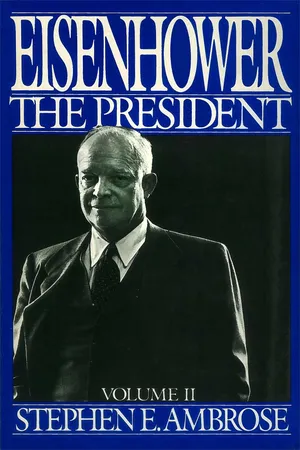
Stephen E. Ambrose draws upon extensive sources, an unprecedented degree of scholarship, and numerous interviews with Dwight D. Eisenhower himself to offer the fullest, richest, and most objective rendering yet of the soldier who became president. Eisenhower: The President, the second and concluding volume of Stephen Ambrose's brilliant biography, is the first assessment of a postwar President based on access to the entire record. It covers a wide range of subjects, including Eisenhower's rejection of the near-unanimous advice he received as President to use atomic weapons; his thinking on defense policy and the Cold War; his handling of a multitude of foreign-affairs crises; his attitudes and actions on civil rights; his views on Joseph McCarthy and on communism. Also illuminated are Eisenhower's relations with Nixon, Truman, Khrushchev, de Gaulle, and other world leaders. Ambrose provides us with an extraordinary portrait—fairminded and enormously well-informed—of the man, both decent and complex, who is increasingly regarded as one of the twentieth century's greatest Presidents.
Frequently asked questions

Yes, you can cancel anytime from the Subscription tab in your account settings on the Perlego website. Your subscription will stay active until the end of your current billing period. Learn how to cancel your subscription.
No, books cannot be downloaded as external files, such as PDFs, for use outside of Perlego. However, you can download books within the Perlego app for offline reading on mobile or tablet. Learn more here.
Perlego offers two plans: Essential and Complete
  • Essential is ideal for learners and professionals who enjoy exploring a wide range of subjects. Access the Essential Library with 800,000+ trusted titles and best-sellers across business, personal growth, and the humanities. Includes unlimited reading time and Standard Read Aloud voice.
  • Complete: Perfect for advanced learners and researchers needing full, unrestricted access. Unlock 1.4M+ books across hundreds of subjects, including academic and specialized titles. The Complete Plan also includes advanced features like Premium Read Aloud and Research Assistant.
Both plans are available with monthly, semester, or annual billing cycles.
We are an online textbook subscription service, where you can get access to an entire online library for less than the price of a single book per month. With over 1 million books across 1000+ topics, we’ve got you covered! Learn more here.
Look out for the read-aloud symbol on your next book to see if you can listen to it. The read-aloud tool reads text aloud for you, highlighting the text as it is being read. You can pause it, speed it up and slow it down. Learn more here.
Yes! You can use the Perlego app on both iOS or Android devices to read anytime, anywhere — even offline. Perfect for commutes or when you’re on the go.
Please note we cannot support devices running on iOS 13 and Android 7 or earlier. Learn more about using the app.
Yes, you can access Eisenhower Volume II by Stephen E. Ambrose in PDF and/or ePUB format, as well as other popular books in Politics & International Relations & Political Biographies. We have over one million books available in our catalogue for you to explore.

CHAPTER ONE

Image

President-Elect

November 1952–January 11, 1953

DWIGHT EISENHOWER actively disliked few people. If a man let him down, or offended his sense of dignity, or insulted him, Eisenhower’s practice was to try to put the man out of his mind. If he was forced to work on a regular basis with someone he disliked—Montgomery during the war is the supreme example—he managed to control and hide his feelings, so that their work together could be effective. Eisenhower also tried, usually successfully, never to publicly question another man’s motives, even when he felt the man’s actions to be selfish, unprincipled, partisan, or stupid.
By November of 1952, Eisenhower actively disliked Harry Truman. He thought the President was guilty of extreme partisanship, poor judgment, inept leadership and management, bad taste, and undignified behavior. Worst of all, in Eisenhower’s view Truman had diminished the prestige of the office of the President of the United States.
Eisenhower had not always been so negative toward Truman. He had first met the President at Potsdam, in July of 1945, and at the time liked and admired the man. During Eisenhower’s tenure as Army Chief of Staff (1946–1948), he and Truman had enjoyed a mutually beneficial working relationship. Although they never became friends (unlike Arthur Eisenhower and Truman, who had been friends since 1905, when they lived in the same Kansas City boardinghouse), they respected each other. In 1948 Truman offered to support Eisenhower for the Presidency, and in 1949 Eisenhower agreed to work for Truman as his chairman of the Joint Chiefs of Staff (JCS). Further, although Eisenhower strongly disagreed with Truman’s domestic policies, especially with regard to labor unions and deficit financing, the two men were in full agreement on foreign policy. Eisenhower supported all of Truman’s major decisions—the containment policy, the airlift to Berlin, the commitment to Korea, the program to build a hydrogen warhead, the limitation of the war in Korea, and most important of all, the North Atlantic Treaty and the sending of four American divisions to Germany to provide a military base for NATO. With regard to the last point, in fact, Eisenhower had been Truman’s principal and enthusiastic agent in making NATO a military reality. In the process Eisenhower had worked closely with Truman’s top advisers, including Dean Acheson, Averell Harriman, Robert Lovett, and George Marshall.
The 1952 campaign destroyed the Eisenhower-Truman relationship. Truman resented the Republicans for their promise to clean up the “mess in Washington” and was bitter about Eisenhower’s criticisms of American foreign policy, especially the emphasis on liberation of the Communist satellites and the charge that the Democrats were “soft on Communism.” The President was furious with Eisenhower for failing to speak up for Marshall in Milwaukee in McCarthy’s presence. Truman thought—and said—that Eisenhower’s pledge to go to Korea if elected was the worst sort of political hucksterism. In the last days of the campaign, Truman went after Eisenhower personally, reportedly saying that “the General doesn’t know any more about politics than a pig knows about Sunday.”
Truman had a long, and legitimate, list of complaints, especially the part about Eisenhower’s hypocrisy in attacking a foreign policy he had helped to create and execute. And, of course, Truman hated to lose. Now he had to hand over the government to the hated Republicans. He was going to do so with as much grace and good will as he could muster, but he could not resist some final digs. Thus the day after the election, he sent a telegram to Eisenhower inviting him to the White House for a conference on the transition, then added that the presidential plane, the Independence, would be available to Eisenhower for his trip to Korea, “if you still want to go.”
Eisenhower, tight-lipped and scowling, replied that any military transport would be fine. Then Eisenhower wrote to Lovett, the Secretary of Defense, thanking Lovett for a recent “kind and thoughtful letter” concerning arrangements for the trip. Eisenhower said Lovett’s communication “creates a feeling of confidence that is not characteristic of some that I have been receiving.” One of Truman’s objections to the “I shall go to Korea” pledge had been its implication that in Korea Eisenhower would find some magic formula to end the war, one that had escaped the Administration and the JCS. Eisenhower was sensitive to this charge, especially as the chairman of the JCS was one of his oldest friends and closest associates, Omar Bradley. So Eisenhower told Lovett, “I am quite sure that you and my old friends there [in the Pentagon] know that I am not trying to be clever and I am not pretending that I will find answers that they have overlooked.”1
On November 18, Eisenhower flew to Washington for a 2 P.M. appointment with the President. The meeting was stiff, formal, embarrassing, and unrewarding. Truman had with him Harriman, Acheson, John Snyder (Secretary of the Treasury), and Lovett. These were the men most responsible for containment, for NATO, and for the commitment to Korea. They were the men with whom Eisenhower had cooperated handsomely in the past, but whom he had vigorously criticized during the campaign. Everyone was ill at ease. Acheson was “perplexed” by Eisenhower’s attitude. “The good nature and easy manner tending toward loquacity were gone. He seemed embarrassed and reluctant to be with us. Sunk back in a chair facing the President . . . he chewed the earpiece of his spectacles and occasionally asked for a memorandum on a matter that caught his attention.”2
The meeting lasted but twenty minutes. Truman offered to leave some portraits in the Oval Office; Eisenhower curtly told him no thanks. Then Truman gave him the world globe that Eisenhower had used in World War II, and that Eisenhower had given to Truman at Potsdam in 1945. Eisenhower accepted the globe, according to Truman, “not very graciously.” Finally Truman tried to give Eisenhower advice on how to organize his staff, but as the President noted in his diary two days later, “I think all this went into one ear and out the other.”3 It did indeed. Eisenhower noted stiffly in his memoirs that the meeting “added little to my knowledge, nor did it affect my planning for the new administration . . .”4 It was his only meeting with the President before Inauguration Day, the only effort to provide for a smooth transition. January 20, 1953, in fact, saw the most hostile transition of the twentieth century.
• •
The evening of January 21, 1953, Dwight Eisenhower took a minute to make an entry in his diary. “My first day at the president’s desk,” he wrote. “Plenty of worries and difficult problems. But such has been my portion for a long time—the result is that this just seems (today) like a continuation of all I’ve been doing since July 1941—even before that.”5
The contrast between Eisenhower’s confident attitude and that of his predecessor after his first day on the job could not have been greater. On April 13, 1945, Harry Truman had told reporters, “Boys, if you ever pray, pray for me now. . . . When they told me yesterday what had happened, I felt like the moon, the stars, and all the planets had fallen on me.”6
• •
Eisenhower’s preparation for the Presidency was, obviously, much better than Truman’s had been. Roosevelt’s death had thrown Truman into a whole new world, one completely strange to him. But Eisenhower was simply continuing a life that he had long since grown accustomed to leading. He had not had a private life since June 1942, when he arrived in London. He had had aides at his elbows and advisers behind him for ten years. He was used to being surrounded by reporters whenever he was in a public place, to having his photograph taken, to having his every word quoted. Most important of all, Eisenhower was accustomed to being held in awe, to being the center of attention, to having the power to make the decisions.
Eisenhower had resigned himself to the loss of many ordinary human pleasures, but also learned to accept the privileges that went with his station. Except for an occasional private banquet, he had not eaten in a restaurant in ten years. His schedule seldom allowed him sustained leisure for the serious reading of history he so loved to do. He had learned to take infrequent and short vacations, to expect them to be interrupted, and to take along plenty of work. To leave his mind and his time free, he had others to do the most basic of human chores for him. He did not dress himself—John Moaney, his valet, put on his underwear, socks, shoes, pants, shirt, jacket, and tie. Eisenhower did not drive a car, never had to worry about a parking place. He did not even know how to use a dial telephone. He had never been in a laundromat or a supermarket. He did not keep his own checkbook or manage his own finances. He handled money only when it was time to settle up on the golf course or at the bridge table, where he hated to lose and hated even more having to pay up. (Correspondingly, collecting a $20 bet gave him great pleasure. He was not above using his rank. Opponents had to hole out their one- or two-foot putts, while Eisenhower would pick up his eight-footer, grin, and say thanks for the gimme.7) His travel arrangements were always made for him. He did not have to worry about where to stand or what toast to make at the many formal occasions he attended; as he told John Foster Dulles, when Dulles corrected him on a point of protocol, he had never bothered to learn such details because “aides have sat on my right all my life.”8
Eisenhower was also ready for the physical demands of the Presidency. Three weeks before the election of 1952, he had celebrated his sixty-second birthday. Despite his age, Eisenhower was in good health. At 175 pounds, he weighed only a few pounds more than he had when he played football at West Point. He ate and drank in moderation, and in 1949 had quit tobacco cold turkey. He exercised regularly, either on the golf course or in a swimming pool. His face was usually sun-tanned, his complexion ruddy. His erect military bearing provided convincing evidence of his good muscle tone and strong constitution. Although he was of medium height (five feet ten inches), he somehow seemed taller. Wherever he went, he stood out, not only because of his reputation, but also because of his animation. His immense storehouse of energy and warmth was sensed, felt, communicated to everyone around him. His associates drew on that apparently inexhaustible source of energy; his political opponents were confounded by it.
• •
Among most groups, Eisenhower inspired confidence. Those who knew him well, and millions who did not, looked to him instinctively for guidance and leadership. Partly this was a result of his proved record of accomplishment, partly the result of his personality. He seemed so self-assured, so competent, so open to new ideas and suggestions, so reasonable, so objective (his own favorite word to describe himself), that when associates or reporters or supporters described him, there was one word that almost all of them used. It was “trustworthy.” His old comrade-in-arms Bernard Law Montgomery put it best when he said of Eisenhower, “He has the power of drawing the hearts of men towards him as a magnet attracts the bits of metal. He merely has to smile at you, and you trust him at once.”9
But Harry Truman had his doubts about Eisenhower’s trustworthiness, and was certain that Eisenhower would not be able to provide the country with competent leadership. As prepared as Eisenhower was for the life-style the Presidency would force on him, he was not, in Truman’s view, at all prepared for the real work facing him in the task ahead. Reflecting on the problems the general-become-President would face, in late 1952 Truman mused, “He’ll sit here, and he’ll say, ‘Do this! Do that!’ And nothing will happen. Poor Ike—it won’t be a bit like the Army. He’ll find it very frustrating.”10
Truman was not alone. As Eisenhower prepared to enter the Presidency, friends as well as critics worried about how unprepared he was for the job. According to this widely held view, Eisenhower had spent his life in the sheltering monastery of the U.S. Army, and therefore knew nothing of such practical matters as economics, partisan politics, the intricacies of the relationship between Capitol Hill and the White House, race relations and labor legislation, or the myriad of other subjects he would have to deal with. He was, or so it was charged, the “captive hero,” the tool of the millionaires in the Republican Party who would use him to suit their purposes, while he would be content to play golf and preside over ceremonial functions.
The truth is so directly the opposite from the portrayal that the real problem is to attempt to understand how such analysis could have attained such popularity. One obvious reason was the American public’s traditional dislike of the professional soldier, its unwillingness to admit that soldiers knew about anything other than making war. Another factor was Eisenhower’s own frequent self-deprecation. “I’m just a simple soldier,” he would say, or “I’m just a farm boy from Kansas.” His penchant for expressing his distaste about politics and his insistence that he was a political innocent also contributed to the popular view. But Eisenhower had lived and worked in Washington throughout most of the Hoover Administration and on into the New Deal. His principal job had been to lobby in Congress for the U.S. Army. He had testified at dozens of congressional hearings; he had spent countless hours meeting privately with congressmen. After World War II, first as the Army Chief of Staff and then as chairman of the JCS, and finally as Supreme Allied Commander, Europe (SACEUR), he had continued to work closely with both the Executive and Congress. Despite the forebodings about the inexperience of the President-elect, Eisenhower knew Washington and its modus operandi at least as well as any of his predecessors, and far better than most.
In foreign affairs, he was undoubtedly the best-prepared man ever elected to the Presidency. He knew personally numerous world leaders, including his main opponent, Joseph Stalin. He had lived in Asia (the Philippines), Central America (Panama), Europe (Paris in the twenties and again in 1951; London in 1942 and 1944), Africa (Algeria in 1943), and had made extended trips to the Near East, the Soviet Union, Japan, and China. He had a close working relationship with every major politician in Western Europe, including those currently in power, most notably Winston Churchill and Konrad Adenauer, and those out of power, including Clement Attlee and Charles de Gaulle. He had the respect and admiration of nearly all the world’s leaders.
• •
He also knew a great deal about teamwork and the need for aides. “No one man can be a Napoleon in modern war,” he had declared in 1942, and he believed the principle applied equally to political leadership in 1953. “Now look,” he once explained, “this idea that all wisdom is in the President . . . that’s baloney. . . . I don’t believe this government was set up to be operated by any one acting alone; no one has a monopoly on the truth and on the facts that affect this country.”11
Eisenhower’s sense of the limitations on the individual, however great the man, was well illustrated in a conversation he had with Churchill during the first week of January 1953. Churchill, who had returned in 1951 to 10 Downing Street, flew to the United States to meet the President-elect.
After only a few minutes of conversation, in which Churchill tried to persuade Eisenhower to help...

Table of contents

  1. Cover
  2. Dedication
  3. Introduction
  4. 1. President-Elect, November 1952-January 11, 1953
  5. 2. Inauguration, January 12-January 20, 1953
  6. 3. Getting Started, January 21-March 31, 1953
  7. 4. The Chance for Peace, April 1-June 30, 1953
  8. 5. Peace in Korea, Coup in Iran, July 1-September 30, 1953
  9. 6. Atoms for Peace, October 1-December 31, 1953
  10. 7. Bricker, McCarthy, Bravo, Vietnam, January 1-May 7, 1954
  11. 8. McCarthy, Guatemala, SEATO, May 8-September 8, 1954
  12. 9. Quemoy and Matsu, Off-Year Elections, September 3-December 31, 1954
  13. 10. The Formosa Doctrine, January 1-June 20, 1955
  14. 11. Open Skies, June-September 1955
  15. 12. Heart Attack, September-December 1955
  16. 13. Recovery, January-March 1956
  17. 14. The Tyranny of the Weak, April-September 1956
  18. 15. Election, Suez, Hungary, September 19-December 31, 1956
  19. 16. The Eisenhower Doctrine, January-July 1957
  20. 17. The High Cost of Defense, Nuclear Testing, Civil Rights, January-July 1957
  21. 18. Little Rock, Sputnik, August-November 1957
  22. 19. Problems: Stroke, Dulles, Disarmament, Space Race, December 1957-April 1958
  23. 20. Lebanon, Sherman Adams, Disarmament, Quemoy and Matsu, Other Woes, May-September 1958
  24. 21. Elections, Test-Ban Talks, Berlin, Fidel, October 1958-February 1959
  25. 22. A Revival, February-June 1959
  26. 23. Traveling for Peace, July-December 1959
  27. 24. High Hopes and Unhappy Realities, January-June 1960
  28. 25. A Bad Summer and a Terrible Fall, July 1-November 9, 1960
  29. 26. Transition, November 9, 1960-January 20, 1961
  30. 27. The Eisenhower Presidency: An Assessment, 1953-1961
  31. 28. Elder Statesman, January 1961-November 1963
  32. 29. Johnson, Goldwater, Vietnam, November 23, 1963–March 1968
  33. 30. Taps, March 1968–March 28, 1969
  34. Acknowledgments
  35. Photographs
  36. About Stephen E. Ambrose
  37. Notes
  38. Bibliography
  39. Index
  40. Copyright