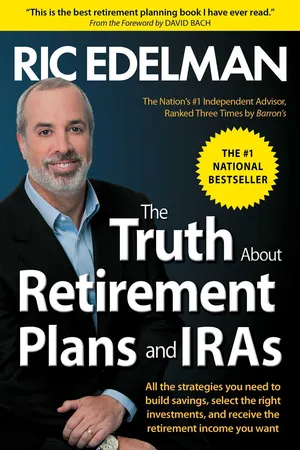
The Truth About Retirement Plans and IRAs
eBook - ePub

The Truth About Retirement Plans and IRAs

  1. 352 pages
  2. English
  3. ePUB (mobile friendly)
  4. Available on iOS & Android
eBook - ePub

The Truth About Retirement Plans and IRAs

About this book

From one of America's most trusted financial advisors: a guide to making the most of your retirement plans and assuring long-term financial security. Everyone knows that investing in your retirement is important. Yet only half of all eligible Americans contribute to a retirement plan. That's because 401(k)s, 403(b)s, 457s, and IRA plans are complicated, confusing, and costly. New York Times bestselling author and acclaimed financial advisor Ric Edelman has counseled thousands of savers and retirees, and has accumulated his advice in this book.Edelman has created a step-by-step guide. With illuminating examples and simple explanations, he shares everything you need to know as a plan participant: how much you need to retire comfortably, how to make wise choices among your investment options, and how to maximize the benefits of your 401(k). Along the way, he debunks the myths and clears up the confusion.
Frequently asked questions

Yes, you can cancel anytime from the Subscription tab in your account settings on the Perlego website. Your subscription will stay active until the end of your current billing period. Learn how to cancel your subscription.
No, books cannot be downloaded as external files, such as PDFs, for use outside of Perlego. However, you can download books within the Perlego app for offline reading on mobile or tablet. Learn more here.
Perlego offers two plans: Essential and Complete
  • Essential is ideal for learners and professionals who enjoy exploring a wide range of subjects. Access the Essential Library with 800,000+ trusted titles and best-sellers across business, personal growth, and the humanities. Includes unlimited reading time and Standard Read Aloud voice.
  • Complete: Perfect for advanced learners and researchers needing full, unrestricted access. Unlock 1.4M+ books across hundreds of subjects, including academic and specialized titles. The Complete Plan also includes advanced features like Premium Read Aloud and Research Assistant.
Both plans are available with monthly, semester, or annual billing cycles.
We are an online textbook subscription service, where you can get access to an entire online library for less than the price of a single book per month. With over 1 million books across 1000+ topics, we’ve got you covered! Learn more here.
Look out for the read-aloud symbol on your next book to see if you can listen to it. The read-aloud tool reads text aloud for you, highlighting the text as it is being read. You can pause it, speed it up and slow it down. Learn more here.
Yes! You can use the Perlego app on both iOS or Android devices to read anytime, anywhere — even offline. Perfect for commutes or when you’re on the go.
Please note we cannot support devices running on iOS 13 and Android 7 or earlier. Learn more about using the app.
Yes, you can access The Truth About Retirement Plans and IRAs by Ric Edelman in PDF and/or ePUB format, as well as other popular books in Persönliche Entwicklung & Private Finanzen. We have over one million books available in our catalogue for you to explore.

PART ONE

Why Retirement Plans Exist — and the Secret to Making Them Work for You

Chapter 1

How Retirement Plans Came to Be

In the beginning, there was no such thing as retirement: If you were alive, you worked.
Children gathered, adults hunted. The old and the sick, unable to work and feed themselves, died.
Soon, nation-states formed, and people organized to defend themselves from invaders.1 But how do you convince people to fight when there is a high likelihood they will die doing so?
One way is to bribe them.

The First Pension in America

During the American Revolution, the Continental Congress offered soldiers a monthly lifetime income as an incentive to join General Washington’s army. The income they’d receive following the war (assuming they survived the ordeal) would be a reward for their service.
This lifetime income was called a pension.
The colonists didn’t invent the idea; it had been used by Romans 2,000 years ago.
But the idea was new to Americans: For the first time, you could work for (just) a finite number of years instead of your entire life, after which you’d continue to receive income as though you were still employed.
As far as Americans were concerned, it was (pardon the pun) a revolutionary idea.
The federal government repeated the offer during the Civil War and has done so ever since.
The first private company to offer a pension plan was American Express, which in 1875 gave an income to each retired employee. The amount was equal to half of the worker’s annual pay, based on an average of the worker’s final 10 years of employment (up to $500 annually). Over the next 50 years, hundreds of other companies created similar plans.
Pensions came to be known as defined benefit plans because the future benefit you are to receive is defined.2 What was undefined was how much it would cost the employer to provide this benefit.
Workers came to love pension plans. They paid nothing for them and had to stay with their employer only long enough to qualify (called vesting) — typically 20 to 40 years. Employers loved the plans too because they helped ensure that productive workers would stay for an entire career. The higher productivity and lower turnover helped the employer save money.

A Retirement Plan for the Public

Then came the Great Depression. Tens of millions of people were out of work, which created fierce competition for jobs. The nation’s economy was agricultural and industrial — both very physically demanding — placing older Americans at a distinct disadvantage. So when these folks lost their jobs, they were unlikely to find new ones. They thus found themselves permanently — albeit involuntarily — retired.
To provide them with income during their retirement years, President Franklin D. Roosevelt introduced the Social Security Act of 1935 — the first public retirement plan. Similar to the private plan created by American Express, Social Security was to pay monthly benefits based on each worker’s length of service and average annual wages. The first person to receive a Social Security check was Mary Fuller. Starting in 1940, she received $22.54 monthly — and she kept receiving money from Social Security until she died in 1975 at age 100.
In 2013, nearly 57 million Americans were receiving Social Security benefits, averaging $1,150 monthly. The maximum monthly retirement income was $3,350 as of December 2013, and you must be at least 70 years old to receive it.
The benefit is based on your 35 highest-earning years.

How the World’s Largest Automobile Manufacturer Changed Retirement Plans Forever

The Studebaker family of South Bend, Indiana, started making wagons for farmers, miners and the military in 1852. Ten years after the first gasoline-powered car was tested in the United States, the Studebakers began manufacturing automobiles and became, at one point, the world’s biggest carmaker. But by the 1960s the company was having financial difficulties, and the last Studebaker car rolled off the assembly line on March 16, 1966.
NON SEQUITUR WILEY
Images
NON SEQUITUR © 2012 Wiley Ink, Inc.. Dist. By Universal Uclick. Reprinted with permission. All rights reserved.
One of Studebaker’s problems was that its pension plan had so little money in it that the company couldn’t afford to pay all its retirees the pensions they had been promised. So when the company went broke, the pensions ended as well, leaving thousands of employees and retirees with no pension or only a fraction of the amount they had been promised.
Studebaker’s collapse, along with similar events at other companies, caused Congress to create the Employee Retirement Income Security Act, signed into law by President Gerald Ford in 1974.
ERISA governs how pension plans operate, to help ensure that promises made to employees are honored by their employers. ERISA also created PBGC, the Pension Benefit Guaranty Corporation. Similar to the FDIC (Federal Deposit Insurance Corporation) for banks, PBGC restores some (not all) of the pension income that workers lose when a company goes out of business.

1. That is without question the fastest history lesson ever. From Cro-Magnon days to modern society in just three and a half sentences. Beat that, Tolstoy.
2. Duh.

Chapter 2

How Retirement Plans Evolved from Defining Benefits to Defining Contributions

In 1981, Ted Benna, co-owner of a benefits consulting firm in Pennsylvania, noticed that the Revenue Act of 1978 added a paragraph to the tax code. This new text allowed a worker to set aside a portion of his paycheck into a separate account. The text was silent as to the tax treatment of this money, and everyone Benna asked told him the money couldn’t be set aside on a pretax basis.
Unconvinced, Benna requested clarification from the Internal Revenue Service. The agency confirmed his suspicion: The new law did not require that taxes be paid on the contributions. So Benna created an account for his own company, and behold: The nation’s first-ever retirement plan was established based on Section 401(k) of the Internal Revenue Code.
“You can be young without money, but you can’t be old without it.”
— Tennessee Williams
Thanks to Benna, employees could voluntarily set aside a portion of their pay into an investment account. Since they had not received the money they set aside, they weren’t taxed on it. This reduced their taxable income. And since they hadn’t received the profits that grew inside the account, the profits weren’t taxed either (until withdrawn, that is).
For the firs...

Table of contents

  1. Cover
  2. Dedication
  3. Acknowledgments
  4. Foreword by David Bach
  5. Introduction
  6. Part One: Why Retirement Plans Exist — and the Secret to Making Them Work for You
  7. Part Two: Fundamental Concepts You Must Understand Before You Invest
  8. Part Three: The Best Way to Handle the Money in Your Retirement Plans and IRAs
  9. About Ric Edelman
  10. 36 Key Take-Aways
  11. Retirement
  12. Glossary
  13. Index
  14. Copyright