Impolite Conversations
eBook - ePub

Impolite Conversations

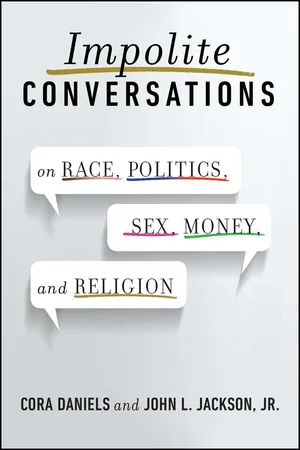
On Race, Politics, Sex, Money, and Religion

  1. 320 pages
  2. English
  3. ePUB (mobile friendly)
  4. Available on iOS & Android
eBook - ePub

Impolite Conversations

On Race, Politics, Sex, Money, and Religion

About this book

When was the last time you said everything on your mind without holding back? In this no-holds-barred discussion of America’s top hot-button issues, a journalist and a cultural anthropologist express opinions that are widely held in private—but rarely heard in public.

Everyone edits what they say. It’s a part of growing up. But what if we applied tell-it-like-it-is honesty to grown-up issues? In Impolite Conversations, two respected thinkers and writers openly discuss five “third-rail” topics—from multi-racial identities to celebrity worship to hyper-masculinity among black boys—and open the stage for honest discussions about important and timely concerns.

Organized around five subjects—Race, Politics, Sex, Money, Religion—the dialogue between Cora Daniels and John L. Jackson Jr. may surprise, provoke, affirm, or challenge you. In alternating essays, the writers use reporting, interviews, facts, and figures to back up their arguments, always staying firmly rooted in the real world. Sometimes they agree, sometimes they don’t, but they always reach their conclusions with respect for the different backgrounds they come from and the reasons they disagree.

Whether you oppose or sympathize with these two impassioned voices, you’ll end up knowing more than you did before and appreciating the candid, savvy, and often humorous ways in which they each take a stand.
Frequently asked questions

Yes, you can cancel anytime from the Subscription tab in your account settings on the Perlego website. Your subscription will stay active until the end of your current billing period. Learn how to cancel your subscription.
No, books cannot be downloaded as external files, such as PDFs, for use outside of Perlego. However, you can download books within the Perlego app for offline reading on mobile or tablet. Learn more here.
Perlego offers two plans: Essential and Complete
  • Essential is ideal for learners and professionals who enjoy exploring a wide range of subjects. Access the Essential Library with 800,000+ trusted titles and best-sellers across business, personal growth, and the humanities. Includes unlimited reading time and Standard Read Aloud voice.
  • Complete: Perfect for advanced learners and researchers needing full, unrestricted access. Unlock 1.4M+ books across hundreds of subjects, including academic and specialized titles. The Complete Plan also includes advanced features like Premium Read Aloud and Research Assistant.
Both plans are available with monthly, semester, or annual billing cycles.
We are an online textbook subscription service, where you can get access to an entire online library for less than the price of a single book per month. With over 1 million books across 1000+ topics, we’ve got you covered! Learn more here.
Look out for the read-aloud symbol on your next book to see if you can listen to it. The read-aloud tool reads text aloud for you, highlighting the text as it is being read. You can pause it, speed it up and slow it down. Learn more here.
Yes! You can use the Perlego app on both iOS or Android devices to read anytime, anywhere — even offline. Perfect for commutes or when you’re on the go.
Please note we cannot support devices running on iOS 13 and Android 7 or earlier. Learn more about using the app.
Yes, you can access Impolite Conversations by Cora Daniels,John L. Jackson in PDF and/or ePUB format, as well as other popular books in Social Sciences & African American Studies. We have over one million books available in our catalogue for you to explore.
RACE

JOHN
We’re all haters.
I’m sitting in the passenger seat of a tow truck in South Philadelphia and having a casual conversation with the driver, a complete stranger, about ā€œthose damned Mexicans.ā€
To be honest, I hardly did much talking. My contributions to the discussion boiled down to a very active brand of listening, only occasionally punctuated by a gentle attempt at playing devil’s advocate, very gentle, without any hint of definitiveness or indignation:
ā€œMexicans can be as hardworking as anyone else, no?ā€
And even those blunted gestures were carefully tempered by toothy smiles and enabling head nods, all served up in hopes of collecting more xenophobic pronouncements, and decidedly not as a direct challenge to ostensibly hostile and racist remarks.
Many would blast me for even taking part in any conversation that includes references to ā€œthose damned Mexicans,ā€ and that’s justifiable, but I should also say, in my own defense, however feeble the defense might seem, that I have a PhD in cultural anthropology, which gives me informal license to let folks say all manner of craziness in my presence without calling them on it. If anything, the profession requires me to drag more and more of such talk out of people. The nuttier, the better. Anthropologists ā€œsuffer fools gladly,ā€ as the biblical saying goes, even if we also love to stumble upon everyday forms of bona fide (and usually underappreciated) genius, which is ultimately much more fun to find anyway. And I’ve been fortunate enough to discover my share of those, too.
Part of my willingness to participate in a conversation that includes talk of ā€œthose damned Mexicansā€ can be chalked up to the fact that many anthropologists reserve their most scathing critiques for the printed page, just like I’m doing right now, saving seemingly righteous rebukes for published books or journal articles. They might be disgusted by something they see or hear, but they can sometimes keep a poker face in the moment (for the sake of social science!), to witness more of what repulses them, a feat that some would rightly characterize as cowardly or conniving or both.
But that wasn’t the only reason for my open-faced smiles, for those rhetorical softballs I tossed back at anti-immigrant rants. There is also anthropology’s long-standing commitment to ā€œcultural relativism,ā€ one of its golden rules, and something that detractors use to pummel it every chance they get.
You are being a cultural relativist when you try to take other people’s practices and beliefs very seriously, especially when those practices and beliefs diverge most radically (and seemingly irreconcilably) from your own, a stance meant to offset the combination of hubris and small-mindedness that comes with being a part of any social group. It is a mind-set that attempts to dampen some of the intrinsic boastfulness that usually accompanies calling a particular ā€œculture,ā€ any culture, your own. Cultural relativism argues that we should respect different worldviews, take other cultures on their own terms, avoid knee-jerk hostilities and snap judgments about alien ideas, especially since the dismissiveness bred from that would be a consequence of unfairly and self-servingly measuring another group against your own culture’s yardstick.
But some critics lampoon the cultural relativist position as a cop-out, a kind of political wimpiness, an excuse for tolerating all kinds of cultural cruelties and nonsense in the name of a false sense of social respectfulness. If Ugandan women are complaining about being subjected to painful forms of female genital mutilation because of cultural traditions (and without any urgent medical reasons to justify them), which is one of the textbook examples of cultural relativism’s ethical and political implications, would non-Ugandans be morally justified if they ignored those cries for help out of some deference to a foreign culture’s internal coherence and distinct moral standards?
Or maybe very few members of a particular cultural group are even complaining about some practice that looks cruel or dangerous or humiliating or evil to the outside world. They just accept it. Their community has been doing things this way for as long as anyone can remember. This is how their parents, grandparents and great-Ā­grandparents lived. They can’t even imagine an alternative. It is just how things are—how they have always been. In that scenario, what would it mean for an outsider to convince members of the community to think about their age-old cultural practices as inherently Ā­oppressive and in need of reform, especially when it tends to be the same cultures (read: Western) condescendingly pouncing on the same other cultures (read: Third World/Global South) in the name of Ā­universal rights and wrongs?
Cultural relativism troubles claims to universalism, with all of their assumed self-evidence. Western culture can’t boast an objective and universal position on things in supposed contradistinction to everyone else’s particular and partial ones. It is just as particular and partial, even if—like just about every other culture known to man—it has far more grandiose aspirations and self-conceptions.
I don’t mean to sound like an ā€œintroduction to anthropologyā€ textbook, but if I am going to invoke terms like ā€œWestern cultureā€ and ā€œcultural relativism,ā€ I should also probably take a second to explain what ā€œcultureā€ actually is, especially since it has such an integral part to play in what makes human beings human and fosters every single one of our social anxieties and hatreds, including race-based ones.
Defining culture isn’t easy. We often don’t know where ā€œcultureā€ ends and its ostensible opposite, ā€œnature,ā€ takes over. We used to highlight the same debate all the time: nature versus nurture, which is more powerful in determining human behaviors and life’s outcomes? It is one of the most seductive questions in science and social policy, and we continue to look for more nuanced ways of answering it.
The debate usually wends its way around the same basic formula. Someone picks a practice, any practice, and then asks, is it hardwired? Is it something we are born with? Like ten fingers and toes. If we are born with it or with a propensity for it (think, the gene for androgenic alopecia, i.e., male pattern baldness), we call it ā€œnatural,ā€ the assumption being that it is, therefore, extremely difficult (if not impossible) to change. The jury is in and one’s fate is sealed. If what we are talking about being born with is a tendency to do something, to act in a particular way (say, walking upright instead of on all fours), doing anything other than that practice would be considered unnatural by definition.
But if we are talking about a social practice or belief that has to be learned and nurtured, something that had to be taught to (and modeled for) us by our parents and teachers and ministers and elected officials and friends and enemies or anyone else, then we are squarely in the realm of culture.
Compared to nature, culture is supposed to be flimsy and fungible. If we don’t like an aspect of our cultural world, we can teach ourselves to do something else; we can learn a new culture, which wouldn’t necessarily be labeled unnatural, even if some people might consider it weird or unwise.
After finding out that the soul food cooking you grew up on isn’t particularly healthy for you, even though your grandmother might have prepared it with every last drop of her love, you could decide to give up meat and become a vegetarian. You might even join a network of similarly health-conscious plant eaters who also regularly attend Bikram yoga classes, purchase provisions from Ā­community-owned gardens (or Whole Foods), and annoy meat-eating family members to no end with consistent criticisms about their dietary choices. And you could call all of those new practices legitimate parts of your newfangled cultural repertoire. Vegetarianism might take discipline and self-control, but it is doable. And it would transform many other aspects of your social life.
If someone wanted to, he could reject portions of his cultural inheritance one item at a time: first diet, then dress code, then speaking style, then religious beliefs, and on and on. The nature versus nurture distinction pivots on this central premise: that we would have a much better chance of reworking the merely cultural stuff of life than we would trying to fool with Mother Nature.
It might seem quaint to invoke nature/nurture concerns these days, but we continue to have that quintessential debate—in the popular media and in the sciences. And all the time.
New parents can be especially obsessed when it comes to questions about raising their little ones. People want to know how much the local environment and family upbringing counts over and against genetic and biological predeterminations of social outcomes. Many classic ā€œtwin studiesā€ were designed to get at this very question, trying to figure out if identical twins (with the same genetic composition) raised apart (with different mothers and fathers and social environments) developed similar personality traits. But parenting concerns don’t corner the market on the nature/nurture theme.
We are constantly battling over how much of our social actions are based on cultural rules we have had to learn versus biological mandates we passively inherited. There have long been arguments about whether or not people might be biologically prone to, say, criminality, with scientists trying to figure out if criminal tendencies might be predicted simply by looking at the shape of people’s heads and faces. Maybe their striding gaits or skin colors.
Intelligence is also situated at the crossroad between nature and nurture. What do we mean by ā€œintelligence,ā€ and how do we test for it? When we do administer those tests, do they capture some kind of inherent genetic capacity for cognitive achievement or only the test taker’s access to learned information that he or she might (or might not) share with the test’s designers? People still fight over this question, with admission to the elitist schools and access to tens of millions of dollars in tuition money hanging in the balance.
And it isn’t just criminality and intelligence that provoke nature/nurture knife fights. There are those ongoing debates about sexual orientation, disputes about whether people are born homosexual or can be made straight through religious therapies. This is still a quintessential part of the nature/nurture discussion, even as its front lines have moved to the question of marriage itself—many people, including defenders of the Defense of Marriage Act, talking about certain marriage arrangements as more or less natural than others.
According to some social critics, and not just right-wing economists, the capitalist market is the most ā€œnaturalā€ way of organizing social exchange. To tamper with the free market of goods, services, and labor, they argue, isn’t just a slippery slope to communism; it more fundamentally means putting artificial and unnatural barriers on the human spirit—all to society’s ultimate detriment.
Forget about ā€œthe race cardā€ā€”the nature card is the highest trump in the deck.
But debates about race can be very informative when it comes to this nature/nurture stuff, especially since race often crosscuts those distinctions in peculiarly instructive ways.
Are racial groupings natural? How about identifying races in the first place? Is that something we do because of some biological imperative? How early do young people start seeing racial differences? How much of that is simply an extension of our more general human capacity for categorization? Does being hardwired to categorize necessarily explain our commitments to traditional racial categories themselves? Those kinds of questions are favorites in many social scientific and psychological circles. And you’d probably hear versions at many proverbial water coolers if you loitered long enough.
A lot of the work in human genetics and genomics today is just a more sophisticated way of trying to find the Holy Grail of nature’s full design, of redrawing the line between social learning and DNA coding. Early versions of the project of predicting criminality, some of which have long been debunked (such as physiognomy) are now being reinvigorated and reimagined as fMRIs attempt to examine the shape of the brain’s architecture with a similar goal in mind: determining whether criminals are born and with what kinds of biological markers/defects.1
Neuroscientists examine the brain’s circuitry to make claims about all kinds of behaviors and traits. Evolutionary psychologists seek evidence for contemporary cultural practices in excavated evidence from (or conjecture about) prehistorical human societies. Primatologists compare human actions to our closest animal relatives for clues about how nature might have preprogrammed our approaches to sexuality, social bonding, child rearing, alliance building, mourning, and just about anything else we do. Much of this work operates from the premise that culture might be little more than a lapdog to nature’s surreptitious suggestions and straightforward demands—that we are giving culture, nurture, and social learning more credit than they deserve.2
But culture is more stubborn than some people think, much more than certain versions of the nature/nurture divide imply, and it isn’t necessarily a foregone conclusion that the nurture side of things is easier to manipulate. Mapping the human genome is ambitious, and it potentially opens human nature up to active modification and prediction. The coding of a DNA sequence could be about trying to figure out how we might engineer hardier human beings in the future. Or we can use it to determine if someone has an extremely high chance of coming down with something like Alzheimer’s disease or breast cancer, well before any actual symptoms are ever observable. Science has long been about demystifying or taming nature, understanding its inner workings, and in many ways such taming might look far more definitive than any prognostications that might be made about culture’s more inconsistent and probabilistic machinations.
Culture is a powerful thing, and maybe even more so in its distance from what we might call practical reasoning, from simple and supposedly objective cost-benefit analysis.3 In fact, cultures can seem quite unreasonable by certain economic or utilitarian standards, which is where cultural relativism comes in—to remind us that their logics are easiest to spy when taken on their own terms. Anthropologist Marshall Sahlins provided one of the classic cases against any understanding of culture as simply a puppet for more powerful natural, economic, or material forces.
Part of culture’s power stems from the fact that it can feel utterly natural. We learn it so fully and completely that it seems instinctual. It can even try to cover up its nonnatural moorings. That’s the reason why we call it ā€œsecond nature.ā€ It passes itself off as natural, which is how we experience many parts of our cultural world—like the air we breathe. ...

Table of contents

  1. Cover
  2. Dedication
  3. The Intro
  4. Sex
  5. Money
  6. Religion
  7. Politics
  8. Race
  9. The Conclusion
  10. Acknowledgments
  11. About the Authors
  12. Endnotes
  13. Copyright