The Way of the World
eBook - ePub

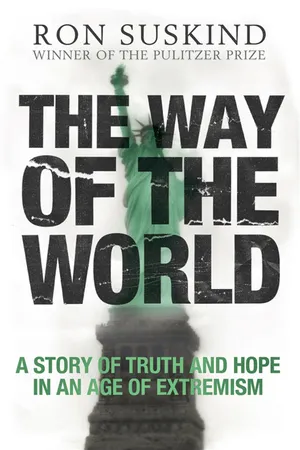
The Way of the World

A Story of Truth and Hope in an Age of Extremism

  1. 432 pages
  2. English
  3. ePUB (mobile friendly)
  4. Available on iOS & Android
eBook - ePub

The Way of the World

A Story of Truth and Hope in an Age of Extremism

About this book

From Pulitzer Prize-winning journalist and bestselling author Ron Suskind comes a startling look at how America and the West lost their way, and at the struggles of their respective governments to reclaim the moral authority on which their survival depends. From the White House to Downing Street, and from the fault-line countries of South Asia tothe sands of Guantanamo, Suskind offers an astonishing story that connects world leaders to the forces waging today's shadow wars and to the next generation of global citizens. Tracking down truth and hope, Suskind delivers historic disclosures with this emotionally stirring and strikingly original portrait of the post 9-11 world.
Frequently asked questions

Yes, you can cancel anytime from the Subscription tab in your account settings on the Perlego website. Your subscription will stay active until the end of your current billing period. Learn how to cancel your subscription.
No, books cannot be downloaded as external files, such as PDFs, for use outside of Perlego. However, you can download books within the Perlego app for offline reading on mobile or tablet. Learn more here.
Perlego offers two plans: Essential and Complete
  • Essential is ideal for learners and professionals who enjoy exploring a wide range of subjects. Access the Essential Library with 800,000+ trusted titles and best-sellers across business, personal growth, and the humanities. Includes unlimited reading time and Standard Read Aloud voice.
  • Complete: Perfect for advanced learners and researchers needing full, unrestricted access. Unlock 1.4M+ books across hundreds of subjects, including academic and specialized titles. The Complete Plan also includes advanced features like Premium Read Aloud and Research Assistant.
Both plans are available with monthly, semester, or annual billing cycles.
We are an online textbook subscription service, where you can get access to an entire online library for less than the price of a single book per month. With over 1 million books across 1000+ topics, we’ve got you covered! Learn more here.
Look out for the read-aloud symbol on your next book to see if you can listen to it. The read-aloud tool reads text aloud for you, highlighting the text as it is being read. You can pause it, speed it up and slow it down. Learn more here.
Yes! You can use the Perlego app on both iOS or Android devices to read anytime, anywhere — even offline. Perfect for commutes or when you’re on the go.
Please note we cannot support devices running on iOS 13 and Android 7 or earlier. Learn more about using the app.
Yes, you can access The Way of the World by Ron Suskind in PDF and/or ePUB format, as well as other popular books in Social Sciences & Sociology. We have over one million books available in our catalogue for you to explore.

Information

CHAPTER 1

Welcome Home

USMAN KHOSA AWAKES TO THE voices of his roommates in the kitchen. A hazy sun is shining in, giving the exposed brick above his bed an orange hue. He checks his night-table clock—7:15—and slips back into the deep sleep of a young man.
It is morning in America. Or at least in an apartment near Dupont Circle in Washington, D.C., where three young, well-educated men start a summer’s day. They are friends, a few years out of Connecticut College, dancing through the anxious glories of first jobs and few obligations. It’s a guy’s world. Linas, a strapping Catholic, American-born, with Midwestern roots, is an economic analyst; David, Jewish and gay, with wavy brown hair and movie-idol looks, is a public relations staffer for an international aid organization. After breakfast, they slip out together, each in a blazer and khakis, Christian and Jew, straight and gay, into the flow of the capital’s professional class.
Their Muslim roommate hears the front door shut and rises with a sense of well-being. He’d worked late, as usual, and then met some friends for dinner, a night that went late with loud talk and laughter. He came south to D.C. from Connecticut just over three years ago, a day after receiving his diploma with its summa cum laude seal, to a waiting desk at an international trade law firm, Barnes Richardson, with offices across the street from the U.S. Treasury Department and a block from the White House. He finds the work fascinating because it is: taking sides in bloodless struggles between countries and their major corporations over product dumping and tariffs. Trade wars. It’s the kind of conflict that smart folks thought the world was moving toward in the mercantile 1990s, when the Soviet Union’s fall was to usher in a post-ideological age, a period when aggression would be expressed, say, with tariffs on imported cars and wheat dumping. It was a hopeful notion that issues of progress and grievance, the fortunes of haves and have-nots, would be fought on an economic field where the score could be kept in terms of GDP, per capita income, and infant mortality rates. It wouldn’t turn out that way, as the few who saw the rise of religious extremism foretold.
And that’s why the boy brushing his teeth this particular morning—July 27, 2006—is not just any young professional on the make. He is, notably, a Muslim from the fault line country of Pakistan—the home, at present, of Osama bin Laden and Ayman al-Zawahiri, Pervez Musharraf and Mullah Omar, fifty-five nuclear weapons and countless angry bands of Islamic radicals. Usman, from this place, of this place, strives with an ardent, white-hot yearning to be accepted into America’s current firmament of fading hopes. Like each fresh wave of newcomers, he presses mightily to make that hope new. Whether he means to or not, he’s testing American ideals at a time of peril.
It’s a fault of cultural nearsightedness, or worse, that he is not immediately seen as a modern kindred to immigrants glorified in oft-told tales of potato famines or Russian pogroms or, back further, a search to worship freely by some Mayflower stowaway. He is, after all, identical to them in every essential way.
But his journey involves a blue ’78 Toyota Corolla. In Pakistan, a car is a symbol of a man who can move as he wishes, where he wishes. A new one is a rarity, a luxury, and Usman’s father, Tariq, was given the car as a wedding gift from his father, who told Tariq that a married man should have a car, and he should be his “own man, beholden to no one.”
The Khosas have a deep history in the region that now lies at the geographical heart of modern-day Pakistan, but the family is not among the few dozen elite who long ruled South Asia and cut deals with the British when the empire took over in the 1860s. The shaping hand of the Brits is still keenly felt in the region, particularly in its cutthroat academic tradition. Competition would be too generous a word. It was more emancipation through recitation, a test of classical British learning with a million contestants, a handful of winners, and enormous prizes, all determined by a crucible known as the civil service exam. In the vast country of India, a fraction of the highest scorers would win coveted acceptance into the civil service—the bureaucracy, running their country for the British—which came with grants of significant leverage over their countrymen and subtly stolen rewards. Even after India broke free in 1947, the civil service test remained, grandfathered in by the country’s ruling elite, who could recall the posting of scores—the day, the minute, the sensation—like a family’s second birth, cited often and judiciously from parent to child across eras.
Usman’s grandfather, a very good student, finished one slot out of the money, so to speak, but carried the fervor of the runner-up into the newly created state of Pakistan. As a young man, he met Muhammad Ali Jinnah and thoroughly internalized the great man’s vision of a Muslim state that would break away from Hindu-dominated India; an Islamic republic with mosque-state separations and protections modeled loosely on Western democracies, where religion would be largely a private matter and rigorous education all but deified. Jinnah’s idea was that this balance would allow the growth of a professional class that would become the country’s cornerstone of progress. Usman’s grandfather embodied that vision. He became a lawyer, involved himself in countless public causes, and began to sell what land the family had built up in the past few centuries to educate his children in the finest regard Pakistan had to offer. Usman’s father, Tariq, was the eldest and the first beneficiary, taking his college degree and that blue Toyota on an array of edgy professional missions and rising through Pakistan’s competitive bureaucracy to become one of the leading law enforcement officials in the country. Like many bureaucrats, he moved between government houses, even had government servants, but acquired little cash, and so the remainder of the family’s land was sold to educate his children at Pakistan’s best schools. This meant that Usman’s sister, two years his senior, starred at Lahore’s finest private academy for girls and won a full scholarship to the London School of Economics. And that Usman, a blazing student at Lahore’s exclusive Aitchison School—built a century before by the British to educate the children of India’s feudal families—was given a full scholarship to Connecticut College. The problem came down to what wasn’t covered: the costly flight from Pakistan to America.
After twenty-two years of faithful service, the Toyota spoke to Tariq. He’d invested an abundance of attitude and nostalgia in the old blue beast, buffed it regularly, scraped out rust; he could feel the distance traveled, for both car and driver, in the sag of the chassis, the glossy bareness of the upholstery. Everyone knew what the car meant to him, and what it meant when he sold it for his only son’s plane fare to America.
That’s how the Khosa line—Jinnah’s line, in a way—passed to Connecticut, where Usman studied fiercely, headed the Muslim Students Association, and became a leader in the student government. He met his current roommates as a sophomore presiding over the freshman class’s disputed student government election, in which both Linas and David were candidates. They both ended up winning their races, and all three now see this as rich and ironic, that Usman—hailing from the due process–challenged Pakistan—was the Connecticut College election commissioner who handed out victories. They furthermore think it’s “sitcom-worthy” that a Jew, a Christian, and a Muslim are sharing an apartment as the world’s us-versus-them divisions seem to be boiling over. They argue, with fierce good nature, over who should do the dishes or whether Usman should introduce Linas to a nice Muslim girl or find a nice Muslim boy for David. No loss of confidence in the cross-border ideal, not here. In fact, this three-bedroom apartment—galley kitchen, utilities included—is a safe house of sorts, the opposite number to a cell of young religious radicals arguing over the dishes in Wembly or Karachi or Kabul.
Usman, like immigrants before him, is a walker. It’s something about the crowd, its intimacy and anonymity, and the way you can flow inside of it. It draws him in. Any trip of a few miles or less he takes on foot. He keeps business suits and sport jackets in the closet at work, or at the dry cleaners near his office. So each day of summer he slips into shorts, Nikes, and a T-shirt and squeezes his laptop into a backpack.
It is a warm day, but not nearly as warm as Lahore, he thinks, stepping outside. Oh yes, Lahore is much hotter than this, and dusty. Washington, even at its most humid, feels temperate and superior, lovely and fresh, and seems to wash ancient grit from his pores. He stops on the top stoop, spins his iPod to a play loop of Arabic tunes, and sets forth for Pennsylvania Avenue.
“THANK YOU, THAT’S FINE FOR TODAY,” George W. Bush says, as he dismisses a half-dozen attendees of his morning intelligence briefing and settles behind the world’s most famous desk. He’s agitated, doing his best to get things in order before he leaves for his annual August vacation in a week. But the world won’t heed his will, not anymore. The Oval Office is quiet—an unscheduled half hour—and a precious moment to step back, to take stock. His best-laid plans for this summer are already in tatters. It was to be a season to focus on his strengths, with the midterm elections just over three months away. That meant domestic issues, where he has capital with a reasonably strong economy, and events highlighting his one remaining area of strength in the foreign arena: handling terrorists.
Except everything, and everyone, has been conspiring against him. His poll numbers are in the basement, with several mid-July tallies putting his approval rating at just 40 percent, the lowest for any modern president going into the midterms. Casualties in Iraq have been steadily rising since the spring—the country is all but exploding in sectarian violence. Karl Rove and Condi Rice are talking about shifting the rhetoric on Iraq away from the value of America’s eventual triumph to the unthinkable dangers that would attend America’s withdrawal. He spent yesterday, July 26, with Iraqi prime minister Nouri al-Malaki, who gave a speech to Congress that the White House staff worked and reworked until it screamed. The consensus sentiment in the morning’s papers is that al-Malaki gave a campaign speech that was completely divorced from reality.
If people want depressing reality, there’s plenty of that to go around. Israel is sinking deeper each day into a disastrous engagement, now two weeks along, with a stronger-than-expected Hezbollah. It’s a mess. The morning’s reports from the region show the worst day of Israeli losses yet—9 dead—and ever worsening PR blowback from two weeks of “unintended” casualties, now at 489 Lebanese civilians. Meanwhile, only 20 Hezbollah fighters have perished. And, two days ago, 4 United Nations workers died when a clearly marked UN outpost was hit by Israeli bombers. Reports have emerged of the humanitarian workers madly radioing Maydays to the Israeli army in their last moments.
Bush talked this morning at 7:30 to Angela Merkel, the German chancellor, about all this. The unified front on Israel and Hezbollah they both helped craft at the G8 meeting last week in Russia is in tatters. Yesterday Rice was in Rome, where representatives from the United States, Europe, and the Middle East met to try to hammer out a cease-fire. But the terms were untenable, and Bush, talking to Rice, opposed it. He was instantly pilloried for that in last night’s news cycles, and all the G8 partners—everyone except the Brits—are distancing themselves. So when he talked to Merkel, he told her no one is saying that aggression is the first choice, not for the Americans in Iraq or the Israelis in Lebanon. But it must be an option. In his first National Security Council meeting as president he tried to set the tone, telling all the NSC principals his view that “sometimes a show of force by one side can really clarify things.” Couldn’t have been much clearer than that. Said it again this morning to Merkel, and still believed it, more strongly than ever. Merkel at least understood this position. She wasn’t like her predecessor, Gerhardt Schroeder, who opposed the United States on Iraq and didn’t seem to think force was ever justified. No, Merkel understood. She’d said so on the phone—their second call this week—and that she would make statements in the coming days in support of the United States and Israel. Some things were worth fighting for.
But what’s really driving Bush’s calculations at the moment is the just-finished intelligence briefing. It involved a plot that he’s been hearing about for some time. The British have been working it since last year: a major terror cell in the suburbs of London. While it’s their case—they’ve made that very clear—U.S. involvement has deepened as the tentacles of the cell have spread across Britain to Pakistan. With about forty suspects, sending plenty of e-mails and making calls, the Brits have increasingly had to rely on what Bush likes to call the “fire-power of Ft. Meade,” the massive National Security Agency surveillance complex in the Maryland hills.
Then, in the past few days, everything changed. Electronic surveillance revealed, finally, the nature of the plot: airliners taking off from Heathrow carrying explosives and headed for the U.S. East Coast. Talk among the suspects revealed it could involve as many as a dozen planes blowing up over U.S. cities. That would make it the biggest plot since 9/11—the so-called second wave that Bush and Cheney have been watching for all these years. Reports of all kinds have been coming to Bush’s desk as the U.S. anti-terror machine has secretly ratcheted up. Mike Chertoff, the head of the Department of Homeland Security, is working his intelligence unit around the clock; NSA’s working overtime; and CIA is doing what it can, especially with its sources in Pakistan.
This morning’s briefers said that the British are advising the United States to sit back and take a deep breath. The Brits have been stressing that this might be just early logistical talk, that they have these suspects so completely wired that they can’t sneeze without generating an electronic dispatch, and that no one is doing anything that would pass for an active operation. Bush has heard this before. Patience, patience. The British are saying that all the time; and that they’re better at intelligence work than the United States—they’ve been doing it longer, they have experience with the IRA’s terror network, and they’re especially well placed in target communities, such as the Pakistanis and the Saudis. The United States, with all its electronic firepower, is having more and more trouble in recent years with the basic spy craft of recruiting spies and getting actionable information from walk-in informants. The big breaks, of course, have come from sources on the inside or nearby, sources that took time to develop, and from informants in communities close to the action. The United States is too anxious and trigger-happy, the Brits complain, taken to picking up some bit of an overheard conversation and then sweeping up suspects. Blair said in a recent conversation with Bush that this was “the error of relying on the capability you have rather than developing the capability you need.”
The Brits, after their experience in Northern Ireland, were starting to believe that the key was to treat this not as a titanic ideological struggle, but rather as a law enforcement issue. This required being patient enough to get the actual evidence—usually once a plot had matured—with which to build a viable case in open court.
But waiting didn’t feel right to Bush, not now. It could take six months or more—who knew?—until this plot became operational. Blair was flying to Washington late tonight. They had a full morning planned for tomorrow, a long meeting and then a joint press conference. Blair was a good man, and they’d covered for each other plenty of times. Blair would come through.
Bush looks up at the Tiffany grandfather clock in the far corner. Ten past nine. He has to leave for a bill-signing ceremony on the South Lawn in five minutes, then he meets the Romanian prime minister, in town for a visit, then they’ll do a ...

Table of contents

  1. Cover
  2. Author biography
  3. Also by Ron Suskind
  4. Title page
  5. Copyright page
  6. Dedication page
  7. Epigraph page
  8. Contents
  9. Prologue: Border Crossing
  10. ACT I: OTHER PEOPLE’S SHOES
  11. 1 Welcome Home
  12. 2 Takeoffs and Landings
  13. 3 American Dilemmas
  14. 4 One Way to Heaven
  15. ACT II: THE ARMAGEDDON TEST
  16. 1 People to People
  17. 2 What We Knew
  18. 3 Spies, Scones, and the Werewolves of London
  19. 4 The Trouble with Genies
  20. ACT III: THE HUMAN SOLUTION
  21. 1 Everything Connects
  22. 2 Ezekiel’s Sword
  23. 3 Waiting for the Call
  24. 4 Truth and Reconciliation
  25. Afterword
  26. Acknowledgments
  27. Index