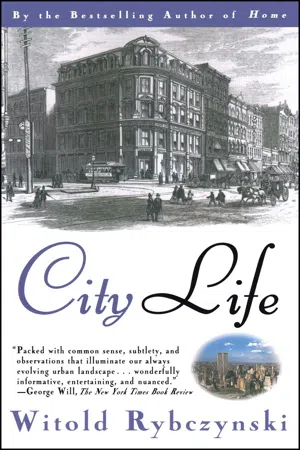
City Life
eBook - ePub

City Life

  1. 256 pages
  2. English
  3. ePUB (mobile friendly)
  4. Available on iOS & Android
eBook - ePub

About this book

In City Life, Witold Rybczynski, bestselling author of Now I Sit Me Down, looks at what we want from cities, how they have evolved, and what accounts for their unique identities. In this vivid description of everything from the early colonial settlements to the advent of the skyscraper to the changes wrought by the automobile, the telephone, the airplane, and telecommuting, Rybczynski reveals how our urban spaces have been shaped by the landscapes and lifestyles of the New World.

Frequently asked questions

Yes, you can cancel anytime from the Subscription tab in your account settings on the Perlego website. Your subscription will stay active until the end of your current billing period. Learn how to cancel your subscription.
No, books cannot be downloaded as external files, such as PDFs, for use outside of Perlego. However, you can download books within the Perlego app for offline reading on mobile or tablet. Learn more here.
Perlego offers two plans: Essential and Complete
  • Essential is ideal for learners and professionals who enjoy exploring a wide range of subjects. Access the Essential Library with 800,000+ trusted titles and best-sellers across business, personal growth, and the humanities. Includes unlimited reading time and Standard Read Aloud voice.
  • Complete: Perfect for advanced learners and researchers needing full, unrestricted access. Unlock 1.4M+ books across hundreds of subjects, including academic and specialized titles. The Complete Plan also includes advanced features like Premium Read Aloud and Research Assistant.
Both plans are available with monthly, semester, or annual billing cycles.
We are an online textbook subscription service, where you can get access to an entire online library for less than the price of a single book per month. With over 1 million books across 1000+ topics, we’ve got you covered! Learn more here.
Look out for the read-aloud symbol on your next book to see if you can listen to it. The read-aloud tool reads text aloud for you, highlighting the text as it is being read. You can pause it, speed it up and slow it down. Learn more here.
Yes! You can use the Perlego app on both iOS or Android devices to read anytime, anywhere — even offline. Perfect for commutes or when you’re on the go.
Please note we cannot support devices running on iOS 13 and Android 7 or earlier. Learn more about using the app.
Yes, you can access City Life by Witold Rybczynski in PDF and/or ePUB format, as well as other popular books in Literature & Architecture Criticism. We have over one million books available in our catalogue for you to explore.

Information

ONE

Why Aren’t Our Cities Like That?

I VISITED PARIS IN THE fall of 1992, After An Absence of more than fifteen years. People had changed, of course. There were more nonwhite faces on the MĂ©tro, and, generally, many of the faces seemed less cheerful, or was that just my imagination? The subway cars themselves were much the same, with the flip-down seats near the doors, and places reserved for the elderly and for crippled war veterans—a grisly reminder of the 1914-18 conflict. There were no survivors of the Great War in evidence, but I didn’t even see many people who looked, well, French. No elderly gentlemen wearing pale leather gloves and rosettes in their lapels, for example. No businessmen with those curious suits with short, ventless jackets and wide shoulders that I associated with actor Lino Ventura and French gangster movies. Workers were wearing nylon windbreakers rather than traditional blue overalls. Parisians, who had previously seemed to me, a North American, slightly old-fashioned, with their distinctive customs and elaborate courtesies, now appeared familiar.
Like young Germans and young Britishers, many young Frenchmen and Frenchwomen were wearing some combination of that now international uniform of jeans, sneakers, and T-shirts. People carried plastic shopping bags instead of the traditional stringed filets, and some wore Walkmans instead of berets. At first glance, I saw nothing that would look out of place in an American mall, or at least a New England mall, since fashionable young Parisians favor Ivy League styles—pressed chinos and penny loafers, for example, or button-down shirts and tweed sports jackets. On second glance, I realized that though the clothing was certainly inspired by American fashions, it was an imagined version of America, not the real thing. Like the imitation cowboy outfits—dude clothes, really—worn by French country-and-western singers. On the whole, there were, I thought, fewer fashionable women; perhaps in Paris it wasn’t chic to be chic that year, I’m not sure. People appeared less formal, but they still spoke rapidly and they still smoked a lot. I was told that the government was instituting a ban on smoking in public places the following month; there seemed to be general agreement that such a ban would be ineffectual. Not that anyone thought smoking was good for you, but it was a personal decision, none of “their” business—this said with a great many oufs and shrugs. When the ban did go into effect, one restaurateur put up a sign saying, “We also welcome our nonsmoking patrons”; another, more direct, simply advertised “Smoking.” At least the French attitude toward authority hadn’t changed.
Everyone looked more prosperous—or perhaps I, with my less valuable Canadian dollars, simply felt poorer than fifteen years earlier. The prosperity was evident in the generally high prices, the many new automobiles, and the expensive shops. For some reason, clothing boutiques in particular bore American names—Mister Cool, New York Jeans—or at least names that the French imagined sounded American. Some things in Paris were new, but many more were old: the names of streets were indicated by the familiar blue and white metal signs, some buildings still displayed those touching historical plaques (so-and-so lived here), and there were still standard stenciled warnings on walls proclaiming Loi de 1881, DĂ©fense d’afficher (“Posters forbidden”). As before, the sidewalks were crowded with cafĂ© terraces, newsstands, and kiosks. I didn’t see any smelly public pissoirs; these have been replaced by unisex cabins that look like enclosed telephone booths. There were still some subterranean public toilets with uniformed attendants and turnstiles; it cost me fifty cents to relieve myself.
The streets themselves were cleaner than I had remembered. Household garbage is picked up seven days a week and there were sweepers everywhere. The French have their own way of doing things—after all, who else would have gone to the trouble of designing plastic brooms to look like straw? In an attempt to keep things tidy, the municipality has installed curbstones with inlaid canine silhouettes to indicate appropriate places in the gutter for pets to defecate. From the evidence underfoot, this anti-poop campaign has not been a total success, but the effort impressed me. Public hygiene, as Eugen Weber, a historian of modern France, has noted, arrived slowly in France. It was the French, after all, who invented bottled mineral water because their tap water was not fit to drink, and who used to ridicule the American obsession with cleanliness. Weber recounts that when the Duc de Broglie, one of the richest men in France, bought what was considered to be a luxury mansion in Paris in 1902, the house had no bathrooms, no indoor toilets, and only one water tap per floor. This can be compared to George Vanderbilt’s Fifth Avenue mansion, which contained a full bathroom as early as 1885; by the turn of the century, even ordinary middle-class Americans could enjoy “A Bed and a Bath for a Dollar and a Half” at the popular Statler Hotel in Buffalo, where every room had a private bathroom with a tub, sink, and water closet. The French, for whom such amenities were a novelty, often referred to them as “American comforts.”
One Parisian comfort that is distinctly un-American was evident to me one evening, as I returned to my hotel from the opera. A month earlier I had walked late at night on the Upper East Side of New York, probably among the wealthiest urban residential neighborhoods in the world. It may have been the cardboardshrouded figures sleeping in the darkened entrances of expensive stores selling ormolu clocks and handmade chocolates, or the almost continuous background whine of police sirens, but I couldn’t shake a slight but persistent sense of wariness. Here in the Fourth Arrondissement, I didn’t feel in the least edgy. Not that there were many people about at midnight—the boulevard Henri IV down which I was walking was quite empty except for passing cars—but the emptiness in the street felt pleasant, not threatening at all. That American cities now have homicide rates higher than those anywhere else in the Western world, sadly, goes without saying. That Paris felt and is safer, however, is not only the result of fewer social problems in what is still a relatively homogeneous culture. The City of Paris with its 2.3 million inhabitants is policed by 35,000 officers, the equivalent of more than 15 gendarmes per 1,000 citizens; New York City, on the other hand, fields only about 4 policemen per 1,000. By American standards, however, this is a high rate of policing (Los Angeles has about 2 officers per 1,000 citizens), which is probably why New York ranks relatively low in urban crime—thirty-eighth among large cities—according to the 1990 FBI Crime Index.
The day I arrived in Paris my publisher, Liana Levi, took me to lunch, and I was pleased to find that good food is still a part of French culture, although the cooking was nouvelle, not bourgeois, more Evian was consumed than wine, and the desserts were distinctly on the light side. Still, the excellent bread was unchanged, the coffee was as strong as ever, and the crowded restaurant was noisy and convivial. It was an atmosphere that I recalled from my earlier visits.
The conversation turned from matters literary—I was there to promote a new book—to architecture, and so inevitably to the Grands Projets. This refers to the monumental government-sponsored additions to Paris—there are nine buildings, thus far—that have been undertaken by President François Mitterrand. Mitterrand’s architectural ambition vastly exceeds that of his three predecessors in the Fifth Republic. Charles de Gaulle, who ruled longest, built least—the undistinguished, doughnut-shaped Maison de la Radio—but he did leave one magnificent architectural legacy. In 1958, he ordered the ravallement, or cleanup, of the facades of Parisian public buildings, which dramatically altered the appearance of the capital, erasing centuries of accumulated dirt and grime. De Gaulle’s successor, Georges Pompidou, was a mediocre president whose tenure was cut short by his death, but he managed to build a lot, most of it bad. He permitted the construction of the first skyscraper in Paris, the looming Tour Montparnasse, inserted expressways along both banks of the Seine, tore down the old market of Les Halles, and cleared a large residential area of the Beaubourg to make way for a multifunctional museum—now called the Centre Pompidou—which, paint peeling and steel rusting, today more than ever resembles an oil refinery (as its unkind critics originally nicknamed it). ValĂ©ry Giscard d’Estaing, pointedly reversing Pompidou’s policy of demolition, initiated the conversion of the vast Gare d’Orsay into a museum of nineteenth-century art, and at La Villette, on the northeast edge of the city, created a museum of science and industry to be housed in a beautifully restored nineteenth-century market building.
Although the record of presidential intervention in the architecture and urbanism of Paris is mixed, one must admire the sentiment embodied in this type of national leadership. The same kind of leadership is in play in Great Britain, where Prince Charles is an outspoken critic of modernist architecture and planning, and in Canada, where Prime Minister Pierre Trudeau played a personal role in the construction of several important public buildings in the national capital. In the United States, recent presidents have shown no interest in the art of building, beyond redecorating the White House.I An exception was Franklin D. Roosevelt, an amateur architect who largely designed his own presidential library in Hyde Park—a building of considerable charm—as well as several other projects. The lack of architectural awareness in the American presidency is striking, since the United States is probably the only country in the world that can boast a national leader who is also a celebrated architect, Thomas Jefferson. The contemporary lack of leadership in architecture appears to be a part of the modern technocratic presidency: the president’s wife may attend to the arts, as Jacqueline Kennedy did; the president himself must be seen to be interested in touch football, cutting brush, speed-boating, or jogging, but not in culture, lest he be accused of elitism.
The French, on the other hand, see no difficulty in comparing their president to Louis XIV, who transformed the architectural face of Paris; certainly, Mitterrand seems intent on emulating the Grand SiÚcle. So far not only has he moved the ministry of finance out of the Louvre and into a new building, renovated the Louvre itself, and endowed Paris with a brand-new opera house on the Place de la Bastille, but he has also built an Arabic institute, a music center, and a new public park at La Villette, and at La Défense in the northwestern suburbs, he has erected an unusual office building in the shape of a huge arch. This modern counterpart to the Arc de Triomphe will be overshadowed by his latest, and likely his last, project: an enormous new national library, a building that will add more than a billion dollars to the three billion that have already been spent on the Grands Projets.
“We will have achieved nothing if in the next ten years we have not created the basis for an urban civilization,” President Mitterrand announced portentously after he was elected. It’s fortunate that Paris was already the seat of a great urban architectural tradition, for Mitterrand’s Grands Projets are not very good buildings. Even I. M. Pei’s new glass pyramid in the courtyard of the Louvre is, finally, a timid gesture, and Jean Nouvel’s Institut du Monde Arabe, while it fits well enough into its surroundings, is fussy and contrived in its details. What the Grands Projets chiefly exhibit is size—they are huge: the largest opera building in the world (almost three times the size of New York’s Metropolitan Opera), the world’s tallest habitable arch at La DĂ©fense, and Europe’s biggest library. Judging from the published drawings, the latter will be a banal composition resembling four half-open books. Its glass-fronted stacks have already been the cause of controversy among bibliophiles: not only are all the books exposed to harmful daylight, but most of the public reading rooms are underground. The huge opera house reminded me of a supertanker that had been grounded in the newly restored seventeenth-century district in the east of Paris; the Pare de la Villette is a collection of goofy pavilions in an arid landscape; and the grandiose government office building at La DĂ©fense recalls less a triumphal arch than a huge marble-covered coffee table. Mitterrand is not Louis XIV, or rather his architects on the whole haven’t lived up to the standards set by the Sun King’s architects—Claude Perrault (designer of the east front of the Louvre), Jules-Hardouin Mansart (builder of the DĂŽme des Invalides), and AndrĂ© Le NĂŽtre (creator of the Tuileries gardens). Mitterrand has imported talent from around the world—the arch of the DĂ©fense was designed by a Dane, the OpĂ©ra by a Canadian—but instead of delicacy, refinement, and delight, there is bureaucratic heavy-handedness, technical gimmickry, intellectual pretension, and brittle modernism.
Nevertheless, despite the onslaught of new cultural monuments, and despite the modernization and the prosperity, the streets of central Paris that I saw had not changed all that much in fifteen years; indeed, the city remained in many ways as I remembered it from my first visit as a college student in 1964. Then, enchanted by this beautiful place (and also in love), I strolled the same tree-lined avenues, the same romantic quais along the Seine, and the same narrow streets in the Latin Quarter; sat on the same park benches and in the same noisy bistros, drinking the same café au lait. Being in Paris almost thirty years later brought it all back.
* * *
“Why aren’t our cities like that?” asked my friend Danielle, who also had just returned from Paris, obviously impressed by what she’d seen. We were sitting around the dinner table in the Boathouse, our country home. The plates had been cleared away and our respective partners were engaged in close conversation nearby. What did she mean? I asked. Well, she answered, Paris had formal squares, stately parks, and tree-lined boulevards with wonderful vistas. I agreed that it was a beautiful city. Then why didn’t we—Danielle is a Montrealer—have anything as elegant as the Place des Vosges, she wanted to know, or as stately as the Palais-Royal, as architecturally complete as the arcades along the Rue de Rivoli, as impressive as the Grands Projets! Where were the elegant avenues, the great civic spaces, and the impressive public monuments?
I sensed accusation in her voice. You architects, she seemed to be saying, have slipped up: You could have built a beautiful city like Paris. Why didn’t you? I tried to explain the difference in history, in politics, and in economics that had formed the two cities. In any case, I argued lamely, this was North America, the New World; if our cities looked different, well, that was to be expected. I sensed myself getting defensive and I could see that I wasn’t making much headway. Danielle regarded me with a tolerant but skeptical look. Thankfully—for me—our conversation was interrupted by a noisy dispute at the other end of the table on the merits and follies of Canada’s ongoing constitutional crisis. Everyone in Quebec has an opinion on this arcane topic. The state of our cities was soon forgotten.
Though Montreal is sometimes described as the most European city on the North American continent, and though about half of Montrealers are descendants of immigrants from France and still speak French, no one could ever confuse Montreal with Paris.II Unlike Paris—and like all North American cities—Montreal is ringed by suburbs comprised mainly of individual houses, and it has a clearly defined commercial downtown of tall office buildings distinct from the residential neighborhoods of lower buildings that surround it. The center of Paris generally is made up of eightstory masonry buildings, which provide a pleasant uniformity of color and scale. The center of Montreal is a typically North American free-for-all: tall buildings of various shapes, steel-and-glass buildings, brick buildings interspersed with empty lots and parking lots. The effect suggests happenstance and improvisation, not planning—a Monopoly board in midgame.
Paris, unlike almost all North American cities, shows evidence of having been planned according to an aesthetic vision. A tradition of building and city planning has guided the Parisian authorities for almost four hundred years. Despite the fact that this tradition is derived from building royal palaces and gardens, it has proved admirably adaptable to planning entire cities: instead of gravel walks, boulevards; instead of box hedges, residential blocks; instead of fountains, civic buildings. Moreover, this formal language of symmetry, vista, and the grand gesture has been adhered to with a consistency that is on the whole admirable. The Place de l’Etoile, for example, dates back to the seventeenth century; at that time the circle, built by Louis XIV, was merely a grandiose clearing in the countryside. In 1806 Napoleon decided to use the circle—now at the edge of the city—as the site for a great symbolic city gate, the Arc de Triomphe. This provided a termination to the vista from the courtyard of the Louvre, a vista that had been first established by Le NĂŽtre’s remodeling of the Tuileries gardens in the 1660s, and reinforced by the majestic Place de la Concorde, which was begun in 1753. By the end of the nineteenth century, Baron Georges Haussmann had surrounded the Place de l’Etoile with buildings and extended the line of the Champs ElysĂ©es another two and a half miles to Neuilly on the Seine. More than three hundred years after Louis XIV, the project has finally been completed by Mitterrand in the shape of the arched office building at La DĂ©fense.
The idea of the urban axis appealed equally to king, emperor, and president, for it was and is a symbol, not of individual hubris, but of Frenchness. What is striking about this example is the consistency with which planning was carried out despite the different political ideologies of the planners. Equally striking is the degree of state intervention in urban development. When a shopping mall was built on the site of Les Halles in the center of Paris, the design had to be approved by President Giscard d’Estaing. When the authorities thought that the Champs ElysĂ©es was becoming too “American,” they declared the boulevard a national landmark and forced it to be remade in a more acceptable, European manner. The same desire for explicit order is visible in the terminology of streets, avenues, and boulevards—indeed, the origin of the last two words is French. Avenues are important diagonal streets, usually linking two public squares; boulevards are broad promenades resembling linear parks that were originally built on the site of the old city walls and are heavily planted with trees.
Montreal, too, has boulevards, but they’re boulevards in name only. RenĂ© LĂ©vesque Boulevard is a windy downtown artery whose chief adornment is a bleak concrete median strip. The city’s best-known boulevard is Boulevard St-Laurent—the Main of Mordecai Richler’s nostalgic and satirical novels of Jewish life in Montreal in the 1940s. The Main is a narrow commercial street whose most famous emporium is neither a haute couture boutique nor a luxury department store but Schwartz’s Hebrew Delicatessen, a smoked-meat eatery of local renown but distinctly un-genteel. Montreal is not without charm, of course. The Main may not be a real boulevard, but it is a real shopping street, lined with Portuguese, Greek, and Italian produce stores that overflow onto the jammed sidewalks and recall nineteenth-century photographs of crowded immigrant neighborhoods in Philadelphia and the Lower East Side of Manhattan. Likewise old-fashioned are many of the residential districts of Montreal: ornate Victorian terraces, mountainside luxury apartment buildings, and turn-of-the-century middle-class suburbs that have grown in with large trees and lush gardens. Montreal working-class neighborhoods have long narrow streets flanked by three- and four-story walk-ups draped with steep exterior stairs and wrought-iron balconies tha...

Table of contents

  1. Cover
  2. Dedication
  3. Epigraph
  4. Preface
  5. 1. Why Aren’t Our Cities Like That?
  6. 2. The Measure of a Town
  7. 3. A New, Uncrowded World
  8. 4. A Frenchman in New York
  9. 5. In the Land of the Dollar
  10. 6. Civic Art
  11. 7. High Hopes
  12. 8. Country Homes for City People
  13. 9. The New Downtown
  14. 10. The Best of Both Worlds
  15. Notes
  16. Index
  17. Copyright