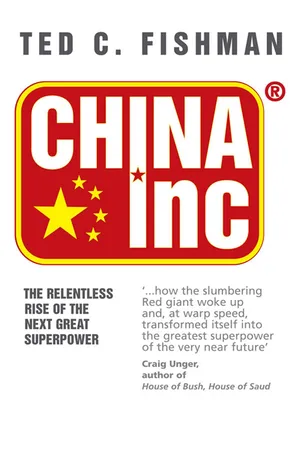
China Inc.
eBook - ePub

China Inc.

The Relentless Rise of the Next Great Superpower

  1. 352 pages
  2. English
  3. ePUB (mobile friendly)
  4. Available on iOS & Android
eBook - ePub

China Inc.

The Relentless Rise of the Next Great Superpower

About this book

What will happen when China can manufacture nearly everything that the United States and Europe can, at one-third the cost? It's a ground-shaking question and, when it comes to the West's future economic health, not everyone will want to hear the answer. The burgeoning output of China's vast low-cost factories and the swelling appetite of its 1.3 billion consumers, both of which are driven by infusions of foreign capital and technological know-how, are rapidly altering global commerce. So are China's newfound freedoms, national ambitions, and growing prestige. In CHINA INC., veteran journalist and former commodities trader, Ted Fishman, shows that economics is just where the story begins. Fishman paints a vivid picture of how the mega trends radiating out of China are shaping the day-to-day lives of people everywhere. Drawing on hundreds of interviews with Chinese, European and American workers, managers, and executives, Fishman also tells how China will force all of us to make big changes in how we think about ourselves as consumers, workers, citizens, and even as parents. The result is a richly engaging work of penetrating reportage and analysis.
Frequently asked questions

Yes, you can cancel anytime from the Subscription tab in your account settings on the Perlego website. Your subscription will stay active until the end of your current billing period. Learn how to cancel your subscription.
No, books cannot be downloaded as external files, such as PDFs, for use outside of Perlego. However, you can download books within the Perlego app for offline reading on mobile or tablet. Learn more here.
Perlego offers two plans: Essential and Complete
  • Essential is ideal for learners and professionals who enjoy exploring a wide range of subjects. Access the Essential Library with 800,000+ trusted titles and best-sellers across business, personal growth, and the humanities. Includes unlimited reading time and Standard Read Aloud voice.
  • Complete: Perfect for advanced learners and researchers needing full, unrestricted access. Unlock 1.4M+ books across hundreds of subjects, including academic and specialized titles. The Complete Plan also includes advanced features like Premium Read Aloud and Research Assistant.
Both plans are available with monthly, semester, or annual billing cycles.
We are an online textbook subscription service, where you can get access to an entire online library for less than the price of a single book per month. With over 1 million books across 1000+ topics, we’ve got you covered! Learn more here.
Look out for the read-aloud symbol on your next book to see if you can listen to it. The read-aloud tool reads text aloud for you, highlighting the text as it is being read. You can pause it, speed it up and slow it down. Learn more here.
Yes! You can use the Perlego app on both iOS or Android devices to read anytime, anywhere — even offline. Perfect for commutes or when you’re on the go.
Please note we cannot support devices running on iOS 13 and Android 7 or earlier. Learn more about using the app.
Yes, you can access China Inc. by Ted C. Fishman in PDF and/or ePUB format, as well as other popular books in Business & Business General. We have over one million books available in our catalogue for you to explore.

Information

Chapter One

Taking a Slow Boat
in a Fast China

THE BANKS OF THE HUANGPU RIVER RUNNING THROUGH SHANGHAI do not just bend. They mind-bend. For a century and a half, the currents of change coursing through modern China have been more visible from Shanghai’s banks than from anywhere else. Here Western powers pushed in most aggressively in the mid-nineteenth century, and later the Japanese made their claim in 1895. The foreigners established an all-but-independent city-state to run their China trade. Western tastes mingled with China’s on such a grand scale that The Bund, then Shanghai’s commercial center on the west bank of the river, looked like the gleaming boulevard of a great European capital.
In the early twentieth century—until China and the world unraveled in the 1930s—Shanghai counted as one of the world’s five most important commercial centers together with London, New York, Paris, and Tokyo. The city was also the world’s second-busiest port. Its banks, housed in the imposing hodgepodge of broad European money palaces and slim towers on The Bund, were flush intermediaries in an irresistible trade with Western and Japanese sellers of machines, cotton cloth, medicines, and opium. Chinese factories poured out clothing, paper, and other simple manufactured goods at prices foreigners could not match at home. Commodities in vast quantities moved in both directions.
While foreigners created Shanghai as a world port, the city soon proved a magnet for Chinese looking to work in factories or, during periods of social unrest, for sanctuary. The large migration into Shanghai, and the foreigners’ fears that their city would be engulfed, helped lead to the system that ultimately divided the city into separate zones, gated sections of town for the colonists, known as concessions, and the rest for Chinese. Paradoxically, the division also created China’s first modern city when the Europeans imposed a formal municipal government over Shanghai. Previously, Chinese cities, though often large, did not have single municipal governments. Interestingly, the English word modern was transliterated into Chinese for the first time in Shanghai, and the city became synonymous with the new.1
This Chinese city reborn with Western management built the country’s tallest buildings, was home to its most prominent banks, had streetcars and running water, beauty parlors, business suits, and French fashions.2 The city’s modernizers were not always Europeans or Americans of the standard colonial mold. Since Shanghai’s modern beginning it was also the home of a small but extraordinary group of Jews, many from Iraq, Spain, Portugal, and India. Controllers of property, entertainment, and financial interests, the Hardoun, Kadoorie, and Sassoon families helped create the new world of Shanghai that was neither Occident nor Orient.
The city, however, was never new enough to wash away old prejudices. Stories are told of the notorious sign outside the British Huangpu Park that forbade entry by “Dogs or Chinese.” Shanghai then, as now, collected the world’s contradictions. Asia’s capitalist hub was also the site in 1921 of the first meeting of the Chinese Communist Party.* The city that gave birth to the verb shanghaied also played host to the lost. In World War II, the city, which stood apart from the world of nations, became a refuge for as many as thirty thousand European Jews fleeing the Nazis.
In 1949, the Communists seized the country, and for the next forty years the creative power of Shanghai turned away from enterprise. Commercial life stopped dead. Shanghai’s grand European architecture and the pre-1940s brick blocks that reflected the city’s worldly blend withered.
Today Shanghai is again China’s most proudly modern and global city. Yet the city’s history of foreign domination is one of China’s enduring national wounds. That collective hurt helps to fuel the insistent drive of the Chinese today, as well as China’s ambivalence about what it is willing to give and take from outsiders. Historical Shanghai was corrupt but glamorous, barbaric but sophisticated, repugnant but remunerative. The Chinese government routinely trots out this darker side of Shanghai’s past. The government uses the colonial history of Shanghai, once painted “The Whore of Asia,” to remind its public that there’s an enemy world ever ready and willing to humiliate their proud civilization.
Thus, if ever a people had chips on their shoulders, it would be the Shanghainese, chips they are urgently stacking into skyscrapers. Despite, or because of, their historical feeling of humiliation, the Shanghainese are perhaps the most assured—other Chinese would call them arrogant—among their countrymen. The Shanghainese consider themselves China’s best businessmen and -women, most capable public administrators, most global in outlook, and most daring risk takers. It is no accident that a disproportionate number of the Communist Party’s highest leadership came from this city, or that China has singled out Shanghai as the city that will first displace Hong Kong as the mainland’s top financial center and then take its place as one of the top business and financial centers of the world.
So the middle of the Huangpu is good place to witness the rhythms of the city past and present. Traffic piles up on the water in the same way that it does on the city’s overcrowded roads, and the afternoon boat tour takes travelers right into the heart of the maritime rush hour, when hundreds of barges, some shaped like oversize sampans, others like floating mountains of sand or coal, line up four or five across the width of the river under the shadows of orange-hulled oceangoing cargo ships or natty gray vessels that look like floating factories but carry gas and chemicals.
The tour boat is billed as a catamaran, but looks and rides like a slow-moving barge—with a three-story restaurant slapped on top. Except for two giant bug-eyed brass dragonheads jutting from the bow, the boat feels like a low-rent Chinese banquet hall. Filled with baroquely carved and generously marred throne chairs, banquet tables with starched but stained tablecloths, and an immobile, bored staff, the vessel is a floating ambassador from the state-run tourism sector, a nationwide empire of shabby hotels and restaurants. The boat service, one of China’s first commercial tourist ventures, still peddles the Communist version of glamour even as it plies the wide gray river for three and a half hours, working its way slowly toward the intersection of the Yangtze River and the East China Sea.
Despite the river traffic, Shanghai was until recently fairly self-contained, bordered close in by a countryside of farms. When the boat tours commenced shortly after China’s economic liberalization began in the early 1980s, one could still gaze across the water and see rice and vegetable fields, yards with chickens, pigs, geese, and shady trees. The Bund had grown dowdy from decades of Communist disdain, and for years few businesses saw any good in it. The grandest buildings had been taken over by regional and municipal agencies with ideological grudges to bear against the old foreign banks and hotels. Even as Shanghai bloomed throughout the 1990s, The Bund remained largely dormant, like an urban set from a 1930s Hollywood movie extravaganza that had never found another script.
Then, as Shanghai earned back its commercial bearings, it attempted to restore some international Ă©lan by leasing space in one of the big Bund buildings to a giant Kentucky Fried Chicken outlet, which at the time was a luxurious taste of the West for locals. Today, KFC is gone from The Bund, but has found new homes all over the city where it has settled into place as a popular indulgence. The Bund, meanwhile, gains the luster delivered in all world capitals by the international purveyors of lifestyle. Now one can find there Italian chocolates, Evian Spa, spruced-up boutique hotels, and world-class restaurants run by superstar chefs from Paris and New York. Three on The Bund, an entertainment complex on the waterfront, occupies an old office tower that underwent a $50 million renovation steered by one of the world’s most prominent architects, Michael Graves. It includes what may be the world’s most spectacular site for an art gallery, high above the river with windows out onto the water traffic and the riverfront’s dancing curtain of colored light.
Making all this change possible is a city with real wealth. Average incomes in town are ten times higher than outside, with a sizable middle class that makes $10,000 or more a year, and often much more. There’s an official name for the money that people make above the income they report: “additional sources.” Plenty of people seem to have them. Jammed on The Bund and elevated highways are private cars that cost thousands more than they do in the United States or Europe. The Shanghai municipality requires drivers to pay a $5,000 permit just to buy one. Top models are back-ordered nonetheless. The boom in private apartments, many costing $100,000 and up, wouldn’t happen in a city without lots of additional sources. A boom is fueling the boom. Shanghai property values climbed so fast that they created a whole new moneyed class in the city. Locals with enough currency and nerve to enter the housing market in the mid and late 1990s saw their property climb in value at least 20 percent year over year. Many properties doubled in price in less than three years. People bought more. Sold some, bought still more. A local scandal erupted on the news that one-third of Shanghai’s new crop of luxury apartments had been bought and sold again before they were ever occupied. The result of the boom is a demographic of young Shanghainese who do not truly grasp where their wealth has come from, feeling that if they just stick their hands in the air, money will fly their way.
One of the triumphs of the Communist Party was its success in spreading the easy use of Mandarin Chinese among nearly all of China’s population. The Shanghainese, of course, speak superb Mandarin these days, but immigrants to the city from other areas of China are now for the first time studying the city’s local tongue, Shanghainese. Phrase books and dictionaries that help Mandarin speakers pick up the dialect are appearing in local bookstores. Shanghainese language schools have begun to pop up. All because the city’s Shanghainese upper stratum of managers talk among themselves in Shanghainese, even in the presence of outside workers, executives, or public officials. The knowing nods and glances make others suspect the Shanghainese are keeping secrets. Foreigners wonder the same. Language-learning materials have begun to appear on eBay for American and European buyers.
The goal of learning the local language is to capture for oneself whatever particles of the city’s energy one can absorb. Colonial Shanghai once prospered by peddling opium to locals hooked on oblivion. Now energy is Shanghai’s drug, craved more powerfully by a population pouring into the city to seize its supercharged moment. Shanghai’s young glow with an optimism that comes of living in a time when the local economy doubled, redoubled, and doubled again.
Behind The Bund and just visible from the boat, the city is pushing against every boundary north, south, and west. The world’s construction cranes started migrating en masse to Shanghai in the late 1980s, stretching the boundaries into the sky too. More than five thousand new buildings over fifteen stories tall were built by 2004.
If the river is the best place to look up at the city, the best place to look down on it is not from one of the city’s tall buildings. From those heights one must peer through a sickeningly brown smog that floats along the upper reaches of the skyline like the film at the top of a coal miner’s bath. The clearest view of Shanghai’s shape is found in the Shanghai Urban Planning Exhibition Hall. One of the fantasy oddball showpieces on Renmin (People’s) Park, Shanghai’s festive answer to Tiananmen Square, the Hall is a gleaming glassy white box of a building about the size of an urban department store. It is topped with four giant canopies shaped like inverted circus tents, making it one of the cheeriest buildings in town.
Inside one may see how thoroughly Shanghai is obliterating its low-rise past and building a high-rise future. On the third floor is a scale model of the entire city with nearly every building extant or planned, rendered as a little colorless tower. The model covers an area the size of a basketball court, and no building is more than four inches tall. What other city in the world would take a parcel of its most valuable real estate bestride its main park and devote it to a building celebrating the civic leaders’ plans for the future? In another city there might be a computer image of future schemes on a Web site somewhere, a model under glass in city hall or the science museum. But not a whole building. In Shanghai, even civic propaganda falls under the spell of gigantism. And it works. Even scaled down to insect size, the burgeoning city feels like a living thing that is spreading over the earth, its horizon receding out of view.
Locals walk the elevated platform that surrounds the model looking for their homes, or the high-rises that have taken the place of their homes. The model would have looked entirely different not long ago. In Shanghai, people grew up in neighborhoods with local schools (often housed in the former mansions of the city’s foreign elite), small shops, and street vendors, and closely quartered two- and three-storied homes, all of which made for intimate, self-contained communities. Kids played ball, moms hung laundry, and granddads played mah-jongg or sat with their caged birds. Today, young people who go off to school in another city or abroad, or graduates who leave the city for work, can return home after a year or two away and find that in place of their little house is a complex the size of New York’s U.N. Plaza. The experience is not just physically dislocating. It gives one the sense that no matter how muscularly it is remade, the city is impermanent, that the only thing that will endure in Shanghai is ambition.
The Exhibition Hall competes for attention along Renmin Park, where the city’s huge but graceful Grand Theater, designed by a Frenchman and opened in 1998, looms like a Pompidou Center reassembled as a Chinese temple. Across the street is the round Shanghai Museum, built of pink Spanish granite and designed to resemble an ancient Chinese bronze vessel, complete with rooftop arches in the shape of handles. The museum was China’s first planned on the modern American model. Appeals for money and artifacts went out to philanthropists, especially overseas Chinese millionaires wanting to give something to the motherland—and perhaps get something back from the motherland too. It is the place in Shanghai where foreign tourists feel most comfortable, connecting the majesty of ancient China with the new. Through the galleries move a throng of foreigners mind-numbed by jet lag and five thousand years of Imperial display.

How Taiwan Invaded Shanghai

Not all of Shanghai’s ambition is homegrown. Far from it. Though the model at the Urban Planning Exposition Hall means to give the impression that the city is in control of its destiny, the view from outside reveals how much the current Shanghai has been remade by foreign energy, money, and world-class talent pouring in. One area of Shanghai once well out of view that now rises in the skyline is the city’s newest foreign enclave, the locus of Shanghai’s resurgence.
In the 1990s, foreigners began rushing in again, and a whole district of the city, the Gubei New Area, was reconfigured for them. For the newcomers, the welcome mat replicated—no, topped!—the relative opulence of Taipei, Hong Kong, and other Asian cities. Huge deluxe apartment complexes the size and subtlety of giant Las Vegas hotels sprang up. Though set back several miles from The Bund, the Gubei complexes—together with those of Shanghai’s other new skyscraper districts—are so enormous that they make the older buildings look like a row of town houses. And, like the international settlements of old Shanghai, which catered to the creature needs of the Europeans and Japanese, Gubei is now a city within Shanghai that replicates the prosperous Asia that lies outside China.
Interestingly, guidebooks offer virtually nothing about Gubei. Lonely Planet Shanghai describes it in nine sentences; Let’s Go: China does not mention it at all. What they overlook today is likely to be exactly what tourists in the future will find so extraordinary. As with old Shanghai, Gubei is something of a foreign concession, the wholesale importation of an alien lifestyle created for and by outlanders.
The first wave of newcomers were actually returnees of a sort, the “overseas Chinese.” Mostly they came from Taiwan, which made them an unusual addition to the local scene. Since their own government in Taipei has no official standing in the People’s Republic, the Taiwanese arrived with little political protection, but they did bring with them money and know-how, two things Shanghai could not resist. Official Shanghai has even created a special bureau that serves as a de facto consulate for the Taiwanese, offering them the sort of resources that citizens of less murky legal status get from their governments. Accurate counts of the Taiwanese in Shanghai are hard to come by; even the city bureau cannot offer one. The official number lies somewhere between 250,000 and 500,000. Shanghai officials do have a count of the number of Taiwanese businesses in town, however; there are more than five thousand of them, representing more than $10 billion in foreign investment coming into the city. Taiwanese businesses have been moving to China so enthusiastically that there are deep fears back home that Taiwan’s economy may hollow out as money and expertise migrate to the mainland.
How much is foreign investment changing the view out the riverboat window? By the end of 2003, a total of 14,400 wholly owned foreign companies were in the city, with another 13,000 businesses underwritten with foreign money.3 In 2004, the city attracted more than $12 billion in foreign direct investment, the overwhelming share of which went for industries that export, mainly to the United States. In other words, Shanghai alone attracted roughly the same level of investment as all of Indonesia, the world’s fourth most populous country, and Mexico, the country that the North American Free Trade Agreement was supposed to turn into a magnet for world capital. Overseas Chinese are the most active investors, providing more than half of the foreign money spent to set up businesses. In the early 1990s, their share was 70 percent.4
Years into Shanghai’s boom, it is still easy to feel the fever that electrified the city’s early investors. Coming in close contact with China changes one’s perspectives on the possible and the permissible. The river tour alone jolts the imagination, stirring up all kinds of schemes and plans to lasso one’s fortunes to others’ schemes that will somehow allow some small bit of the commerce of this great multitude to drift in one’s direction. Matters that in other contexts might seem repulsive here glisten. There is the inescapable, peering crowd; the all-embracing political footprint of the Communist Party; the mushrooming of cities and sprawl; the common and pathological desire to exchange time for money, no matter what the social cost. From afar, these qualities in China look like demons. Fr...

Table of contents

  1. Cover
  2. Title Page
  3. Contents
  4. Copyright
  5. Dedication
  6. Introduction: The World Shrinks as China Grows
  7. Chapter One: Taking a Slow Boat in a Fast China
  8. Chapter Two: The Revolution Against the Communist Revolution
  9. Chapter Three: To Make 16 Billion Socks, First Break the Law
  10. Chapter Four: Meet George Jetson, in Beijing
  11. Chapter Five: Chairman Mao Sells Soup
  12. Chapter Six: Through the Looking Glass
  13. Chapter Seven: The China Price
  14. Chapter Eight: How the Race to the Bottom Is a Race to the Top
  15. Chapter Nine: Pirate Nation
  16. Chapter Ten: The Chinese-American Economy
  17. Chapter Eleven: The Chinese Century
  18. Chapter Twelve: One Last Story
  19. Notes
  20. Selected Bibliography
  21. Acknowledgments
  22. Index