eBook - ePub
Veil
About this book
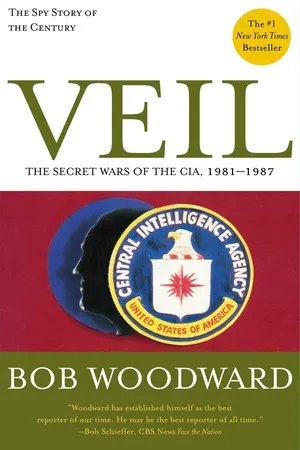
Veilis the story of the covert wars that were waged in Central America, Iran and Libya in a secretive atmosphere and became the centerpieces and eventual time bombs of American foreign policy in the 1980s.
Frequently asked questions
Yes, you can cancel anytime from the Subscription tab in your account settings on the Perlego website. Your subscription will stay active until the end of your current billing period. Learn how to cancel your subscription.
No, books cannot be downloaded as external files, such as PDFs, for use outside of Perlego. However, you can download books within the Perlego app for offline reading on mobile or tablet. Learn more here.
Perlego offers two plans: Essential and Complete
- Essential is ideal for learners and professionals who enjoy exploring a wide range of subjects. Access the Essential Library with 800,000+ trusted titles and best-sellers across business, personal growth, and the humanities. Includes unlimited reading time and Standard Read Aloud voice.
- Complete: Perfect for advanced learners and researchers needing full, unrestricted access. Unlock 1.4M+ books across hundreds of subjects, including academic and specialized titles. The Complete Plan also includes advanced features like Premium Read Aloud and Research Assistant.
We are an online textbook subscription service, where you can get access to an entire online library for less than the price of a single book per month. With over 1 million books across 1000+ topics, weâve got you covered! Learn more here.
Look out for the read-aloud symbol on your next book to see if you can listen to it. The read-aloud tool reads text aloud for you, highlighting the text as it is being read. You can pause it, speed it up and slow it down. Learn more here.
Yes! You can use the Perlego app on both iOS or Android devices to read anytime, anywhere â even offline. Perfect for commutes or when youâre on the go.
Please note we cannot support devices running on iOS 13 and Android 7 or earlier. Learn more about using the app.
Yes, you can access Veil by Bob Woodward in PDF and/or ePUB format, as well as other popular books in Social Sciences & Sociology. We have over one million books available in our catalogue for you to explore.
Information
1
ALTHOUGHM CASEY WASNâT bucking for DCI, he thought Turner probably didnât believe him. In fact Casey wanted Secretary of State or Defense. State and Defense counted. They would, by all reasonable anticipation, be the instruments for a new Reagan foreign and military policy. But Casey understood that he might have to settle for less, or for nothing. He was not one of the President-electâs California intimates, and clearly the Californians were going to dominate. He had come late to the Reagan campaign, and his final role as campaign manager, exalted at least in theory, was partly accidental. He had not been a longtime, committed Reaganaut.
Earlier the previous year, 1979, Casey had received a call out of the blue from candidate Reagan, soliciting help. Casey was a dedicated lifelong Republican who practiced a rich manâs law from his office at 200 Park Avenue in New York. He had made millions from a string of highly speculative investments, from good luck and intuition with the stock market, and from his authorship or editorship of some two dozen tax, investment and legal books. Money gave him the time to play in his favorite game of politics. Having served as campaign worker, organizer, speech writer and Republican convention-goer dating back to 1940, he had had several senior federal posts in the Nixon and Ford administrations, the most prominent being chairman of the Securities and Exchange Commission in 1973-74.
âItâs too early to join your campaign,â Casey told Reagan during that phone solicitation. He explained that his reluctance to sign up now should not be taken as a lack of sympathy. On the contrary.
He grabbed his checkbook and hastily filled in $1,000 to the Reagan candidacy, as he had done for all the other Republican hopefuls. It was the maximum allowable individual contribution. He scrawled his name at the bottom of the check, the W in âWilliamâ a slashing parody of the grammar-school penmanship he had learned at Public Schools 13 and 89 six decades earlier in the lower-middle-class Queens community of Elmhurst in New York. The y at the end of âCaseyâ was a strong textbook y with a nearly straight, long downstroke and a beautiful, exquisitely curled loop, as if he had created a signature that was self-confident but not self-important.
There had been nine âTardyâ marks and a letter-grade C in conduct on his report card in the second half of sixth grade at P.S. 89, his only grammar-school grade lower than a B. His academic work had been graded A. His classmates called him âVolcano.â Since that year, 1924, his life had been a steady march to the other, better side of the tracks. He learned to play golf by caddying, and now he belonged to a good club. In 1934-35, he attended the Catholic University School of Social Work, where most students were priests, nuns and others with strong religious convictions. At the bottom of his scholastic record someone scrawled, âVery good.â But Casey concluded that social work was for women, and left for law school. This very year he had given away the equivalent of a social workerâs annual salary in charitable contributions, $21,970, through a foundation he had set up in 1958. He was a common man of uncommon wealth. He hoped he was a heavyweight, a man of means, a man of affairs who had learned the art of advancement on two tracks: first through personal wealth and business; second through experience in government, boards, commissions and political involvement. All this had been earned, he realized, at the partial expense of his reputation. Many saw him as an unsavory businessman, a corner-cutter who had made quick money through a string of opportunistic investments and countless business aggressions, a magnet for controversy. He was known as a man who astutely played the stock market he had once regulated. At times he appeared indifferent to criticism, accustomed to lawsuits, but underneath Casey craved acceptance and respect. With all his devotions, his church, his Republicanism, his stock portfolio, he could appear flexible about ideas, but not about people. His friends received his total loyalty. But Casey showed a hundred different faces to a hundred different worlds.
Reagan had called Casey again. He wanted more than the $1,000. He was coming east for a fund-raiser on Long Island, Caseyâs home. Could they meet? Casey agreed. The two had breakfast at a motel near Caseyâs home, a large Victorian-era estate named Mayknoll.
The two men schmoozed easily over the Republican election prospects for an hour and a half. Casey had heard that Reagan was shallow, but found him knowledgeable enough about economics and national-security issues. Reagan didnât delve deeply, but his instincts on these matters seemed sound, and they conformed with Caseyâs convictions about a free market, strong defense and active anti-Communism. Reagan was only two years older, and the two men shared a generational view. Both had been poor as children. Casey was attracted to the variety in Reaganâs lifeâas sportscaster, actor, labor union officer, governor, and conservative spokesman with stamina. It mirrored somewhat the variety in Caseyâs ownâlawyer, author, OSS spymaster, amateur historian (he was presently writing a book on the OSS) and former government official. They had both seen the Depression and four wars. They both found genuine satisfaction in a well-told story and a good, hearty laugh. More important, though, both had contempt for Jimmy Carter and what they thought was his weakness, his indecisiveness and his unhealthy, hand-wringing anxiety.
Soon Casey was invited to California to be on the executive committee of the Reagan campaign task force on issues. It was a bone, he knew, but it was involvement. He flew out, looked at the issue books and met Meese and the Reagansâ closest friend, a small, pleasant man named Michael Deaver.
âI want you to come into town and have lunch with Ron and Nancy Reagan,â Casey was soon saying to his rich Republican friends, inviting them to a fund-raiser. If they hesitated, he added, âListen, you donât want to be out of it, do you? This fellowâs going to win. This fellowâs going to be President.â Casey knew how to squeeze out the New York Republican money. Working the phone persistently, he was instrumental in collecting $500,000 for the Reagan campaign in late 1979. When Reaganâs campaign manager, John P. Sears, was fired, in early 1980, the candidate asked Casey to take over.
It was something Casey had worked for all his life. Politics was his first love.
Back at the 1952 Republican convention, Casey, then only thirty-nine, had watched with disappointment as the conservative Senator Robert A. Taft was beaten out by Dwight D. Eisenhower for the Republican presidential nomination. Shortly after, Casey shared his view of this with twenty-six-year-old William F. Buckley, Jr., already launched on his high-wire act as the conservative boy wonder with his book God and Man at Yale. Casey and Buckley were members of the anti-Communist, anti-liberal fraternity in New York City. It was a very small club, maybe fifty members. There was practically a secret handshake, Buckley used to joke. Casey told Buckley, âIf I had managed that campaign, Taft wouldâve won the nomination,â and Buckley remembered the remark for years. So in 1980, when Reagan called his friend Buckley to tell him, âIâve fired John Sears and Iâve hired Bill Casey,â Buckley was delighted. As far as Buckley was concerned, Casey was a true believer with only one minor, forgivable deviation. In 1966, two years after Barry Goldwaterâs disastrous run for the presidency, Casey had launched his first and, thank God, only campaign for public office. He had sought the Republican congressional nomination from his district on the North Shore of Long Island with the backing of the Nelson Rockefeller-Jacob K. Javits wing of the party. Steven B. Derounian, a Goldwaterite, won the Republican nomination, and Casey returned to behind the scenes, where Buckley and many New York Republicans thought he belonged.
As the new Reagan campaign manager, Casey had to assess the power centers around Reagan. The looks, the voices, the glances, the subtle deference told one story: Nancy. Actor James Stewart had once remarked, âIf Ronald Reagan had married Nancy the first time, she couldâve got him an Academy Award.â Casey could see that Nancy Reagan was the premier student in identifying her husbandâs interests.
But Casey was not always comfortable with the hard right-wingers in the campaign. âThereâre some crazies around us and Iâm a member of the Council on Foreign Relations,â he told a campaign associate. He didnât add that he had initially been rejected for membership and was furious that only when he became undersecretary of state in 1973 had he been invited to join. Casey had been tempted to throw the invitation in the toilet and tell them to go to hell, but had calmly accepted. It was a useful if pretentious credential.
Certain campaign members and some reporters described Casey as âspacey.â He abandoned laundry all over Washington and Los Angeles. Sometimes he traveled without a suitcase and just bought clean clothes when he needed them. On one occasion Deaver sat next to him at a meeting and, from his body odor, concluded that Casey had not had time to shop. The next day Casey was scrubbed clean, apparently having been made aware of his oversight. But Deaver realized that when Casey was on a mission he let nothing get in his way. He worked nights, weekends. It was a single-mindedness that had to be admired.
One month before the election, anticipating a Reagan victory, Casey created a little-noticed interim foreign-policy advisory board, selecting a group of seventeen senior experts, including former President Ford and other Republican and Democratic high-profilers. He chaired the group, assigning papers and studies. Some thought he was placing himself center stage as a potential Secretary of State. When he had served briefly as undersecretary of state for economic affairs in 1973-74, he had been forced out by the then Secretary, Henry A. Kissinger. Casey had left little impact and had merited a single perfunctory reference in Kissingerâs 2,690-page two-volume memoir, but he placed Kissinger on Reaganâs advisory board.
The group identified an immediate and important challenge to the incoming Administration. It was the Communist insurgency in a tiny Central American country. Casey decided that El Salvador was, symbolically, the most important place in the world. If the United States could not handle a threat in its backyard, Reaganâs credibility would be at risk in the rest of the world. Casey was dumbfounded to learn that the CIA had closed its station in El Salvador in 1973 to save money and had reopened it only in 1978. That left a five-year gap. How could that be? What was going on at the CIA? Intelligence was supposed to be a first line of defense. It would have no role in defense or offense if there was no effort to get information.
The day after Turnerâs November 20 briefing, Reagan flew back to California. While he was waiting to take office, the soul of the Reagan Administration was up for grabs. No one recognized this more than his conservative friends in California and elsewhere. They had arranged for Reagan to receive an important visitor from abroad. He was Colonel Alexandre de Marenches, the head of the French equivalent of the CIA, the Service of External Documentation and Counterespionage, the SDECE. Marenches was a well-known figure in European conservative circles. A large, mustached patrician with an American wife, he had headed the SDECE for ten years. The SDECE, nicknamed the âSwimming Poolâ because its headquarters buildings are located near the Tourelles swimming pool on the outskirts of Paris, had played heavily in French internal politics. Marenches had in his office a map of the world that showed the spread of Communism in red. Small versions of the map were handed out to official visitors. Several years earlier he had given one of his maps to Admiral Turner during an official liaison meeting between the two intelligence chiefs.
On his California trip, Marenches had more than a colored map to offer. For the French official, spying was a most serious business, one to be undertaken at great risk, with expectations of great return. He held in low esteem the CIA habit of hiding its agents abroad undercover as diplomats in American embassies; the CIA station chief and the senior officersâoften all CIA officersâwere quickly identifiable, making a mockery of their espionage. It was more effective, if more difficult, to operate undercover as an airplane salesman or someone simply out in society. Real spying involved total immersion; it was strenuous exercise. European intelligence services at times used journalists as cover for spying, but the Americans shunned this. Free speech was valued over national security. Spies posing as diplomats were, in Marenchesâ eyes, pretenders.
Marenches talked to the President-elect about shared conservative principlesâthe menace of Communism, the danger of weakness in military and intelligence matters. But he spoke in general themes.
âArenât you going to give me advice?â Reagan asked. âEveryone has advice for me.â
âI can only tell you about people,â Marenches replied. (He spoke perfect English; he believed that languages were a must for an intelligence officer.) He could only tell the President-elect about âpeople you should see and people you shouldnât see.â
âWho should I see?â
Marenches mentioned Alexander Solzhenitsyn, the Soviet author. He understood the nature of the Soviet evil. Also Reagan should see Jonas Savimbi, the resistance leader in Angola who was fighting the Communist regime in that key southwest-African nation. The United States had given covert CIA support to Savimbi, but it had been cut off when Congress in 1976 passed the so-called Clark Amendment banning covert action in Angola.
âWhen you want to learn about hell, you should talk to people who have been there,â the French chief declared.
âWho shouldnât I see?â Reagan said.
âMany,â Marenches said. âBut I will give you one who stands for them allâArmand Hammer.â Hammer was the chairman of Occidental Petroleum and longtime friend of many Soviet leaders. He was the symbol of dĂ©tente.
âFunny,â Reagan said, âI see him often. Every time I go to the barbershop, heâs there.â
âSee what I mean?â Marenches said.
Hammer had recently made a standing request: Every time Reagan scheduled a haircut at Druckerâs in Beverly Hills, Hammer wanted an appointment in the next chair.*
Marenches had an additional thought. âDonât trust the CIA. These are not serious people.â The French intelligence chief did not mean that the CIA had a mole or lax security or that it leaked to newspapers. He was referring to its lack of purposefulness.
Reagan repeated Marenchesâ warningââDonât trust the CIAââto George Bush, who had been CIA chief in 1976-77. Bush thought it was hogwash, but all the same it obviously left a deep impression on Reagan. Bush had already told one of his CIA friends that, given Reaganâs detached management style and his unfamiliarity with intelligence matters, it was important that the President have a CIA director he felt close to, someone he trusted fully, particularly on the issue of purposefulness. Now, after the Marenches warning, that was even more important.
Casey watched with some dismay as the Reagan Cabinet selection went forward. There was a list of three names for each Cabinet post, and he was on for State and Defense, but there was no overall coordinator. Instead, as in the campaign, there were pockets of authority, none of them absolute. There were Meese and the California Kitchen Cabinet, there were the individual ambitions of the hopefuls, and there was Reagan himself, now back at his Palisades home in California. Things got screwed up terribly and quickly. Reagan had decided finally that George P. Schultz, the former Nixon and Ford Cabinet member (Labor Secretary, Office of Management and Budget director, Treasury Secretary) was his first choice for State. Apparently thinking the groundwork had been laid, Reagan had called Shultz. The trouble was, Shultz had been told that he was on the Treasury list.
âIâm interested in having you join my Cabinet,â the President-elect told Shultz with unintentional ambiguity.
Shultz, assuming that it was Treasury, turned it down.
Deaver, who was in the room when Reagan made the call, didnât learn until months later what had happened. Shultz would have accepted State.
Reaganâs second choice, Alexander M. Haig, Jr., emerged as the front-runner for State, and Nancy Reagan favored him. She thought Haig had star qualityâhe was handsome, forceful, had military bearing, was charming and warm. A leading man. It became clear that the gap in Reaganâs foreign-policy background could not be bridged by Caseyâs foreign-policy advisory board and Haig had it all. He was a four-star general who had commanded NATO forces in Europe, he had White House experience as Kissingerâs deputy and as Nixonâs chief of staff.
âI wonât get State,â Casey told a friend. âWe all supported Haig. We need the prestige.â
And Caspar W. Weinberger, an old Reagan California friend, landed Defense.
Casey, miffed, went home to New York to catch up on the rest of his life, but it was not nearly as exciting as what was going on in Washington and California, where the rest of the Cabinet was being selected. He kept in touch with Meese. Casey let it be known that he want...
Table of contents
- Cover
- Praise
- Also by Bob Woodward
- Message
- Title Page
- Copyright
- Dedication
- Contents
- AUTHORâS NOTE
- A NOTE TO READERS
- CAST OF CHARACTERS
- INTELLIGENCE ACRONYMS, TITLES AND DEFINITIONS
- PROLOGUE
- 1
- 2
- 3
- 4
- 5
- 6
- 7
- 8
- 9
- 10
- 11
- 12
- 13
- 14
- 15
- 16
- 17
- 18
- 19
- 20
- 21
- 22
- 23
- 24
- 25
- CENTRAL AMERICAN COVERT-ACTION CHRONOLOGY
- ACKNOWLEDGMENTS
- INDEX
