- 304 pages
- English
- ePUB (mobile friendly)
- Available on iOS & Android
eBook - ePub
About this book
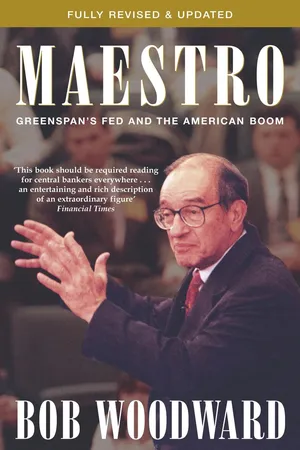
Who is responsible? From the President to the Federal Reserve Chairman, Alan Greenspan to Wall Street to the role of the emerging technologies, Woodward uses his exhaustive investigative technique to reveal the ideas and politics that have changed the lives of millions of people and established the United States as the world's preeminent power. He shows why America has found itself in this exalted position. How it might have been different and when and why it might end.
Frequently asked questions
Yes, you can cancel anytime from the Subscription tab in your account settings on the Perlego website. Your subscription will stay active until the end of your current billing period. Learn how to cancel your subscription.
No, books cannot be downloaded as external files, such as PDFs, for use outside of Perlego. However, you can download books within the Perlego app for offline reading on mobile or tablet. Learn more here.
Perlego offers two plans: Essential and Complete
- Essential is ideal for learners and professionals who enjoy exploring a wide range of subjects. Access the Essential Library with 800,000+ trusted titles and best-sellers across business, personal growth, and the humanities. Includes unlimited reading time and Standard Read Aloud voice.
- Complete: Perfect for advanced learners and researchers needing full, unrestricted access. Unlock 1.4M+ books across hundreds of subjects, including academic and specialized titles. The Complete Plan also includes advanced features like Premium Read Aloud and Research Assistant.
We are an online textbook subscription service, where you can get access to an entire online library for less than the price of a single book per month. With over 1 million books across 1000+ topics, weâve got you covered! Learn more here.
Look out for the read-aloud symbol on your next book to see if you can listen to it. The read-aloud tool reads text aloud for you, highlighting the text as it is being read. You can pause it, speed it up and slow it down. Learn more here.
Yes! You can use the Perlego app on both iOS or Android devices to read anytime, anywhere â even offline. Perfect for commutes or when youâre on the go.
Please note we cannot support devices running on iOS 13 and Android 7 or earlier. Learn more about using the app.
Yes, you can access Maestro by Bob Woodward in PDF and/or ePUB format, as well as other popular books in Business & Business General. We have over one million books available in our catalogue for you to explore.
Information
1
ON THE morning of Tuesday, August 18, 1987, Greenspan walked through the door of his private office and into the adjoining massive conference room at the vast marble Federal Reserve headquarters on Constitution Avenue in downtown Washington, D.C. He had been chairman of the Fed for less than one week. Gathering in the stately meeting room were the members of the Federal Open Market Committee (FOMC), which Greenspan now chaired.
The FOMC is an unusual hybrid consisting of 12 voting membersâall 7 Fed governors plus 5 of the 12 presidents from the Federal Reserve district banks around the country.
At its regularly scheduled meetings every six weeks, the FOMC sets the most important interest rate that the Fed controlsâthe short-term fed funds rate. This is the interest rate that regular banks charge each other for overnight loans, seemingly one of the smallest variables in the economy. Greenspan had come to understand that controlling the fed funds rate was key to the Fedâs power over the American economy.
The law gives the Fed power to trade in the bond market. The FOMC can direct the âeasingâ of credit by having its trading desk in New York buy U.S. Treasury bonds. This pumps money into the banking system and eventually into the larger economy. With more money out there, the fed funds rate drops, making it easier for businesses or consumers to borrow money. Lowering the fed funds rate is the normal strategy for averting or fighting a recession.
On the other hand, the committee can tighten credit by selling Treasury bonds. This withdraws money from the banking system and the economy. With less money out there, the fed funds rate rises, making it more difficult to borrow. Raising the fed funds rate is the normal strategy for fighting inflation.
This buying or selling of U.S. Treasury bonds, so-called open market operations, gives the Fed a brutal tool. Changes in the fed funds rate usually translate into changes in the long-term interest rates on loans paid by consumers, homeowners and businesses. In other words, the FOMCâs monopoly on the fed funds rate gives the Fed control over credit conditions, the real engine of capitalism. Though the changes in the rate were not announced in 1987, private market watchers in New York closely monitored the Fedâs open market operations and soon figured out the changes. The discount rate was the way that the Fed communicated its intentions publicly; the fed funds rate was the way the Fed actually imposed those intentions.
The FOMC, and now Greenspan, had the full weight of the law and nearly 75 years of historyâand mythâbehind them. They could work their will if they chose.
The committee members spent several hours in a roundtable discussion, reviewing economic conditions. Then Greenspan took the floor.
âWe spent all morning, and no one even mentioned the stock market, which I find interesting in itself,â Greenspan said casually, looking down the colossal 27-foot-long oval table.
Greenspanâs remark was deeply understated. He meant to convey something significantly stronger: For Godâs sake, he was trying to tell them, there are factors other than the old classical forces moving the economy. There was more to all of this than consumer or government spending, more than business inventories and profits, more than interest rates, national economic growth, savings, unemployment statistics and inflation. There was a whole other world out thereâa world that included the stock market, which had run up 30 percent since the beginning of the year. Wall Street and the financial markets of New York were creating the underlying thrust for a severely overheated economy, the new chairman was certain. The run-up had created more than $1 trillion in additional wealth during the last year. Most of these gains were only on paper, but some people were undoubtedly cashing in and spending more. In any case, many people felt richerâa powerful psychological force in the economy. On top of that, a stock speculation and corporate takeover frenzy was sweeping Wall Street. And nobody had mentioned it. Was the distance between New York and Washington so great?
None of the committee members seemed interested in Greenspanâs point about the stock market, but the chairman was convinced of it. By many measures, including earnings, profits and dividends, the stock market was really quite overvalued, he felt. Speculative euphoria was gripping the economy, and the standard economic models and statistics werenât capturing what was happening. Greenspan was concerned about the stability of the entire financial system. During his first week on the job, he had quietly set up a number of crisis management committees, including one on the stock market. The situation, that summer of 1987, had the makings of a potential runaway crisis, he thought.
Greenspan had fully acquainted himself with the law, which requires that the Fed try to maintain stable prices. For practical purposes, that means annual inflation ratesâthe annual increase in pricesâof less than 3 percent. For Greenspan, that rate ideally would be even lower, 2 percent or less. The law also directs the Fed to maintain what is called âsustainable economic growth,â a rate of increase in overall production in the United States that can continue year after year while maintaining maximum possible employment. The problem, as Greenspan knew too well, was that annual economic growth above 3 percent traditionally triggered a rapid rise in wages and prices. The Fed was charged with finding a balance between growth and inflation. For Greenspan, any imbalances were warning signs.
The economy in August of 1987 was going too strong. There were no measurable signs of inflation yet, but the seeds were there. Greenspan was sure of it. He saw from economic data reports that the lead times on deliveries of goods from manufacturers to suppliers or stores were increasing, just starting to go straight up. Rising lead times meant that demand was increasing and goods were growing more scarce. He had seen this happen too many times in past decades, so he felt that he knew exactly what he was looking at. The pattern in economic history was almost invariably that you got a bang as prices headed up, resulting in 8 or 9 percent annual inflationâa disaster that would destroy the purchasing power of the dollar. The question now, for Greenspan, was how hard the Federal Reserve could lean against the economy to slow it down, to avoid a drastic series of imbalances. If they tried to put the clamp on with interest rate increases, the system might be so fragile that it would crack under them. The Fed and its new chairman could trigger a recession, defined technically as two quarters, or six months, of negative economic growth.
To Greenspanâs mind, they were faced with a challenge similar to trying to walk along a log floating in a river. You sense an imbalance and move slightly to adjust; in the process you may lose your balance, but if you regain it, you end up in a better, more stable place. If you donât, you fall off and crash.
Greenspan contemplated two potential missteps. The first would be to do nothing, which would sanction the overheating. The second would be to take action and raise interest rates. It was quite a bind: acting and not acting each had grave consequences.
The new chairman also felt a mild amount of tension because he didnât want to screw up the formal operating procedures of the FOMC. Before his official arrival at the Fed, Greenspan had met with senior staff members to learn the ropes, to make sure he got it right. A Fed chairman was a symbol, but he was also the discussion group leader. He had to know his stuff. Greenspanâs only flub so far had been to mispronounce the name of the president of the Philadelphia Federal Reserve Bank, Edward G. Boehne. It is pronounced âBaney,â rhyming with âJaney,â and Greenspan had embarrassingly called him âBoney.â
Despite Greenspanâs apprehension about the economy, he felt confident in his ability to serve as chairman. The key was his private business experience as much as it was his previous government service as chairman of Fordâs Council of Economic Advisers from 1974 to 1976. In 1953, at the age of 27, he had founded an economic consulting business in New York City with William Townsend, a bond trader. With a love of mathematics, data and charts, Greenspan had developed models for forecasting based on detailed measurements of real economic activityâfrom loans and livestock to mobile home sales, inventories and interest rates. Townsend-Greenspan only had about 35 employees, and Greenspan was a hands-on manager, involved in every facet of the firmâs work. In addition to his consulting work, he had served on the boards of Automatic Data Processing, Alcoa, Mobil, Morgan Guaranty and General Foods, among others. He believed that he understood the backbone of the American economy from this experienceâcomputers, metal, oil, banking and food.
With a somewhat severe face, bespectacled, a bit hunched, narrow eyed and pensive, Greenspan radiated gloom. He spoke in a gravelly monotone, often cloaking his thoughts in indirect constructions reflecting the economistâs âon the one hand, on the other hand.â It was almost as if his words were scouting parties, sent out less to convey than to probe and explore.
A cautious man, Greenspan didnât want to overstate his fears about the economy to his colleagues at his very first FOMC meeting. The staff report assembled by the Fedâs 200 expert economists headed by Michael J. Prell, a small, bearded Fed veteran, forecast âmoderate growth.â
âWhile the staff forecast is in a way the most likely forecast,â Greenspan told the FOMC, âIâd be inclined to suppose that the risks are clearly on the upside.â Growth and inflation were much more likely to be higher than the staff had predicted. âAnd my last forecast is that thatâs likely the way Mike will come out the next time around.â
One member suggested, at least half-jokingly, that Greenspan was trying to pressure Prell, whose next report would come in six weeks, just before the FOMCâs next scheduled meeting.
âIn case thereâs any doubt,â Greenspan replied confidently, âI think the real world is going to influence him.
âThe risk of snuffing out this expansion at this stage with mild tightening is extraordinarily small,â he went on, referring to increasing interest rates that make it more difficult to borrow money. âI just find it rather difficult to perceive a set of forces which can bring this expansion down.â
Greenspan could see that the other committee members didnât share the alarm he felt and had somewhat concealed. He realized he didnât know enough yet. And he also didnât think, having been there only a week, that he could walk into the room and expect loyalty and support from everyone. It would not happen. If he had proposed raising the fed funds rate, he could not be sure he would get the votes. It would, he concluded, take quite a while to gain intellectual control of the committee and persuade the members to let him lead them. For Greenspan, it was a sobering moment.
During the next weeks, Greenspan pored over the economic data, attempting to pinpoint the volume in inventories, shipping times, sales and prices that explained the real condition of the economy. He knew where to get the numbers about production and orders for rolled steel, specific kinds of cotton fabric or any other industry he might want to examine. From the data and the charts he could reasonably forecast where the next point on a graph would be plotted, or the general direction and the range of next points. From this, he made his own predictions about how fast the economy was growing. He could see pressures on prices and wages brewing, and he was convinced that momentum in the overall economy was building. It was clear to him that they would have to move interest rates up, sooner rather than later.
Since the FOMC was not scheduled to meet until late September, Greenspan had other options. The seven-member Board of Governors set the other interest rate that the Fed controlled, the so-called discount rate, which is the rate that the Fed charges banks for overnight loans. The economic impact of the discount rate is small compared to that of the fed funds rate controlled by the FOMC, but in 1987 changes in the discount rate were publicly announced and changes in the fed funds rate were not. The discount rate was the Fedâs only public announcement vehicle, and changes to it could send a loud public message. It was the equivalent of hitting the gongâexactly what Greenspan was looking forâand declaring publicly that the Fed was worried about possible inflation.
All the Fed governors were full-time and had their offices in the main building, set off wide, attractive marble corridors that seemed a strange cross between a European villa and a funeral parlor. Greenspan made an effort to get to know each governor, seeking some out in their offices or inviting them to his office for unhurried but pointed discussion of the economy. He called this âbilateral schmoozing.â Over about a week, he sounded out and convinced the governors to support a discount rate increase. A graceful listener, he nonetheless made it clear what he wanted. In private he could convey more of the urgency he felt.
On September 4, two weeks after Greenspanâs first FOMC meeting, t...
Table of contents
- Cover
- Title Page
- Copyright
- AUTHORâS NOTE
- Dedication
- Contents
- PREFACE
- PROLOGUE
- Chapter 1
- Chapter 2
- Chapter 3
- Chapter 4
- Chapter 5
- Chapter 6
- Chapter 7
- Chapter 8
- Chapter 9
- Chapter 10
- Chapter 11
- Chapter 12
- Chapter 13
- Chapter 14
- Chapter 15
- EPILOGUE
- GLOSSARY
- NOTES
- ACKNOWLEDGMENTS
- INDEX
- About the author