The War Within
eBook - ePub

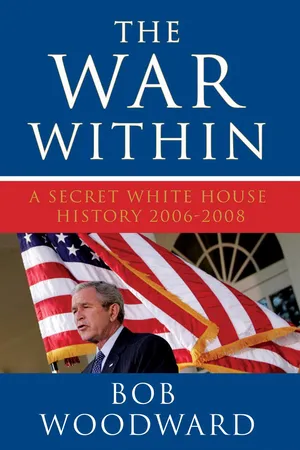
The War Within

A Secret White House History 2006-2008

  1. 512 pages
  2. English
  3. ePUB (mobile friendly)
  4. Available on iOS & Android
eBook - ePub

The War Within

A Secret White House History 2006-2008

About this book

In his fourth book on President George W. Bush and his controversial 'War on Terror,' Bob Woodward takes us behind closed doors, into the hidden rooms of the White House, the Pentagon, the State Department, and US intelligence agencies, where the details of the wars in Iraq and Afghanistan were fiercely debated and eventually determined. Today, the Iraq War is a major source of contention around the world, and may become the defining political, social and moral issue of this brief period in American history. In an attempt to understand the Bush presidency, and its divisive legacy, Woodward examines this conflict at its source: in Washington D.C.

This fast-paced, groundbreaking book includes never-before-published information, as Woodward draws upon his vast experience a veteran political journalist to provide a richly detailed and meticulously researched examination of the war in Iraq over the past two years. In The War Within, Woodward expands upon his study of the Bush administration in his previous three books, with his signature authoritative, measured, and deeply human sense of perspective.
Frequently asked questions

Yes, you can cancel anytime from the Subscription tab in your account settings on the Perlego website. Your subscription will stay active until the end of your current billing period. Learn how to cancel your subscription.
No, books cannot be downloaded as external files, such as PDFs, for use outside of Perlego. However, you can download books within the Perlego app for offline reading on mobile or tablet. Learn more here.
Perlego offers two plans: Essential and Complete
  • Essential is ideal for learners and professionals who enjoy exploring a wide range of subjects. Access the Essential Library with 800,000+ trusted titles and best-sellers across business, personal growth, and the humanities. Includes unlimited reading time and Standard Read Aloud voice.
  • Complete: Perfect for advanced learners and researchers needing full, unrestricted access. Unlock 1.4M+ books across hundreds of subjects, including academic and specialized titles. The Complete Plan also includes advanced features like Premium Read Aloud and Research Assistant.
Both plans are available with monthly, semester, or annual billing cycles.
We are an online textbook subscription service, where you can get access to an entire online library for less than the price of a single book per month. With over 1 million books across 1000+ topics, we’ve got you covered! Learn more here.
Look out for the read-aloud symbol on your next book to see if you can listen to it. The read-aloud tool reads text aloud for you, highlighting the text as it is being read. You can pause it, speed it up and slow it down. Learn more here.
Yes! You can use the Perlego app on both iOS or Android devices to read anytime, anywhere — even offline. Perfect for commutes or when you’re on the go.
Please note we cannot support devices running on iOS 13 and Android 7 or earlier. Learn more about using the app.
Yes, you can access The War Within by Bob Woodward in PDF and/or ePUB format, as well as other popular books in Social Sciences & Sociology. We have over one million books available in our catalogue for you to explore.

Information

BOOK ONE

image

PROLOGUE

On June 13, 2006, halfway through the sixth year of his presidency and more than three years into the Iraq War, George W. Bush stood on a veranda of the American embassy compound in Baghdad. He had flown through the night for a surprise visit to the new Iraqi prime minister. With so much at stake in Iraq, where success or failure had become the core of his legacy, Bush had been anxious to meet the man he had, in many ways, been waiting for since the invasion.
It was now evening. A hazy sunset had descended over the sweltering, violent capital. The president stepped aside for a private conversation with Army General George W. Casey Jr., the 57-year-old commander of the 150,000 U.S. forces in the country. A 5-foot-8, four-star general with wire-rim glasses, closely cropped graying hair and a soft voice, Casey had been the commander in Iraq for two years. As American military units rotated in and out, rarely serving more than a year, Casey had remained the one constant, seeing it all, trying to understand—and end—this maddening war in this maddening land.
Recently, there had been some positive news in Iraq. A week earlier, U.S. forces had killed Abu Musab al-Zarqawi, the man Osama bin Laden had declared the “Prince of al Qaeda in Iraq” and the terrorist organization’s in-country operational commander. And the previous month, after three elections and months of delay, Nouri al-Maliki finally had taken office as the country’s first permanent prime minister.
Now, in the warm Baghdad dusk, the president and the general lit thin cigars.
“We have to win,” Bush insisted, repeating his public and private mantra. Casey had heard the president’s line dozens of times.
“I’m with you,” he replied. “I understand that. But to win, we have to draw down. We have to bring our force levels down to ones that are sustainable both for them and for us.”
Casey felt that the Iraqis, a proud people and resistant to the Western occupation, needed to take over. The large, visible U.S. force was ultimately a sign of disrespect. Worse, the prolonged occupation was making the Iraqis dependent. Each time additional U.S. troops arrived, they soon seemed indispensable. The Iraqis needed to take back their country and their self-respect, so central to Arab culture. They needed to fight their own war and run their own government; they were doing neither.
Casey studied Bush’s face, now wrinkled and showing its 59 years, the right eye slightly more closed than the left under graying, full eyebrows. The general had pushed for a drawdown for two years. And while the president had always approved the strategy, he no longer seemed to buy Casey’s argument.
“I know I’ve got work to do to convince you of that,” the general said, “but I firmly believe that.”
Bush looked skeptical.
“I need to do a better job explaining to you” why winning means getting out, Casey said.
“You do,” Bush replied.
Casey had long concluded that one big problem with the war was the president himself. He later told a colleague in private that he had the impression that Bush reflected the “radical wing of the Republican Party that kept saying, ‘Kill the bastards! Kill the bastards! And you’ll succeed.’” Since the beginning, the president had viewed the war in conventional terms, repeatedly asking how many of the various enemies had been captured or killed.
The real battle, Casey believed, was to prepare the Iraqis to protect and govern themselves. He often paraphrased British Lieutenant Colonel T. E. Lawrence, the early-20th-century innovative godfather of irregular warfare, known as Lawrence of Arabia: “Better they do it imperfectly with their own hands than you do it perfectly with your own.” In Seven Pillars of Wisdom, Lawrence had written, “For it is their war and their country, and your time here is limited.”
The year before, Casey had had a list of 11 rules printed on laminated cards and posters to distribute to his troops. The most important was: “Help the Iraqis win—don’t win it for them.”
This isn’t a conventional war, Casey told every U.S. brigade that came to Iraq. He emphasized that the job was to gradually shift counterinsurgency tasks to the Iraqi security forces while continuing to conduct counterinsurgency operations themselves. On a scale of 1 to 10, he told the troops, “This is degree of difficulty 12.”
“These guys are primarily Arabs. They’re never going to like us,” he said, “We’re going to do it, or they’re going to do it. And I don’t believe we will ever succeed in Iraq by us doing it for them.”
In weekly secure videoconferences with the president, Casey had tried to drum home the point that they needed to reduce forces. Casey’s boss up the chain of command, General John Abizaid, the head of U.S. Central Command, who sat in on the conferences, shared Casey’s view. Though video didn’t have the intimacy of face-to-face meetings, Abizaid watched Bush carefully—the nods, the expressions, the president’s impatient dance in his chair as he listened. After the videoconferences, Casey and Abizaid, both students of Bush’s body language, often compared notes.
“What do you think?” Casey asked more than once. “Did we get through today?”
“Oh, no, I don’t think so,” Abizaid would reply. “I think the body language was bad on that one.”
Casey and Abizaid had been one-star generals together in Bosnia in 1996 and had seen that the various ethnic groups in the Balkans didn’t reconcile until the violence got totally out of hand.
Abizaid had concluded that the United States’ armed presence in Iraq on such a large scale for so many years was doing more harm than good. In private, he put it bluntly: “We need to get the fuck out.”
Casey was troubled by the thought that the president simply didn’t get it, didn’t understand the war and the nature of the fight they were in. The large, heavily armed Western force was on borrowed time, he believed. And worse, the president never really understood how the economy and the politics of Iraq must be rebuilt if military gains were to be sustained.
The president often paid lip service to the importance of these political and economic elements, and winning over the people. But then he would lean in with greater interest and ask about raids and military operations, grilling Casey about killings and captures. Months earlier, during one of the videoconferences, he had told Casey that it looked as if he weren’t doing enough militarily. “George, we’re not playing for a tie. I want to make sure we all understand this, don’t we?” Later in the videoconference Bush emphasized it again: “I want everybody to know we’re not playing for a tie. Is that right?”
In Baghdad, Casey’s knuckles whitened on the table. The very suggestion was an affront to his dignity that he would long remember, a statement just short of an outright provocation.
“Mr. President,” Casey had said bluntly, “we are not playing for a tie.”
After the screen went blank in Baghdad, David Satterfield, the deputy chief of mission in the embassy, who had been sitting in on the session, turned to Casey.
“George,” Satterfield said, “I don’t know how you manage to contain yourself.”
“I’m disciplined,” Casey replied.
Not so disciplined that General Abizaid, who was also on the videoconference, hadn’t noticed. He called Casey. “You shouldn’t yell at the president,” he advised.
But Casey was boiling. The president repeatedly questioned his commander about whacking the bad guys, as if everything would be okay if they just whacked enough. He summed up Bush’s approach for a colleague: “If you’re not out there hooking and jabbing with American forces every day, you’re not fighting the right fight.”
The president’s persistent questions suggested to Casey that the commander in chief believed in an attrition strategy of simply eliminating the bad guys. The Vietnam War had established that that wouldn’t work. No matter how many insurgents they killed or arrested, more would follow. The United States had killed tens of thousands of Iraqis. The classified operational summaries showed that 1,000 AIF, meaning “anti-Iraqi forces,” defined as al Qaeda, insurgents or other violent extremists, were being killed each month. It was pure body count, one more echo of Vietnam.
In 2005, after Hurricane Katrina had devastated New Orleans and the Gulf region, Bush praised Federal Emergency Management Agency Director Michael D. Brown. “Brownie, you’re doing a heck of a job,” he said, in one of the more memorable lines of his presidency. Within a week, Brownie had been relieved for bungling the disaster response.
At the end of one secure videoconference with Casey soon after the Katrina debacle, Bush told the crew in Iraq, “Guys, you’re doing a heck of a job.” He paused and added, “But then, I said the same thing to Brownie.”
In Baghdad, when the video screen went blank seconds later, nervous laughter filled the room. Bush had seemed serious. It was a clear reminder for Casey that his neck was on the line.
Adding to the frustration was the fact that the president had approved Casey’s strategy, which explicitly stated that the goal was to transition the security mission to the Iraqis.
The day before Bush’s conversation with Casey on the veranda in Baghdad, the president and his war cabinet had met at Camp David and unanimously approved Casey’s Joint Campaign Plan. The plan, classified SECRET, stated, “This strategy is shaped by a central tenet: Enduring, strategic success in Iraq will be achieved by Iraqis.” The concept was broken down into three phases—“stabilization” to early 2007, “restoration of civil authority” to mid-2008, and “support to self-reliance” through 2009.
But Casey never felt he had broken through to Bush. “I never cracked it,” he said later.
The private battle between president and general had been simmering for too long. Casey could feel their mounting mutual resistance, and he saw no way to lessen the intensity of their differences. Bush always insisted that he had confidence in Casey, but over time, each man had silently lost confidence in the other.
And now their bond seemed unrecoverable. Both men hoped the same wasn’t true of the war.
Also on the veranda that evening in Baghdad was Stephen J. Hadley, the president’s national security adviser. Hadley, 59, was the most deferential, perhaps the hardest working, and certainly the least visible to the public of the president’s senior advisers. He watched from a distance as the president and Casey shared a smoke and a private chat.
Since World War I, presidents have had a central coordinator in the White House to act as their eyes and ears—and enforcer if need be—on foreign policy and war. Presidents Dwight D. Eisenhower and John F. Kennedy formalized roles for an assistant to the president for national security. President Richard Nixon raised it to new heights with Henry Kissinger. Some national security advisers, like the strong-willed and opinionated Kissinger, have dominated foreign affairs, while others have acted merely as referees.
Hadley believed he had developed as close a relationship with his president as any national security adviser in history. He was ever present, so much so that the joke around the White House was that the only time President Bush was alone was when he went to the washroom, and even then Hadley would be waiting outside with a fresh towel. Hadley said of their relationship, “If I feel it, he feels it. If he feels it, I feel it.”
I later read Hadley’s statement to the president during an interview in the Oval Office.
“Yes,” Bush agreed.
“I’m watching him all the time,” added Hadley, seated nearby.
“I’m watching him watch me all the time,” Bush said.
The president lavished praise on his national security adviser. He said Hadley didn’t need permission to walk into the Oval Office. He could stop by or call anytime.
Traditionally, the National Security Council provides a setting to present all his advisers’ points of view to the president. But Hadley didn’t believe the NSC should be an arena for contentious and divisive debate. He believed his task was to ascertain Bush’s wishes, and then bring the secretary of state, secretary of defense, the chief of intelligence and others into line. He believed that consensus was not only possible in the quarrelsome world of national security policy, but necessary. “It is truth: A group of smart people looking at the same facts,” he said once, “generally come to the same conclusions over time.” In scientific discovery, brilliant people might suddenly see what nobody else sees, he said. But “you can’t patent ideas in this policy world.”
Bush’s vision for Iraq relied heavily on the country developing a viable poli...

Table of contents

  1. Cover
  2. Title Page
  3. Copyright
  4. Dedication
  5. Contents
  6. Author’s Note
  7. Cast of Characters
  8. Book I
  9. Book II
  10. Epilogue
  11. Glossary
  12. Notes
  13. Acknowledgments