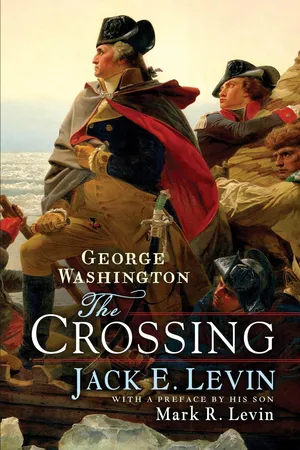
The #1 New York Times bestselling book for many weeks, Jack Levin presents a beautifully designed account of George Washington’s historic crossing of the Delaware River and the decisive Battle of Trenton, with a foreword by his son, #1 New York Times bestselling author and radio host Mark R. Levin.
With the warm-hearted patriotism and passion he brought to his beautiful volume Abraham Lincoln’s Gettysburg Address Illustrated, Jack E. Levin illuminates a profound turning point of the American Revolution: the decisive Battle of Trenton and its prelude—General George Washington leading his broken and ailing troops in a fleet of small wooden boats across the ice-encased Delaware River.
While one iconic nineteenth-century painting made the crossing a familiar image, the significance of the against-all-odds victory put into motion on Christmas night, 1776, cannot be told enough. Jack Levin brings to light several vital perspectives, and draws his text from General Washington’s letter to the Continental Congress to describe the amazing account of the unlikely defeat of the Hessian army at Trenton.
As a father, Jack Levin inspired his sons—including Mark Levin, and Douglas, and Robert—with his love for America. Around the family table, he would share the facts and events of the nation’s founding, spark lively debates, and pass along his extensive knowledge and his deep and abiding patriotism. Featuring Revolution-era artwork, portraiture, and maps, George Washington: The Crossing imparts the same vivid, intimate telling, that of a father to his sons—the kind of history lesson that lives in the heart forever.
- 64 pages
- English
- ePUB (mobile friendly)
- Available on iOS & Android
eBook - ePub
George Washington: The Crossing
About this book
Information
Subtopic
Early American HistoryIndex
HistoryTable of contents
- Cover
- Dedication
- Preface
- Epigraph
- Foreword
- The Crossing
- Author’s Note
- Photo Credits
- About Jack E. Levin and Mark R. Levin
- Copyright
Trusted by 375,005 students
Access to over 1.5 million titles for a fair monthly price.
Study more efficiently using our study tools.
Frequently asked questions
Yes, you can cancel anytime from the Subscription tab in your account settings on the Perlego website. Your subscription will stay active until the end of your current billing period. Learn how to cancel your subscription
No, books cannot be downloaded as external files, such as PDFs, for use outside of Perlego. However, you can download books within the Perlego app for offline reading on mobile or tablet. Learn how to download books offline
Perlego offers two plans: Essential and Complete
- Essential is ideal for learners and professionals who enjoy exploring a wide range of subjects. Access the Essential Library with 800,000+ trusted titles and best-sellers across business, personal growth, and the humanities. Includes unlimited reading time and Standard Read Aloud voice.
- Complete: Perfect for advanced learners and researchers needing full, unrestricted access. Unlock 1.5M+ books across hundreds of subjects, including academic and specialized titles. The Complete Plan also includes advanced features like Premium Read Aloud and Research Assistant.
We are an online textbook subscription service, where you can get access to an entire online library for less than the price of a single book per month. With over 1.5 million books across 990+ topics, we’ve got you covered! Learn about our mission
Look out for the read-aloud symbol on your next book to see if you can listen to it. The read-aloud tool reads text aloud for you, highlighting the text as it is being read. You can pause it, speed it up and slow it down. Learn more about Read Aloud
Yes! You can use the Perlego app on both iOS and Android devices to read anytime, anywhere — even offline. Perfect for commutes or when you’re on the go.
Please note we cannot support devices running on iOS 13 and Android 7 or earlier. Learn more about using the app
Please note we cannot support devices running on iOS 13 and Android 7 or earlier. Learn more about using the app
Yes, you can access George Washington: The Crossing by Jack E. Levin,Mark R. Levin in PDF and/or ePUB format, as well as other popular books in History & Early American History. We have over 1.5 million books available in our catalogue for you to explore.