
- 416 pages
- English
- ePUB (mobile friendly)
- Available on iOS & Android
eBook - ePub
The World within War
About this book
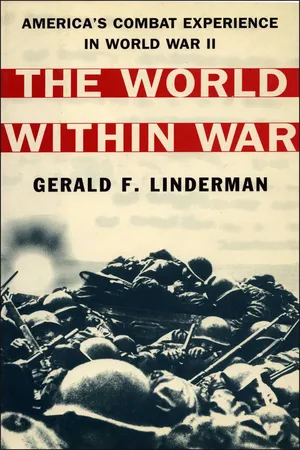
Gerald Linderman has created a seamless and highly original social history, authoritatively recapturing the full experience of combat in World War II. Drawing on letters and diaries, memoirs and surveys, Linderman explores how ordinary frontline American soldiers prepared for battle, related to one another, conceived of the enemy, thought of home, and reacted to battle itself. He argues that the grim logic of protracted combat threatened soldiers not only with the loss of limbs and lives but with growing isolation from country and commanders and, ultimately, with psychological disintegration.
Frequently asked questions
Yes, you can cancel anytime from the Subscription tab in your account settings on the Perlego website. Your subscription will stay active until the end of your current billing period. Learn how to cancel your subscription.
No, books cannot be downloaded as external files, such as PDFs, for use outside of Perlego. However, you can download books within the Perlego app for offline reading on mobile or tablet. Learn more here.
Perlego offers two plans: Essential and Complete
- Essential is ideal for learners and professionals who enjoy exploring a wide range of subjects. Access the Essential Library with 800,000+ trusted titles and best-sellers across business, personal growth, and the humanities. Includes unlimited reading time and Standard Read Aloud voice.
- Complete: Perfect for advanced learners and researchers needing full, unrestricted access. Unlock 1.4M+ books across hundreds of subjects, including academic and specialized titles. The Complete Plan also includes advanced features like Premium Read Aloud and Research Assistant.
We are an online textbook subscription service, where you can get access to an entire online library for less than the price of a single book per month. With over 1 million books across 1000+ topics, weâve got you covered! Learn more here.
Look out for the read-aloud symbol on your next book to see if you can listen to it. The read-aloud tool reads text aloud for you, highlighting the text as it is being read. You can pause it, speed it up and slow it down. Learn more here.
Yes! You can use the Perlego app on both iOS or Android devices to read anytime, anywhere â even offline. Perfect for commutes or when youâre on the go.
Please note we cannot support devices running on iOS 13 and Android 7 or earlier. Learn more about using the app.
Yes, you can access The World within War by Gerald Linderman in PDF and/or ePUB format, as well as other popular books in History & Military & Maritime History. We have over one million books available in our catalogue for you to explore.
Information
1 BATTLE
Expectation, Encounter, Reaction
One expects to find in war a killing power. What American soldiers in World War II failed to foresee was that battle also possessed a power to impose thorough and dramatic change on those whom it did not kill. To continue in combat exposed the body and the mind to the hammerings of a behemoth; its blows seemed to pound away individual variation, to compel submission, and to portend a collective, ever-pliant combat personality.
In the event, even amid coerced change, American soldiers demonstrated an adaptability that, weighed against the force bearing hard on them, was often astonishing. They reacted in a medley of ways; sometimes they invested in logic, sometimes in magic, often in both. Even when those longest in combat felt that they were losing all efficacy, they continued to make choices.
The passages below try to describe the collision of American soldiers with the forces of the battlefield and to trace the repercussions of the combat experience, particularly in infantrymenâs feelings of abandonment and expendability. The chapter that follows explores how soldiers attempted to withstand battle, and measures the outcome of their efforts.
In light of the American publicâs initial view of the war as a distasteful necessity, soldiers anticipated combat with what today seems an unlikely receptivity. Following basic training, they believed themselves ready for battle, were impatient to engage the enemy, minimized their adversariesâ capacities to oppose them, and seldom worried about the results either for themselves or for their country. An exuberant aggressiveness infused their words and actions.
Most felt a powerful impulse to close on the enemy without delay. Private Mario Sabatelli spoke for those Marine Raiders with whom he moved toward the invasion of Tulagi: âWe wanted to get our hands on Japs.â A seaman whose combat station was a machine-gun mount on a light cruiser declared en route to Guadalcanal that âI came out here to see action and I hope this is the biggest battle of all time. . . . I . . . donât care how many Japs I run into.â Army private Morton Eustis worried that there would not be combat enough to satisfy him: âIâm so scared Germany may sue for peace before we have a chance to take a crack at her. . . .â Such sentiments drew their keenness from dissatisfaction with the pre-combat present, from soldiersâ confidence that they would realize the gratifications of combat and from the conviction that battle, entered upon as quickly and as unrestrainedly as possible, represented the fastest âroad back to America.â1
Impatience to fight trailed closely the conviction of many that their training ensured success in battle. Said Sabatelli on the eve of Tulagi: âWe felt good. . . . I felt cool and confident. My feeling was that it was going to be tough, but after the training weâd had I felt this was my business and I was ready for it.â When the troops with whom Ernie Pyle was travelingâas a correspondent for the Scripps-Howard newspaper chainâlanded on Sicily and encountered no enemy resistance, there was disappointment, for they thought themselves âtrained to such a point that instead of being pleased with no opposition they were thoroughly annoyed.â2
Others, whatever they considered their trainingâs effectiveness, simply could no longer tolerate its irksomeness. Eustis wrote from England in April 1944: âI donât credit the Army with being sufficiently far-sighted to make their training so boring that men are really anxious to go into combat just to get away from it, but that is actually what happens.â And the simple termination of training did not suffice; the interval between training and battleâmere waiting, in the menâs viewâwas worse, one of the warâs most unendurable stages. Eustis spoke to this point, too: âI donât believe thereâs a man in our company who wouldnât rather be under enemy fire than in garrison over here [in England]. And I know that theyâre itching to get going and get this over with, rather than to sit around for months and even years.â3
To those who thought themselves ready to fight, activity designated to fill the interim was intolerable make-work. When a Marine private refused orders to continue laboring in the hold of a ship anchored off Guadalcanal, the captain to whom his dereliction was reported was curious. âYou volunteered, you know. You didnât have to come out here. Why did you enlist?â âTo fight, Sir. . . . Iâve been working all the way across [the Pacific], swabbing decks, cleaning heads. Iâve spent twelve hours down there in the hold today, while some of them goldbricks that ainât done a tap got to go ashore with the first detail. Iâve done more than my share and I ainât taking any more pushing around.â He had come to the southwest Pacific âto get me some Japsânot work as a stevedore.â Others like him looked forward to battle as relief from camp or shipboard life, as action that would deliver them from insufferable inaction.4
Some found ways other than insubordination to quell their impatience. Basic training taught no lesson more convincingly than âDonât volunteer!â and James Johns âknew betterâ than to do so, but when Admiral William Halsey himself asked for fifty men to offer to service Marine aircraft in the eye of combat on Guadalcanal, he stepped forward. Geddes Mumford, a messenger at battalion headquarters, hastened his way into the fight. â[E]very time he was given a message to deliver, he wandered off with his rifle to hunt for Germans or to attach himself to a rifle company in the lines.â5
Those compelled to wait envied those who were about to see or had already seen battle. Eustis, eager for combat but counting days in a North African replacement depot, was jealous of two tent-matesââthe lucky devilsââwho were sent to the front. A Marine private, a replacement on Guadalcanal, complained that âOther guys . . . have [already] had personal, hand-to-hand fights with the Japs, but not me. Somehow, I donât get those breaks.â In a Honolulu bar, James Jones, while a soldier training in Hawaii, met crewmen of the carrier Yorktown, which had just fought in the Battle of the Coral Sea and was doomed soon to go down at Midway. All three sailors were âcuriously sun-blackened and with deep hollow eyesâ and âdrunk as hoot owlsâ at nine oâclock in the morning. At his first glance, Jones realized that they were âdifferent from me.â He stayed with them for hours, listening to their battle stories. They âhad already passed on into a realm I had never seen.â Jones, an enlistee in the peacetime Regular Army, was not as impatient as most to enter battleâs domain, but as for those fighting sailors, âThe whole encounter had been immensely romantic for meâ and âMore than anything in the world I wanted to be like them.â6
Such comments reflected minds unintimidated by the prowess of the enemy or the prospect of death. To very few did their opponents appear formidable; indeed, Americans approached their enemies with a nonchalance edging on disdain. So little concerned with the oppositionâs lethal power was Joseph Miller, an engineer officer in North Africa, that he found the opening round of German machine-gun and artillery fire âjust sort of excitingâ and carried on with his sergeant âa raceâ to determine who would become the first wounded and thus âget the first Purple Heart.â Morton Eustis deemed the Italians worth hardly a thought. It was âhumiliatingâ that Italian soldiersââif you can dignify them by the nameââcried âlike sniveling babiesâ and were so eager to surrender. As for the Germans, Eustis hoped that he and his friends âcan each knock out at least a hundred Jerries apiece . . . just as a starter.â He would dedicate the first German cut down to his mother and the second to his brother. âIf I donât kill at least ten personally, I shall be most unhappy!â7
In the Pacific, Army sergeant Myles Standish Babcock, embarking for Guadalcanal, said much the same about his enemy. âIntensely desirous of going into combat . . . Iâd like to kill ten Japs, then become a casualty of sufficient importance to justify convalescence in New Zealand or even the United States of America!â Aboard another vessel bound for Guadalcanal, U.S. correspondent Richard Tregaskis listened as Marines loaded cartridges into machine-gun belts. âOne of them kept time with the clink of the belter. âOne, two, three, another Jap for me,â he said. Others tried other ideas. . . . Another boy said, âHonorable bullet take honorable Jap honorable death. So solly.â âIâve got a Japâs name written on each bullet. Thereâs three generals among âem.â âWhich oneâs for Tojo?â . . . âOh, Hell, the first oneâs got his name on it.â â8
Partner to this insouciance sometimes bordering on frivolousness was sterner stuffâa hard, comprehensive, but very abstract vindictiveness. When family members wrote to Eustis of their misgivings about the American bombing of German towns, he disparaged all qualms. âGod knows, I donât advocate the wholesale slaughter of enemy civilians in cold blood, though, in the case of Germany, some of that medicine wonât do them any harm. But if civilians must be killed to attain your objective, why then thereâs nothing to do but kill them. . . . I think the Germans . . . should suffer. . . . The simple solution of the problemâcomplete extermination of the German peopleâis, I realize, a consummation that can never be realized, however devoutly [I wish it].â It is difficult to measure the depth of conviction to which such disdain and vengefulness reached, but those soldiers who offered dire prescriptions seldom expected them to receive serious consideration, nor was any ordinarily given. Much of what soldiers said was intended to bolster the exuberance of their war talk.9
Equally emboldening was the soldierâs conviction that he need not worry much about his own death in battle. Psychiatrist Jules Masserman has identified faith in personal survival as one of the master beliefs undergirding the individualâs psychic defense against warâs destructiveness, and there is persuasive evidence of World War II recruitsâ certainty of their invulnerability. âYou hear of casualties, see casualties, and read of casualties,â explained a member of an Army ordnance unit in North Africa, âbut you believe it will never happen to you.â In a letter written on the eve of the invasion of Iwo Jima, Marine private James Bruce assured his wife that â[N]othing could make [him] really, fundamentally believe that a bullet or chunk of bomb or shell might suddenly rip the life out of [him].â Roger Hilsman remembered how his group of twelve, aboard a ship sailing for Bombay and destined for grim service with Merrillâs Marauders in Burma, hooted at a suggestion that any one of them could be wounded in the approaching fighting. All comprehended intellectually that woundings and dyings constituted war, but those not yet under fire proceeded as if each had been granted some fundamental exemption.10
Soldiers who survived first combat realized how profound had been their conviction of imperishability. Just ashore on Guadalcanal, Marine Grady Gallant deliberated on what would happen if Japanese aircraft attacking American ships in the roadstead shifted targets. âWhat horror it would be . . . if they [were to] strafe our beachhead and bomb it. . . . The men and supplies were still confined to a rather small area. . . . Bombs and machine guns could kill most of us, or wound us, and there would be no help for us against a thing we could not fight, or stop, or avenge. This possibility froze my blood.â As Marine Eugene Sledge realized, âThe fact that our lives might end violently or that we might be crippled while we were still boys didnât seem to register.â11
With many so resistant to any thought of personal jeopardy, the few in whom disquietude appeared early were ordinarily able to draw reassurance from within (â . . . if I die . . . [But] that is stupid thinking, a part of myself told the other part, you are not going to die. That is the way to look at it, the only wayâ) or from friends (âYou know somebodyâs going to get it, but not [us].â)12
Widespread enthusiasm for closing and grappling with the enemy and obliviousness to oneâs own mortality did not relieve soldiers of all anxiety. One immediately pressing concern was peculiar: Convinced that he would not die in battle, the soldier still worried that those important to him could. âThe other fellow will get it, not me.â But what if the other fellow were a comrade? Even this was a source of only minor alarm. Bonds among those approaching battle were weaker than they would become as a result of battle. The emphasis remained on death passing by the self rather than striking others close by, and the soldierâs anticipation of the destruction of friends served principally to reassert the certainty of his own survival. As Marine private Allen Matthews put it, âOf course we knew that fatalities might and probably would occur, but in our mindâs eye we saw ourselves grieving over the loss of friends and we never could picture our friends grieving over us.â One story, as popular as it was apocryphal, illustrated how the soldier accommodated the certainty that he would survive with the certainty that war killed soldiers. Prior to an assault, a battalion commander âstood in front of his men . . . and painted a picture of impending doom. âBy tomorrow morning . . . every man here, except one, will be dead.â The remark bit deeply into every man present, and each glanced at his comrades with undisguised compassion. âGee,â each man thought to himself, âthose poor fellows.â â13
A more pressing concern of the soldier was his own performance in battle. Morton Eustis, just assigned to an armored division, included in a letter home an apprehension that many felt. He was worried ânot whether Iâm killed, wounded or taken prisoner . . . but how well I acquit myself when I come up against the real thing.â The conception of combat as a test of the individual had lost most of its specificity and some of its gravity since Theodore Roosevelt and his Rough Riders had demonstrated its centrality to the combat of the Spanish-American War, but an aura of its influence remained and some of its precepts continued to circulate: that combat was the ultimate test of the soldierâs courage and manhood; that it tried the soul but would purify successful participants; that it confirmed character by strengthening the strong and by diminishing further the already weak. Such beliefs no longer received serious attention at home. No one had challenged departing soldiers to âBe brave!â as had family and friends at the outset of the Civil War. The test had largely lost its social dimension. Still, it remained a source of private, painful curiosity within many soldiers. âWe had questions about ourselves that could be answered only in combat,â said platoon leader Harold Leinbaugh, a lieutenant in Company K, 333d Infantry Regiment, 84th Division. When, in another unit, the captain announced that âTomorrow night we attack the Siegfried Line!â platoon leader Howard Randall welcomed the news: an assault would end the uncertainty and enable the men to answer the question, âHow would we stand up under really rugged action?â14
Randallâs alacrity, like the anticipation of so many American soldiers entering battle, hinged on a critical assumptionâthat the consequences of combat would be determined by the effectiveness of the soldierâs own reasoning and of his consequent responses. This conviction incorporated another of the beliefs Jules Masserman held fundamental to the functioning soldierâthat there was a connection between his actions and what happened to himâbut moved beyond it to assert the soldierâs ability to control his own fate. Writing from an infantry training camp, Geddes Mumford told his parents that â[W]orrying about my getting killed . . . is foolish. I have no intention of doing anything but returning. Most men get killed in battle because they forget to take cover or make some such tactical mistake. Iâll make no mistake like that.â Such certainty, circulating widely in the view that soldiers were rarely hit if they did not lose their heads, propelled Mumfordâs efforts to attach himself to a rifle company whenever opportunity offered and ultimately to transfer from clerk-messenger to combat scout.15
Like Mumford, a soldier in Fort Benningâs officer training program revealed the unexplored and unchallenged major premise, the assumption of individual control. Officer Candidate Bodine knew who would dominate his encounter with the enemy. âIt keeps coming back just when Iâm falling off to sleep . . . how itâll be to draw a bead on a living man and take his life away. I really canât wait to get over.â He would act rather than be acted upon. He would place others in his sights, not find himself in othersâ sights. âIf I just act in the right ways, from the right values,â American soldiers reasoned, âall will be well.â âItâs good to have courage,â thought poet and airman John Ciardi; ânothing happens to the brave.â16
Soldiers also anticipated that the war they would control would be the war that they desired, on...
Table of contents
- Cover
- Dedication
- Acknowledgments
- Introduction
- Chapter 1: Battle: Expectation, Encounter, Reaction
- Chapter 2: Battle: Coping with Combat
- Chapter 3: Fighting the Germans: The War of Rules
- Chapter 4: Fighting the Japanese: War Unrestrained
- Chapter 5: Discipline: Not the American Way
- Chapter 6: The Appeals of Battle: Spectacle, Danger, Destruction
- Chapter 7: The Appeals of Battle: Comradeship
- Chapter 8: War Front and Home Front
- Conclusion: The World Within War
- Notes
- References and Bibliography
- Index
- Copyright