The Prize
eBook - ePub

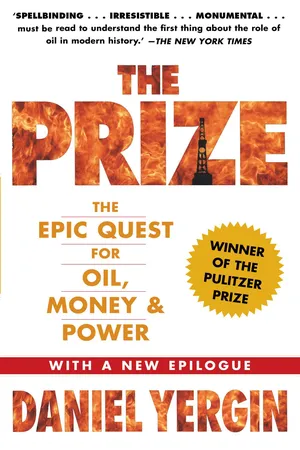
The Prize

The Epic Quest for Oil, Money & Power

  1. 928 pages
  2. English
  3. ePUB (mobile friendly)
  4. Available on iOS & Android
eBook - ePub

The Prize

The Epic Quest for Oil, Money & Power

About this book

The Prize recounts the panoramic history of oil -- and the struggle for wealth power that has always surrounded oil. This struggle has shaken the world economy, dictated the outcome of wars, and transformed the destiny of men and nations. The Prize is as much a history of the twentieth century as of the oil industry itself. The canvas of this history is enormous -- from the drilling of the first well in Pennsylvania through two great world wars to the Iraqi invasion of Kuwait and Operation Desert Storm. The cast extends from wildcatters and rogues to oil tycoons, and from Winston Churchill and Ibn Saud to George Bush and Saddam Hussein. The definitive work on the subject of oil and a major contribution to understanding our century, The Prize is a book of extraordinary breadth, riveting excitement -- and great importance.
Frequently asked questions

Yes, you can cancel anytime from the Subscription tab in your account settings on the Perlego website. Your subscription will stay active until the end of your current billing period. Learn how to cancel your subscription.
At the moment all of our mobile-responsive ePub books are available to download via the app. Most of our PDFs are also available to download and we're working on making the final remaining ones downloadable now. Learn more here.
Perlego offers two plans: Essential and Complete
  • Essential is ideal for learners and professionals who enjoy exploring a wide range of subjects. Access the Essential Library with 800,000+ trusted titles and best-sellers across business, personal growth, and the humanities. Includes unlimited reading time and Standard Read Aloud voice.
  • Complete: Perfect for advanced learners and researchers needing full, unrestricted access. Unlock 1.4M+ books across hundreds of subjects, including academic and specialized titles. The Complete Plan also includes advanced features like Premium Read Aloud and Research Assistant.
Both plans are available with monthly, semester, or annual billing cycles.
We are an online textbook subscription service, where you can get access to an entire online library for less than the price of a single book per month. With over 1 million books across 1000+ topics, we’ve got you covered! Learn more here.
Look out for the read-aloud symbol on your next book to see if you can listen to it. The read-aloud tool reads text aloud for you, highlighting the text as it is being read. You can pause it, speed it up and slow it down. Learn more here.
Yes! You can use the Perlego app on both iOS or Android devices to read anytime, anywhere — even offline. Perfect for commutes or when you’re on the go.
Please note we cannot support devices running on iOS 13 and Android 7 or earlier. Learn more about using the app.
Yes, you can access The Prize by Daniel Yergin in PDF and/or ePUB format, as well as other popular books in Ciencias sociales & Historia de Oriente Medio. We have over one million books available in our catalogue for you to explore.

PART I

Images

THE FOUNDERS

CHAPTER 1

Oil on the Brain: The Beginning

THERE WAS THE MATTER of the missing $526.08.
A professor’s salary in the 1850s was hardly generous, and in the quest for extra income, Benjamin Silliman, Jr., the son of a great American chemist and himself a distinguished professor of chemistry at Yale University, had taken on an outside research project for a fee totaling $526.08. He had been retained in 1854 by a group of promoters and businessmen, but, though he had completed the project, the promised fee was not forthcoming. Silliman, his ire rising, wanted to know where the money was. His anger was aimed at the leaders of the investor group, in particular, at George Bissell, a New York lawyer, and James Townsend, president of a bank in New Haven. Townsend, for his part, had sought to keep a low profile, as he feared it would look most inappropriate to his depositors if they learned he was involved in so speculative a venture.
For what Bissell, Townsend, and the other members of the group had in mind was nothing less than hubris, a grandiose vision for the future of a substance that was known as “rock oil”—so called to distinguish it from vegetable oils and animal fats. Rock oil, they knew, bubbled up in springs or seeped into salt wells in the area around Oil Creek, in the isolated wooded hills of northwestern Pennsylvania. There, in the back of beyond, a few barrels of this dark, smelly substance were gathered by primitive means—either by skimming it off the surface of springs and creeks or by wringing out rags or blankets that had been soaked in the oily waters. The bulk of this tiny supply was used to make medicine.
The group thought that the rock oil could be exploited in far larger quantities and processed into a fluid that could be burned as an illuminant in lamps. This new illuminant, they were sure, would be highly competitive with the “coal-oils” that were winning markets in the 1850s. In short, they believed that, if they could obtain it in sufficient quantities, they could bring to market the inexpensive, high-quality illuminant that mid-nineteenth-century man so desperately needed. They were convinced that they could light up the towns and farms of North America and Europe. Almost as important, they could use rock oil to lubricate the moving parts of the dawning mechanical age. And, like all entrepreneurs who became persuaded by their own dreams, they were further convinced that by doing all of this they would grow very rich indeed. Many scoffed at them. Yet, persevering, they would succeed in laying the basis for an entirely new era in the history of mankind—the age of oil.

To “Assuage Our Woes”

The venture had its origins in a series of accidental glimpses—and in the determination of one man, George Bissell, who, more than anybody else, was responsible for the creation of the oil industry. With his long, towering face and broad forehead, Bissell conveyed an impression of intellectual force. But he was also shrewd and open to business opportunity, as experience had forced him to be. Self-supporting from the age of twelve, Bissell had worked his way through Dartmouth College by teaching and writing articles. For a time after graduation, he was a professor of Latin and Greek, then went to Washington, D.C., to work as a journalist. He finally ended up in New Orleans, where he became principal of a high school and then superintendent of public schools. In his spare time, he studied to become a lawyer and taught himself several more languages. Altogether, he became fluent in French, Spanish, and Portuguese and could read and write Hebrew, Sanskrit, ancient and modern Greek, Latin and German. Ill health forced him to head back north in 1853, and passing through western Pennsylvania on his way home, he saw something of the primitive oil-gathering industry with its skimmings and oil-soaked rags. Soon after, while visiting his mother in Hanover, New Hampshire, he dropped in on his alma mater, Dartmouth College, where in a professor’s office he spied a bottle containing a sample of this same Pennsylvania rock oil. It had been brought there a few weeks earlier by another Dartmouth graduate, a physician practicing as a country doctor in western Pennsylvania.
Bissell knew that amounts of rock oil were being used as patent and folk medicines to relieve everything from headaches, toothaches, and deafness to stomach upsets, worms, rheumatism, and dropsy—and to heal wounds on the backs of horses and mules. It was called “Seneca Oil” after the local Indians and in honor of their chief, Red Jacket, who had supposedly imparted its healing secrets to the white man. One purveyor of Seneca Oil advertised its “wonderful curative powers” in a poem:
The Healthful balm, from Nature’s secret spring,
The bloom of health, and life, to man will bring;
As from her depths the magic liquid flows,
To calm our sufferings, and assuage our woes.
Bissell knew that the viscous black liquid was flammable. Seeing the rock oil sample at Dartmouth, he conceived, in a flash, that it could be used not as a medicine but as an illuminant—and that it might well assuage the woes of his pocketbook. He could put the specter of poverty behind him and become rich from promoting it. That intuition would become his guiding principle and his faith, both of which would be sorely tested during the next six years, as disappointment consistently overwhelmed hope.1

The Disappearing Professor

But could the rock oil really be used as an illuminant? Bissell aroused the interest of other investors, and in late 1854 the group engaged Yale’s Professor Silliman to analyze the properties of the oil both as an illuminant and lubricant. Perhaps even more important, they wanted Silliman to put his distinguished imprimatur on the project so they could sell stock and raise the capital to carry on. They could not have chosen a better man for their purposes. Heavyset and vigorous, with a “good, jolly face,” Silliman carried one of the greatest and most respected names in nineteenth-century science. The son of the founder of American chemistry, he himself was one of the most distinguished scientists of his time, as well as the author of the leading textbooks in physics and chemistry. Yale was the scientific capital of mid-nineteenth-century America, and the Sillimans, father and son, were at the center of it.
But Silliman was less interested in the abstract than in the decidedly practical, which drew him to the world of business. Moreover, while reputation and pure science were grand, Silliman was perennially in need of supplementary income. Academic salaries were low and he had a growing family; so he habitually took on outside consulting jobs, making geological and chemical evaluations for a variety of clients. His taste for the practical would also carry him into direct participation in speculative business ventures, the success of which, he explained, would give him “plenty of sea room … for science.” A brother-in-law was more skeptical. Benjamin Silliman, Jr., he said, “is on the constant go in behalf of one thing or another, and alas for Science.”
When Silliman undertook his analysis of rock oil, he gave his new clients good reason to think they would get the report they wanted. “I can promise you,” he declared early in his research, “that the result will meet your expectations of the value of this material.” Three months later, nearing the end of his research, he was even more enthusiastic, reporting “unexpected success in the use of the distillate product of Rock Oil as an illuminator.” The investors waited eagerly for the final report. But then came the big hitch. They owed Silliman the $526.08 (the equivalent of about $5,000 today), and he had insisted that they deposit $100 as a down payment into his account in New York City. Silliman’s bill was much higher than they had expected. They had not made the deposit, and the professor was upset and angry. After all, he had not taken on the project merely out of intellectual curiosity. He needed the money, badly, and he wanted it soon. He made it very clear that he would withhold the study until he was paid. Indeed, to drive home his complaint, he secretly handed over the report to a friend for safe-keeping until satisfactory arrangements were made, and took himself off on a tour of the South, where he could not easily be reached.
The investors grew desperate. The final report was absolutely essential if they were to attract additional capital. They scrounged around, trying to find the money, but with no success. Finally, one of Bissell’s partners, though complaining that “these are the hardest times I ever heard of,” put up the money on his own security. The report, dated April 16, 1855, was released to the investors and hurried to the printers. Though still appalled by Silliman’s fee, the investors, in fact, got more than their money’s worth. Silliman’s study, as one historian put it, was nothing less than “a turning point in the establishment of the petroleum business.” Silliman banished any doubts about the potential new uses for rock oil. He reported to his clients that it could be brought to various levels of boiling and thus distilled into several fractions, all composed of carbon and hydrogen. One of these fractions was a very high-quality illuminating oil. “Gentlemen,” Silliman wrote to his clients, “it appears to me that there is much ground for encouragement in the belief that your Company have in their possession a raw material from which, by simple and not expensive processes, they may manufacture very valuable products.” And, satisfied with the business relationship as it had finally been resolved, he held himself fully available to take on further projects.
Armed with Silliman’s report, which proved a most persuasive advertisement for the enterprise, the group had no trouble raising the necessary funds from other investors. Silliman himself took two hundred shares, adding further to the respectability of the enterprise, which became known as the Pennsylvania Rock Oil Company. But it took another year and a half of difficulties before the investors were ready to take the next hazardous step.
They now knew, as a result of Silliman’s study, that an acceptable illuminating fluid could be extracted from rock oil. But was there enough rock oil available? Some said that it was only the “drippings” from underground coal seams. Certainly, a business could not be built from skimming oil stains off the surfaces of creeks or from wringing out oil-soaked rags. The critical issue, and what their enterprise was all about, was proving that there was a sufficient and obtainable supply of rock oil to make for a substantial paying proposition.2

Price and Innovation

The hopes pinned on the still mysterious properties of oil arose from pure necessity. Burgeoning populations and the spreading economic development of the industrial revolution had increased the demand for artificial illumination beyond the simple wick dipped into some animal grease or vegetable fat, which was the best that most could afford over the ages, if they could afford anything at all. For those who had money, oil from the sperm whale had for hundreds of years set the standard for high-quality illumination; but even as demand was growing, the whale schools of the Atlantic had been decimated, and whaling ships were forced to sail farther and farther afield, around Cape Horn and into the distant reaches of the Pacific. For the whalers, it was the golden age, as prices were rising, but it was not the golden age for their consumers, who did not want to pay $2.50 a gallon—a price that seemed sure to go even higher. Cheaper lighting fluids had been developed. Alas, all of them were inferior. The most popular was camphene, a derivative of turpentine, which produced a good light but had the unfortunate drawback of being highly flammable, compounded by an even more unattractive tendency to explode in people’s houses. There was also “town gas,” distilled from coal, which was piped into street lamps and into the homes of an increasing number of middle- and upper-class families in urban areas. But “town gas” was expensive, and there was a sharply growing need for a reliable, relatively cheap illuminant. There was that second need as well—lubrication. The advances in mechanical production had led to such machines as power looms and the steam printing press, which created too much friction for such common lubricants as lard.
Entrepreneurial innovation had already begun to respond to these needs in the late 1840s and early 1850s, with the extraction of illuminating and lubricating oils from coal and other hydrocarbons. A lively cast of characters, both in Britain and in North America, carried the search forward, defining the market and developing the refining technology on which the oil industry would later be based. A court-martialed British admiral, Thomas Cochrane—who, it was said, provided the model for Lord Byron’s Don Juan—became obsessed with the potential of asphalt, sought to promote it, and, along the way, acquired ownership of a huge tar pit in Trinidad. Cochrane collaborated for a time with a Canadian, Dr. Abraham Gesner. As a young man, Gesner had attempted to start a business exporting horses to the West Indies, but, after being shipwrecked twice, gave it up and went off to Guy’s Hospital in London to study medicine. Returning to Canada, he changed careers yet again and became provincial geologist for New Brunswick. He developed a process for extracting an oil from asphalt or similar substances and refining it into a quality illuminating oil. He called this oil “kerosene”—from Keros and elaion, the Greek words, respectively, for “wax” and “oil,” altering the elaion to ene, so that his product would sound more like the familiar camphene. In 1854 he applied for a United States patent for the manufacture of “a new liquid hydrocarbon, which I denominate Kerosene, and which may be used for illuminating or other purposes.”
Gesner helped establish a kerosene works in New York City that by 1859 was producing five thousand gallons a day. A similar establishment was at work in Boston. The Scottish chemist James Young had pioneered a parallel refining industry in Britain, based on cannel coal, and one also developed in France, using shale rock. By 1859, an estimated thirty-four companies in the United States were producing $5 million a year worth of kerosene or “coal-oils,” as the product was generically known. The growth of this coal-oil business, wrote the editor of a trade journal, was proof of “the impetuous energy with which the American mind takes up any branch of industry that promises to pay well.” A small fraction of the kerosene was extracted from Pennsylvania rock oil that was gathered by the traditional methods and that would, from time to time, turn up at the refineries in New York.3
Oil was hardly unfamiliar to mankind. In various parts of the Middle East, a semisolid oozy substance called bitumen seeped to the surface through cracks and fissures, and such seepages had been tapped far back into antiquity—in Mesopotamia, back to 3000 B.C. The most famous source was at Hit, on the Euphrates, not far from Babylon (and the site of modern Baghdad). In the first century B.C., the Greek historian Diodor wrote enthusiastically about the ancient bitumen industry: “Whereas many incredible miracles occur in the Babylonian country, there is none such as the great quantity of asphalt found there.” Some of these seepages, along with escaping petroleum gases, burned continuously, providing the basis for fire worship in the Middle East.
Bitumen was a traded commodity in the ancient Middle East. It was used as a building mortar. It bound the walls of both Jericho and Babylon. Noah’s ark and Moses’ basket were probably caulked, in the manner of the time, with bitumen to make them waterproof. It was also used for road making and, in a limited and generally unsatisfactory way, for lighting. And bitumen served as a medicine. The description by the Roman naturalist Pliny in the first century A.D. of its pharmaceutical value was similar to that current in the United States during the 1850s. It checked bleeding, Pliny said, healed wounds, treated cataracts, provided a liniment for gout, cured aching teeth, soothed a chronic cough, relieved shortness of breath, stopped diarrhea, drew together severed muscles, and relieved both rheumatism and fever. It was also “useful for straightening out eyelashes which inconvenience the eyes.”
There was yet another use for oil; the product of the seepages, set aflame, found an extensive and sometimes decisive role in warfare. In the Iliad, Homer recorded that “the Trojans cast upon the swift ship unwearied fire, and over her forthwith streamed a flame that might not be quenched.” When the Persian King Cyrus was preparing to take Babylon, he was warned of the danger of street fighting. He responded by talking of setting fires, and declared, “We also have plenty of pitch and tow, which will quickly spread the flames everywhere, so that those upon the house-tops must either quickly leave their posts or quickly be consumed.” From the seventh century onward, the Byzantines had made use of oleum incendiarum—Greek fire. It was a mixture of petroleum and lime that, touched with moisture, would catch fire; the recipe was a closely guarded state secret. The Byzantines heaved it on attacking ships, shot it on the tips of arrows, and hurled it in primitive grenades. For centuries, it was considered a more terrible weapon than gunpowder.4
So the use of petroleum had a long and varied history in the Middle East. Yet, in a great mystery, knowledge of its application was lost to the West for many centuries, perhaps because the known major sources of bitumen, and the knowledge of its uses, lay beyond the boundaries of the Roman empire, and there was no direct transition of that knowledge to the West. Even so, in many parts of Europe—Bavaria, Sicily, the Po Valley, Alsace, Hannover, and Galicia, to name a few—oil seepages were observed and commented upon from the Middle Ages onward. And refining technology was transmitted to Europe via the Arabs. But, for the most part, petroleum was put to use only as the all-purpose medicinal remedy, fortified by learned disquisitions on its healing properties by monks and early doctors. But, well before George Bissell’s entrepreneurial vision and Benjamin Silliman’s report, a small oil industry had developed in Eastern Europe—first in Galicia (which was variously part of Poland, Austria, and Russia) and then in Rumania. Peasants dug shafts by hand to obtain crude oil, from which kerosene was refined. A pharmacist from Lvov, with the help of a plumber, invented a cheap lamp suited to burning kerosene. By 1854, kerosene was a staple of commerce in Vienna. By 1859, Galicia had a thriving kerosene oil business, with over 150 villages involved in oil mining, led by such families as Backenroth-Bronicki. Altogether, European crude production in 1859 had been estimated at thirty-six thousand barrels, primarily from Galicia and Rumania. What the Eastern European industry lacked, more than anything else, was the technology for drilling.
In the 1850s, the spread of kerosene in the United States faced two significant barriers: There was as yet no substantial source of supply, and there was no cheap lamp well-suited to burning what kerosene was available. The lamps that did exist tended to become smoky, and the burning kerosene gave off an acrid smell. Then a kerosene sales agent in New York learned that a lamp with a glass chimney was being produced in Vienna to burn Galician kerosene. Based upon the design of the pharmacist and the plumber in Lvov, the lamp overcame the problems of the smoke and the smell. The New York salesman started to import the lamp, which quickly found a market. Though its design was subsequently improved many times over, that Vienna lamp became the basis of the kerosene lamp trade in the United States and was later re-exported around the world.5
Thus by the time that Bissell was launching his venture, a cheaper quality illuminating oil—kerosene—had already been introduced into some homes. The techniques required for refining petroleum into kerosene had already been commercialized with coal-oils. And an inexpensive lamp had been developed that could satisfactorily burn kerosene. In essence, what Bissell and his fellow investors in the Pennsylvania Rock Oil Company were trying to do was discover a new source for the raw m...

Table of contents

  1. Cover
  2. Title Page
  3. Dedication
  4. List of Maps
  5. Prologue
  6. Part I: The Founders
  7. Part II: The Global Struggle
  8. Part III: War and Strategy
  9. Part IV: The Hydrocarbon Age
  10. Part V: The Battle for World Mastery
  11. Epilogue: Reflections on ‘The Prize’
  12. Photographs
  13. The Story of the Story
  14. Chronology
  15. Oil Prices and Production
  16. Acknowledgments
  17. Additional Acknowledgments
  18. About the Author
  19. Notes
  20. Bibliography
  21. Index
  22. Photo Credits
  23. Copyright