
- 352 pages
- English
- ePUB (mobile friendly)
- Available on iOS & Android
eBook - ePub
About this book
A long and distinguished tradition of writers have used the form of a satirical dictionary to undermine the received ideas of their day. Voltaire wrote a sharply humorous "Philosophical Dictionary," while Samuel Johnson's dictionary of the English language was derisive and opinionated. These early dictionaries and encyclopedias were really weapons in a struggle for the soul of civilization between forces of humanistic enlightenment and the forces of orthodoxy and dogmatism. Their authors attacked and exposed the half-truths of their day by showing that it was possible to think differently about the social and political arrangements that everyone took for granted.
But as John Ralston Saul argues in this decidedly unorthodox book, modern dictionaries have once again been captured by the forces of orthodoxy—albeit this time a rationalist orthodoxy. Our language has become as predictable, fragmented, and rhetorical as it was in the 18th century, divided as it is by special interest groups into dialects of expertise that are hermetically sealed off and inaccessible to citizens. In The Doubter's Companion, a marvelous subversive contribution to the great 18th century tradition of the humanist dictionary, Saul skewers and discredits the accepted content of common terms like Advertising, Academics, and Air Conditioning (defined as "an efficient means for spreading disease in enclosed public spaces"); Cannibal, Conservative, and Croissant; Dandruff, Death, and Dictionary ("opinions presented as truth in alphabetical order"); and several hundred others, including Biography ("a respectable form of pornography"), Museum ("safe storage for stolen objects"), and Manners ("people are always splendid when they're dead").
There is much in this volume that will stimulate, offend, provoke, perplex, and entertain. But Saul deploys these tactics of guerilla lexicography to advance the more serious purpose of reclaiming public language from the stultifying dialects of modern expertise.
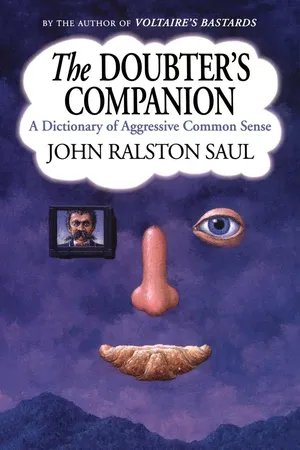
But as John Ralston Saul argues in this decidedly unorthodox book, modern dictionaries have once again been captured by the forces of orthodoxy—albeit this time a rationalist orthodoxy. Our language has become as predictable, fragmented, and rhetorical as it was in the 18th century, divided as it is by special interest groups into dialects of expertise that are hermetically sealed off and inaccessible to citizens. In The Doubter's Companion, a marvelous subversive contribution to the great 18th century tradition of the humanist dictionary, Saul skewers and discredits the accepted content of common terms like Advertising, Academics, and Air Conditioning (defined as "an efficient means for spreading disease in enclosed public spaces"); Cannibal, Conservative, and Croissant; Dandruff, Death, and Dictionary ("opinions presented as truth in alphabetical order"); and several hundred others, including Biography ("a respectable form of pornography"), Museum ("safe storage for stolen objects"), and Manners ("people are always splendid when they're dead").
There is much in this volume that will stimulate, offend, provoke, perplex, and entertain. But Saul deploys these tactics of guerilla lexicography to advance the more serious purpose of reclaiming public language from the stultifying dialects of modern expertise.
Frequently asked questions
Yes, you can cancel anytime from the Subscription tab in your account settings on the Perlego website. Your subscription will stay active until the end of your current billing period. Learn how to cancel your subscription.
No, books cannot be downloaded as external files, such as PDFs, for use outside of Perlego. However, you can download books within the Perlego app for offline reading on mobile or tablet. Learn more here.
Perlego offers two plans: Essential and Complete
- Essential is ideal for learners and professionals who enjoy exploring a wide range of subjects. Access the Essential Library with 800,000+ trusted titles and best-sellers across business, personal growth, and the humanities. Includes unlimited reading time and Standard Read Aloud voice.
- Complete: Perfect for advanced learners and researchers needing full, unrestricted access. Unlock 1.4M+ books across hundreds of subjects, including academic and specialized titles. The Complete Plan also includes advanced features like Premium Read Aloud and Research Assistant.
We are an online textbook subscription service, where you can get access to an entire online library for less than the price of a single book per month. With over 1 million books across 1000+ topics, weâve got you covered! Learn more here.
Look out for the read-aloud symbol on your next book to see if you can listen to it. The read-aloud tool reads text aloud for you, highlighting the text as it is being read. You can pause it, speed it up and slow it down. Learn more here.
Yes! You can use the Perlego app on both iOS or Android devices to read anytime, anywhere â even offline. Perfect for commutes or when youâre on the go.
Please note we cannot support devices running on iOS 13 and Android 7 or earlier. Learn more about using the app.
Yes, you can access The Doubter's Companion by John Ralston Saul in PDF and/or ePUB format, as well as other popular books in Education & Education General. We have over one million books available in our catalogue for you to explore.
Information
Topic
EducationSubtopic
Education GeneralC
CALM A state of emotion which is overrated except in religious retreats. It is used principally to CONTROL people who are dissatisfied with the way those in authority are doing their jobs. When individuals show annoyance, the person in power or with privileged information or expertise will make them feel they are not calm enough to deal with the situation rationally. A lack of calm suggests a lack of courage, intelligence or professionalism.
Calm was the quality most admired by World War I generals in themselves and in their troops. Since then, calm incompetence has risen to become a quality of high professionalism. A loss of calm in a catastrophe is seen to be worse than cowardly; it indicates a lack of breeding as well as inappropriate amateurism. Outsiders are amateurs.
The clichĂŠ of calm as a virtue was captured in Rudyard Kiplingâs âIf you can keep your head when all about you . . .â But Kipling was far too smart to mean that people should be victims of incompetence or mulishly stubborn or blindly loyal to either their professions or their class. He was talking about deft, razor-sharp coolness; a fast, flexible mind capable of admitting error and adjusting to circumstance; a talent for reaction to crisis with white-heat action or invisible subtlety.
The Captain of the Titanic was no doubt pleased that his male passengers in first class remained calm as they waited to drown. Had they been less controlled, they might have found some small satisfaction in passing their time by throwing him overboard. See: PANIC.
CANADA
1. So complicated that nobody knows how it works, which causes Canadian social scientists to talk about it all the time, which causes foreigners to say itâs boring because nothing ever happens.
2. The most decentralized country in existence, which causes Canadians to complain constantly about the power of the central government.
3. Administered under the third oldest constitution in the world, which causes Canadians to insist that it has never worked and must be changed.
4. The only major country in which the two leading western cultures have managed to live peacefully together for several centuries, causing Canadians to insist that they cannot live together.
5. Burdened by the laziest ĂŠlite of any developed nation; people who have made their fortunes by selling off the countryâs resources and by working for more energetic foreigners. They are most comfortable on their knees, admiring those from larger countries who have purchased them.
6. A country where 95 per cent of the land is north of the major cities, which causes its urban inhabitants to treat their hinterland as an embarrassing and backward region, while pretending that they themselves are situated hundreds of miles to the south, somewhere between New York and FLORIDA.
CANNIBALISM A few years ago over dinner in St. Tropez, a retired colonial doctor in his nineties began recounting his experiences with cannibals in the Cameroons. He had been twenty-one. We were up on a terrace looking across the great bay with the lights of other towns ringing the shore.
His account turned entirely on the administrative problems which the phenomenon produced. Was it a crime? By whose law? Who was to be punished? A whole village would have consumed the body. Were they therefore, in European terms, accomplices to the murder? This was his first colonial job and he had been left as the sole civil authority over hundreds of square miles. In this district the villages were isolated from one another.
I eventually interrupted to ask what seemed to me a key question. How did they cook their humans? The doctor stared at me as if he didnât understand.
âGrilled or boiled?â I asked again.
With an energetic enunciation of contemptâthe sort of energy which was common in language before electronics cooled itâhe replied, âBoiled of course! Boiled!â
Sensible civilizations, which have not been deformed by urban fashions, are unanimous about the healthiest way to cook meat. Some may grill it after it has been boiled. But all will boil it. This removes excess fats and other unhealthy enzymes as well as tenderizing the flesh. Only the most basic savages grill or barbecue their meat. Interestingly enough, this universal early human understanding has been confirmed by contemporary chemists who have discovered that the grilling process causes a molecular rearrangement which is bad for the eater and may contribute to cancer.
According to the colonial doctor, no particular religious or social mythology was involved in these incidents except that villagers did not eat their own. But if they were short of food and a stranger happened to travel through the area, they might well kill him and boil him. In the course of each year two or three cases would be brought to his attention and each of these led to interminable complications. See: CROISSANT.
CAPITALISM A concept which has moved beyond the stage of sensible discussion.
Capitalism can be a useful social tool or a weapon of unabashed human exploitation. Which it will be depends entirely on the way it is regulated. Capitalism itself contains no ethical values. Those who use it decide by their actions whether it is a force of good or evil.
⢠⢠â˘
Each economic system does tend to be more at home in certain circumstances than in others. Capitalism is happiest in a non-democratic society.
Not that any old dictatorship will do. Two types in particular can be disastrous. The first is the bureaucratic sort, when a nation is dominated by a state religion or ideology, as in the former Soviet Union. Second are the personalized dictatorships, where all financial dealings must run through the hands of the dictator, his family and friends.
Capitalism thrives in the evolved authoritarian dictatorship. There the streets are calm, dissent is discouraged, disorder repressed. Little time is wasted over politics, debates, elections and tiresome, inefficient legislatures. For decades at a stretch the same ministers and policies remain in place. The firm hand all of this suggests must, however, be benevolent. Individuals must have the freedom to make money and spend it as they wish, believing that so long as they donât challenge the system, they will be permitted to live out their lives in peace, keep their wealth and pass it on to their children.
The glory days of the Industrial Revolution came in England before a series of parliamentary reforms had created anything resembling a fairly elected assembly. With the rise of mass democracy during the late nineteenth century, the capitalist system began to stall, then decline, and has never recovered. In France, capitalismâs greatest moments came under two benign dictators: Louis-Philippe and Louis-Napoleon; in Germany it prospered happily under Kaiser Wilhelm.
In the United States the capitalist system was first established under slavery. Its moment of glory came in the last quarter of the nineteenth century and the first quarter of the twentieth, when the workforce was flooded by immigrants who either were not yet citizens or were still politically passive. Slavery still functioned in its legal form of segregation. Capitalism complained a great deal from 1932 to 1968; the period during which public participation was most evenly spread and government paid most attention to the needs of the whole populace. It regained a sense of optimism during the 1970s and 1980s when voter participation fell to 50 per cent in presidential elections and far lower in those for Congress. This period coincided with a rise of public disgust for the political process, a decline in labour-union membership and intense deregulation.
Capitalism was reasonably content under Hitler, happy under Mussolini, very happy under Franco and delirious under General Pinochet.
⢠⢠â˘
This is not what the early philosophers of capitalism had expected. The tempering of man by commerce as imagined by Adam Smith and David Hume has not happened. The once-popular view that democracy blossomed thanks to the rise of capitalism can now be seen in perspective. Their parallel rise isnât one of cause and effect, as their ongoing difficult relationship continues to demonstrate.
These misunderstandings arenât surprising. Remarkable men writing in the eighteenth century were trying to guess what the new economic whirlwind would bring. We now have the advantage of experience.
Even Max Weber in the early twentieth century was convinced that bureaucratic capitalism, along with public bureaucracy, would be forces for efficiency, speed and precision. We now know that he was wrong. The large corporations use their structures and their wealth to protect themselves from their own failures, but they are ineffectual when compared to smaller owner-managed companies.
These visible experiences have been clouded for us by the self-serving public relations of the business schools, which continue to feed the structures, and the kidnapping of people like EDMUND BURKE and Adam Smith by the NEO-CONSERVATIVE ideologues. They present Smith as an apostle of unrestricted trade and unregulated markets. In fact his was a relatively moderate, balanced position which included public regulation to curb the excesses of capitalism.
We can now see how some of the miscalculations were made. For example, many of those who imagined the new American Republic had the Venetian Republic in mind as a model. They saw VENICEâS economic organization as a solution to their problems. They scarcely bothered with its underlying principles which excluded such elements as individualism, a responsible citizenry, free speech and democracy. It was an almost perfect CORPORATIST dictatorship.
The great American philanthropist industrialistsâsuch as Carnegie and Rockefellerâwere in some ways naĂŻve descendants of the Venetian tradition. They seemed to promise a society led by economic daring. Alongside their economic infrastructures, which became those of the nation, they left wonderful monuments to culture. But their sort of robber BARON leadership, no matter how creative, undermined the possibility of a citizen-based state.
⢠⢠â˘
What these experiences indicate is that democracy and capitalism are not natural friends. That doesnât mean they must be enemies. But if allowed free run of the social system, capitalism will attempt to corrupt and undermine democracy, which after all is not a natural state. Democracy was a gradual and difficult creation against the stated desires of the natural sectors of power (authoritarian, military, class). It requires constant participation and can only be maintained by the toughness of its citizenry.
A functioning democracy nevertheless needs to create wealth. It therefore needs some balance of capitalism. By carefully defining the limits permitted to that phenomenon, responsible government can allow the process of wealth creation to succeed. This doesnât mean that democracy can create ethical capitalism. That would be to impute values where none exist. Democracy can, however, lay out rules of procedure which are based in ethics. Capitalism is then surprised to discover that it can produce wealth within the rules of the democratic game, providing that they are perfectly clear and designed with the creation of wealth in mind. See: CORPORATISM and FREE.
CARLYLE, THOMAS There is a certain pleasure to be had in picking out unpleasant individuals from the past and blaming them for whatever has since gone wrong. Unfortunately this is an inadvertent way of embracing the Heroic or Great Man view of HISTORY.
As the nineteenth century advanced, so the battle between the forces of democracy and dictatorship gathered strength and they repeatedly engaged each other. Thomas Carlyleâs role was to round up all the anti-democratic ideas careening about in a society dependent on great menâideas largely inspired by the Napoleonic adventureâto make an integrated theory of civilization. On Heroes, Hero-worship and the Heroic in History appeared in 1841, the year Napoleonâs body was brought back to Paris in triumph.
Carlyleâs concept had an enormous impact. He had packaged what the anti-democratic elements in society had been trying to express. He was not the first to evoke the Great Man theory. Hegel preceded him. Friedrich Nietzsche, LĂŠon Bloy, Max Weber and Oswald Spengler followed close behind. But it was Carlyle who neatly wrapped up the whole theory in an intellectually respectable yet populist manner.
For, as I take it, Universal History, the history of what man has accomplished in this world, is at bottom the History of the Great Men who have worked here. They were the leaders of men, these great ones; the modelers, patterns, and in a wide sense, creators of whatsoever the general mass of men contrived to do or to attain; all things that we see standing accomplished in the world are properly the outer material result, the practical realization and embodiment, of Thoughts that dwelt in the Great Men sent into the world.1
One of Carlyleâs most effective tricks was to roll famous dead poets, philosophers and martyrs together with generals and dictators into a single Heroic class. In his chapter on Dante and Shakespeare he insists that âin man there is the same altogether peculiar admiration for the Heroic gift, by what name soever called . . .â2 Twice he speaks of Napoleon while discussing Dante. They are part of the same Heroic family.
Of course the Florentine poet was a genius who made an important contribution to our civilization. But Dante never sought craven worship from others. He would have detested Carlyleâs fawning attitude. There is nothing worshipful in the way he wrote of the famous dead men he met in The Divine Comedy.
In Carlyleâs analysis of Napoleon, the Great Manâs flaws are treated as mere âsmoke and waste.â3 This contrasting of the Hero and his weaknesses is central to our contemporary âpersonalityâ debates. And it continues to play its role as a mechanism for removing the citizenâs sense of his or her right to judge their leaders on matters of importance.
To me, in these circumstances . . .âHero-worshipâ becomes a fact inexpressibly precious; the most solacing fact one sees in the world at present. There is an everlasting hope in it for the management of the world. Had all traditions, arrangements, creeds, societies that men ever instituted, sunk away, this would remain. The certainty of Heroes being sent us; our faculty, our necessity, to reverence Heroes when sent: it shines like a polestar through smoke-clouds, dust-clouds and all manner of down-rushing and conflagration.4
Conventional wisdom has it that the last world war liberated us from these sorts of Heroic attitudes. But even a cursory examination of contemporary political debate reveals that we are still caught up in Carlyleâs dream of ...
Table of contents
- Cover
- Dedication
- The Grail of Balance
- A
- B
- C
- D
- E
- F
- G
- H
- I
- J
- K
- L
- M
- N
- O
- P
- R
- S
- T
- U
- V
- W
- X
- Y
- Z
- Acknowledgments
- Notes
- Word List
- Copyright