I Got Schooled
eBook - ePub

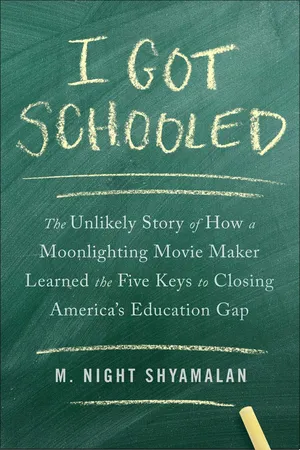
I Got Schooled

The Unlikely Story of How a Moonlighting Movie Maker Learned the Five Keys to Closing America's Education Gap

  1. 320 pages
  2. English
  3. ePUB (mobile friendly)
  4. Available on iOS & Android
eBook - ePub

I Got Schooled

The Unlikely Story of How a Moonlighting Movie Maker Learned the Five Keys to Closing America's Education Gap

About this book

In this vital book, the famed filmmaker tells how his passion for education reform led him to learn that there are five tested, indispensable keys to transforming America’s underperforming schools.

Famed director M. Night Shyamalan has long had a serious interest in education. The founda­tion he and his wife started once gave college scholarships to promising inner-city students, but Shyamalan realized that these scholarships did nothing to improve education for all the other students in under-performing schools. When he learned that some schools were succeeding with similar student populations, he traveled across the country to find out how they did this and whether these schools had something in common. He eventually learned that there are five keys to closing America’s achievement gap. But just as we must do several things to maintain good health— eat the right foods, exercise regularly, get a good night’s sleep—so too must we use all five keys to turn around our lowest-performing schools.

These five keys are used by all the schools that are succeeding, and no schools are succeeding without them. Before he discovered them, Shyamalan investigated some popular reform ideas that proved to be dead ends, such as smaller class size, truculent unions, and merit pay for teachers. He found that the biggest obstacle to school reform is cognitive biases: too many would-be reformers have committed themselves to false solutions.

This is a deeply personal book by an unbiased observer determined to find out what works and why so that we as a nation can fulfill our obliga­tion to give every student an opportunity for a good education.
Frequently asked questions

Yes, you can cancel anytime from the Subscription tab in your account settings on the Perlego website. Your subscription will stay active until the end of your current billing period. Learn how to cancel your subscription.
No, books cannot be downloaded as external files, such as PDFs, for use outside of Perlego. However, you can download books within the Perlego app for offline reading on mobile or tablet. Learn more here.
Perlego offers two plans: Essential and Complete
  • Essential is ideal for learners and professionals who enjoy exploring a wide range of subjects. Access the Essential Library with 800,000+ trusted titles and best-sellers across business, personal growth, and the humanities. Includes unlimited reading time and Standard Read Aloud voice.
  • Complete: Perfect for advanced learners and researchers needing full, unrestricted access. Unlock 1.4M+ books across hundreds of subjects, including academic and specialized titles. The Complete Plan also includes advanced features like Premium Read Aloud and Research Assistant.
Both plans are available with monthly, semester, or annual billing cycles.
We are an online textbook subscription service, where you can get access to an entire online library for less than the price of a single book per month. With over 1 million books across 1000+ topics, we’ve got you covered! Learn more here.
Look out for the read-aloud symbol on your next book to see if you can listen to it. The read-aloud tool reads text aloud for you, highlighting the text as it is being read. You can pause it, speed it up and slow it down. Learn more here.
Yes! You can use the Perlego app on both iOS or Android devices to read anytime, anywhere — even offline. Perfect for commutes or when you’re on the go.
Please note we cannot support devices running on iOS 13 and Android 7 or earlier. Learn more about using the app.
Yes, you can access I Got Schooled by M. Night Shyamalan in PDF and/or ePUB format, as well as other popular books in Education & Education General. We have over one million books available in our catalogue for you to explore.

Information

PART ONE

THE GAP

1

AS JOHN ADAMS SAID . . .

Some filmmakers love location scouting. I’m not one of them. You drive in a van or fly a plane for eternity just to get out, look around, and say, ā€œThis isn’t it.ā€ You do this over and over till you find the place where you know the characters can live and breathe and walk around.
Which is what I was doing in the spring of 2007, with a team of location managers and scouts who were ferrying me around Philadelphia, looking at potential filming locations for The Happening, which was going to star Mark Wahlberg as a teacher in a Philadelphia high school. Our search had taken us to the Julia R. Masterman Middle and High School, a public school located at 17th and Spring Garden, right in the middle of the city. This is a flat-out beautiful building and beautiful school. I knew right away when I stepped out that this was the place. It just felt right. There was light there.
I’m not superfamous, but people know my movies. Once it got around that we were scouting Masterman High School, the kids went crazy. They started coming out of the classrooms, circling, asking questions. ā€œAre you making a movie here?ā€ ā€œIs someone going to die here?ā€ ā€œCan I die?ā€ The usual inquiries. It was a pied piper–like scene as we moved through the building. We took our notes, talked to the principal, and left.
Then we drove fifteen minutes to Overbrook High School in West Philadelphia. It is a towering, imposing building. Inside, it’s all fluorescent lights and metal detectors. The classrooms had bars on their doors and windows, and each one had to be unlocked before we could see them.
Something you should know about me is that I’m a pretty selfish guy. Not a great citizen of the world. I care about my family and films. That’s it. Someone needs saving, countries need assistance, I’m sympathetic, but it doesn’t penetrate me. But when they showed me the floor of the school that was closed because of too much drug use and sexual activity, something dark wrapped in outrage started growing in my stomach. It kept growing as they showed me the school theater that was being renovated because of a suspiciously set fire.
Something happened to me standing in the hallway in Overbrook High School. My arms became tight. My jaw set. It’s exactly what happens when someone elbows me in a basketball game. It gets my attention.
Which is more than we got at Overbrook. When we walked down the halls, only one boy even looked at us. Something akin to recognition flickered in his eyes and then vanished. He looked back down and kept walking. That was the only moment of acknowledgment that a film-location crew was in the building.
I’m certain that the students of Overbrook watch just as many movies as the kids at Masterman. Just as many of them want to be actors or directors or producers. To Masterman’s students, though, while a visit from a film crew wasn’t an everyday event, it was exactly the sort of thing they expected to happen. Their entire lives had taught them that things like that were possible. That anything was possible. Overbrook’s students didn’t even believe we were there. If the kids at Masterman had spent their lives being taught that anything was possible, Overbrook’s student body had learned the opposite.
That’s one reason that the achievement gap that separates inner-city schools from suburban ones doesn’t exist at Masterman. Which meant they had opened up a cavernous gap between themselves and Overbrook. In 2010, Masterman was one of only two high schools in the state of Pennsylvania to be awarded a National Blue Ribbon, which means just what it sounds like. Masterman students take enriched math and foreign language programs, participate in half a dozen different music ensembles, and can try out for nationally ranked chess and National Academic League teams. The school has a 100 percent graduation rate, and nine out of ten Masterman graduates are headed to a four-year college. Overbrook? Only 54 percent of Overbrook’s students get a diploma. At Masterman, nearly one student in four takes the Advanced Placement test in English, and 90 percent receive a score of 3, 4, or 5: enough for college credit. At Overbrook, only one student in fifty takes it and, the last time anyone checked, none got as high as a 3.
It’s not apples to apples. Masterman is a magnet school, and a very selective one. Even to apply to Masterman, a fourth-grader—almost every student starts in the fifth grade, and continues to graduation—needs to test in the top 12 percent of all students in the city of Philadelphia. But neither school has an especially affluent student body; the percentage of poor kids at Masterman is around 40 percent; at Overbrook a little more than 60 percent. The teachers at Overbrook work just as hard as their colleagues at Masterman, and care just as much. The schools use the same standards for language arts and mathematics. Only about four miles separates them. And a sense of possibility.
Here’s another thing about me: My mind is hardwired to see possibilities everywhere. I look up in the night sky and expect to see a UFO. I was the kid who stared at the paper cup for hours convinced I’d move it with my mind. (Never happened.) I’m also the guy who saw my wife for the first time and knew she was the one. (Married twenty years.) I went to my first dance at a girls’ school when I was twelve and knew my kids would go there one day. (All three do today.) I’m that guy. The eternal optimist on steroids.
The visit to the two schools made something crystal clear to me: I was now invested in the struggles of education, and I was going to figure out what Masterman’s kids were getting that Overbrook’s weren’t. I wasn’t sure how to do it. But I had a notion of where to start.
—
Six years before visiting the two schools, in October of 2001, my wife, Bhavna (who is a great citizen of the world), and I had signed the various documents—and written the check—that launched the M. Night Shyamalan Foundation (MNS Foundation). Its mission is ā€œto support remarkable leaders working to remove the barriers created by poverty and inequality, which prevent individuals and communities from unleashing their full potential.ā€ Bhavna and I believe that every person on the planet is born with an unknowably great potential for knowledge, growth, and success, and that we are all responsible for helping turn that potential into actuality.
Over the years, the Foundation has mounted initiatives to fight hunger and improve access to livable housing in Philadelphia. We’ve supported single mothers in their efforts to get GEDs. We’ve funded programs of self-empowerment around the world, investing in community leaders like Usha, a woman from the slum community of Nagpur, India, who stood up to the gang that had terrorized her community for years and came to MNS when she needed help training her neighbors in job skills. The Foundation invested in the Sudanese secondary school for boys and girls built by Valentino Achak Deng (the subject of Dave Eggers’s What Is the What). The Foundation has given orphans in Africa access to a daily multivitamin that, all by itself, prevents a whole raft of potentially life-threatening deficiency diseases like scurvy and pellagra. We provided a grant to the Samburu Project, started by Kristen Kosinski, a former Paramount executive who left her job, flew to Kenya, and is now working to provide fresh water to an entire region.
So, when we decided that America’s educational failures were the biggest obstacle ā€œpreventing individuals and communities from unleashing their full potential,ā€ we had an organization in place that could examine the scope of those failures. The first thing the foundation came back with was a reminder—the first of many—that what I knew just wasn’t so. In this case, what everyone knew just wasn’t so. Despite the impression left by thousands of research studies, tens of thousands of blog posts, and millions of words in every newspaper and magazine in the country, America’s schools aren’t failing.
I know how this sounds to you. But it’s true. The country’s high school graduation rate, college graduation rate, and average performance on those work-of-the-devil standardized tests are the highest they’ve ever been. Elementary and middle school students in the United States have been tested on their proficiency in math and science every four years since 1995, and have improved every single time. (A separate problem is that America’s best students, our top 10 percent, are starting to fall behind the best European and Asian students. A good book could be written about this problem, but this isn’t that book.)
OK. So maybe the problem is only that American schools are in relative decline. Maybe our schools shouldn’t be compared to what they were twenty years ago, but with what other countries are doing today. If you read the New York Times, or the Wall Street Journal, or listen to National Public Radio, or just about anything else, you’ve already heard about how they do education better everywhere else—Finland and Singapore are favorite examples. But, again, there’s a lot less to this than meets the eye.
The most important international comparison of educational performance is the Programme for International Student Assessment, or PISA, a test given every three years to fifteen-year-olds all over the world. Last time out, the U.S. average score was 500, just behind Poland and ahead of Liechtenstein.
However . . .
If America’s scores were limited to those from schools in districts in which the poverty rate was less than 10 percent—Finland’s poverty rate is less than 4 percent—the United States would lead the world, and it wouldn’t be close: 551 on the latest PISA test, compared to Finland’s 536, or South Korea’s 539. In fact, if all you did was exclude the American schools that have student bodies that are more than three-quarters poor, U.S. schools would still score 513, just behind Australia, but ahead of the Netherlands, Belgium, Sweden, Germany, Iceland . . . well, you get the picture.
Unfortunately, nearly 20 percent of schools in the United States have student bodies that are more than 75 percent poor. That’s a fifth—the bottom quintile—of all the 100,000 public schools in the country: 22 percent of America’s elementary schools, and 11 percent of our secondary schools. The top four-fifths of America’s public schools are Norway. The bottom 18 percent—14,000 elementary schools, and more than 3,000 secondary schools—is Serbia. I knew there was a gap. But I didn’t know that the gap was as big as the Grand Canyon. And, like the Grand Canyon, it was around for a long time before anyone actually ā€œdiscoveredā€ it. The first real evidence of what everyone already knew emerged only around fifty years ago, when the U.S. Department of Education issued the first comprehensive study of the subject, the 1966 Equality of Educational Opportunity. New studies have been coming out what seems like every few months ever since. A few highlights:
• A study by the Annie E. Casey Foundation found that third-graders who live in poverty—and remember, that’s a fifth of the entire country—and read below grade level are three times as likely to drop out as students whose families have never fallen below the poverty line.
• In 2010, the average reading score on one test given to eighth-grade students in high-poverty schools was thirty-three points below the score in low-poverty schools. The gap in scores between poor and nonpoor students in math was thirty-six points. Every ten points is approximately equal to one grade level in performance.
• Twenty-two percent of children who have lived in poverty for more than a year or two don’t graduate from high school (only 6 percent of those who have never lived in poverty fail to graduate). Spend more than half your childhood in poverty, and your chance of dropping out rises to an almost unbelievable 32 percent.
• It’s mostly an urban problem: Only 29 percent of America’s public school students attend schools in cities, but a whopping 58 percent of them are in high-poverty schools. Thirty-five percent of all public school students are in suburban schools, but only 23 percent of them are high-poverty schools. In towns, only 9 percent attend high-poverty schools, 11 percent in rural areas.
• The National Center for Education Statistics estimates that only 68 percent of twelfth-graders in what they defined as high-poverty schools—ones in which more than 75 percent of the students are eligible for a free or reduced-price lunch—ever graduate, as opposed to 91 percent everywhere else. Overbrook has a lot of company.
• Here’s the really bad news. None of these numbers has improved in any real way for at least the last twenty years.
This was pretty depressing, even to an optimist like me. About the only good news I could extract from this research was that the problem was localized; that it seemed to happen everywhere you had a high percentage of low-income, urban families. That’s what my Foundation researchers told me. And, since I don’t live on Mars, and know that ā€œlow-income and urbanā€ is code for ā€œAfrican-American and Latino,ā€ I then asked, ā€œIs this a problem of poverty or racism?ā€
Well, it’s both, obviously. In America, especially, they overlap. In California, black students are six times more likely than white students to attend the state’s lowest-performing 30 percent of schools; Latino students four times more likely. But an honest look at the numbers shows that poverty is an even bigger part of the problem than race. The reading-score difference between low-poverty schools and high-poverty schools is nearly a third higher than the achievement gap separating African-Americans or Hispanics from white students.
That struck me as less of a daunting problem. We don’t have to fix the problem of racial discrimination in America. Just the problem of poverty. (I’m being sarcastic.)
Or maybe not. I had another brainstorm. Paul Orfalea, the hyperactive (really hyperactive, as in diagnosed with ADHD) founder of Kinko’s, used to say that his only secret was that he was so restless that he visited every Kinko’s operation he could, found out what worked, and then told every other store manager about it. We could do that, I thought. If the problem is largely restricted to America’s urban schools, let’s look at a hundred or so urban school districts and find the ones that have the highest-achieving students. Then we’ll figure out what they’re doing that’s different from the others and tell everyone about it, first in Philadelphia, then everywhere else.
A month later, I had my answer. The Foundation couldn’t find a ā€œbestā€ urban school system. They had to move heaven and earth even to find a good one.
Again the eternal optimist on steroids took this as good news. To me, this said that these school systems have different rules than the rest of the education world, and that they are reacting uniformly—like a system. We just had to figure out the system’s rules.
Actually, figuring out the rules wasn’t all I had to do. I also had to figure out why I was looking for them in the first place. It wasn’t enough to carry that dark ball of outrage in my stomach. I needed to get rid of it. After all, I wasn’t in this just to satisfy my curiosity, as I believed in change. And when it comes to education, change means changing people’s minds. If I had to change a bunch of minds, I needed to know my own.
So I started with one thing I knew for sure: America hadn’t become a nation of educational apartheid entirely by chance. A big chunk of the problem was self-inflicted. We’ve done this to ourselves.
And when I say ā€œwe,ā€ I mean me, too. Remember that girls’ school I visited when I was twelve, knowing that my daughters would go there someday? They’re not going there just because I’m sentimental; it’s probably one of the two or three best private schools in the state of Pennsylvania. I want my family to have the best, and I’ve been lucky enough to be able to afford it. And I don’t think I’m very different from anyone else. We all want our schools to be great. None of us wants to send our kids to an average school, much less a below-average one.
The dark side of this equation is, if your school is above average, then someone else’s has to be below average.
This isn’t necessarily a bad thing. One hospital might be above average, another below, but we expect both of them to be able to remove an appendix or deliver a baby. The real problem with wanting your school to be above average is when that means ā€œin comparison to another school.ā€ If what really matters to people isn’t the absolute benefit of attending a particular schoo...

Table of contents

  1. Cover
  2. Dedication
  3. Prologue
  4. Part One: The Gap
  5. Part Two: The Five Keys
  6. Part Three: Conclusion
  7. Appendix A: Fifty Schools That Are Closing America’s Achievement Gap
  8. Appendix B: A Short Note on Statistical Significance, Standard Deviation, and Effect Size
  9. Acknowledgments
  10. About M. Night Shyamalan
  11. Notes
  12. Bibliography
  13. Index
  14. Copyright