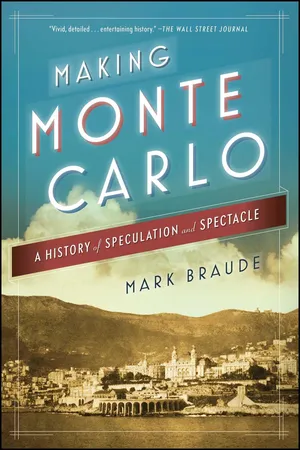
Making Monte Carlo
eBook - ePub

Making Monte Carlo

A History of Speculation and Spectacle

  1. 304 pages
  2. English
  3. ePUB (mobile friendly)
  4. Available on iOS & Android
eBook - ePub

Making Monte Carlo

A History of Speculation and Spectacle

About this book

"A brisk historical tour of the marketing and selling of the small principality of Monaco and its famous city
A well-researched, dramatic rags-to-riches urban tale" ( Kirkus Reviews ) of Monte Carlo's rise from small principality to prosperous resort town of the 1920s. Monte Carlo has long been known as a dazzling playground for the rich and famous. The "vivid, entertaining" ( The Wall Street Journal ) Making Monte Carlo traces a narrative history of the world's first modern casino-resort, from the legalization of gambling in Monaco in 1855—passed as a desperate bid to stave off bankruptcy—through the resort's improbable emergence as a glamorous gambling destination of to its decline in the wake of WWI and its subsequent reinvention in the 1920s until the inaugural Monaco Grand Prix in 1929, on the eve of the Wall Street crash that would largely spell the end of the freewheeling era.Along the way, we encounter a colorful cast of characters, including Francois Blanc (a professional gambler and cheat and eventual founder of Monte Carlo); Basil Zaharoff (notorious munitions dealer and probable secret owner of the casino for some years in the 1920s); Elsa Maxwell (hired as the casino's publicist in the late 1920s); RĂ©nĂ© LĂ©on (a visionary Jewish businessman with murky origins); Serge Diaghilev, Jean Cocteau, Coco Chanel, Pablo Picasso, and other satellite members of the Ballet Russes dance company; as well as Gerald and Sara Murphy and other American expats, such as Ernest Hemingway and F. Scott Fitzgerald."An engrossing examination of how politics, personality, and publicity coalesced to transform a sleepy village into a luxurious playground populated with casinos and beautiful people" ( Publishers Weekly ), Making Monte Carlo is a classic rags-to-riches tale set in the most scenic of European settings.
Frequently asked questions

Yes, you can cancel anytime from the Subscription tab in your account settings on the Perlego website. Your subscription will stay active until the end of your current billing period. Learn how to cancel your subscription.
At the moment all of our mobile-responsive ePub books are available to download via the app. Most of our PDFs are also available to download and we're working on making the final remaining ones downloadable now. Learn more here.
Perlego offers two plans: Essential and Complete
  • Essential is ideal for learners and professionals who enjoy exploring a wide range of subjects. Access the Essential Library with 800,000+ trusted titles and best-sellers across business, personal growth, and the humanities. Includes unlimited reading time and Standard Read Aloud voice.
  • Complete: Perfect for advanced learners and researchers needing full, unrestricted access. Unlock 1.4M+ books across hundreds of subjects, including academic and specialized titles. The Complete Plan also includes advanced features like Premium Read Aloud and Research Assistant.
Both plans are available with monthly, semester, or annual billing cycles.
We are an online textbook subscription service, where you can get access to an entire online library for less than the price of a single book per month. With over 1 million books across 1000+ topics, we’ve got you covered! Learn more here.
Look out for the read-aloud symbol on your next book to see if you can listen to it. The read-aloud tool reads text aloud for you, highlighting the text as it is being read. You can pause it, speed it up and slow it down. Learn more here.
Yes! You can use the Perlego app on both iOS or Android devices to read anytime, anywhere — even offline. Perfect for commutes or when you’re on the go.
Please note we cannot support devices running on iOS 13 and Android 7 or earlier. Learn more about using the app.
Yes, you can access Making Monte Carlo by Mark Braude in PDF and/or ePUB format, as well as other popular books in History & Entertainment Industry. We have over one million books available in our catalogue for you to explore.

Information

1


The Cunning and the Easily Duped

WHEN THE GAMBLING IMPRESARIO François Blanc arrived in Monaco in the spring of 1863, he would have seen three churches, a poorly built hotel next to a modest two-story casino, five paved roads, and a dozen alleyways, the whole scene enveloped in a light haze of dirt and dust whipped up by the cold northwesterly winds known as the mistral. From a distance, the prince’s palace perched up on the Rock of Monaco may have impressed, but a closer look would have spoiled the illusion. Inside, many of the walls were bare. The paintings that had once adorned them had recently been sold off, along with jewels and other family treasures amassed over six centuries of rule.
A Monégasque glimpsing Blanc would have been equally unimpressed by the sight of a jowly man in poor health, with a tonsure of unkempt white hair, wearing clothes that despite their obvious expense hung awkwardly on his small frame. This Blanc was no match for the one who populated the fantastic stories that had preceded his arrival: stories about the wild vagabond and exile, the card sharper, the prodigy, the charmer and showman with the pretty German wife nearly three decades his junior, the man richer than even their own Prince Charles III.
Any tales told about François Blanc were unlikely to have fazed the MonĂ©gasques. The idea that someone born so low could have gained so much by entirely legal methods would have struck them as laughable. As one of the most astute chroniclers of the age had put it, behind a great fortune there often hides “a crime which has been forgotten, because it was committed cleanly.” HonorĂ© de Balzac’s words appeared in 1835, the same year Monte Carlo’s future founder was carrying off his boldest swindle yet.

In the village of Courthézon that lies in the Rhone Valley, famed for its luscious wines, Marie-ThérÚse Blanc gave birth to identical twins. Her husband, Claude, a minor tax official, had died while his sons were in the womb. Perhaps as compensation for their humble beginnings, the widow Blanc gave her boys kingly names; the firstborn was Louis-Joseph, the younger Louis-François. It was December 12, 1806.
Though seemingly ill starred, the twins were born lucky in their own way. They entered the world at the opening of a century when more so than ever before, starting life poor and obscure in the provinces didn’t automatically mean ending it the same way. Louis-François, who went by François to distinguish himself from his brother, was the brighter of the two. He could do things with numbers that puzzled his village teachers. Having no family trade or plot to inherit, François and Louis left the valley as soon as they were old enough to care for themselves. There is no record indicating that the Blanc brothers ever returned to CourthĂ©zon, or that François offered any inspiring speeches about his humble beginnings once he’d achieved worldwide fame.
The brothers drifted from town to town in the centuries-old style of the compagnons, workers who crisscrossed the country on tours de France to apprentice under several masters. They took whatever jobs they could find, while François honed his own kind of craft in the boisterous back rooms of the inns and taverns they frequented in their travels. There he’d stake his and Louis’s wages on games of cards and dice, and was soon winning enough to support them both. In those years, professional gamblers rarely relied on luck alone. Most were skilled in a variety of useful arts, from bottom-dealing, to sharping cards, to manipulating rigged dice. And someone with François’s facility with numbers could have offered trumped-up odds to his opponents without much risk of getting caught, as the still novel concept of probability would have been unknown to most if not all of his opponents.
Winning the wages of hapless compagnons made for a lucrative business and by 1833 the Blancs had enough money to open a small bank in Bordeaux. The term bank applied loosely, as the depositors of that town merely provided the necessary float for the brothers to pursue their true interest, which was speculating on the bourse, the Parisian exchange. If half a dozen clients had ever tried withdrawing their accounts on the same day, the Banque Blanc would have folded.
François and Louis understood the bourse as an arena where skill and artfulness could trump luck. As with any contest, it could be fixed. For traders out in the provinces like themselves, the trick was getting information out of Paris before one’s competitors, and then buying or selling according to how the exchange had performed, before other traders caught up. This was a time when news still traveled slowly and inconsistently, just before the wide adoption of the wireless telegraph changed everything. The Blancs had heard stories about the Rothschild banking family and their continent-wide network of agents, all supposedly communicating with the help of specially trained carrier pigeons. The brothers also learned of harebrained schemes involving windmills: a miller on the outskirts of Paris opened his shutters to show a rise in stocks for the day and his neighbor did the same, and so on down the line until the message reached a trading house miles away; but these systems proved more maddening than profitable, as a single distracted miller could undo the whole chain.
Traders at that time coveted a bit of French ingenuity known as the télégraphe aérien (aerial telegraph). The genius of this state-run network lay in the simplicity of its semaphore system. An official in Tower A held a written message aloft for another official in Tower B to spy though his telescope and pass along in the same way to the next tower. Paris was connected to all the major cities in France in such a manner, but the network could only be used to relay official messages and private citizens were forbidden from building their own towers. So the Blancs devised a plan to profit from the télégraphe aérien as straightforward as the technology itself: they bribed as many telegraph officials as they could.
Their operation, focusing on the Parisian bond market, worked as follows: Messieurs Gormand and Franck were the Blancs’ two agents in Paris. Each trading day, one of them sent a package by morning mail coach to an official named Guibout, who ran the tĂ©lĂ©graphe atop City Hall in Tours, roughly halfway between Paris and Bordeaux. If bonds were up, Guibout received a pair of gloves; if bonds were down he got stockings, or sometimes a cravat. The same package included the day’s code, a random letter of the alphabet. Guibout would insert a typo into an official telegram, followed by the day’s code letter and then an H for hausse (rise), or a B for basse (fall). Conspirators at other towers recognized the code and passed it along with the erratum uncorrected. The final insider, working the Bordeaux tower, ran the message to the Blancs and they traded accordingly. Over the months the codes grew more complex, with specific colors of clothing indicating the magnitude of the day’s rise or fall. The mail carriers of France could be forgiven for thinking that Gormand and Franck of Paris and Guibout of Tours were engaged in some kind of intricate courtship ritual, or perhaps contemplating a move into the garment business. The Parisians sent more than 100 packages to Guibout between the summer of 1834 and the spring of 1836, during which time the Blancs netted about 100,000 francs.
The problem was that Guibout couldn’t man the Tours telegraph at all hours, so the Blancs brought on another confederate, named Lucas, to cover the post. This led to their undoing. When Lucas fell ill in the spring of 1836, a telegraph worker named Cailteau saw him through his last days and Lucas, wanting to pass along his good fortune to his caregiver, told him about the arrangement with the Blancs. He promised that Cailteau needed only to say the word to Guibout and he’d be set up to take his place. When Lucas died a few days later, Cailteau went straight to the director of the Tours telegraph, who launched an investigation. A package was intercepted; it contained a pair of yellow gloves and a note bearing only a single letter of the alphabet; a search of Guibout’s papers confirmed that codes had been transmitted. The French authorities arrested the Blancs and charged them with corrupting government officials. Guibout and his wife were also placed under arrest. The record is silent as to the fate of Gormand and Franck, the two Parisian agents.

At ten o’clock in the morning of March 11, 1837, guards opened the doors of the Palais-de-Justice in Tours to let in the gathered crowd, whose members were eager to have all of their worst suspicions about crooked financiers confirmed. They’d waited for hours to see how the “Affaire des tĂ©lĂ©graphes” would unfold. When the brothers entered, the court reporter could tell them apart only because François wore white glasses and Louis wore blue ones. The brothers were both dressed tastefully in black suits. The proceedings revealed that people who’d met the twins during their years of vagabondage hadn’t been left with any memories that could attest to lives dedicated to probity or hard work. A Marseillaise recalled seeing the Blancs forcibly ejected from a club there called Le Salon. At a cafĂ© in Lyon, François had been spotted over a two-day stretch winning at cards with alarming consistency and he’d also attended a course in “prestidigitation” in the same town. At a private gambling club in Paris, after winning considerable amounts, the brothers were asked not to return, on suspicion of fraudulent methods. In Brussels, François had gone by the name Leblanc and had made inquiries about how one might build a private network of telegraph towers.
The brothers didn’t deny any of the charges against them. Louis testified, with what the court reporter described as “a kind of dignity” in his voice, that they’d only “met their adversaries on equal terms.” Every smart trader, said Louis, employed his own method to attain secret information—that was how the game worked. He described the use of windmills and of carrier pigeons. He pointed to the methods employed by the Rothschilds, whom he noted were well respected and received by royalty, a comment that prompted hoots and whistles from the gallery. François, in his testimony, added that even with what little information they did attain, they still often lost huge sums.
Since the bourse was in truth little more than “an infamous gambling-hell,” argued counsel for the defense, the methods employed by his clients, while undeniably callous, only epitomized the kind of shrewdness and ingenuity one needed to survive in the modern marketplace. “An idea occurred to the Blanc Brothers,” he told the court, “which could not have occurred to me, or to you either, for ordinary people who do not frequent the Stock Exchange would be simply incapable of conceiving such a thing. . . . If you want to play on the Exchange you must keep up your guard, because there you will only meet two kinds of people, the cunning and the easily duped, and if you don’t want to be a dupe than you had better be cunning.”
It was hard to argue with such clear logic, and no law had yet been written to adequately address the practice of insider trading. The court acquitted Guibout’s wife outright, and though the Blanc brothers and Guibout were found guilty, they received only small fines to cover court costs. François and Louis left town for Paris, to try their hand at a different kind of speculation.

Any gambler newly arrived to Paris at that time would have soon found his way to the Palais-Royal, the city’s hub for vice and intrigue of all sorts. The four-story palace complex occupied an entire block in the heart of the first arrondissement, just across the Rue de Rivoli from the Louvre. It had served as the Parisian residence of the OrlĂ©ans dynasty until the twilight of the ancien rĂ©gime, when the cash-strapped duc d’ OrlĂ©ans, Louis Philippe Joseph, rented out the top floors as apartments and partitioned the adjoining arcades into 180 leasable units for commercial use. The palace gardens were opened to the public and, as forces conspired to turn the once influential duc into a hated enemy of the Revolution, city officials lost interest in policing this potent reminder of aristocratic excess. Few other sites in Paris attracted such a wild mix of people. Loan sharks, flĂąneurs, pamphleteers, musicians, and hawkers of wares both fine and flimsy gathered in the salons, theaters, restaurants, bookstores, and brothels of the palace arcades. A curious visitor might be shown the cafĂ© table the journalist Camille Desmoulins mounted on the eve of the Revolution to make a fiery speech that stoked a citywide riot, or the shop a few steps away where the young Charlotte Corday bought the knife she used to assassinate the ferocious Jean-Paul Marat after the Revolution turned to Terror.
Amid the upheaval of the 1790s, the stipulations the duc d’OrlĂ©ans had laid out in the original commercial leases came up for some creative reinterpretation. After a series of transfers and subleases (and some well placed bribes), gambling houses opened in the arcades in 1791, with winking approval from the state. For the first time in the city’s history, working Parisians could legally play the same games that members of the aristocracy had at court, in a public and open setting. Soon more than one hundred gambling operations populated the Palais-Royal and its vicinity.
In 1793 the Revolutionary Government declared the OrlĂ©ans palace and its arcades national property. The duc d’OrlĂ©ans had by then fallen to the guillotine (though not before trying to buy time by reinventing himself as the reform-minded “Philippe ÉgalitĂ©â€), and the people of France weren’t especially keen on debating the intricacies of his will. Nor did the new owners of the Palais-Royal see any reason to change established practices, and so gambling continued there as before, though the myriad small operations gradually consolidated into fewer houses. By the time the Blancs arrived in Paris, the arcades held only five clubs.
The French called these clubs enfers (hells)—with love or disdain depending on the speaker. Balzac set the opening of his first hit with the reading public, La Peau de chagrin (The Wild Ass’s Skin), at the gates of the hell at No 36. Inside, “the paper on the walls is greasy to the height of your head, there is nothing to bring one reviving thought. There is not so much as a nail for the convenience of suicides. The floor is worn and dirty. An oblong table stands in the middle of the room, the tablecloth is worn by the friction of gold, but the straw-bottomed chairs about it indicate an odd indifference to luxury in the men who will lose their lives here in the quest of the fortune that is to put luxury within their reach.”
The novelist didn’t have to do much exaggerating to conjure such a description; the Palais enfers could indeed be raucous and inhospitable. People joked about how perfectly these hells were located since the Seine flowed just a short walk away, should you suffer an unlucky streak that could only be cured by throwing yourself in. Still, even the most austere of the Palais houses exuded a rough kind of glamour, particularly for new arrivals to Paris who relished the proximity to big-city decadence and the thrill of potential ruin. Each enfer had its particular flavor: No 36 barred entrance to women and served no strong spirits; people with strong royalist sympathies favored No 50; and if one wanted a quiet game, best avoid the crowded No 154 and head instead to the decrepit No 113. This had been the most popular of the e...

Table of contents

  1. Cover
  2. Dedication
  3. Epigraph
  4. Map of the Blue Train Route
  5. Map of the Circuit de Monaco
  6. Map of Monte Carlo
  7. Preface: Monte Carlo Stories
  8. 1. The Cunning and the Easily Duped
  9. 2. The Art of Misdirection
  10. 3. The Antechamber of Death
  11. 4. Complete Disorder Reigns
  12. 5. We Do Not Approve of Gaming Houses
  13. 6. A Whole Town Remains to Be Built!
  14. 7. This Little Paradise
  15. 8. Karl Marx's Cough
  16. 9. Prodigal Sons and Wayward Daughters
  17. 10. Monaco at War
  18. 11. The Merchant of Death
  19. 12. Salvation by Exile
  20. 13. The Blue Train
  21. 14. A Monument to Frivolity
  22. 15. Enter Elsa
  23. 16. The Fast Life
  24. 17. One-Way Street
  25. Postscript: Faites Vos Jeux
  26. Acknowledgments
  27. Archival Sources
  28. About Mark Braude
  29. Notes
  30. Index
  31. Copyright