
eBook - ePub
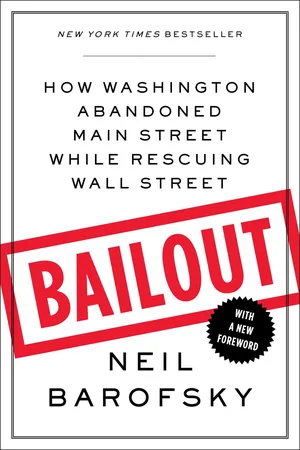
Bailout
An Inside Account of How Washington Abandoned Main Street While Rescuing Wall Street
- 288 pages
- English
- ePUB (mobile friendly)
- Available on iOS & Android
eBook - ePub
Bailout
An Inside Account of How Washington Abandoned Main Street While Rescuing Wall Street
About this book
In this "jaw-dropping play-by-play of how the Treasury Department bungled the financial bailouts" (USA TODAY), a former federal prosecutor offers behind-the-scenes proof of the corrupt ways Washington officials serve the interests of Wall Street.
At the height of the financial crisis in 2008, Neil Barofsky gave up his job as a prosecutor in the esteemed US Attorney’s Office in New York City, where he had convicted drug kingpins, Wall Street executives, and perpetrators of mortgage fraud, to become the inspector general in charge of overseeing administration of the bailout money. From the onset, his efforts to protect against fraud and to hold big banks accountable for how they spent taxpayer money were met with outright hostility from Treasury officials in charge of the bailouts.
In this bracing, page-turning account Barofsky offers an insider’s perspective on the mishandling of the $700 billion TARP (Troubled Asset Relief Program) bailout fund. With vivid behind-the-scenes detail, he reveals the extreme lengths to which our government officials were willing to go in order to serve the interests of Wall Street firms at the expense of the broader public—and at the expense of effective financial reform.
Bailout is a riveting account of Barovsky’s plunge into the political meat grinder of Washington, as well as a vital revelation of just how captured by Wall Street our political system is and why the too-big-to-fail banks have become even bigger and more dangerous in the wake of the crisis.
At the height of the financial crisis in 2008, Neil Barofsky gave up his job as a prosecutor in the esteemed US Attorney’s Office in New York City, where he had convicted drug kingpins, Wall Street executives, and perpetrators of mortgage fraud, to become the inspector general in charge of overseeing administration of the bailout money. From the onset, his efforts to protect against fraud and to hold big banks accountable for how they spent taxpayer money were met with outright hostility from Treasury officials in charge of the bailouts.
In this bracing, page-turning account Barofsky offers an insider’s perspective on the mishandling of the $700 billion TARP (Troubled Asset Relief Program) bailout fund. With vivid behind-the-scenes detail, he reveals the extreme lengths to which our government officials were willing to go in order to serve the interests of Wall Street firms at the expense of the broader public—and at the expense of effective financial reform.
Bailout is a riveting account of Barovsky’s plunge into the political meat grinder of Washington, as well as a vital revelation of just how captured by Wall Street our political system is and why the too-big-to-fail banks have become even bigger and more dangerous in the wake of the crisis.
Frequently asked questions
Yes, you can cancel anytime from the Subscription tab in your account settings on the Perlego website. Your subscription will stay active until the end of your current billing period. Learn how to cancel your subscription.
No, books cannot be downloaded as external files, such as PDFs, for use outside of Perlego. However, you can download books within the Perlego app for offline reading on mobile or tablet. Learn more here.
Perlego offers two plans: Essential and Complete
- Essential is ideal for learners and professionals who enjoy exploring a wide range of subjects. Access the Essential Library with 800,000+ trusted titles and best-sellers across business, personal growth, and the humanities. Includes unlimited reading time and Standard Read Aloud voice.
- Complete: Perfect for advanced learners and researchers needing full, unrestricted access. Unlock 1.4M+ books across hundreds of subjects, including academic and specialized titles. The Complete Plan also includes advanced features like Premium Read Aloud and Research Assistant.
We are an online textbook subscription service, where you can get access to an entire online library for less than the price of a single book per month. With over 1 million books across 1000+ topics, weāve got you covered! Learn more here.
Look out for the read-aloud symbol on your next book to see if you can listen to it. The read-aloud tool reads text aloud for you, highlighting the text as it is being read. You can pause it, speed it up and slow it down. Learn more here.
Yes! You can use the Perlego app on both iOS or Android devices to read anytime, anywhere ā even offline. Perfect for commutes or when youāre on the go.
Please note we cannot support devices running on iOS 13 and Android 7 or earlier. Learn more about using the app.
Yes, you can access Bailout by Neil Barofsky in PDF and/or ePUB format, as well as other popular books in Politics & International Relations & Political Biographies. We have over one million books available in our catalogue for you to explore.
Information
1

Fraud 101
I WAS SITTING AT my desk after hours on Wednesday, October 15, 2008, when the phone rang. Iād been sifting through a pile of FBI reports about my newest caseāa loathsome ring of predators who were stealing houses out from under home owners who had fallen behind in their mortgage payments. Looking down at the caller ID, I saw that it read us attorney. Shit, I thought. It was my boss, Mike Garcia, the U.S. attorney for the Southern District of New York, and I figured that either I was in trouble or he was going to dump something urgent on me.
āYou got a minute?ā he asked. āCāmon up.ā
As I headed out of my office, I tried to think of who I might have pissed off enough to warrant getting called to the principalās office. While I was waiting for Mike to get off the phone, he handed me a copy of a statute describing the creation of an inspector generalās office for the Troubled Asset Relief Program, the $700 billion bank bailout Congress had passed less than two weeks earlier.
When he hung up, Mike asked, āDid you know that when they passed TARP, they also created a $50 million law enforcement agency to oversee it?ā
āNo, I had no idea,ā I replied.
He then started describing the new office in detail. It would have two roles. First, it was going to be a full-fledged law enforcement agency, a mini-FBI for the TARP, which would try to catch the inevitable criminal flies that would be drawn to the $700 billion in government honey. It would also have an audit function, providing Congress with regular reports on how the Treasury Department was carrying out the bailout. Relieved that I wasnāt in trouble, I half listened while trying to figure out why Mike was telling me about this new agency. Rumors were swirling around the office that with the presidential election just a few weeks away, Mike, who was a Bush appointee, was about to step down. I thought maybe he was taking the inspector general job and that he might be trying to recruit me to go with him. I began planning my polite refusal.
āSo, you think youād be interested?ā Mike asked, snapping my attention back.
āIn what?ā I responded, making a mental note to pay closer attention when the boss was talking.
āIn the job,ā he said.
āWhat job?ā I asked, still not understanding what he was getting at.
He looked exasperated and said, āThe special inspector general job.ā
I was stunned. As a federal prosecutor I had been fortunate to investigate and try some remarkable cases, but I sucked at office politics. I had a hard time keeping my opinions to myself, and my aversion to bullshit and hypocrisy occasionally led to an Aspergerās-like bluntness. That didnāt always endear me to people, particularly some of my recent supervisors. (Months later, Mike explained that was partly why he had recommended me: āYou can be kind of a dick at times, and they needed someone who could be kind of a dick.ā) And although Mike had recently promoted me to lead the officeās newly created mortgage fraud group, he had also passed me over for a supervisory job a couple of years earlier.
Now, out of nowhere, he was asking me if I was interested in a job that he explained would require a nomination from President George W. Bush and confirmation by the U.S. Senate. Clearly this job would be a highly sought after political appointment for the type of person who aspires to such things. Did Mike not realize that I was a nobody? That I knew almost no one in Washington? More important, did he not realize that I was a lifelong Democrat who had recently contributed to the Barack Obama campaign? Me? A Bush appointee?
It wasnāt just that I couldnāt see how I could possibly get the nomination; I wasnāt interested. I didnāt even really know what an inspector general did. My experiences with IGs, as they were called, were largely limited to a handful of cases Iād handled back when I first started as a prosecutor in 2000. My friend and colleague Mike Purpura used to joke that the true sign a case was going to prove a colossal waste of time was if it involved what he referred to as āthose three magic letters, O-I-Gāāfor Office of the Inspector General. I started thinking of excuses.
āIs the job in New York?ā I asked.
āNo, D.C., of course itās in D.C.,ā Mike responded in a tone that made clear he didnāt subscribe to the old adage that there is no such thing as a stupid question.
I explained that the timing really wasnāt right. I was getting married in a few months to my fiancĆ©e, Karen, for one thing, and I was preparing to try a big case against the lawyer Joseph Collins, who had been charged in a multibillion-dollar accounting fraud related to the collapsed giant commodities broker Refco. Iād worked like a rented mule to get the case indicted. It had become my āwhite whale,ā and I couldnāt imagine walking away from it. Not only that, but I was also just getting the mortgage fraud group off the ground. These were some of the most appalling cases imaginable, with predators feasting on struggling borrowers and clueless banks while lining their own corrupt pockets. I was looking forward to bringing these criminals to justice. Mikeās face told me that he wasnāt buying any of my excuses, so I rolled out the big gun.
āAnd, Mike, you know that Iām a Democrat, right?ā I said, pausing for a moment for effect, then delivering my coup de grĆ¢ce. āAnd just last week I donated to Obamaās campaign.ā
I was sure that would be a deal killer, but Mike persisted.
āI thought of you exactly because of Collins and the mortgage fraud group. Those cases are exactly the types of experiences that the White House is looking for. As for your politics, they wonāt care; this is a merit appointment.ā
I wondered for a moment where Mike had found the unicorns and fairies to hand out those āmeritā Bush nominations to Obama-contributing Democrats.
Then Mike pulled out his āGod and countryā speech. The Southern District office stands just a few blocks from Ground Zero, and he reminded me of the sacrifices some of the recent legends of the office had made after the terrorist attacks on September 11, 2001, dropping everything to work around the clock chasing down the terrorists.
āThey had expertise in terrorism, and it was never a question that they would step up. That is what this office does. Our people step up and sacrifice when they need to.ā
Now he had my full attention. On that perfect blue-skied morning as I walked up the stairs out of the subway on my way to work, I saw a woman crying hysterically and pointing at the smoking gash in the North Tower. She told me that she had just seen an American Airlines plane strike the building, and I stood next to her along with dozens of others as we watched the rest of the terror unfold.
When what seemed like strange debris began falling from the towers, I commented to a man next to me about it, uncomprehendingly, and he responded simply, āDebris donāt move like that.ā With horror I immediately realized we were watching people jumping to escape the raging fire. I had tried hard to forget those images, along with the sound of the blast and the heat of the fireball that burst from the guts of the South Tower when the second plane struck. Every night for months when I tried to close my eyes to sleep, I would relive those moments. It is still difficult to look at 9/11 footage on television without breaking down.
āWhat weāre going through now is the economic equivalent of 9/11,ā Mike continued. āItās time for you to step up. The American taxpayer has paid a lot of money to train you and give you this unique set of skills. Who else is going to protect the public from what could be a $700 billion clusterfuck of fraud?ā
It was a good speech.
There was no question that the country was in the midst of a true crisis. The Dow Jones Industrial Average had plunged more than 5,500 points over the past year, and once iconic New York firms such as Bear Stearns and Lehman Brothers had melted down. Unprecedented sums of money were being poured into the insurance giant AIG to keep it afloat. The value of peopleās 401(k)s, including my own, would lose a third of their value, $2.8 trillion in all, between September 2007 and December 2008.1 Foreclosures had also been exploding nationwide, with more than 2.3 million properties receiving filings in 2008 alone, an 81 percent increase from 2007 and a 225 percent increase from the year before that.2 As chief of the mortgage fraud group, I had seen one of the causes: widespread fraud involving sophisticated rings of professionals who took advantage of the lendersā complete disregard of their underwriting standards as part of Wall Streetās blind quest for profit and fees. I had seen the predatory practices of those criminals, which still had the capacity to shock me even after spending years prosecuting international narcotics kingpins. Though I knew in my heart that Mike was right, that it was my duty to put in for the job, I also couldnāt imagine giving up the only job Iād ever wanted, disrupting my marriage before it even really began, and leaving the city that I loved.

THE OFFICE OF the U.S. Attorney for the Southern District of New York, known simply as āthe Office,ā is just one of the ninety-four U.S. Attorneyās Offices in the country. But the Office is different: it has long been the preeminent prosecutorās office in the country. In recent years, it has handled a string of high-profile cases, including landmark Wall Street prosecutions against executives like Michael Milken, Ivan Boesky, Bernie Ebbers, and Bernie Madoff, as well as those against the terrorists responsible for the 1993 World Trade Center attack and the bombings of the U.S. embassies in Tanzania and Kenya in 1998.
I got the bug to work in the Office while at law school at New York University, when Professor Andrew Schaffer regaled my criminal procedure class with war stories from his own time in the Office. I knew I needed experience at a law firm before I could get a job there, so after I graduated, I joined one of the large New York City firms before moving to a smaller litigation boutique to begin a three-and-a-half-year apprenticeship under two brilliant white-collar defense lawyers, Robert Morvillo and Elkan Abramowitz. They taught me both the nuts and bolts of being a lawyer and the necessity of following a strict ethical code while doing so. They had each served as chief of the Criminal Division of the Office, and I hoped that by working my tail off I could gain their support for my application.
I distinctly remember sitting in my office in the spring of 2000 when the call came in. āPlease hold for Mary Jo White.ā I was ecstatic. It was widely known that Mary Jo, whoād been running the Office for eight years, called applicants only with offers, not rejections. I was going to be an assistant U.S. attorney for the Southern District of New York.
Like all new prosecutors, I started in General Crimes and then graduated to the Narcotics Unit. Iād never aspired to work on narcotics cases, but I knew all prosecutors spent a year in Narcotics after completing General Crimes, and I figured I wouldnāt spend one day over the required minimum.
That changed after I started working for Richard Sullivan, the Narcotics Unitās chief. He was actually an odd match for me. A tall, intense, deeply religious man who had never touched a drop of alcohol in his life, Rich worked tirelessly: he was always already at work when I arrived, and he often stayed after Iād left. There were a lot of brilliant lawyers at the Office, and Rich was definitely one of them. But what struck me about him was how deeply committed he was to the work. Working for Rich was a revelation, and I started following him around like a puppy.
In 2002, Rich formed the International Narcotics Trafficking Unit, known as INT, to go after the most sophisticated transnational narcotics organizations. He saw evil in the drug world and believed that he could make a difference. Joining INT meant buying into that mission completely and learning how to be a prosecutor under Richās exacting standards wasnāt easy. But it proved invaluable. Rich firmly believed that the greatest sins a prosecutor could commit were being outworked or under-prepared. You would have a short and miserable time in his unit if you ever went into court without having done your homework.
Once he assigned me to a case that was set to go to trial in just three weeks. The defendant was the first to be extradited from Colombia solely on money-laundering charges, and Rich let me know the gravity of the case when he assigned it to me.
āLosing is not an option,ā he told me. āIf you lose this case, extradition from Colombia will end as we know it.ā He repeated that warning to me every day through the end of the trial. I didnāt sleep much, and I probably lost about ten pounds, but the anxiety and hard work paid off: the jury was out for less than an hour before convicting the defendant on all counts.
Years later, when I had a staff of my own at SIGTARP, the question āWhat would Sullivan do?ā was an important guidepost in navigating the treacherous waters of Washington. I tired to make his ethos of āalways the right thing, rarely the easy thingā my own.
Little did I know how relevant the experiences I would gain through investigating, prosecuting, and fighting over those cases would be when I later tried to gain my bearings in Washington as the special inspector general for TARP.
In early 2004, Rich had asked me to jump onto an investigation into what would prove to be the worldās largest narco-terrorist cartel, the Revolutionary Armed Forces of Colombia, or FARC. FARC was one of South Americaās oldest insurgencies, an old-school Marxist-Leninist guerrilla organization that had fallen on hard times after one of its sources of funding, the former Soviet Union, collapsed. To fund its terrorist activities, FARC forcibly moved into the nuts and bolts of cocaine production. It wasnāt your typical cartel of powerful traffickers, it was a 20,000-member army that operated out of the Andean jungle and controlled a large portion of the Colombian countryside. As we later learned from our investigation, they ruled with an iron fist, ripping children from local peasant families and forcing them to āenlist,ā routinely raping their female recruits, and often engaging in the gruesome torture and murder of those who dared to steal from their narcotics enterprise (including dismembering a suspected thief alive with a chainsaw in front of his friends and family). The FARC would even murder the child ārecruitsā who later tried to escape, often ordering other children to carry out the executions.3 When I asked Rich how I was supposed to proceed, he told me simply to go down to BogotĆ” and figure it out.
In doing so, we were going to be stepping on the toes of the Justice Department, a preview of the hostility I would later have to deal with at Treasury. The Office had an occasionally contentious relationship with Main Justice, or DOJ, the Washington division of the Department of Justice. All U.S. Attorneyās Offices report to the deputy attorney general of the United States, who in turn reports to the attorney general. Also reporting to the deputy attorney general is an assistant attorney general who oversees a bevy of Washington-based prosecutorial sections that are divided into subject matter areas such as fraud, organized crime, money laundering, narcotics, civil rights, and terrorism. Tho...
Table of contents
- Cover
- Dedication
- Cast of Characters
- Foreword to the Paperback Edition
- Chapter 1: Fraud 101
- Chapter 2: Hank Wants to Make It Work
- Chapter 3: The Lapdog, the Watchdog, and the Junkyard Dog
- Chapter 4: I Wonāt Lie for You
- Chapter 5: Drinking the Wall Street Kool-Aid
- Chapter 6: The Worst Thing That Happens, We Go Back Home
- Chapter 7: By Wall Street for Wall Street
- Chapter 8: Foaming the Runway
- Chapter 9: The Audacity of Math
- Chapter 10: The Essential $7,700 Kitchen Assistant
- Chapter 11: Treasuryās Backseat Driver
- Chapter 12: Happy Endings
- Afterword
- Acknowledgments
- About Neil Barofsky
- Notes
- Index
- Copyright