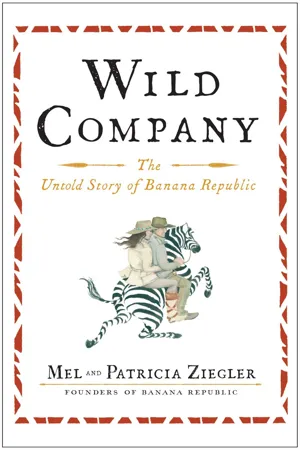
Wild Company
eBook - ePub

Wild Company

The Untold Story of Banana Republic

  1. 224 pages
  2. English
  3. ePUB (mobile friendly)
  4. Available on iOS & Android
eBook - ePub

Wild Company

The Untold Story of Banana Republic

About this book

In the tradition of Pour Your Heart Into It and How Starbucks Saved My Life, a surprising and inspiring memoir from the founders of Banana Republic. With $1, 500 and no business experience, Mel and Patricia Ziegler turned a wild idea into a company that would become the international retail colossus Banana Republic. Re-imagining military surplus as safari and expedition wear, the former journalist and artist created a world that captured the zeitgeist for a generation and spoke to the creativity, adventure, and independence in everyone. In a book that's honest, funny, and charming, Mel and Patricia tell in alternating voices how they upended business conventions and survived on their wits and imagination. Many retail and fashion merchants still consider Banana Republic's early heyday to be one of the most remarkable stories in fashion and business history. The couple detail how, as "professional amateurs, " they developed the wildly original merchandise and marketing innovations that broke all retail records and produced what has been acclaimed by industry professionals to be "the best catalogue of all time." A love story wrapped in a business adventure, Wild Company is a soulful, inspiring tale for readers determined to create their own destiny with a passion for life and work and fun.
Frequently asked questions

Yes, you can cancel anytime from the Subscription tab in your account settings on the Perlego website. Your subscription will stay active until the end of your current billing period. Learn how to cancel your subscription.
No, books cannot be downloaded as external files, such as PDFs, for use outside of Perlego. However, you can download books within the Perlego app for offline reading on mobile or tablet. Learn more here.
Perlego offers two plans: Essential and Complete
  • Essential is ideal for learners and professionals who enjoy exploring a wide range of subjects. Access the Essential Library with 800,000+ trusted titles and best-sellers across business, personal growth, and the humanities. Includes unlimited reading time and Standard Read Aloud voice.
  • Complete: Perfect for advanced learners and researchers needing full, unrestricted access. Unlock 1.4M+ books across hundreds of subjects, including academic and specialized titles. The Complete Plan also includes advanced features like Premium Read Aloud and Research Assistant.
Both plans are available with monthly, semester, or annual billing cycles.
We are an online textbook subscription service, where you can get access to an entire online library for less than the price of a single book per month. With over 1 million books across 1000+ topics, we’ve got you covered! Learn more here.
Look out for the read-aloud symbol on your next book to see if you can listen to it. The read-aloud tool reads text aloud for you, highlighting the text as it is being read. You can pause it, speed it up and slow it down. Learn more here.
Yes! You can use the Perlego app on both iOS or Android devices to read anytime, anywhere — even offline. Perfect for commutes or when you’re on the go.
Please note we cannot support devices running on iOS 13 and Android 7 or earlier. Learn more about using the app.
Yes, you can access Wild Company by Mel Ziegler,Patricia Ziegler in PDF and/or ePUB format, as well as other popular books in Betriebswirtschaft & Modedesign. We have over one million books available in our catalogue for you to explore.

Information

Images
1
Images
The Racket Begins with a Jacket
Images
If you took 1,500 one-dollar bills and laid them end to end, they would stretch all of 750 feet. That gets you only three-quarters of the way down a crosstown block in Manhattan. We had to stretch those dollars into a lifetime—a lifetime free of ever having to work for anyone other than ourselves again.
I was a writer in my early thirties, and Patricia, several years younger, an artist. Newly in love, not wanting to be apart for a second, we itched to travel and see the world. That was never going to be possible if we continued to live month to month. We had met at the San Francisco Chronicle, where I worked as a reporter and Patricia as an illustrator and courtroom artist. The Chronicle job served up some stimulating opportunities for a young reporter in the 1970s, and I jumped and cajoled my way into as many as I could. I wrote several stories exposing notorious cult leaders (and questionable gurus such as Werner Erhard, the founder of est) then flourishing in San Francisco’s fertile permissiveness, covered the charismatic philosopher Alan Watts’s Zen funeral and the Patty Hearst kidnapping by a strange group called the Symbionese Liberation Army, interviewed Andy Warhol and other cultural icons, and wrote the first profile on California’s eccentric new young Zen-spouting governor named Jerry Brown. Even so, many of my best ideas were rejected by editors for reasons that had nothing to do with the quality of the idea. Budget, for instance. As the joke went, a notoriously stingy management considered venturing across the Bay Bridge to Oakland to be an out-of-town story subject to layers of approvals. A union shop—every reporter hired was required to join and pay dues—the prevailing mentality in the city room favored seniority over initiative. Plum assignments went to tired old-timers who hacked out stories between swills of Jack Daniel’s at Hanno’s, the dive in the alley behind the Chronicle Building. If I happened to sneak a good story past the city editor and into the paper one day, I was punished the next day by being handed a pile of obituaries to write. I knew I had to get out of there.
Images
It was an eventful time in San Francisco, and working at the Chronicle was exciting. I’d jump on the cable car to work, and many long nights would be spent in lively conversation with our colleagues and politicos at the Washington Square Bar and Grill, the North Beach media hangout. As a sketch artist in 1975 and 1976, I was assigned to cover the trial of Patty Hearst, the kidnapped newspaper heiress turned bank robber, and the trial of Sara Jane Moore, for the attempted assassination of President Gerald Ford. Thrilling as it was to see my work published on page one the morning after I sketched it, there was much downtime between such assignments and a lot of grousing from our colleagues about management, wages, and one another. Of the fifty or sixty people working in the city room, many of them our friends, most had been there considerably longer than we had—some even for twenty or thirty years. Not going to happen to us, we adamantly agreed. I started taking on freelance magazine assignments to fill the lulls, hoping I could soon be able to live on this work alone, trading in the day job for what appeared to be freedom.
One day I came home from work and shot Mel a playful I’ve-got-something-to-tell-you look. He had returned from an earlier shift and was on the couch reading.
Looking up, he asked, ā€œWhat?ā€
ā€œGuess what?ā€ I could not wait to tell him. ā€œI just quit!ā€
ā€œNo!ā€ he replied impishly. ā€œI was going to surprise you—so did I.ā€
We were counting on freelance magazine assignments to tide us over until we figured out what to do. First we downsized, moving from our two-floor San Francisco apartment on Russian Hill to a two-bedroom house off Highway 1 in Mill Valley. The cars whizzed by at night, their headlights penetrating our blinds and invading our sleep. Magazine stories paid well but were irregular. Mimicking our moods, Indian summer gave way to a particularly long, cold, and rainy winter. The rough-sawn redwood interior walls of our rented house kept the days dark. We knew we had to find a way out. While many of our journalist colleagues had invested their union salaries in Marin County houses when they were selling for less than six figures, we were barely making the rent.
We weren’t panicking—we were too young and optimistic for that. We were interested in money only so it could buy us the freedom to paint, write, and travel. We didn’t spend much. Our entertainments were hiking, biking, reading, and home-cooked meals with friends. Mel drove an old, beat-up Volkswagen, and I, an old Datsun. Even our cats were frugal, living off the local birds for their meals. We didn’t dream about a ā€œsomedayā€ with a house, children, and vacations in Hawaii. We viewed the future as one big, mysterious, open-ended possibility, which was what we had wanted, but our new circumstances were beginning to crimp. Freelancing, it became clear, wasn’t so free.
Mel came home from the library one afternoon with a copy of Napoleon Hill’s Think and Grow Rich and tossed it to me.
ā€œMaybe this is what we need to do,ā€ he said.
The book prompted three basic questions: How much money do I want to make? How long do I give myself to make it? How will I make it?
We wrote down our answers separately and compared them. We had both scribbled ā€œa millionā€ and ā€œfive years.ā€ In 1978, $1 million was a number that any twentysomething middle-class American might have dreamed of making. Five years was the longest period we could envision. That both of us had come up with the same number and time frame validated our answers. Then we each looked at what the other had jotted down as an answer to the ā€œhowā€ question. Again, the same: ā€œstart a business.ā€
But what business?
Several rainy days later, we had yet to find a business idea. The phone rang with a welcome magazine assignment for Mel to explore Australia with several other journalists. ā€œIt’s probably just a junket,ā€ he said, ā€œbut it’ll pay a couple of months’ rent.ā€ While Mel went off to the sunny Southern Hemisphere, I braved the next few weeks home alone finishing up my local fashion column and putting the final touches on a magazine assignment about mail-order clothing.
Images
Toward the end of the Australian junket, I wandered off one day into the backstreets of Sydney and stumbled on a ā€œdisposal store,ā€ which is what Australians call their surplus stores. I had been drawn to military surplus clothing since my days as a college student in the 1960s. Like others of my generation, I liked to wear surplus clothing because it was cheap. I also got a tickle from the paradox of being stridently antiwar yet happy to attire myself in military detritus. Until I stepped into the Sydney disposal store that day, most of the surplus I’d seen was originally issued to American soldiers. I was thrilled to find for the first time other surplus from Australia, Britain, France, and elsewhere. One item especially caught my fancy: a British Burma jacket. Made of thick but soft khaki cotton twill, it looked like a safari jacket. It had the tailored feeling of a fine garment. I had to have it, if only to wear it when I landed in San Francisco the following day. I wanted to see Patricia’s reaction.
Patricia had exquisite taste and a limited budget, a dichotomy she balanced with a talent for spying gems at flea markets and vintage stores. Most people looking at her thought she’d maxed out the credit card on Madison Avenue, when she’d put herself together for pennies. I never thought much about clothing, which led to playful repartee between us. I needled her for being a fashionista, contrasting myself as someone who couldn’t care less about what he wore. I claimed to dress in the ā€œfirst availableā€ clothing I found in my closet. But she was too smart to accept my preposterous claim, countering nimbly that I had selected every piece of clothing in my closet.
ā€œEveryone thinks about what they wear,ā€ she said, laying me bare, ā€œeven people like you who claim they don’t.ā€
Walking jauntily out of customs at San Francisco International Airport in my new British Burma jacket, topped off with an Australian bush hat I also bought in the disposal store, was meant to be a playful concession to her irrefutable point.
Images
A tan man in a khaki bush jacket and an olive green wide-brimmed hat pinned up on one side strode out of the glass doors of customs. I almost didn’t recognize Mel. He’d been gone two weeks, the longest we’d been apart since we’d met over two years earlier. I saw him anew. My heart quickened as I watched him, with his usual intensity, searching for my face in the waiting crowd—and then our eyes met. He looked great. Our embrace knocked off his hat, an authentic Australian Army bush hat with the official puggaree band and medallion, he was quick to point out. But it was not his hat that most intrigued me. It was the jacket. How perfect the color, the raised lines of twill, the slightly worn collar and cuffs. This four-pocket jacket screamed ā€œauthenticā€ and ā€œadventure.ā€ He caught my stare.
ā€œLike it?ā€ he said with a grin.
Images
Driving home, Mel regaled me with stories of the Outback and the Great Barrier Reef, but my eyes kept drifting from his face to the jacket. Something was different. Had he acquired this new worldliness, this rather heroic nonchalance, from his adventures Down Under, or was it the jacket?
I had been fascinated by the transformative power of clothing since my first job at sixteen in a department store in downtown San Francisco. Visually starved by a childhood of Catholic school uniforms, I ravenously studied the dressing habits of the clientele from the more sophisticated side of the city. It became clear to me that sartorial habits communicated as much as Professor Henry Higgins discerned from accents. I began to understand how clothes conveyed character, charisma, and class, and with a newly refined eye, I picked out treasures lost in the bins of secondhand stores and flea markets, making slight alterations when necessary, to stretch my small clothing budget. Mel’s new jacket said with panache close to everything that I and the friends I admired valued in life: character, adventure, heritage, and independence, especially from the frivolous dictates of fashion. However, it could use some new buttons.
Mel trusted me with the improvements. I added suede elbow patches and leather trim on the cuffs and collar, and swapped the metal military buttons for wooden ones. He loved the jacket even more and thanked me profusely.
ā€œMy favorite jacket of all time,ā€ he said, and he wore it almost every day.
Images
With Patricia’s classy refinements, the bush jacket became my proudest possession. Never had I been more at home in a piece of clothing. The jacket had an alchemical effect. I felt roguish and buoyant. Wearing it, I seemed to walk taller, with a more worldly gait. Everywhere I went, people stopped me with a comment or question.
ā€œWhat a great jacket!ā€
ā€œWhere did you get that fabulous jacket?ā€
ā€œExcuse me, do you mind if I ask you where you bought your jacket?ā€
On and on and on.
The jacket had a message for me, and it didn’t take me long to get it: here was the business we’d been looking for. Patricia got the same message on her own. Yes!
Between us, we had $1,500 in our bank accounts. We would use it to start a company that would sell jackets like the British Burma jacket and anything else like it we could find.
Therein lay the full and complete business plan of a writer and an artist who had quit their jobs to make it on their own.
ā€œWhat should we name it?ā€ Patricia wondered.
That didn’t take me a second.
ā€œBanana Republicā€ popped into my head the moment she asked. What better proverbial source of military surplus than politically unstable tropical countries? I fantasized that routine coups produced an abundance of disposed uniforms from toppled regimes.
I could not have been happier. The name was not only catchy, but in 1978 it was jarringly irreverent as well. If years in journalism taught me anything, it was to grab ’em and get their attention. It was easier then. The era of fanciful company names spawned by dot-coms had yet to dawn.
The name was the easy part.
Starting a company wasn’t so easy. Neither of us had any experience in business or had taken even a single business course in college. We knew nothing about retail, nothing about mail order, nothing about manufacturing, nothing about surplus, nothing about finance, nothing about management. The only asset we had was our own oblivion. That would keep us blissfully ignorant of the bewildering and arbitrary impediments that would entangle us until we became so embroiled that quitting was no longer a possibility.
As any reporter would, I began making phone calls. I learned that when the U.S. government declared military goods surplus, everything went to auction. I tracked down the next nearby auction at Travis Air Force Base in Fairfield, California. There the auctions were divided into ā€œlotsā€ into which government bureaucrats dumped all kinds of goods in no sensible order. A lot might contain ā€œ27 typewriters, used; 1,500 tubes of U.S. Army toothpa...

Table of contents

  1. Cover
  2. Dedication
  3. Chapter 1: The Racket Begins with a Jacket
  4. Chapter 2: The Lady Closes the Deal
  5. Chapter 3: Twists and Terms
  6. Chapter 4: Finding Assets Hiding in Liabilities
  7. Chapter 5: The Tao of Averages
  8. Chapter 6: Going with What We Got
  9. Chapter 7: Tropics in the Cold, Hard World
  10. Chapter 8: In Surplus We Trust
  11. Chapter 9: Propaganda: Handle with Respect
  12. Chapter 10: Pros and Cons
  13. Chapter 11: Details, Details
  14. Chapter 12: Jeito!
  15. Chapter 13: When All Else Fails, Expand
  16. Chapter 14: Her Majesty’s Leftovers
  17. Chapter 15: Now, There’s an Idea
  18. Chapter 16: Khaki, the Denim of the Eighties
  19. Chapter 17: Falling into The Gap
  20. Chapter 18: A Line of Our Own
  21. Chapter 19: Ask Not Why but Why Not?
  22. Chapter 20: ā€œDr. and Mrs. Livingstone, I Presume?ā€
  23. Chapter 21: Raising a Republic
  24. Chapter 22: The Muse of Travel
  25. Chapter 23: Size Matters
  26. Chapter 24: Money Knows Best
  27. Chapter 25: Coup
  28. Acknowledgments
  29. Photograph and Illustration Credits
  30. About the Authors
  31. Endnotes
  32. Copyright