Book Of Vision Quest
eBook - ePub

Book Of Vision Quest

  1. 304 pages
  2. English
  3. ePUB (mobile friendly)
  4. Available on iOS & Android
eBook - ePub

Book Of Vision Quest

About this book

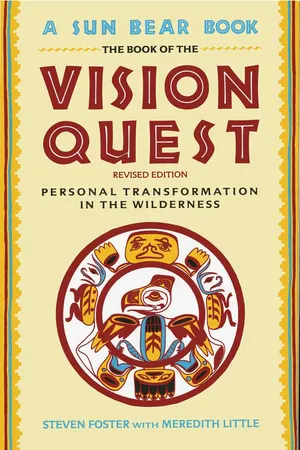
Blending numerous heritages, wisdoms, and teachings, this powerfully wrought book encourages people to take charge of their lives, heal themselves, and grow. Movingly rendered, The Book of the Vision Quest is for all who long for renewal and personal transformation. In this revised edition—with two new chapters and added tales from vision questers—Steven Foster recounts his experiences guiding contemporary seekers. He recreates an ancient rite of passage—that of "dying, " "passing through, " and "being reborn"—known as a vision quest. A sacred ceremony that culminates in a three-day, three-night fast, alone, in a place of natural power, the vision quest is a mystical, practical, and intensely personal journey of self-knowledge.
Frequently asked questions

Yes, you can cancel anytime from the Subscription tab in your account settings on the Perlego website. Your subscription will stay active until the end of your current billing period. Learn how to cancel your subscription.
At the moment all of our mobile-responsive ePub books are available to download via the app. Most of our PDFs are also available to download and we're working on making the final remaining ones downloadable now. Learn more here.
Perlego offers two plans: Essential and Complete
  • Essential is ideal for learners and professionals who enjoy exploring a wide range of subjects. Access the Essential Library with 800,000+ trusted titles and best-sellers across business, personal growth, and the humanities. Includes unlimited reading time and Standard Read Aloud voice.
  • Complete: Perfect for advanced learners and researchers needing full, unrestricted access. Unlock 1.4M+ books across hundreds of subjects, including academic and specialized titles. The Complete Plan also includes advanced features like Premium Read Aloud and Research Assistant.
Both plans are available with monthly, semester, or annual billing cycles.
We are an online textbook subscription service, where you can get access to an entire online library for less than the price of a single book per month. With over 1 million books across 1000+ topics, we’ve got you covered! Learn more here.
Look out for the read-aloud symbol on your next book to see if you can listen to it. The read-aloud tool reads text aloud for you, highlighting the text as it is being read. You can pause it, speed it up and slow it down. Learn more here.
Yes! You can use the Perlego app on both iOS or Android devices to read anytime, anywhere — even offline. Perfect for commutes or when you’re on the go.
Please note we cannot support devices running on iOS 13 and Android 7 or earlier. Learn more about using the app.
Yes, you can access Book Of Vision Quest by Steven Foster in PDF and/or ePUB format, as well as other popular books in Social Sciences & Native American Studies. We have over one million books available in our catalogue for you to explore.

Information

BOOK 1

Image

THE QUEST

Image
What can be known? The unknown.
My true self runs toward a Hill.
More! O More! visible.
Now I adore my life
With the Bird, the abiding Leaf
With the Fish, the questing Snail,
And the Eye altering all;
And I dance with William Blake
For love, for Love’s sake. . . .
—Theodore Roethke, ā€œOnce More, the Roundā€
Many years ago, haunted by guilt, pursued by images of freedom, persistently, relentlessly believing that I had to acquire experiences at the risk of all, I left my vocation of college teaching and went into the world. Though I lived with great appetite, and seemed, even to myself, suicidally bent on my own destruction or the destruction of anyone who loved me, I found myself drawn into the land of my father’s childhood and early manhood: the vast stretches of loneliness called Nevada, and the remote, desolate regions of the desert called Mojave.
I went into the desert alone, not knowing why, searching for something I had lost, or could find: something, someone, some revelation waiting for me at the bend of the dry river bed, some face-to-face encounter with what I feared, and desired, most.
At the time I did not realize I was seeking death. That is, I was not seeking to die, but to reap the fruit of death, to reenter the womb of things, the matrix of unknowing, and to be born anew, severed from old distinctions and limitations, to induce, by sheer force of will, self-transformation.
But self-transformation is a gradual, painstaking process won at the expense of joy and sorrow, or so it has been for me. Nevertheless, certain power events, or growth events, blaze out from the background of my life. These events mark the juncture at which my restless heart touched the timeless, transforming heart of the universe. The year I spent in the desert was filled with many such events.
Was it because my mother had told me I had been conceived at Shadow Mountain, within view of the mountains of Death Valley, that I went into the desert? Was it because my childhood had been steeped in the stories of the Old Testament, the tales of the desert prophets, Moses, Isaiah, Elijah? Was it because, even when I was very small, I felt a deep affinity with the spirit of the desert? Something lured me. I responded with instinctive faith in a feeling that quickened me to the core, a shuddering, shivering, passionate feeling.
I packed an old VW bus with a few essentials, said goodbye to my children, my friends, and my life, and drove away. I headed east toward Reno, gateway to the far-flung deserts of the Great Basin. I came back, eventually, to pick up the threads of my ā€œcivilizedā€ life, a life that had changed because I had changed.
But when I got into my car and took off down the road, I gave no thought to returning. I had reached a point where desperation overshadowed responsibilities. I could not continue living as I had been living. Something more was waiting. Surely, if I actively sought it, the answer would be revealed to me out there, in the trackless waste. I drove away with such deep excitement. I had not thought I was capable of such emotion.
What happened to me in the desert? I cannot exactly say. My lips are sealed by the inadequacy of words. I am convinced that the Great Mother eventually led me to heights and depths of being that are akin to ā€œvisionary.ā€ But much of the time my memory only coughs up facts, events, and places. I was not prepared to understand all that came to pass. Much of the time I was bored—either having nothing in particular to do or attending to the basic needs of my own survival. Sometimes I had to deal with the consequences of my own ignorance, such as not knowing how to start a fire with wet wood, not knowing how to adequately protect myself from the cold or searing heat, or not knowing how to perform simple but critical repairs on the engine of the bus.
Though for years I had made pronouncements about ā€œnatureā€ to students from my egotistical ivory tower, I knew very little about the process of truly living on the land. I understood very little about the rhythms and elements of our Great Mother. The night I finally took leave of Elko and turned my face to the Ruby Mountains I realized how inadequately I had prepared myself. I trembled with fear and considered going back. What if I died out there? It might be a long time before somebody found me. What if I got lost? I would have nowhere to go, no one to come home to, no one to help me find myself. I feared insanity. I feared flash floods (though I had never seen one), rattlesnakes, tarantulas, the dark, the cold, the bad roads, car trouble, dying of thirst, and physical illness. Most of all, I feared loneliness. All my heroic myths about myself came down like the walls of Jericho when I first heard, really heard, the awesome trumpet sound of the loneliness of the wilderness—the sound of silence. Against that absence of sound I was nothing but a cipher. My ego withered, as pages of a book thrown to a fire.
How little I knew about survival, or myself, or death! Having rejected other teachings, I had unwittingly apprenticed myself to the most exacting teacher of all. But I did not understand her language. Her voice was the roaring of silence in my ears. She taught, not with words, but through my body, with light and darkness, rain and wind, snow and fire. She pierced my virgin ears with bird calls. And the words and sounds she caused me to utter were not the words of the world I knew. Some of them were cries that came from my stomach and bowels, strange to my ears, more like those of an animal: howls, moans, grunts, and growls. And the actions she taught me were animal actions, almost forgotten: eating, sleeping, eliminating, creeping, burrowing, hiding, listening. The learning of these gestures marked the beginnings of change in my life.
Is it the vulnerability of loneliness that drives us to love and to be loved? The implacable stars and the horned moon ride the night sky, leaving the ache and emptiness of another morning without love in their wake. Thus we learn to live with loneliness, to curse and accept it, to fill it with the rituals of survival. But finally loneliness would break me down into rigid insistence: My body craved, as dry leaves crave the wind, the presence of another. I would go into Winnemucca or Austin or Goldfield or Goodsprings or Lone Pine or Furnace Creek, looking for someone to talk to.
In a way, loneliness is a way of preparing for death. Once, as I drove a long, desolate stretch of highway between Wells and Ely, I overtook a young woman walking beside the road, without pack or water, twenty-five miles north of Currie. Imagining she was in trouble or needed a lift, I stopped and asked her if I could be of help.
She looked at me from a face blistered by the sun. She saw a wild-looking man, dirty, unshaven, horizons gleaming in his eyes. I saw a weary woman with a wasted longing in her eyes.
ā€œNo thanks,ā€ she said.
Curious, I asked her what she was doing here, out in the middle of nowhere.
ā€œNowhere is somewhere,ā€ she replied curtly and kept on walking.
So I drove on. Her toiling form shrank in the rear-view mirror, until she was just a speck, which then vanished. I sometimes wonder about her. She reminded me of myself. Surely she was one of those lonely, lost people learning how to die.
Many a night I spent watching unidentified lights move on the horizon. Sometimes they seemed to approach. The optical phenomenon so frightened me one night that I sat up all night by the fire, reluctant to close my eyes in sleep against the possible unknown terror the moving lights represented. Many a night I spent frightened, uncomfortable, anxious, restless, in a vague dread that calamity would befall me. Many a night I lay awake, remembering my children, my women, my family, my friends. Many a morning I awoke to the bitter taste of emptiness in my coffee, and for several days the pangs of unrequited love would keep me from food. Spasms of self-pity would come and go. Sometimes I heard the strange sound of a man crying for himself.
One early summer day in Dry Lake Valley, west of Caliente, Nevada, surely one of the most desolate regions of the earth, I ingested enough LSD for a dozen people. Reasoning that if I was to seize the fire from the altar, this was the way to do it, I entered the morning with high expectations. By noon the temperature had risen to intolerable limits, and I had no shelter but my car, which had become a furnace. At 4:00 P.M. I got into the furnace and drove all the way to Lake Mead, camping that night in the Valley of Fire. What had occurred had not included a self-transformation. I had walked several miles along a bad jeep road that only led me deeper into burning, infernal regions. A lizard slipped across my path, and I jumped a country mile. I wrote in my journal some time during the day: ā€œIf I am God, then why is God afraid of his own shadow?ā€ I was badly sunburned and in some pain through the night. The next day God drove into Las Vegas and bought a hamburger and a chocolate malt, never to drop LSD again.
Nevertheless, I persisted in believing that eventually I would attain a vision. I sought places in the earth that were haunted by the ghosts of Native American souls, isolated springs and mountain tops, canyons crawling with rattlesnakes and cats, stone quarries where percussion flakes of obsidian, agate, and chert lay on the ground like unmelted snow for hundreds of years. I drank from the creeks of the Toiyabes and the Inyos, slept in the arroyos of the Funerals and the Paradise, climbed the ridges of the Black, Ruby, and Last Chance ranges. Everywhere my Teacher surrounded me with beauty and terror. She assailed my senses with the smell of sage, the taste of native trout, the scatter and gather of little birds. The coyote chilled me with calls that imitated the crying of my children. The rattlesnake hissed from the damp reeds. The halfrotted carcass of a wild burro grinned up at me from Crystal Spring.
I learned that Nature spoke to me when I emptied my ears of my own internal dialogue. I saw many powerful teachings, when my eyes were not distracted by my brain. I prepared my heart through fasting and attention to detail, watching by the hour as the leaves of the cottonwoods collected the solar wind. I thought every now and then about dying.
Many strange and wonderful instances of the Great Mother’s creation were revealed to me. But I never had a vision, if by ā€œvisionā€ is meant that which Black Elk or Jacob or St. John saw. When the time came to return to civilization, the same man returned who went forth. His Teacher had worked profound alterations in his heart, but he was the same man.
I knew more about this soul system, this cocoon. I knew I was an eye with two blind feet. My emptiness craved motion; my fire craved fuel; my ears craved the music of silence; my arms craved the rough, red earth; my feet craved miles; my thirst craved more deeply than any desert spring could satisfy. ā€œWho are you?ā€ the unshielded sun roared at me, tearing away the letters of my name from the being who crouched inside. The sun made me write a poem about him, tear it out of my journal, and fling it on the wasteland for the scorpion to read. He made me know myself then.
The desert, my Mother, taught me that the flash of a mockingbird’s wing was more precious than the finest sapphire. She taught me that the smell of sagebrush after a rain was more lush than the words from a poet’s mouth. Through her I came to know my belly when it was hungry, my eyes when they were wide open, my voice when it was chocked by my heart, my ears when they filled with alkali dust, my genitals when they were forgotten, my breast when it was emptied of loneliness by loneliness, my legs when they were called on for another mile.
Above all, I learned that my way would be hard; that my way would require courage, endurance, independence, and all the wits I possessed; that my way was narrow, dangerous, precise, spiraling ever upward, skirting the edge, threading the shuttle of my heart between the warp and woof of birth and death. I learned that it did not matter what others thought so long as I kept to the inner path that led to the final, ecstatic assimilation of contradiction in death; that my path was lonely, that death walked with me—he the body, I the shadow—into high noon. I learned to submit to my mortality, but never to my death.
The decision to return to civilization came suddenly one afternoon while I was in the laundromat in Elko, Nevada, the town where my quest had begun. It occurred to me, as I watched the locals and tourists do what I was doing, that I was not truly afraid of being alone anymore. In fact, I preferred it. My real problem was that I was afraid of being with people.
All at once I remembered my children. The life I had exiled myself from crashed in on me. I was overwhelmed by the reality of my situation. Aside from being a hermit, I really did not know what to do with my life. I was nearing middle age; my children were scattered; I had no mate; I had no money; I had no home.
I did have a civilized name: Steven Foster. The making of the sound of it was foreign in my mouth. The idea that the name was connected to the being who had been wandering the earth, scouring his body with sun and moon and wind, was confusing and disheartening. I wanted to remain with my spiritual ancestors, the Paiute (ā€œwater-peopleā€), and dance the Ghost Dance. I gave myself a name: Heart in His Throat.
As my clothes whirled in the dryer, I went over all the old contradictions between Nature and civilization. Never did I abhor the latter more. But my heart, which I had come to respect, said calmly: ā€œGo back to your life and your loved ones. Work it out there. That which you fear most is the source of ultimate revelation and power. Go and learn to live with your people.ā€
So I went back to live a life I was reluctant to lead, to take my place as a man in the adult world of Marin County, California. I went back to live alone, as a single male and a divorced father. It was shaky at first. It was difficult to imprison my shadow under roofs and artificial lights. I feared humans, the most dangerous of animals. I feared my own social reactions. I was self-conscious and deeply scornful of people who lived artificial lives.
Slowly the freeways claimed me. The beat of the clock parceled out my days. There was somewhere to get to, someone to see and feel emotional about, something to do or something that should be done. There were dollars to earn and an infinite number of places to spend them. Gradually, the memory of my desert life retreated, attenuated by the insistent need to survive in the wilderness of the city. I forgot to practice the lessons my Teacher had imparted: the lessons of patience, self-reliance, clear sight, and animal ease. I began to question the relevance of my wilderness education to the practical necessities of survival in a wilderness more savage than any desert.
The mother of my children needed money and my children needed their father. The rent had to be paid, the master cylinder replaced, the check-out stand endured, the feet well heeled, the body made respectable with clothing. This seemed no dark night of the soul I faced; this was an endless round of pseudoevents, a whirl of routine deadlines. For a long while my heart of hearts would not accept the idea that money had anything to do with survival. When I finally had to accept this fact, I accepted it bitterly.
Yet it was a dark night of the soul I had descended into. I pitied myself. The impregnating joys of the wilderness were gone. The sorrows of bringing forth had commenced. I was not to be granted the privilege of being taught by the Great Mother without the responsibility of carrying these teachings to others. For a long time I resented the burden. But the vision of my life began to grow, regardless, in the close, anxious darkness of despair.
Something was being born in me. The tenseness and dismay of my life were due to labor pains developing in the region of my heart and pushing upward into an aching void in my throat. My days were the placenta upon which fed the roots and tendrils of an unenvisioned dream. The uterine dream, call it a dream of destiny, kicked and stretched in the bland plasma of unuttered words, and silently mouthed.
As with any birth, death precedes release. I had to die before my mind could read the words reflected on the mirror of my heart. Exactly when I died I do not remember. It might have been one rainy afternoon when I walked ...

Table of contents

  1. Cover
  2. Dedication
  3. Preface to the Revised Edition
  4. Second Preface
  5. Preface
  6. Book 1
  7. Book 2
  8. Book 3
  9. Book 4
  10. Book 5
  11. Book 6
  12. Book 7
  13. Contributors in Order of Appearance
  14. About the Authors
  15. Select Bibliography
  16. Copyright