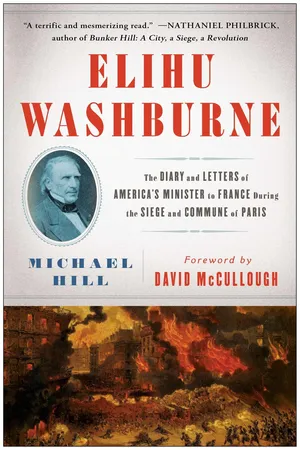
Elihu Washburne
eBook - ePub

Elihu Washburne

The Diary and Letters of America's Minister to France During the Siege and Commune of Paris

  1. 288 pages
  2. English
  3. ePUB (mobile friendly)
  4. Available on iOS & Android
eBook - ePub

Elihu Washburne

The Diary and Letters of America's Minister to France During the Siege and Commune of Paris

About this book

This is the remarkable and inspiring story—told largely in his own words— of American diplomat Elihu Washburne, who heroically aided his countrymen and other foreign nationals when Paris was devastated by war and revolutionin1870–71.

Elihu Washburne rose from a hardscrabble existence in New England and the Midwest to become a congressman and diplomat. A confidante of Lincoln and Grant during the Civil War, Washburne was appointed Minister to France by Grant in 1869, arriving in Europe shortly before the outbreak of the Franco- Prussian War. When Bismarck ordered the Prussian army to lay siege to Paris, intent on forcing the French to surrender, Minister Washburne—alone among major power diplomats—remained at his post, determined to protect Americans and German nationals trapped in Paris. After the French capitulation, new horrors struck Paris. The government was toppled by a band of violent revolutionaries, known as the Commune, who embarked on a reign of terror that filled the streets with blood. Once again, Washburne stepped forward to help wherever he could until the Commune collapsed and its bloody orgy ended.

During his ordeal Washburne endured cannon bombardments, brutally cold weather, dwindling food supplies, bouts of ill health, and long separations from his family. He witnessed the plight of starving women and children, riots in the streets, senseless executions, and countless acts of unspeakable violence and bloodshed.

In the midst of it all, Washburne kept a remarkable personal diary that chronicled the monumental events swirling about him. He knew he was at the center of history and was determined to record what he saw. The diary—and letters he wrote to family and officials in Washington—provides a vivid personal account of life during some of Paris’s darkest days. Filled with political and military insight, Washburne’s writings also have an unmistakable charm, at times blending homespun expressions with quotations from Shakespeare and the Bible.

Michael Hill provides essential background information and historical context to the excerpts from Washburne’s diary and letters, which are drawn from the original manuscript sources and collected into one volume for the first time. Through his own words, we come to know and admire Washburne as he struggles to stay alive, perform his duty, and not let his country down. The story of Elihu Washburne is a great American story—the tale of an American hero rising to greatness in the midst of difficult and extraordinary times.
Frequently asked questions

Yes, you can cancel anytime from the Subscription tab in your account settings on the Perlego website. Your subscription will stay active until the end of your current billing period. Learn how to cancel your subscription.
No, books cannot be downloaded as external files, such as PDFs, for use outside of Perlego. However, you can download books within the Perlego app for offline reading on mobile or tablet. Learn more here.
Perlego offers two plans: Essential and Complete
  • Essential is ideal for learners and professionals who enjoy exploring a wide range of subjects. Access the Essential Library with 800,000+ trusted titles and best-sellers across business, personal growth, and the humanities. Includes unlimited reading time and Standard Read Aloud voice.
  • Complete: Perfect for advanced learners and researchers needing full, unrestricted access. Unlock 1.4M+ books across hundreds of subjects, including academic and specialized titles. The Complete Plan also includes advanced features like Premium Read Aloud and Research Assistant.
Both plans are available with monthly, semester, or annual billing cycles.
We are an online textbook subscription service, where you can get access to an entire online library for less than the price of a single book per month. With over 1 million books across 1000+ topics, we’ve got you covered! Learn more here.
Look out for the read-aloud symbol on your next book to see if you can listen to it. The read-aloud tool reads text aloud for you, highlighting the text as it is being read. You can pause it, speed it up and slow it down. Learn more here.
Yes! You can use the Perlego app on both iOS or Android devices to read anytime, anywhere — even offline. Perfect for commutes or when you’re on the go.
Please note we cannot support devices running on iOS 13 and Android 7 or earlier. Learn more about using the app.
Yes, you can access Elihu Washburne by Michael Hill in PDF and/or ePUB format, as well as other popular books in History & Historical Biographies. We have over one million books available in our catalogue for you to explore.

Information

1

line

WAR AND REVOLUTION

Within hours after the outbreak of war, on July 15, 1870, word reached Washburne by telegraph in Carlsbad. It was “like a clap of thunder in a cloudless sky,” he wrote. He quickly set out for Paris and along the way was caught up in the frantic mobilization for war. “The excitement was something prodigious, recalling to me the days at home of the firing upon [Fort] Sumter in 1861 . . . The troops were rushing to the depots; the trains were all blocked, and confusion everywhere reigned supreme.” When at last he arrived in Paris on the night of July 18, the city was in chaos. “The streets, the Boulevards, the avenues, were filled with people in the greatest state of enthusiasms and excitation,” he would recall.
The declaration of war had “inflamed the natural hatred of the Parisians toward the Germans.” Many German nationals were arrested as spies and some later executed. A proclamation by the French government ordered the immediate expulsion of some 30,000 Germans who “came in shoals” to the American Legation, desperately seeking protection and assistance. Amid all the confusion, Washburne barely had time to dash off notes to his wife and brother after the grueling journey back to Paris.
Elihu Washburne, Paris—to Adele Washburne, La Rochelle, France—July 19, 1870
You will see I am back again in Paris. I telegraphed you yesterday from Belgium that I was on my way. I heard of the declaration of war on Saturday and left that night and arrived here at 10 o’clock last night after a terribly hard and continuous trip of 52 hours . . . I was sorry to have to give up my cure, but it was inevitable. This is my place where duty calls me and here I must remain. I have no time to write particulars this morning . . .
Elihu Washburne, Paris—to his brother Israel Washburn, Jr.—July 21, 1870
You see we are in troublesome times . . . I got back last night a good deal “banged up” and . . . worse off than I was when I left two weeks ago. The suddenness of the terrible events which we are now confronting appal the world. No human ken can measure the consequences . . . that will result from the fearful conflict which is impending. For one I had prayed never to see more war but here I am [in] the very midst of it and in a position of great responsibility and labor. I shall endeavor to meet, as best I can, all the requirements of my position . . . My Legation has been filled today with Prussians wanting to get home and I am in an important correspondence with the Foreign Office on that subject. Indeed I am overrun all the time. It is as bad as being Secretary of State at the advent of a new administration. The war is on the most miserable pretext but it could not be avoided . . . Both sides are ready . . . and will fight with unheard of desperation. I take no sides, but preserve an “armed neutrality.” Adele and the children are well and . . . at La Rochelle, where they are taking sea baths. The Lord knows when I will see them as I am now tied to Paris.
On July 28 NapolĂ©on III led his troops into battle with great ceremony. Washburne reported to President Grant that the Emperor had left Paris “with great panache and parade. He took more baggage than you did . . . when you [set] out on the Vicksburg campaign.”
Although ill and worn out, NapolĂ©on III accepted his fate and the inevitability of war, summoning his subjects to battle with a stirring proclamation: “Frenchmen! There are in the lives of people solemn moments, where national honor, violently excited, imposes itself as an irresistible force, dominates all interests, and takes in hand the direction of the destinies of the country. One of these decisive hours has just sounded for France.”
But the Emperor’s spirited call to war could not overcome a French army horribly disorganized, badly supplied, and badly led. They faced a Prussian force well prepared and ready to strike. It was led by the Prussian King himself, Wilhelm I, the first professional soldier on the throne since Frederick the Great; Field Marshal Helmuth von Moltke, chief of the Prussian General Staff; and the “Iron Chancellor,” Count Otto von Bismarck, the King’s Minister-President and architect of the war. Washburne had once seen Bismarck during a brief visit to Berlin in 1867. “He is the great I am of Prussia and his rod rules,” Washburne wrote at the time, although he added, “But a rather gay boy, fond of wine and women.”
It was a “magnificent” fighting force. Émile Zola warned of a “Germany ready, better commanded, better armed, sublimated by a great charge of patriotism; France frightened, delivered into disorder . . . having neither the leaders nor the men, nor the necessary arms.”
On August 2, the first skirmish of war took place. French morale was briefly boosted when the army overran a small Prussian force at SaarbrĂŒcken. Back in Paris a great triumph was declared, but four days later, disaster struck. The Emperor’s forces were crushed and routed by an overwhelming Prussian force at Weissenburg and Spicheren. “The two nations were in full war, and blood was flowing like water on both sides,” wrote Washburne.
Muddled reports of French victories soon flooded the city, reminding Washburne of the Civil War when “rumors, exaggerations and . . . false reports . . . spread in times of such excitement.”
Diary—August 6, 1870, Saturday evening
There was a tremendous time down town today, in a false report of a French victory. Somebody read a pretended dispatch that the French had taken 25,000 Prussian prisoners including the Crown Prince. Everybody in the neighborhood went perfectly crazy—flags everywhere went out of windows, people rushed wildly into the streets and went to yelling, hugging, kissing, singing, weeping, swearing and tearing. The Bourse went up wildly, opera singers were mounted on omnibuses and sang the Marsellaise and the whole crowd joined—never was such a scene witnessed on the face of the earth. Nobody pretended to doubt the news, everybody had seen the dispatch—it was official. But after the first furor had exhausted itself, somebody ventured to enquire a little and it turned out it was a hoax. The cry was raised that it was a stock jobbing affair, and the . . . cry was raised, “à la Bourse” [to the Bourse] and away the crowd—20,000—rushed furiously to the Bourse, broke in, seized every fellow they could get hold of and threw him out of the window or door. And then how flat they all felt—knew it was a canard from the beginning—the flags were all pulled in and the crowd dispersed swearing vengeance.
Diary—August 7, 1870, Sunday morning
I went down to the Rue de Lafayette about four o’clock yesterday P.M. I saw some few crowds in the street, but all was pretty quiet. On my return through Place VendĂŽme I saw a big crowd in front of the Ministry of Justice. I told the “cocher” [coachman] to hold up in order to see what was going on. I immediately discovered [Émile] Ollivier1 at the window making a speech to this crowd, but it was so noisy and turbulent that I could hear nothing and so I continued on my way home. I was so tired that I did not go out after dinner, but Mr. [Frank] Moore [assistant secretary to the American Legation] went down town and came home at midnight. He represents the effervescence as terrific. Place VendĂŽme was filled with an excited crowd uttering menacing cries for Ollivier. The current seems to be moving heavily against him, as the author of that savage and terrible press law which prevents the people getting any news from the army. The news of the battle of Weissenburg was published Friday morning in the London Times, but they did not let it out here till Friday noon, and then only a few lines. The people were terribly incensed . . . Last night the people were in the highest possible state of excitement—Champs-ÉlysĂ©es, Rue de la Paix, Place VendĂŽme and all the boulevards were filled with excited crowds singing, yelling, threatening. There is no doubt but things are very serious, but I am as quiet as a May morning. Yet I don’t know what is to become of all these poor Germans under my protection. The Gov’t is taking stringent measures against them, and I can do but little for them. The crowd at the Legation continues.
When news arrived that the Prussians had crossed into French territory, the people of Paris were shattered, “tormented with fear and suspense,” reported Washburne. This “grave news” prompted the Empress EugĂ©nie, now Regent in the Emperor’s absence, to issue a proclamation formally declaring Paris “in a state of siege.”
Diary—August 8, 1870, Monday morning
About three o’clock yesterday P.M. a man came in and told me the news, and perhaps none more pregnant with great events. The news of the morning that [General Charles Auguste] Frossard’s corps was in retreat was very significant, but I was unprepared to learn that the crack corps of the French Army commanded by their crack General, Marshal [Patrice] MacMahon, had been defeated in a pitched battle, for the Emperor himself had telegraphed in these words: “Le Marshal MacMahon a perdu une bataille.” [Marshal MacMahon has lost a battle.] And then on top of this news we had the Proclamation of the Empress and the decrees placing Paris in a state of siege and convoking legislative bodies.
You can well imagine the effect of all this upon such a people as the Parisians. It was like the day after Bull Run at Washington only more so . . . The rain which was falling nearly all day gave additional gloom. I went down town about four o’clock P.M. and everywhere found knots of people on the sidewalk reading newspapers and discussing the situation. In the evening I was down town, but while there were great crowds in the street there was no disturbance. The blows received during the day had apparently stunned the mob. There is no news this morning which affords the French people any consolation. A big battle appears imminent and it may decide the fate of the campaign. I must now go over to the Legation where there will be a crowd all day. But at noon I must go to the funeral of Provost-Paradol2 and two o’clock go to see the Empress unless she countermands the order to see me.
Later that day, with Paris in an uproar, Washburne arrived at the Tuileries for his appointment with the Empress. He found her “in great distress of mind,” having “passed a sleepless and agitated night.”
Diary—August 8, 1870, 11 o’clock evening
At two o’clock I went to the Tuileries to . . . [see] the Empress. My interview was short. She received me very courteously . . . [and] then enquired what news I had from my country and I replied that it was all good. “Unfortunately, the continent is not so—here it is all very bad—we have very bad news now.” I replied that reverses were incident to all military operations and that we had experienced such reverses and such disappointments in our war, particularly at its commencement. “Yes,” she said, “I know at Bull Run but, alas! our people are not like yours—the French people give up so quick and become so dissatisfied and unreasonable, while your people have so much courage and fortitude. But I don’t despair and I keep up my courage . . . I think we can retrieve all our disasters.” I then explained to her an observation on the beginning of the war and how our people rallied after our defeats &c. After a little more talk and just as I was about to leave I enquired for His Majesty and the Prince Imperial. When I mentioned the little Prince the mother’s tear started in her eye and she answered trembling that so far he was safe and well. With a few words more I made a gesture of withdrawal and she said, “I thank you much,” when I bid adieu. The poor, poor woman—what terrible feelings she must have. Haggard, pale, worn, she is not the bright and graceful person you saw at the Tuileries last winter. She now confronts the sternest realities of life. As I left I wondered under what circumstances I should see her next time.
All of Paris was “paralyzed by the terrible events which have burst upon them in such rapid and fearful succession,” Washburne reported to Secretary of State Hamilton Fish. With the Emperor on the field of battle and the Empress increasingly helpless, people looked to the French Legislative Assembly, the Corps LĂ©gislatif, “for some action which might stem the tide of disaster which was then rolling over Paris and France.” (The Corps LĂ©gislatif “shared the legislative function of the government with the Emperor.” Washburne, in his ...

Table of contents

  1. Cover
  2. Foreword
  3. Prologue
  4. Chapter 1: War and Revolution
  5. Chapter 2: Siege
  6. Chapter 3: Desperation and Despair
  7. Chapter 4: Defeat
  8. Chapter 5: Peace
  9. Chapter 6: Reign of Terror
  10. Epilogue
  11. Acknowledgments
  12. Illustration Credits
  13. Photographs
  14. About Michael Hill
  15. Notes
  16. Bibliography
  17. Index
  18. Endnotes
  19. Copyright