
eBook - ePub
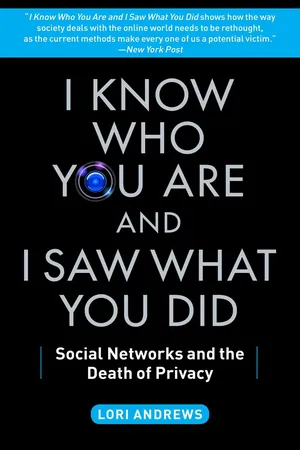
I Know Who You Are and I Saw What You Did
Social Networks and the Death of Privacy
- 272 pages
- English
- ePUB (mobile friendly)
- Available on iOS & Android
eBook - ePub
About this book
Hailed as “stunning” (New York Post), “authoritative” (Kirkus Reviews), and “comprehensively researched” (Shelf Awareness), a shocking exposé of the widespread abuses of our personal online data by a leading specialist on Web privacy.
Social networks, the defining cultural movement of our time, offer many freedoms. But as we work and shop and date over the Web, we are opening ourselves up to intrusive privacy violations by employers, the police, and aggressive data collection companies that sell our information to any and all takers.
Through groundbreaking research, Andrews reveals how routinely colleges reject applicants due to personal information searches, robbers use vacation postings to target homes for break-ins, and lawyers scour our social media for information to use against us in court. And the legal system isn't protecting us—in the thousands of privacy violations brought to trial, judges often rule against the victims. Providing expert advice and leading the charge to secure our rights, Andrews proposes a Social Network Constitution to protect us all. Now is the time to join her and take action—the very future of privacy is at stake.
Log on to www.loriandrews.com to sign the Constitution for Web Privacy.
Social networks, the defining cultural movement of our time, offer many freedoms. But as we work and shop and date over the Web, we are opening ourselves up to intrusive privacy violations by employers, the police, and aggressive data collection companies that sell our information to any and all takers.
Through groundbreaking research, Andrews reveals how routinely colleges reject applicants due to personal information searches, robbers use vacation postings to target homes for break-ins, and lawyers scour our social media for information to use against us in court. And the legal system isn't protecting us—in the thousands of privacy violations brought to trial, judges often rule against the victims. Providing expert advice and leading the charge to secure our rights, Andrews proposes a Social Network Constitution to protect us all. Now is the time to join her and take action—the very future of privacy is at stake.
Log on to www.loriandrews.com to sign the Constitution for Web Privacy.
Frequently asked questions
Yes, you can cancel anytime from the Subscription tab in your account settings on the Perlego website. Your subscription will stay active until the end of your current billing period. Learn how to cancel your subscription.
No, books cannot be downloaded as external files, such as PDFs, for use outside of Perlego. However, you can download books within the Perlego app for offline reading on mobile or tablet. Learn more here.
Perlego offers two plans: Essential and Complete
- Essential is ideal for learners and professionals who enjoy exploring a wide range of subjects. Access the Essential Library with 800,000+ trusted titles and best-sellers across business, personal growth, and the humanities. Includes unlimited reading time and Standard Read Aloud voice.
- Complete: Perfect for advanced learners and researchers needing full, unrestricted access. Unlock 1.4M+ books across hundreds of subjects, including academic and specialized titles. The Complete Plan also includes advanced features like Premium Read Aloud and Research Assistant.
We are an online textbook subscription service, where you can get access to an entire online library for less than the price of a single book per month. With over 1 million books across 1000+ topics, weâve got you covered! Learn more here.
Look out for the read-aloud symbol on your next book to see if you can listen to it. The read-aloud tool reads text aloud for you, highlighting the text as it is being read. You can pause it, speed it up and slow it down. Learn more here.
Yes! You can use the Perlego app on both iOS or Android devices to read anytime, anywhere â even offline. Perfect for commutes or when youâre on the go.
Please note we cannot support devices running on iOS 13 and Android 7 or earlier. Learn more about using the app.
Yes, you can access I Know Who You Are and I Saw What You Did by Lori Andrews in PDF and/or ePUB format, as well as other popular books in Technology & Engineering & Politics. We have over one million books available in our catalogue for you to explore.
Information

Facebook Nation
When David Cameron became Britainâs prime minister, he made an appointment to talk to another head of stateâMark Zuckerberg. Yes, that Mark Zuckerberg: the billionaire wunderkind, the founder of Facebook. At the meeting at 10 Downing Street, Prime Minister Cameron and Facebook President Zuckerberg discussed ways in which social networks could take over certain governmental duties and inform public policymaking.1
A month later, Zuckerberg and Cameron had a follow-up conversation, later posted on YouTube. Cameron, dressed in suit and tie, chatted with Zuckerberg, who wore a blue cotton T-shirt.2 âBasically, weâve got a big problem here,â Cameron pointed out to Zuckerberg, describing the U.K.âs financial woes.
Zuckerberg outlined how Facebook could be used as a platform to decrease spending and increase public participation in the political process: âI mean all these people have great ideas and a lot of energy that they want to bring and I think for a lot of people itâs just about having an easy and a cheap way for them too to communicate their ideas.â
âBrilliant,â Cameron said.
Within a year, Zuckerberg had a seat at the table with government leaders. In May 2011, he attended the G8 Summit, the annual meeting of key heads of state (named after the eight advanced economiesâFrance, the United States, the United Kingdom, Germany, Japan, Italy, Canada, and Russia).3 The media reported that world leaders from German Chancellor Angela Merkel to French President Nicolas Sarkozy were more in awe of Zuckerberg than he was of them.4 Zuckerberg summarized how Facebook had played a role in worldwide democratic movements and pressed his own policy agendaâurging European officials to back off of proposed regulation of the internet. âPeople tell me on the one hand âItâs great you played such a big role in the Arab spring, but itâs also kind of scary because you enable all this sharing and collect information on people,â â Zuckerberg said.
Is it odd to think of Mark Zuckerberg as a head of state? Perhaps. But Facebook has the power and reach of a nation. With more than 750 million members, Facebookâs population would make it the third largest nation in the world. It has citizens, an economy, its own currency, systems for resolving disputes, and relations with other nations and institutions. After watching the video chat between Cameron and Zuckerberg, I became intrigued by the concept of a social network as a nation. I began to wonder, what kind of government rules Facebook? What are its politics? And, if it is like a nation, should it have a Constitution?
People are drawn to Facebook, as early settlers are drawn to any new nation, by the search for freedom. Social networks expand peopleâs opportunities. An ordinary individual can be a reporter, alerting the world to breaking news of a natural disaster or a political crisis. Or an investigator, helping cops solve a crime. Filmmakers and musicians at the start of their careers can find large followings through social networks.
The power of people is harnessed in new ways on social networks. Art itself is redefined as bands and novelists post early works and use crowdsourcing to change the music, lyrics, and story lines. Anybody can be a scientist, participating in a crowdsourced research project. In the Galaxy Zoo project, members of the public classify data from a million galaxies and publish the results in scientific journals. Facebook itself uses crowdsourcing to translate its pages into foreign languages.
Social networks also provide new ways for people to interact with government. The White House asked its Twitter followers for comments on a tax law.5 An official from the National Economic Council then posted a blog with links to questions raised by the Twitter followers, eliciting a discussion about the direction tax policy should take. In 2011, the social network created by the city of San Francisco introduced a phone app that allowed citizens to take photos of potholes and other things that needed maintenance and upload them directly to the proper city office to order repairs. Through that same network, people with CPR skills can volunteer to help in an emergency. If someone has a heart attack on a golf course, a smart- phone app will recruit volunteers in the area based on their GPS position and ask them to rush over to Hole 7 to render aid.
And when people get fed up with their government, they can use Facebook, Twitter, and YouTube to incite others to join them in the streets to protest. While previous forms of political protest required a charismatic leader, that leader could be killed or his headquarters destroyed. Itâs much more difficult to stop a widely dispersed group of antagonists such as the citizens of Facebook Nation. Itâs harder to put out thousands of revolutionary fires burning across the Web.
Social networks have enormous benefits, helping us stay in touch with people from our pasts and introducing us to people who share our interests. They create a much-needed comfort zone. As philosopher Ian Bogost points out, âPublic spaces in general have been destroyed, privatized, and policed in recent decades, but the public life of teens and young adults has been particularly damaged, due to additional fears of abduction, abuse, criminality, and moral corruption.â6 According to Bogost, social networks provide a place to hang out, akin to the main drag or the video arcade of the past.
Social networks have become ubiquitous, necessary, and addictive. Social networking is no longer just a pastime; itâs a way of life. People expect to be able to log on to Facebook or Myspace wherever they go and to tweet their every thought. Until recently, cell phones and internet use were banned in certain places, like courthouses, but now social institutions have largely abandoned their efforts to keep someone away from their Facebook friends or Twitter audience. As a result, thereâs a whole new set of issues, with judges friending defendants, jurors looking up witnessesâ Facebook pages to assess their credibility, and lawyers blogging about confidential interchanges with their clients.
The military held out for a long time. In August 2009, the U.S. Marine Corps formalized its ban on marinesâ use of Myspace, Facebook, and YouTube on its networks.7 The militaryâs concern was the same as it is with many of usâphishing, hacking, and other security breaches. But the stakes were much higher. Itâs a hassle when you have to get a new credit card because your American Express number is hacked through PlayStation.8 But itâs much more serious if military design secrets are stolen by other countries or soldiers die when confidential battle plans are revealed.9
The military ban made sense except for two things. It was hard enough to get people to enlist in an all-volunteer armed services. But morale sank even lower when they were cut off from Facebook friends and Myspace family members. And the technology of armed conflict itself was demanding a link to the Web. For certain weapons to be used most effectively, soldiers need access to smartphone appsâsuch as iSnipe and Shooterâto estimate bullet trajectories. Another app allows soldiers to see the positions of friendly soldiers and enemy combatants on a map updated in real time.10 Thereâs even an appâJibbigoâto translate a particular Iraqi dialect of Arabic.11 And another, Telehealth Mood Tracker, to measure a soldierâs mental health.12
In February 2010, the U.S. military embraced social networks in a big way. The military reconfigured its internet grid, NIPRNET (Non-classified Internet Protocol Router Network)âthe largest private network in the worldâto provide soldiers access to YouTube, Facebook, Myspace, Twitter, and Google apps.13 The army began issuing smartphones to soldiers to test the appsâ effectiveness both in and out of combat.14 In war zones, wireless networks on which to run the apps are brought into the field attached to vehicles, planes, or air balloons.15
Not just our soldiers but our global enemies are taking to social networks. A 2010 Department of Homeland Security Report entitled âTerrorist Use of Social Networking Sites: Facebook Case Studyâ found that jihad supporters and mujahedeen are increasingly using Facebook to propagate operational information, including improvised explosive device (IED) recipes in Arabic, English, Indonesian, Urdu, and other languages.16
A 2,000-member militant Islamic Facebook group includes informational videos on âtactical shooting,â âgetting to know your AK-47,â âhow to field strip an AK-47,â and so forth.17 Facebook pages for other extremist Islamist groups contain propaganda videos featuring wounded and dead Palestinians in Gaza, links to Al Qaeda YouTube videos, and videos promoting female suicide bombers, all of which can be accessed by the public without becoming a âfanâ of the groups, âlikingâ the groups, or âfriendingâ the Facebook pages.
Even criminals use the Web for everything from figuring out who to rob by checking Facebook posts containing the word âvacationâ to using a search engine to train for murder. Sometimes virtually the whole crime can be reconstructed from a search history, as in the case of a nurse who killed her husband after Googling âundetectable poisons,â âstate gun laws,â âinstant poison,â âgun laws in Pennsylvania,â âtoxic insulin levels,â . . . âhow to commit murder,â âhow to purchase hunting rifles in NJ,â. . . âneuromuscular blocking agents,â . . . âchloral hydrate,â âchloral and side effects,â and âWalgreens.â18
Facebook even facilitates real-time broadcasts of crimes in progressâand allows criminals to seek aid from friends. When Utah police tried to serve a warrant on Jason Valdez, a member of the Norteños gang, he barricaded himself in a motel room, taking Veronica Jensen as a hostage. With SWAT officers outside his motel room and in the adjoining rooms, Jason used his Android phone to post six status updates to Facebook, add 15 friends, respond to numerous comments on his wall posted by friends and family, and post a picture of himself and his hostage with the caption, âGot a cute âHOSTAGEâ, huh?â A Facebook friend posted on Jasonâs page that a SWAT officer was hiding in the bushes: âgun ner in the bushes stay low.â âThank you homie,â Jason replied. âGood looking out.â19
Eight hours later, Jason posted his last update: âWell I was lettin this girl go but these dumb bastards made an attempt to come in after I told them not to, so I popped off a couple more shots and now were startin all over again it seems.â The standoff ended when SWAT officers used explosives to blast through the front door and through the wall from an adjoining room. The hostage was fine, Jason ended up in intensive care, and police are considering whether to charge Jasonâs friend with obstruction of justice for warning him about the SWAT officer.20
Itâs easy to understand why people flock to Facebook and other social networks. But itâs harder to anticipate what will happen to you when you become a citizen of this new world. If you were to move to a kibbutz in Israel, teach English in Japan, enlist in the army, or move to a rural farm, youâd have some sense of what you were getting into. When you join Facebook, you donât know enough about the ramifications of social network citizenship to understand where that decision will lead and how it might transform you and your life. The governing rules of Facebookâits terms of serviceâshift rapidly and without warning. One day, it promises you that your friends are private; the next day, it makes them public.
One might think that Facebook enhances the Constitutionally protected freedom of association since it allows groups to form. Class of 1995 Reunion Committee. I Love Justin Bieber :)). Free the West Memphis Three. Yet peopleâs Facebook associations have been used against them. Judges have been disciplined for âfriendingâ lawyers on Facebook, even though it is completely acceptable for judges to be friends with attorneys in real life. In one case, a prison guard in England was fired after he friended prisoners on Facebook.21
And a crucial part of the freedom of association is the right not to reveal your associations. In 1958, for example, the U.S. Supreme Court allowed the civil rights organization for African Americans, the NAACP, to keep its member list secret from the government of Alabama. The NAACP argued that compelled disclosure would âabridge the rights of its rank-and-file members to engage in lawful association in support of their common beliefs.â22 In deciding not to compel disclosure, the Court held that people might be afraid to exercise their freedom of expression and engage in collective action to further those beliefs if their membership in the organization was known. Exposing a personâs membership in a group could lead to âeconomic repris...
Table of contents
- Cover
- Dedication
- Chapter 1: Facebook Nation
- Chapter 2: George Orwell . . . Meet Mark Zuckerberg
- Chapter 3: Second Self
- Chapter 4: Technology and Fundamental Rights
- Chapter 5: The Right to Connect
- Chapter 6: Freedom of Speech
- Chapter 7: Lethal Advocacy
- Chapter 8: Privacy of Place
- Chapter 9: Privacy of Information
- Chapter 10: FYI or TMI?: Social Networks and the Right to a Relationship with Your Children
- Chapter 11: Social Networks and the Judicial System
- Chapter 12: The Right to a Fair Trial
- Chapter 13: The Right to Due Process
- Chapter 14: Slouching Towards a Constitution
- The Social Network Constitution
- Acknowledgments
- About Lori Andrews
- Notes
- Index
- Copyright