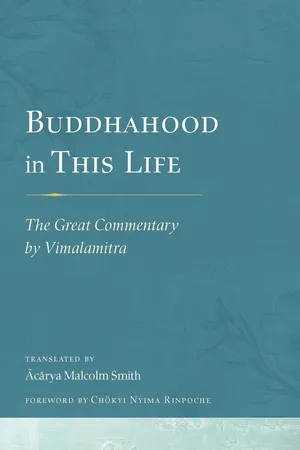
Buddhahood in This Life
eBook - ePub

Buddhahood in This Life

The Great Commentary by Vimalamitra

  1. 248 pages
  2. English
  3. ePUB (mobile friendly)
  4. Available on iOS & Android
eBook - ePub

Buddhahood in This Life

The Great Commentary by Vimalamitra

About this book

Discover a profound text that has influenced Tibetan teachers for generations. Buddhahood in This Life is a complete translation of the earliest Tibetan commentary on the Dzogchen secret instructions. Available for the first time in English, Buddhahood in This Life presents the Great Commentary of Vimalamitra—one of the earliest and most influential texts in the Dzogchen tradition of Tibetan Buddhism. It explores the theory and practice of the Great Perfection tradition in detail, shows how Dzogchen meditation relates to the entirety of the Buddhist path, and outlines how we can understand buddhahood—and even achieve it in our lifetime. This essential text includes topics such as: ·How delusion arises
·The pathway of pristine consciousness
· How buddhahood is present in the body
· and more. Translator Malcolm Smith includes an overview, analysis and clarification for all topics. Buddhahood in This Life covers fine details of Dzogchenmeditation, including profound "secret instructions" rarelydiscussed in most meditation manuals. This text is essentialfor any serious student of the Great Perfection.
Frequently asked questions

Yes, you can cancel anytime from the Subscription tab in your account settings on the Perlego website. Your subscription will stay active until the end of your current billing period. Learn how to cancel your subscription.
No, books cannot be downloaded as external files, such as PDFs, for use outside of Perlego. However, you can download books within the Perlego app for offline reading on mobile or tablet. Learn more here.
Perlego offers two plans: Essential and Complete
  • Essential is ideal for learners and professionals who enjoy exploring a wide range of subjects. Access the Essential Library with 800,000+ trusted titles and best-sellers across business, personal growth, and the humanities. Includes unlimited reading time and Standard Read Aloud voice.
  • Complete: Perfect for advanced learners and researchers needing full, unrestricted access. Unlock 1.4M+ books across hundreds of subjects, including academic and specialized titles. The Complete Plan also includes advanced features like Premium Read Aloud and Research Assistant.
Both plans are available with monthly, semester, or annual billing cycles.
We are an online textbook subscription service, where you can get access to an entire online library for less than the price of a single book per month. With over 1 million books across 1000+ topics, we’ve got you covered! Learn more here.
Look out for the read-aloud symbol on your next book to see if you can listen to it. The read-aloud tool reads text aloud for you, highlighting the text as it is being read. You can pause it, speed it up and slow it down. Learn more here.
Yes! You can use the Perlego app on both iOS or Android devices to read anytime, anywhere — even offline. Perfect for commutes or when you’re on the go.
Please note we cannot support devices running on iOS 13 and Android 7 or earlier. Learn more about using the app.
Yes, you can access Buddhahood in This Life by Malcolm Smith in PDF and/or ePUB format, as well as other popular books in Theology & Religion & Buddhism. We have over one million books available in our catalogue for you to explore.

Information

SECTION TWO:
The Explanation for Those Inclined toward the Unelaborate
Image
NOW, FOR THE BENEFIT of those inclined toward the unelaborate, there are five topics in the inner explanation of the definitive intimate instruction, the meaning of the text:
1.The topic of the narrative account in order to create confidence
2.The topic of the divisions of yoga in order to recognize the introduction into the general and specific characteristics of the vehicles
3.The topic of the purpose in order to be free from the illness of fever through the effort of verbosity
4.The topic of the words that disclose the context in order to conquer the syllables of the words
5.The explanation of the names of the root topics in order to explain that all phenomena are gathered into the state of one’s vidyā free from a basis of proliferation
Further, the Union of the Sun and Moon Tantra states:
Recognize the name with the root topic.
Explain the entryways with the topic of yoga.
Rest in one’s own state with the topic of the purpose.
Present the main section with the topic of the words.
Satisfy minds with the topic of the narrative account. [12a]
Regarding the validity of defining these five topics, since the five afflictions that are the basis of taming exist in the continuum of a single person to be tamed, those five topics are explained to be the taming remedy. Nonreferential meditation is intended for those afflicted with ignorance. The nonreferential view is intended for those afflicted with hatred. The conduct free from accepting and rejecting is intended for those afflicted with desire. The basis free from deviation and obscuration is intended for those afflicted with pride. The result without abandonments or obtainments is intended for those afflicted with jealousy. As such, there is no need for more than five topics. The topics would be incomplete if there were fewer, therefore, five topics are defined.
The [Union of the Sun and Moon Tantra] states:
If the topic of the narrative account is not explained,
there will be the fault of lack of confidence
in this great secret definitive discourse.
If the root topic is not explained,
there will be the fault of endlessness
because all phenomena will not be included in vidyā.
If the topic of yoga is not explained,
the greater and lesser stages will be meaningless
because vehicles are not differentiated. [12b]
If the topic of the words is not explained,
there will be the fault of not conquering the syllables
of the words that clarify the tantras in stages.
If the topic of the purpose is not explained,
there will be the fault of lack of purpose
for the Great Perfection free from efforts.
2.1 First, there are two in the explanation of the subjects of the narrative account to create confidence: (1) the narrative account of buddhahood, the method of buddhahood for a single person (the support) and (2) the narrative account of sentient beings that confirms the precious oral tradition.
2.1.1 First, the narrative account of buddhahood for the person (the support): Some people with incorrect views make the claim, “As such, though an explanation through the five perfections may be profound, the method of buddhahood, the tantras, the techniques of practice, and signs of realization do not exist.”
Ultimately, the texts of the tantras are explained with eleven topics:
1.Demonstrating how the basis (the natural reality of entities) is present in the beginning before realization produced buddhas and nonrealization produced sentient beings
2.Confirming the way delusion occurs regarding the basis present in that way [13a]
3.Demonstrating the principle of how that basis is present as the basis or seed of perfect complete buddhahood in sentient beings at the time of delusion
4.Demonstrating where such a basis is located within oneself in this life
5.Demonstrating through which path the pristine consciousness of vidyā (present in such a way) travels
6.Demonstrating the path that the pristine consciousness of vidyā emerges from or the door through which the pristine consciousness of vidyā arises
7.Demonstrating in which field that pristine consciousness (which has arisen through the doorway) appears
8.Demonstrating how a person (the support of that pristine consciousness of vidyā that appears in the field) practices
9.Identifying the signs of practice
10.Demonstrating how the bardo of dharmatā arises when the lazy do not make time to practice even when they possess the intimate instructions for this
11.Demonstrating what are the great stages of ultimate liberation
Further, the Realms and Transformations of Sound Tantra states:
What are the critical points of the origin of saṃsāra? [. . .]55
How does the delusion of sentient beings occur?
What is the reality of the pristine consciousness of one’s vidyā?
In what location is it located?
Through what path does it arise?
What is the door to the arising of pristine consciousness? [. . .]56
What is the critical point of the field in which it arises?57
How does one practice? [13b]
What are the signs of that and what are the authoritative appearances?
What are the appearances of the bardo?
Into what liberation is one’s mind liberated?
The String of Pearls Tantra states:
Although reality is inconceivable,
pristine consciousness has three aspects.
Though there are many bases of delusion,
the basis of delusion is natural perfection and compassion.
Abiding within oneself are the kāyas, families,58 and pristine consciousnesses.
The location of buddhamind is in the center of the heart.
The path is the four nāḍīs;59 vāyu causes movement.
There are four gates of arising: the eyes and so on.
The field is the sky free of clouds.
The practice is trekchö and thögal.
The gauge is the yoga of four confidences.
The bardo is the meeting of the mother and child.
The stage of liberation is first.60
_______________
55.Two lines are elided from the citation: ’das pa’i tha ma gang gis bzung// sangs rgyas ma ’khrul gnad ’di ci/.
56.Two lines are elided from the citation: sgron ma’i gnad ni ji lta bu// de’i mtshan nyid ji ltar snang/.
57.Two lines are elided from the citation: nges rten khyad par gang gis sgrub// blo rims gnad ni ji lta bu/.
58.Following the reading given at 264b in the Clarification of the String of Pearls.
59.These four nāḍīs will be explained below.
60.Following ADZ.
TOPIC 1: The Basis
image
2.1.1.1 The first of the eleven to...

Table of contents

  1. Cover Page
  2. Title Page
  3. Table of Contents
  4. Foreword by Chökyi Nyima Rinpoche
  5. Introduction
  6. Prologue
  7. Section One: The Explanation for Those Inclined toward the Elaborate
  8. Section Two: The Explanation for Those Inclined toward the Unelaborate
  9. Table of Tibetan Equivalents
  10. Bibliography
  11. Index
  12. About the Translator
  13. What to Read Next from Wisdom Publications
  14. About Wisdom Publications
  15. Copyright