eBook - ePub
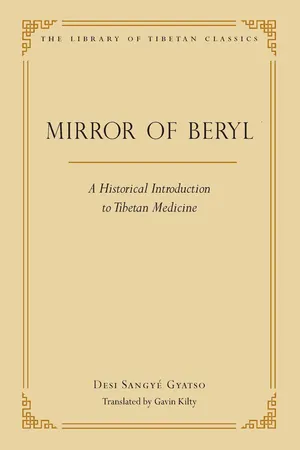
The Mirror of Beryl
A Historical Introduction to Tibetan Medicine
- 696 pages
- English
- ePUB (mobile friendly)
- Available on iOS & Android
eBook - ePub
About this book
Composed while its author was the ruler of Tibet, Mirror of Beryl is a detailed account of the origins and history of medicine in Tibet through the end of the seventeenth century. Its author, Desi Sangye Gyatso (1653 - 1705), was the heart disciple and political successor of the Great Fifth Dalai Lama and the author of several highly regarded works on Tibetan medicine, including his Blue Beryl, a commentary on the foundational text of Tibetan medicine, The Four Tantras. In the present historical introduction, Sangye Gyatso traces the sources of influence on Tibetan medicine to classical India, China, Central Asia, and beyond, providing life stories, extensive references to earlier Tibetan works on medicine, and fascinating details about the Tibetan approach to healing. He also provides a commentary on the pratimoksha, bodhisattva, and tantric Buddhist vows. Desi Sangye Gyatso's Mirror of Beryl remains today an essential resource for students of medical science in Tibet.
Frequently asked questions
Yes, you can cancel anytime from the Subscription tab in your account settings on the Perlego website. Your subscription will stay active until the end of your current billing period. Learn how to cancel your subscription.
At the moment all of our mobile-responsive ePub books are available to download via the app. Most of our PDFs are also available to download and we're working on making the final remaining ones downloadable now. Learn more here.
Perlego offers two plans: Essential and Complete
- Essential is ideal for learners and professionals who enjoy exploring a wide range of subjects. Access the Essential Library with 800,000+ trusted titles and best-sellers across business, personal growth, and the humanities. Includes unlimited reading time and Standard Read Aloud voice.
- Complete: Perfect for advanced learners and researchers needing full, unrestricted access. Unlock 1.4M+ books across hundreds of subjects, including academic and specialized titles. The Complete Plan also includes advanced features like Premium Read Aloud and Research Assistant.
We are an online textbook subscription service, where you can get access to an entire online library for less than the price of a single book per month. With over 1 million books across 1000+ topics, weāve got you covered! Learn more here.
Look out for the read-aloud symbol on your next book to see if you can listen to it. The read-aloud tool reads text aloud for you, highlighting the text as it is being read. You can pause it, speed it up and slow it down. Learn more here.
Yes! You can use the Perlego app on both iOS or Android devices to read anytime, anywhere ā even offline. Perfect for commutes or when youāre on the go.
Please note we cannot support devices running on iOS 13 and Android 7 or earlier. Learn more about using the app.
Yes, you can access The Mirror of Beryl by Sangye Desi Gyatso, Gavin Kilty in PDF and/or ePUB format, as well as other popular books in Medicine & Alternative & Complementary Medicine. We have over one million books available in our catalogue for you to explore.
Information
PART 1
THE SCIENCE OF HEALING IN INDIA

4. Early Indian Medical Traditions
WHEN HUMAN BEINGS were first created ages ago in this world of JampudvÄ«pa, they subsisted for a long time on the joys of meditative concentration, and even the name of coarse and ordinary food did not exist. Because they radiated their own light, there was no sun, moon, stars, or planets, no day and no night. They had the power to fly, and they enjoyed their bodies and pleasures on a par with with the gods of light. After some time, instincts of craving awoke in those of the race known as Manu,138 who were the first to be born in the human realm, and they began to partake of natural-earth ambrosia, which gave them indigestion. BrahmÄ heard their cries of pain, and moved by pity for the beings that he is said to have created, he conceived the idea of giving them boiled water as medicine for the indigestion. Alternatively, some say that he remembered a teaching from the Hundred Thousand Versed Science of Healing Collection taught by MahÄÅÄkyamuni Buddha at an earlier time, which prescribed boiled water as a cure for indigestion. Whatever the origin, BrahmÄ taught them the preparation of boiled water, and the indigestion was cured. From this it is well known in the world that the first illness was indigestion, the first patients were the Manu, the first medicine was boiled water, and the first doctor was BrahmÄ.
When the affix an is added to denote a descendent and the vowel a of bra is lengthened, one arrives at the term BrÄhmaį¹a, meaning the āchildren of BrahmÄā commonly known as brahmans, who are asserted to be his descendents. Through their high-birth physicians, the brahmans developed and spread the transmission of Äyurveda. This can be seen in the widespread Fortunate Eon Deva tradition and the VidyÄdhara Rishi tradition. These will be explained later.
The Buddhist scriptural tradition
The tradition known as the Buddhist scriptural tradition is explained as follows. In this particular eon, the fortunate eon, we cannot say with certainty that teachings given by the buddhas and the commentaries on them by others up to the era of Buddha KÄÅyapa have entirely disappeared, [30] but these days we cannot identify them with any certainty. As for Buddha ÅÄkyamuni, concurrent with teaching the four truths during the first turning of the wheel of Dharma at VÄrÄį¹asÄ«, it is believed that he also taught the Vimalagutra Medical Collection in 72,000 Chapters 139 and the Eight Branches in 20,000 Fascicles. The Basic Vinaya on the topic of medicine says, āA sick monk should approach a doctor and follow his advice.ā140 Expanding on this somewhat, the third section of this Vinaya work talks a little on medicines, suppositories, and so on, whereas the bulk of the teaching can be illustrated by the following summarizing verse:
On medicine: that which is permitted,
medicinal fats, medicine for scabrous skin,
eye medicines, medicine for the insane, for the monk Pilinda,
for the monk Revati, and acidic juice.141
Therefore, when the Buddha was dwelling in the AnÄthapiį¹įøada retreat in Jeta Grove and the monks became pale through autumnal illnesses, he allowed them to rely on specific remedies, but he did not allow medicines to be taken beyond specific times. The monks remained pale:
Änanda, therefore, the following is permitted. Monks should rely on four types of medicine: taken at the right times, taken at specific times, seven-day medicines, and life-long medicines.142 Foods to be eaten at the right times include pastes, boiled rice, gruel, meat, and fried or baked breads. Drinks that are to be taken at specific times include the juices from the fruit of the chocha tree, plantains, Indian juniper, aÅvattha figs, udumbara figs, parūṣaka berries, grapes, and dates. Seven-day medicines include ghee, sesame oil, molasses, honey, and white sugar.
Life-long medicines are of nine kinds: roots, stems, leaves, flowers, fruits, the five resin decoctions, the five powders, the five salts, and the five astringents. Root medicines include nutgrass, sweet flag, turmeric, wild ginger, white aconite, and any other medicinal roots that are not normally used for food. Stem or trunk medicines include sandalwood, clematis, juniper, deodar, heart-leaved moonseed, Indian barberry, [31] and any other stems not used for food. Leaf medicines include the leaves of paį¹ola, vÄÅaka, the neem tree, koÅÄtaka, and the seven-leaved saptaparį¹a, and any other leaves not normally used for food. Flower medicines include vÄÅaka flowers, the neem tree, coriander, Åata, and lotus filament, and any other flowers not normally used for food. Fruit medicines include chebulic myrobalan, emblic myrobalan, beleric myrobalan, black pepper, long pepper, and any other fruits not normally used for food. The five resin decoctions are asafetida, sal tree resin, lac, beeswax, and black pepper. The five powders are those made from barley, barley husk, corn smut, sesame, and aloe wood. The five salts are rock salt, brown salt, sanchal salt, white salt, and sea salt. The five astringents come from the mango, neem, jambÅ«, Åiriį¹£a, and koÅam trees.143
This and further passages teach the use of medicine and the consecration of the medicine.
At the time of the middle turning of the wheel of Dharma, the āphenomena devoid of signsā turning on Vultureās Peak, the Buddha taught the Hundred Thousand Versed Science of Healing Collection to the supreme god BrahmÄ. During the same period, when King PadmaÅrÄ« had invited the Buddha for the rainy-season retreat in Matkuį¹a Grove in the southern town of Sukhakara, the Buddha taught the Clearly Seeing Knowledge Tantra of a hundred thousand verses in 3,500 chapters to AvalokiteÅvara, BrahmÄ, ÅÄriputra, and others of the Mahayana family. It is also asserted that this work is the same as the Hundred Thousand Versed Science of Healing Collection.
In the Sutra of Golden Light: King of the Supremely Victorious Sutras, which was also taught on Vultureās Peak but during the period of the third turning, it says in chapter 24 on the elimination of illness in the version translated from the Chinese:
Goddess of the family, at a time in the past countless eons ago, [32] Buddha RatnacÅ«įøa, the tathÄgata, the destroyer, the perfect buddha, perfectly enlightened, with an enlightenment built on the foundation of the three trainings, the sugata, knower of the world, the greatest of all beings, the charioteer, teacher of gods and men, the bhagavÄn buddha, came to this world. When his doctrine had become a mere reflection, there lived in the land of King SureÅvaraprabhÄ the merchant Jalada, who was very learned in medicine, who had fully comprehended the eight branches of knowledge, and who tended to living beings and protected them from the sufferings of illness caused by an imbalance in the four great elements. This merchant had a son called JalavÄhana, who was fair of face and of handsome build, so that all gazed upon him with great delight. By nature he was of a quick mind. He soon mastered the scriptures, and ...
Table of contents
- Cover Page
- Title Page
- Table of Contents
- General Editorās Preface
- Translatorās Introduction
- Technical Note
- Mirror of Beryl: A Well-Explained History of the Glorious Science of Medicine, A Feast to Delight the Rishis
- Introduction
- Part 1. The Science of Healing in India
- Part 2. Earlier Development of Medical Science in Tibet
- Part 3. Later Development of Medical Science in Tibet
- Part 4. The Study of Medicine and the Three Sets of Vows
- Conclusion
- Notes
- Materia Medica
- Glossary
- Bibliography
- Index
- About the Contributors
- Copyright