
eBook - ePub
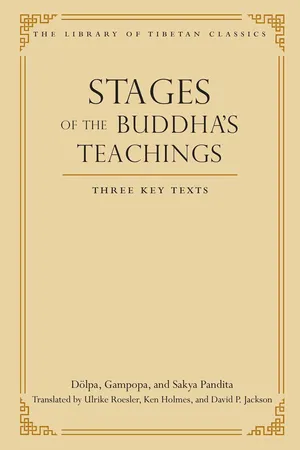
Stages of the Buddha's Teachings
Three Key Texts
- 816 pages
- English
- ePUB (mobile friendly)
- Available on iOS & Android
eBook - ePub
Stages of the Buddha's Teachings
Three Key Texts
About this book
Stages of the Buddha's Teachings is an extraordinary and systematized representation of the complete path to enlightenment. From the acclaimed Library of Tibetan Classics.
The “stages of the teachings” or tenrim genre of Tibetan spiritual writing expounds the Mahayana teachings as a graded series of topics, from the practices required at the start of the bodhisattva’s career to the final perfect awakening of buddhahood. The three texts in the present volume all exerted seminal influence in the Tibetan Buddhist tradition. The first text, The Blue Compendium, presents the instructions of the Kadam teacher Potowa (1031–1106) as recorded by his student Dölpa (1059–1131). This text is followed by Gampopa’s (1079–1153) revered Ornament of Precious Liberation, which remains the most authoritative text on the path to enlightenment within the Kagyü school. The final text is Clarifying the Sage’s Intent, a masterwork by the preeiment sage of the Sakya tradition, Sakya Pandita (1182–1251).
Frequently asked questions
Yes, you can cancel anytime from the Subscription tab in your account settings on the Perlego website. Your subscription will stay active until the end of your current billing period. Learn how to cancel your subscription.
At the moment all of our mobile-responsive ePub books are available to download via the app. Most of our PDFs are also available to download and we're working on making the final remaining ones downloadable now. Learn more here.
Perlego offers two plans: Essential and Complete
- Essential is ideal for learners and professionals who enjoy exploring a wide range of subjects. Access the Essential Library with 800,000+ trusted titles and best-sellers across business, personal growth, and the humanities. Includes unlimited reading time and Standard Read Aloud voice.
- Complete: Perfect for advanced learners and researchers needing full, unrestricted access. Unlock 1.4M+ books across hundreds of subjects, including academic and specialized titles. The Complete Plan also includes advanced features like Premium Read Aloud and Research Assistant.
We are an online textbook subscription service, where you can get access to an entire online library for less than the price of a single book per month. With over 1 million books across 1000+ topics, weāve got you covered! Learn more here.
Look out for the read-aloud symbol on your next book to see if you can listen to it. The read-aloud tool reads text aloud for you, highlighting the text as it is being read. You can pause it, speed it up and slow it down. Learn more here.
Yes! You can use the Perlego app on both iOS or Android devices to read anytime, anywhere ā even offline. Perfect for commutes or when youāre on the go.
Please note we cannot support devices running on iOS 13 and Android 7 or earlier. Learn more about using the app.
Yes, you can access Stages of the Buddha's Teachings by Dolpa,Gampopa,Sakya Pandita, David P. Jackson, Ulrike Roesler, Ken Holmes, David P. Jackson,Ulrike Roesler,Ken Holmes in PDF and/or ePUB format, as well as other popular books in Theology & Religion & Buddhism. We have over one million books available in our catalogue for you to explore.
Information
Topic
Theology & ReligionSubtopic
BuddhismPART I
The Blue Compendium
TEACHINGS ON THE GRADED PATH OF POTOWA RINCHEN SAL (1027/31ā1105)
Compiled in verse by Dƶlpa Sherap Gyatso (1059ā1131)
Translated by Ulrike Roesler

1. Preliminaries
1. Homage and need for composing the work1
Having bowed with reverence to the teachers,
the treasury of all good qualities,
I, a person of weak intellectual power, have made a compendium
by uniting what was scattered here and there.
In the section on not giving up the spiritual mentor from the Compendium of Trainings,2
it is stated that the starting point of all advice is, in brief,
to never give up the noble spiritual mentor.
Deeds, faith, the thought of awakening, and the like
come from him, and he is a treasury of all good qualities.
2. How to find a religious teacher and rely on him
The right way to seek out a spiritual mentor and rely on him
is to emulate the way of our mentor.
We should not seek out many; we should invest our life for the one weāve sought.
Itās not fit for a person who has not cultivated the mind to seek many.
These days we behave like an ox in autumn or summer
that sniffs at everything and becomes engaged with nothing;
our way has come to be
to listen to everyone without holding anyone as our teacher.
A lack of respect for his instruction and for all his explications of the Dharma
is the main reason our insight declines.
Therefore, as long as we have not examined our relationship with a teacher, there are not many [obligations].3
Once we have examined and adopted a teacher, we must respect him.
Then we will not be deprived of our teacher in the future.
That is the nature of things: karma does not vanish.
When someone from Tsang asked about the way to rely [on the teacher, he was told that]4
we should devote ourselves to the teacher with the notion that he is a buddha.
This notion when it is not genuine leads nowhere.
It must be generated in this way whether he is a teacher of the secret mantra
or of the path of the perfections.
The story of the Nepalese Hangdu can be presented in this context,5 and
Fifty Verses about the Guru also [prescribes] the same manner toward both [sutra and tantra teachers].6
In the teacher, the buddhas of the three times appear to us.
To a bodhisattva who has mastered the ten bodhisattva levels, they appear in the enjoyment body (saį¹bhogakÄya).
They appear here as is appropriate for the recipient.
When we honestly regard the teacher as a buddha
and follow him in this way, to enjoy our share of the teachings
is not just like enjoying our share of material things. [2]
The whole way of relying on the spiritual mentor is contained in this.
Since all good qualities depend on the teacher,
someone who is never separated from him
will achieve all purposes in no more than an instant.
To one who is endowed with great faith and wisdom
the teacher will give the whole instruction at one time.
Even if you have fully acquired knowledge and understanding,
if you practice and do not stay with him but live separately,
no good qualities will arise from this,
and even if some good qualities have arisen, they will vanish quickly.
Even if your wisdom is weak, as long as the root of faith is there
and you always stay with the teacher without separation,
all the teachings of the Buddha are fully contained in him.
Therefore you should always remain with him full of respect
and always consider the teacherās good qualities, not the faults.
With regard to the teacherās body and speech, whatever his deeds,
never think of it as something to either adopt or reject.
If you speak about him as you would about aged cheese and the like,7
and think accordingly, everything will become rotten.
If you harbor doubts about his instructions,
there will be no blessing at all; thatās the way it is.
Trust, therefore, in his actions and teaching.
In this way the blessing will arise.
While ordinary beings act as spiritual mentors,
they will never be without flaws.
Therefore never ponder their flaws
but always think about their virtues.
In this way the blessing will reach you.
Turning away [from this attitude] will cause you to not meet [a spiritual mentor in the future].
Moreover, you need to know the right time to approach him.
To follow him is something very precious.
In this way, all aims will be accomplished.
Not observing the appropriate time
is a serious transgression.
All good qualities depend on the teacher;
Even pratyekabuddhas up to the stage of the highest worldly realization rely on a teacher.8
Therefore please the teacher in every possible way.
First become acquainted with him through material offerings and respect.
When you have become acquainted, there are two obligations
with regard to the noble field of merit,
and the true way of fulfilling these obligations
is to practice according to his words.
To [attempt to] please him by honoring him without practicing
is not the way to behave...
Table of contents
- Cover
- Title
- Message from the Dalai Lama
- Special Acknowledgments
- Publisherās Acknowledgment
- Contents
- General Editorās Preface
- Translatorsā Introduction
- Acknowledgments
- Technical Note
- Abbreviations
- Part I: The Blue Compendium
- Part II: Ornament of Precious Liberation
- Part III: Clarifying the Sageās Intent
- The Conclusion of the Treatise
- Appendix 1. Table of Tibetan Transliteration
- Appendix 2. Outline of Clarifying the Sageās Intent
- Notes
- Glossary
- Bibliography
- Index
- About the Contributors
- The Institute of Tibetan Classics
- The Library of Tibetan Classics
- Become a Benefactor of the Library of Tibetan Classics
- About Wisdom Publications
- Copyright