Illuminating the Thirty-Seven Practices of a Bodhisattva
eBook - ePub

Illuminating the Thirty-Seven Practices of a Bodhisattva

  1. 224 pages
  2. English
  3. ePUB (mobile friendly)
  4. Available on iOS & Android
eBook - ePub

Illuminating the Thirty-Seven Practices of a Bodhisattva

About this book

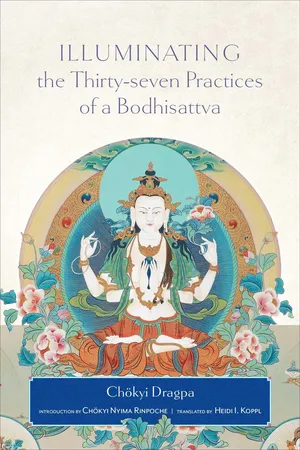
A unique presentation of the Buddhist path by Chökyi Dragpa, the foremost Gelug disciple of the famed nineteenth-century Tibetan master Patrul Rinpoche.

Illuminating the Thirty-Seven Practices of a Bodhisattva's quotations and direct instructions from realized sages of the past reinforce one another, subtly penetrating the mind and preparing it for meditation. This book, while fully accessible to newcomers, is especially powerful for serious, established practitioners.

Illuminating the Thirty-Seven Practices of a Bodhisattva was previous published under the title Uniting Wisdom and Compassion.
Frequently asked questions

Yes, you can cancel anytime from the Subscription tab in your account settings on the Perlego website. Your subscription will stay active until the end of your current billing period. Learn how to cancel your subscription.
At the moment all of our mobile-responsive ePub books are available to download via the app. Most of our PDFs are also available to download and we're working on making the final remaining ones downloadable now. Learn more here.
Perlego offers two plans: Essential and Complete
  • Essential is ideal for learners and professionals who enjoy exploring a wide range of subjects. Access the Essential Library with 800,000+ trusted titles and best-sellers across business, personal growth, and the humanities. Includes unlimited reading time and Standard Read Aloud voice.
  • Complete: Perfect for advanced learners and researchers needing full, unrestricted access. Unlock 1.4M+ books across hundreds of subjects, including academic and specialized titles. The Complete Plan also includes advanced features like Premium Read Aloud and Research Assistant.
Both plans are available with monthly, semester, or annual billing cycles.
We are an online textbook subscription service, where you can get access to an entire online library for less than the price of a single book per month. With over 1 million books across 1000+ topics, we’ve got you covered! Learn more here.
Look out for the read-aloud symbol on your next book to see if you can listen to it. The read-aloud tool reads text aloud for you, highlighting the text as it is being read. You can pause it, speed it up and slow it down. Learn more here.
Yes! You can use the Perlego app on both iOS or Android devices to read anytime, anywhere — even offline. Perfect for commutes or when you’re on the go.
Please note we cannot support devices running on iOS 13 and Android 7 or earlier. Learn more about using the app.
Yes, you can access Illuminating the Thirty-Seven Practices of a Bodhisattva by Chokyi Dragpa, Heidi I. Koppl in PDF and/or ePUB format, as well as other popular books in Theology & Religion & Buddhism. We have over one million books available in our catalogue for you to explore.

Information

THE EXCELLENT VASE OF NECTAR
The Unity of Scriptures and Oral Instructions
image
A Commentary on Gyalse Togme’s
The Thirty-Seven Practices of a Bodhisattva
BY CHÖKYI DRAGPA
Namo Guru
These aggregates, the illusory bodies of myself and others,
If sick, how enjoyable their sickness!
This is the exhaustion of bad karma, gathered in the past.
The various activities of one’s Dharma practice
Exist for the purpose of purifying the two obscurations.
If not sick, how enjoyable that is!
When body and mind are well, virtuous activity increases.
To engage in virtue with body, speech, and mind
Is the fulfillment of this human birth.
If lacking riches, how enjoyable that is!
Uninvolved with protecting and unconcerned about losing.
Disturbances arising from conflicts, however many there may be,
Surely occur because of wealth, cherished and desired.
If wealthy, how enjoyable that is!
Let the virtuous gathering of merit increase.
Immediate and future benefits and happiness, however many there may be,
Are certainly the fruition of merit.
If dying soon, how enjoyable that will be!
Unobstructed by bad circumstances and
Aided by one’s excellent habits at the meeting point,
One is certain to enter the unmistaken path.
If living long, how enjoyable that is!
Bringing forth the harvest of experience.
Without letting the moisture of the oral instructions evaporate,
Sustaining them at length, they will grow to fullness.
Whatever may come, meditate on it as being enjoyable.
This was spoken in response to a geshe’s questions as to what should be done when one falls sick. This way of taking sickness and so forth onto the path was arranged by the monk Togme, who teaches the Dharma.
May it be virtuous!
Mangalam.
THE GOODNESS OF THE BEGINNING
I bow to the great heroes and their children,
Those who have arrived and those who will arrive at the great realization,
Bearing with great courage their burden to guide to great enlightenment
All beings extending throughout space.
He who with his eyes of great compassion
Never shirks his promise to gaze on those who wander,
To the Dharma lord who is the display of this supremely noble one,
To the feet of Gyalse Togme, devoutly I bow.
The supreme entrance gate through which all the victors and their children,
As many as there are, have passed or will pass,
That excellent path that takes one from bliss to bliss,
Its practice I will here explain, delivering it into your hand.
There are three points to the explanation of the practices of the bodhisattvas, composed by the glorious son of the victorious ones, Gyalse Togme.
1.Praise and promise to compose
2.The nature of the treatise to be composed
3.The meaning of the conclusion
PRAISE
Namo Lokeshvaraya
Seeing that all phenomena are beyond coming or going,
He strives solely for the benefit of sentient beings.
To the supreme master and protector, Avalokiteshvara,
I prostrate continuously and respectfully with body, speech, and mind.
As for the first of these points, “Namo Lokeshvaraya” means “Prostrations to the lord of the world.” His omniscient wisdom sees all phenomena as the natural state, exactly as it is, in which the complexities of any of the eight extremes—coming and going, permanence and nihilism, existence and no existence, one and many—have not the slightest bearing. Yet, by the power of great compassion and love, he strives one-pointedly for the welfare of sentient beings. To this supreme lama who shows me the path of the Great Vehicle and who is inseparable from the noble Avalokiteshvara, the personification of the compassion of all the buddhas, the protector of all those who are without protection, I prostrate continuously with respectful body, speech, and mind.
THE PROMISE TO COMPOSE
The perfectly enlightened ones, sources of benefit and happiness,
Appear from having accomplished the holy Dharma.
Since that accomplishment depends on knowing the practices,
I will here explain the practice of the bodhisattvas.
The perfectly enlightened ones, those who have become the sources of temporary benefit and ultimate bliss, from what cause did they appear? In the context of training on the path, they appeared solely from having practiced the holy Dharma of the Great Vehicle in a correct manner. You may then ask, “How is that?” At the very outset, they bring forth a mind that is basically great compassion. Thereafter, they gather the accumulations, which are comprised of the six paramitas—the aspect of means, generosity, and so forth—as well as the aspect of knowledge that realizes all phenomena to be without self-nature. All such qualities depend exclusively on knowing how to practice. Therefore, for those who wish to train on the path of the Great Vehicle in order to achieve buddhahood, the following promise is made: “I shall explain the training in the motivation and conduct of the bodhisattvas, just...

Table of contents

  1. Cover
  2. Title
  3. Table of Contents
  4. Translator’s Preface
  5. Introduction by Chökyi Nyima Rinpoche
  6. The Excellent Vase of Nectar: The Unity of Scriptures and Oral Instructions
  7. Appendix: The Thirty-Seven Practices of a Bodhisattva
  8. Notes
  9. Glossary
  10. Sources Cited
  11. Index of Names
  12. About the Authors
  13. Wisdom Publications
  14. Also Available from Wisdom Publications
  15. Copyright