Perfect Conduct
eBook - ePub

Perfect Conduct

Ascertaining the Three Vows

  1. 192 pages
  2. English
  3. ePUB (mobile friendly)
  4. Available on iOS & Android
eBook - ePub

About this book

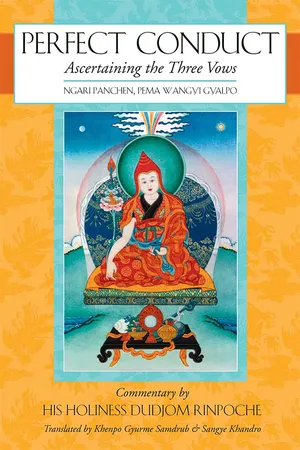
All religions teach codes of ethical behavior. So too does Buddhism. This books is a translation of an indispensable exposition of the three sets of vows that are central to Tibetan Buddhist codes of discipline--the pratimoksa vows of individual liberation; the vows of the bodhisattva, who selflessly strives for the liberation of all beings; the vows of the esoteric path of tantra.Here, the late Dudjom Rinpoche provides his authoritative commentary on the role of ethics and morality in Buddhist practice, outlining in detail the meaning and scope of the vows, and giving practical advice on maintaining the vows as supportive tools in the journey toward enlightenment.
Frequently asked questions

Yes, you can cancel anytime from the Subscription tab in your account settings on the Perlego website. Your subscription will stay active until the end of your current billing period. Learn how to cancel your subscription.
At the moment all of our mobile-responsive ePub books are available to download via the app. Most of our PDFs are also available to download and we're working on making the final remaining ones downloadable now. Learn more here.
Perlego offers two plans: Essential and Complete
  • Essential is ideal for learners and professionals who enjoy exploring a wide range of subjects. Access the Essential Library with 800,000+ trusted titles and best-sellers across business, personal growth, and the humanities. Includes unlimited reading time and Standard Read Aloud voice.
  • Complete: Perfect for advanced learners and researchers needing full, unrestricted access. Unlock 1.4M+ books across hundreds of subjects, including academic and specialized titles. The Complete Plan also includes advanced features like Premium Read Aloud and Research Assistant.
Both plans are available with monthly, semester, or annual billing cycles.
We are an online textbook subscription service, where you can get access to an entire online library for less than the price of a single book per month. With over 1 million books across 1000+ topics, we’ve got you covered! Learn more here.
Look out for the read-aloud symbol on your next book to see if you can listen to it. The read-aloud tool reads text aloud for you, highlighting the text as it is being read. You can pause it, speed it up and slow it down. Learn more here.
Yes! You can use the Perlego app on both iOS or Android devices to read anytime, anywhere — even offline. Perfect for commutes or when you’re on the go.
Please note we cannot support devices running on iOS 13 and Android 7 or earlier. Learn more about using the app.
Yes, you can access Perfect Conduct by Pema Wangyi Gyalpo, Gyurme Samdrub, Sangye Khandro, Gyurme Samdrub,Sangye Khandro in PDF and/or ePUB format, as well as other popular books in Theology & Religion & Buddhism. We have over one million books available in our catalogue for you to explore.

Information

THE COMMENTARY
FIRST: THE INITIAL VIRTUE
The initial virtue, the intermediate virtue, and the concluding virtue are the three divisions in this and in all commentaries that are written based on the Buddha’s spoken teachings. These three divisions are similar to the three pure recollections: those of motivation, nonconceptual awareness during the actual practice, and the concluding dedication of merit. In the initial virtue there are the three divisions that explain the title of the text, the homage, and the commitment to compose.
I.The Title of the Text:
A Branch on the Path of the Natural Great Perfection Called Ascertaining the Three Vows
Within the profound expanse of the innate, unaltered, natural mind, all meanings, including the foundation, path, and result, are originally perfected. This spontaneous presence, which is unsurpassed by any other, is called “great.” The unmistaken actualization of this nature is the ultimate fruit of all paths, the atiyoga. From anuyoga on down, all the paths of sūtra and tantra are practiced in order to realize this nature. In this way they are established as “branches” of the path. The three vows, the essence of the practice of all these paths, are the main subject at hand. To establish an accurate understanding of the view of the three vows through the three investigations—actual, inferential, and scriptural—is the meaning of “ascertaining.”
Śāstra literally means that which has the potential to sever all negative emotions and grant refuge from rebirth in the three lower realms. Specifically, a śāstra is a commentary on the Buddha’s teachings written by a perfect follower. There are three levels to be considered here. Ideally, the author of a śāstra must have realization of the nature of the dharmatā. To qualify as average the author should have had a vision of the deity. At least, the author should be perfectly learned in the five major sciences.17 In addition, the commentary must be eloquently written with the qualities and ability to alleviate the causes of delusion, as well as to produce the results that grant protection from inferior rebirths in cyclic existence.
The purpose of the title will vary according to the sensibility of the reader. Those of superior sensibility, just by reading the title, will be able to realize the entire meaning of the text. Those of average sensibility will derive a general idea of its contents, and those of common sensibility will become interested and inspired to begin to study the text.
II.Homage:
A.General homage to the supremely kind guru:
Namo Guruve!
Homage to the Guru-Lama!
“Namo” means to pay homage. “Guru” describes an individual whose noble qualities are limitless, whose wisdom-knowledge is unsurpassed, and whose great loving-kindness is unequalled. To such a guru-lama, with great admiration and respect from the three doors of body, speech, and mind, homage is rendered.
B.Specific homage to the great master, Padmasambhava:
By churning the treasure ocean of the glorious two accumulations, the white light of knowledge and loving-kindness brings forth the all-pervasive rain of the definitive secret vehicle. To the supreme crown jewel of all scholars and accomplished masters of Tibet’s Land of Snow, to the guide of all sentient beings, the Lake-born Vajra (Guru Padmasambhava), I pay homage!
It is believed by the Vedic school of Hinduism that by churning the ocean the moon arose. The author draws from this example to poetically illustrate the qualities of Guru Padmasambhava. By churning the vast ocean of the accumulation of ordinary and wisdom merit, supreme wisdom and loving-kindness arise indivisibly, forming the maṇḍala of the moon with its cooling, moist, illuminating rays. The all-pervasiveness of a rain shower is likened to the spontaneity of the concerned action that arises from such a “moon” to reveal the secret mantra teachings in order to tame the minds of beings.
This analogy exemplifies the object of specific homage, the great master Padmasambhava, who is the very embodiment of the great ocean of the two accumulations of merit, the source from which all enlightened qualities of wisdom-knowledge and compassion arise. As the supreme crown jewel of all scholars and accomplished masters in the three realms, including the snow land of Tibet, he is well known as the Lake-born Vajra.18
The Lake-born Vajra, Padmasambhava, was born from the center of a lotus without depending on parents. The word “vajra” refers to this transcendence of the concept of birth and death. Because he possesses the wisdom to guide all beings on whatever level is necessary according to their specific needs, he is known as the supreme guide of beings.
III.The Commitment to Compose:
This sage, skilled in knowing how to cleanse the mental stains of beings and upholding the lapis lazuli vase of supreme intelligence, bestows the ambrosia-like explanations of the three vows. May all those with sincere interest gather here to partake of this!
The author, Ngari Panchen, refers to himself as a sage, defined as one who is wise in the worldly knowledge of what to accept and reject. As is the case with all scriptural commentaries, the author’s “commitment” must reveal with superiority the four necessities of this Dharma. The first necessity is the subject, in this case the three vows. The second necessity is a superior explanation of the subject so that the meaning and purpose can be fully understood, leading readers to embark upon the path to liberation. This bestows temporary benefit. Third, once the path is entered and perfected, perfect awakening is revealed as the ultimate benefit. Fourth, the interdependent relationship between each of these four is demonstrated, in that one arises in dependence upon the other and is accomplished accordingly.
SECOND: THE INTERMEDIATE VIRTUE
The actual text is divided into three sections:
I.A brief explanation of the stages of the main teaching
II.An extensive explanation of the nature and precepts of each of the three vows
III.A concise explanation of the manner in which an individual practices the three vows together without conflict
CHAPTER ONE:
A BRIEF EXPLANATION OF THE STAGES OF THE MAIN TEACHING
I.Chapter One: A Brief Explanation of the Stages of the Main Teaching, in three subdivisions:
A.Recognizing the basis for purification and the ultimate result:
The general expression of primordial wisdom is the Great Perfection atiyoga. The perfectly pure embodiment, kāya, of the great Vajradhara is ultimate fruition, the oneness of buddha.
Generally, the Great Perfection is considered in three divisions: foundation, path, and result. The foundational Great Perfection is the fundamental nature of all living beings as the essential nature of the realized ones. The path of Great Perfection is the ultimate result sought by all the vehicles, namely the cleansing of the two obscurations and all habitual propensities, which overshadow the buddha nature. The resultant state of the Great Perfection is separation from all obscurity, and dwelling in the inner lucency of the ever-youthful vase presence, the unsurpassed nature of pure presence and primordial wisdom. This nature of truth, known here as the “general expression of primordial wisdom,” is otherwise inexpressible, yet prevalent throughout existence and beyond.
The basis for the purification is the buddha nature itself. The object of the purification is the temporary veil through which all that appears as cyclic existence is perceived. The purification is the essence of the path of the three vows, the profound path of mantra, practiced by those who uphold pure awareness, the vidyādharas. Although the path itself is not inherently “true,” it exists in order to fully purify the sudden stain of the two obscurations as well as all residual habitual propensities. The result of this purification is the spontaneous accomplishment of the two purposes, which manifests as the five states of pure presence, kāyas, and the five primordial wisdoms,19 the nature of which is the Buddha. This buddha nature is also referred to as Samantabhadra or Mahāvajradhara. This is the result of all vehicles, the “ultimate fruition, the oneness of buddha.”
B.A general explanation of the different aspects of the path to accomplish, in three subdivisions:
1.A brief revelation of the one and only path:
Although the ways of entry into the profound and extensive Dharma are beyond number, without relying upon the great secret path of maturation and liberation (Vajrayāna), there is no attainment, the perfected Buddha said.
The reference to the profound Dharma indicates its ability to reveal the ultimate nature of emptiness, as it is. The reference to extensive Dharma indicates all conventional paths that comprise the multitudes of entranceways. However, without reliance upon the great secret vehicle of ripening empowerments, as well as the supreme paths of liberation, generation, and completion stage practice, enlightenment will never be obtained, because what binds us to cyclic existence is the extremely subtle red and white bodhicitta and the vital air, through which the three appearances20 are generated at the time of transition from this life to the next. The methods that clear the obscurations created by these three appearances are found only in the Vajrayāna. This was clearly taught by the perfected Buddha, who actualized the primordial wisdom of being unimpeded by, and unattached to, all knowable things.
2.A specific explanation of how vehicle distinctions are merely steps on the path, in two subdivisions:
a.An explanation of the general characteristics of the foundational vehicles:
Just as mental engagements are unceasing, one cannot possibly engage in all the inconceivable numbers of vehicles. A...

Table of contents

  1. Cover
  2. Title
  3. Contents
  4. Preface
  5. Introduction
  6. Translator’s Note
  7. The Commentary, Including the Root Text
  8. Translation of the Root Text, Ascertaining the Three Vows
  9. Outline of the Commentary
  10. Notes
  11. Wisdom Publications
  12. Also available from Wisdom Publications
  13. Copyright