
- 144 pages
- English
- ePUB (mobile friendly)
- Available on iOS & Android
eBook - ePub
About this book
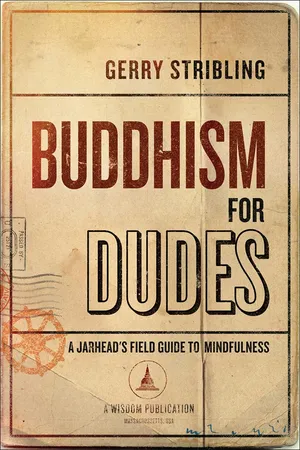
A tough former Marine leads Buddhist basic training for the average Joe. In Buddhism for Dudes, Gerry "Strib" Stribling, former Marine and all-around good guy, answers questions on life and living with a healthy dose of Buddhist wisdom for the regular guy. Strib takes a good look at who the Buddha was, meditation, karma, and more. With good humor and without sentimentalism, he explains these down-to-earth insights in everyday language. Showing how Buddhism boldly approaches life's problems head on, unflinching and alertâlike a soldier in a forward listening post in the dark of nightâStrib emphasizes the Buddhist call to moral action for the good of oneself and others.
Frequently asked questions
Yes, you can cancel anytime from the Subscription tab in your account settings on the Perlego website. Your subscription will stay active until the end of your current billing period. Learn how to cancel your subscription.
At the moment all of our mobile-responsive ePub books are available to download via the app. Most of our PDFs are also available to download and we're working on making the final remaining ones downloadable now. Learn more here.
Perlego offers two plans: Essential and Complete
- Essential is ideal for learners and professionals who enjoy exploring a wide range of subjects. Access the Essential Library with 800,000+ trusted titles and best-sellers across business, personal growth, and the humanities. Includes unlimited reading time and Standard Read Aloud voice.
- Complete: Perfect for advanced learners and researchers needing full, unrestricted access. Unlock 1.4M+ books across hundreds of subjects, including academic and specialized titles. The Complete Plan also includes advanced features like Premium Read Aloud and Research Assistant.
We are an online textbook subscription service, where you can get access to an entire online library for less than the price of a single book per month. With over 1 million books across 1000+ topics, weâve got you covered! Learn more here.
Look out for the read-aloud symbol on your next book to see if you can listen to it. The read-aloud tool reads text aloud for you, highlighting the text as it is being read. You can pause it, speed it up and slow it down. Learn more here.
Yes! You can use the Perlego app on both iOS or Android devices to read anytime, anywhere â even offline. Perfect for commutes or when youâre on the go.
Please note we cannot support devices running on iOS 13 and Android 7 or earlier. Learn more about using the app.
Yes, you can access Buddhism for Dudes by Gerry Stribling in PDF and/or ePUB format, as well as other popular books in Theology & Religion & Eastern Philosophy. We have over one million books available in our catalogue for you to explore.
Information
1
Buddhism, No Bullshit
There is a healthy, reasonable way of living, a simple philosophy that people mistake for a religion, which is a recipe for both world peace and personal sanity. Itâs called Buddhism, and itâs hardly new; the Buddha lived five hundred years before Jesus was born. In a very real way, Buddhism is pretty easy to understandâyet many people think that it is mysterious and inscrutable. There are some pretty wacky misconceptions about Buddhism out there, but it can become a real support system for those of us who just donât otherwise get the point of modern life.
If you Google âBuddhismâ and start clicking on sites, youâre going to encounter a confusing array of ideas, writingsâand plenty of bullshit. The nitty-gritty stuff you really need to know to understand Buddhism and explore how following the Buddhist path can improve your lifeâwell, dude, thatâs harder to find.

Most images of the Buddha have fit, studlier bodies with a round head of curly hair tied in a top-knot.
Americans tend to have a skewed conception of Buddhism. If youâre over fifty, the indelible image seared in your mind from the Buddhist world may be the monk who set himself on fire in Saigon to protest the Vietnam War. Under fifty and you probably picture the Dalai Lama. Some people see Buddhism as an âAsian thingâ inaccessible to Americans except for overeducated, vegan, antiwar whale huggers and the like. Misconceptions and partial information tend to typify our idea of what Buddhism is.
Take, for example, the image of the Buddha himself, or at least the image many Americans associate with the founder of this philosophy: until I went to Asia, I didnât know that the Buddha was not a fat guyâthe hairless bag-toting Santa Claus often seen in the front of Chinese restaurants wearing a shit-eating grin on his big, chubby face. That image is actually a Chinese god of happiness and contentment. Most images of the Buddha have fit, studlier bodies with a round head of curly hair tied in a topknot. But when it comes down to it, what sets the Buddha apart isnât his appearance; itâs what he taught.
My experience with Buddhism is focused on the hard-core basics of the belief system and their application in our professional and personal lives. Buddhism is good stuff. I want my fishing buddies to know about it. Everybody should know some Dharma. If they did, the world would be a more peaceful place.
Everything you need to know about basic, no-frills Buddhist wisdom can be outlined on a half-sheet of paper. There are three refuges, four noble truths, five precepts, and an eight-point guide to proper (and happy) living. You donât have to âgo Asianâ to understand Buddhism. You donât have to quit eating meat or drinking beer. The Buddha ate meat when that was what was offered to him, and a beer every now and then isnât going to get you into too much trouble.
Buddhism is all about being a stand-up guy, a mensch, someone whoâll never let someone down. Buddhism is being secure and confident in your approach to life. Iâm sure a lot of people benefit in many different ways from Buddhist wisdomâwhat many people donât understand is that itâs not about them.
It takes guts to be a Buddhist dude. Itâs not about hiding in your own little world; itâs about living and meeting all of lifeâs challenges in a meaningful and unselfish way. Itâs about superhero ethics, a soldierâs devotion to duty, and the kind of happiness you come by only from being fearless. A significant contention of this book is that you donât have to surrender your manly fortitude to adopt Dharma into your life.
2
Who Was the Buddha?
More than twenty-five-hundred years ago in northern India, a prince was born into a world of great splendor and wealth. Siddhartha Gautama lived the lifestyle of the rich and famous. His parents, intent on making sure the young princeâs life was as happy as possible, sheltered him from the ugly realities of the world. In fact, he was pushing thirtyâwith a wife and a kid, no lessâbefore he learned that people grow old, get sick, and die. For a clueless but otherwise intelligent guy to discover the cold, hard facts of life at that late a stage was a real wake-up-call, a major bombshell. âSuffering!â the prince realized. âThe human experience is about a lot of suffering. Holy crap!â
Gautama became obsessed with finding out how to deal with the suffering he saw in the world. It was a pretty tall order, but somebody had to do it. He left the life of luxury (and also his wife and kid) and, like Willie Nelson, he hit the roadâGautama the Dharma bum. How many servicemen and women have had to make the same kind of sacrifice for the greater good? Karen Armstrong, a biographer of the Buddha, says that he probably agonized over that decision.
At first he sought out gurus in order to learn from them and to synthesize their wisdom. They disappointed him. He then tried living the life of an ascetic, an existence characterized by self-denial and self-imposed misery. Because he starved himself, he lost a lot of weight and even ended up near death, nothing but skin and bones. Finally, after giving it his best effort, and after eating a bowl of milk rice, Gautama figured out that such an austere existence was as stupid as his former royal life was decadent and meaningless. After experiencing the two extremes, he eventually realized that the truth was to be found somewhere in the middle between the twoâa âmiddle path,â if you will.
Gautama sat under a tree and started meditating, vowing to himself that he would not leave that spot until he figured it all out: What is the purpose of existence? Why does life have to hurt so much? How should we live and deal with our suffering and with the suffering of our fellow human beings? He sat under that tree for a long time. And thenâWHAMMO! The final eureka smacked him upside the head and he achieved perfect understandingâenlightenment. He experienced such incredible bliss that he closed his eyes, tilted his head back, and wagged it back and forth from experiencing the joy of it all. He didnât stop, they say, for seven days. Tradition says otherwise, but I like to imagine that he felt just as if heâd struck gold at Sutterâs Mill and had to go tell somebody.
He sought out five equally starved buddies in the park, guys whoâd stuck with him through thick and thin, and he told them what he had discovered. That speech is now known as the Buddhaâs first sermon, or the âfirst turning of the Dharma Wheel.â In it the Buddha expressed everything anyone ever needed to know in order to survive life and to achieve contentment and salvation. The Dharma, i.e., the wisdom that the Buddha shared with others for the next half-century, is handed down to us today. The essence of that wisdom is called the Four Noble Truths. Contained within the Four Noble Truths is the Noble Eightfold Path, a blueprint for living life the right way. And part of that blueprint is the Five Precepts, the Buddhaâs rules for living a stand-up life. (Something like a Buddhist version of the Ten Commandments. Although the analogy is imprecise, you get the idea.) All of Buddhist wisdom can be found in that first sermon. In an important sense, everything else the Buddha taught (and thereâs a lot of it) is commentary.
The Buddha was in his midthirties when he achieved perfect wisdom, and for the next fifty years he traveled all around northern India teaching what he learned for himself under the Bodhi Tree. He attracted a great many disciples and died in his eighties from food poisoning. If you ever travel the world and see statues of the Buddha and you see one lying down, thatâs the dying Buddha, felled by foul pork just like any ordinary man after a trip to a bad barbecue joint.
After all, that was all the Buddha ever claimed to be: an ordinary man.

After experiencing the two extremes, he eventually realized that the truth was to be found somewhere in the middle between the twoâa âmiddle path,â if you will.
3
Is Buddhism a Religion or Not?
Now, the notion that the Buddha was not divine confused the heck out of me when I first took up residence at a Buddhist temple in Asia. I hung out exclusively in the company of monks for months, during which time I saw a lot of what looked to me a heck of a lot like religious rituals. Several times a day monks would chant what seemed to be prayers, and they frequently behaved toward statues in a way that any Orthodox Rabbi would call âbowing down to false idols.â
Dozens of Buddha statues sat around the templeâs campus, but the main one, the big guy in the shrine, was humongousâat least triple life-sized, and covered in gold. In many parts of Asia, you canât turn around without seeing a Buddha imageâa little Buddha here, a big Buddha there, even Buddhas carved out of entire mountains. Every shop in Sri Lanka and Thailand has its own little shrine, and every home has one too. Youâll encounter roadside Buddha shrines wherever you go. The Buddha is everywhere.
One night at the temple I had the chance to ask some fairly hot-shot Buddhist theologians about what the monks were up to during their services. Revealing my confusion, I asked, âIf the Buddha was just a dude and not a god, then why do people bow down and pray to his image? What does all that worship have to do with Buddhism?â
Buddhism, I was informed, is not a religion. It is a moral philosophy. Buddhist âworshipâ isnât really worship, chanting isnât the same as prayer, and Buddha images are ubiquitous because we need to be reminded that there is a code of conduct to live by, and that this guy figured it out. When Buddhists sit before the Buddhaâs image they are reminded of the inner peace that they should enjoy if they live meditative, compassionate, and moral lives. The Buddha said that there was no reason to venerate him personally. His message is whatâs important.
By chanting we repeat the Buddhaâs message in order to remind ourselves of what we already know. Bowing and holding oneâs hands together in a prayerful way are Asian traditions. You see people make these gestures all the time over much of Asia, as well as any yoga class you might care to attend. To greet someone with a bow and your hands together is almost like shaking hands in the West, only there is an added element of reverence and respect. Showing respect is not worshipping. Itâs also more sanitary than shaking hands.
Most of us need ritual and tradition, even some form of âworship,â if you want to call it that, whether we get it from religion or not. When it comes to ritual and tradition, NASCAR and the NFL and a standing tee time with your foursome might meet that need...
Table of contents
- Cover
- Title
- Dedication
- Contents
- Introduction
- 1. Buddhism, No Bullshit
- 2. Who Was the Buddha?
- 3. Is Buddhism a Religion or Not?
- 4. So, Like, What Is Truth?
- 5. The Middle Path
- 6. Karma and Rebirth
- 7. How Itâs Done for Real
- 8. A Beautiful Mind
- 9. The Well-Trained Brain
- 10. Meditation: Can I Be âSorta-Kindaâ Buddhist?
- 11. OK, This Is Really Important
- 12. The Real Secret of Life
- 13. Roadside Attractions
- Acknowledgments
- About the Author
- About Wisdom Publications
- More Books from Wisdom Publications
- Copyright