Buddhism
eBook - ePub

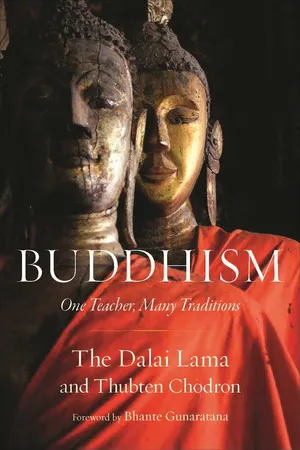
Buddhism

One Teacher, Many Traditions

  1. 352 pages
  2. English
  3. ePUB (mobile friendly)
  4. Available on iOS & Android
eBook - ePub

Buddhism

One Teacher, Many Traditions

About this book

Explore the common ground underlying the diverse expressions of the Buddha's teachings with two of Tibetan Buddhism's bestselling authors. Buddhism is practiced by hundreds of millions of people worldwide, from Tibetan caves to Tokyo temples to redwood retreats. To an outside viewer, it might be hard to see what they all have in common. In Buddhism, His Holiness the Dalai Lama and American Buddhist nun Thubten Chodron map out with clarity the convergences and the divergences between the two major strains of Buddhism--the Sanskrit traditions of Tibet and East Asia and the Pali traditions of Sri Lanka and Southeast Asia. Especially deep consideration is given to the foundational Indian traditions and their respective treatment of such central tenets as the four noble truths the practice of meditation the meaning of nirvana enlightenment. The authors seek harmony and greater understanding among Buddhist traditions worldwide, illuminating the rich benefits of respectful dialogue and the many ways that Buddhists of all stripes share a common heritage and common goals.
Frequently asked questions

Yes, you can cancel anytime from the Subscription tab in your account settings on the Perlego website. Your subscription will stay active until the end of your current billing period. Learn how to cancel your subscription.
No, books cannot be downloaded as external files, such as PDFs, for use outside of Perlego. However, you can download books within the Perlego app for offline reading on mobile or tablet. Learn more here.
Perlego offers two plans: Essential and Complete
  • Essential is ideal for learners and professionals who enjoy exploring a wide range of subjects. Access the Essential Library with 800,000+ trusted titles and best-sellers across business, personal growth, and the humanities. Includes unlimited reading time and Standard Read Aloud voice.
  • Complete: Perfect for advanced learners and researchers needing full, unrestricted access. Unlock 1.4M+ books across hundreds of subjects, including academic and specialized titles. The Complete Plan also includes advanced features like Premium Read Aloud and Research Assistant.
Both plans are available with monthly, semester, or annual billing cycles.
We are an online textbook subscription service, where you can get access to an entire online library for less than the price of a single book per month. With over 1 million books across 1000+ topics, we’ve got you covered! Learn more here.
Look out for the read-aloud symbol on your next book to see if you can listen to it. The read-aloud tool reads text aloud for you, highlighting the text as it is being read. You can pause it, speed it up and slow it down. Learn more here.
Yes! You can use the Perlego app on both iOS or Android devices to read anytime, anywhere — even offline. Perfect for commutes or when you’re on the go.
Please note we cannot support devices running on iOS 13 and Android 7 or earlier. Learn more about using the app.
Yes, you can access Buddhism by Dalai Lama, Thubten Chodron in PDF and/or ePUB format, as well as other popular books in Theology & Religion & Buddhism. We have over one million books available in our catalogue for you to explore.

Information

1 | Origin and Spread of the Buddha’s Doctrine
NOT ALL PEOPLE think alike. They have different needs, interests, and dispositions in almost every area of life, including religion. As a skillful teacher, the Buddha gave various teachings to correspond to the variety of sentient beings. We’re going to look at the development of the two major Buddhist traditions containing these teachings, the Pāli and Sanskrit traditions.1 But first, we begin with the life story of Śākyamuni Buddha.

THE BUDDHA’S LIFE

In the view common to both traditions, Siddhārtha Gautama, a prince from the Śākya clan, was born and grew up near what is now the India-Nepal border in the fifth or sixth century B.C.E. As a child, he had a kind heart and excelled in the arts and studies of his time. He lived a sheltered life in the palace during his early years, but as a young man he ventured out beyond the palace walls. In the town, he saw a sick person, an old person, and a corpse, prompting him to reflect on the suffering nature of life. Seeing a wandering mendicant, he considered the possibility of liberation from saṃsāra. And so, at age twenty-nine, he left the palace, shed his royal attire, and adopted the lifestyle of a wandering mendicant.
He studied with the great teachers of his time and mastered their meditation techniques but discovered they did not lead to liberation. For six years he pursued severe ascetic practices in the forest, but realizing that torturing the body doesn’t tame the mind, he adopted the middle way of keeping the body healthy for the sake of spiritual practice without indulging in unnecessary comforts.
Sitting under the bodhi tree in what is present-day Bodhgaya, India, he vowed not to arise until he had attained full awakening. On the full moon of the fourth lunar month, he finished the process of cleansing his mind of all obscurations and developing all good qualities, and he became a fully awakened buddha (sammāsambuddha, samyaksaṃbuddha). Thirty-five years old at the time, he spent the next forty-five years teaching what he had discovered through his own experience to whoever came to hear.
The Buddha taught men and women from all social classes, races, and ages. Many of those chose to relinquish the householder’s life and adopt the monastic life, and thus the saį¹…gha community was born. As his followers attained realizations and became skilled teachers, they shared with others what they had learned, spreading the teachings throughout ancient India. In subsequent centuries, the Buddhadharma spread south to Sri Lanka; west into present-day Afghanistan; northeast to China, Korea, and Japan; southeast to Southeast Asia and Indonesia; and north to Central Asia, Tibet, and Mongolia. In recent years, many Dharma centers have opened in Europe, the Americas, the former Soviet republics, Australia, and Africa.
I feel a deep connection to Gautama Buddha as well as profound gratitude for his teachings and for the example of his life. He had insights into the workings of the mind that were previously unknown. He taught that our outlook impacts our experience and that our experiences of suffering and happiness are not thrust upon us by others but are a product of the ignorance and afflictions in our minds. Liberation and full awakening are likewise states of mind, not the external environment.

BUDDHIST CANONS AND THE SPREAD OF THE DHARMA

Vehicle and path are synonymous. While they are sometimes used to refer to a progressive set of spiritual practices, technically speaking they refer to a wisdom consciousness conjoined with uncontrived renunciation.
The Buddha turned the Dharma wheel, setting forth practices of three vehicles: the Hearer Vehicle (Sāvakayāna, Śrāvakayāna), the Solitary Realizer Vehicle (Paccekabuddhayāna, Pratyekabuddhayāna), and the Bodhisattva Vehicle (Bodhisattayāna, Bodhisattvayāna). According to the Sanskrit tradition, the three vehicles are differentiated in terms of their motivation to attain a specific goal, their principal meditation object, and the amount of merit and time necessary to attain their goals. Teachings and practitioners of all three vehicles exist in both the Pāli and Sanskrit traditions. In general, those practicing the Hearer Vehicle principally follow the Pāli tradition, and those practicing the Bodhisattva Vehicle principally follow the Sanskrit tradition. Nowadays in our world, hardly anyone follows the Solitary Realizer Vehicle.
The Buddha’s teaching spread widely in India in the centuries after the Buddha lived and was brought to Sri Lanka from India by King Aśoka’s son and daughter in the third century B.C.E. The early suttas were transmitted orally by the bhāṇakas—monastics whose job it was to memorize the suttas—and according to Sri Lankan sources, they were written down about the first century B.C.E. to form what is now the Pāli canon. Over the centuries, beginning in India and later augmented by Sinhala monks in the old Sinhala language, a body of commentaries on the scriptures built up. In the fifth century the great translator and commentator Buddhaghosa compiled the ancient commentaries and translated them into Pāli. He also wrote his famous masterwork the Visuddhimagga and numerous commentaries. Another South Indian monk, Dhammapāla, lived a century later and also wrote many commentaries in Pāli. Pāli is now the scriptural language uniting all Theravāda Buddhists.
Beginning in the first century B.C.E., the Sanskrit tradition came into view and gradually spread in India. Philosophical systems in India—Vaibhāṣika, Sautrāntika, Yogācāra (a.k.a. Cittamātra or VijƱānavāda), and Madhyamaka—evolved as scholars developed divergent views on points not explained explicitly in the sÅ«tras. Although many tenets of the Pāli tradition are shared with one or another of these four tenet systems, it cannot be equated with any of them.
Several monastic universities arose—Nālandā, Odantapuri, and Vikramaśīla—and there Buddhists from various traditions and philosophical schools studied and practiced together. Philosophical debate was a widespread ancient Indian custom; the losers were expected to convert to the winners’ schools. Buddhist sages developed logical arguments and reasonings to prove the validity of Buddhist doctrine and to deflect the philosophical attacks of non-Buddhists. The renowned Buddhist debaters were also great practitioners. Of course not all Buddhist practitioners were interested in this approach. Many preferred to study the sÅ«tras or to practice meditation in hermitages.
Nowadays, three canons exist: the Pāli, Chinese, and Tibetan; a Sanskrit canon was not compiled in India. Each canon is divided into three ā€œbasketsā€ (piį¹­aka)—or categories of teachings—which are correlated with the three higher trainings. The Vinaya basket deals chiefly with monastic discipline, the SÅ«tra basket emphasizes meditative concentration, and the Abhidharma basket is mainly concerned with wisdom.
The Chinese canon was first published in 983, and several other renditions were published later. The standard edition used now is the Taishō Shinshū Daizōkyō, published in Tokyo in 1934. It consists of four parts: sūtras, vinaya, śāstras (treatises), and miscellaneous texts originally written in Chinese. The Chinese canon is very inclusive, sharing many texts with both the Pāli and Tibetan canons. In particular, the Āgamas in the Chinese canon correspond to the first four Nikāyas in the Pāli canon.
The Tibetan canon was redacted and codified by Buton Rinpoche in the fourteenth century. The first rendition of the Tibetan canon was published in 1411 in Beijing. Later editions were published in Tibet in Nartang in 1731–42 and later in DergĆ© and ChonĆ©. The Tibetan canon is composed of the Kangyur—the Buddha’s word in 108 volumes—and the Tengyur—the great Indian commentaries in 225 volumes. Most of these volumes were translated into Tibetan directly from Indian languages, chiefly Sanskrit, although a few were translated from Chinese and Central Asian languages.

PĀLI TRADITION

Buddhism spread to Sri Lanka, China, and Southeast Asia many centuries before coming to Tibet. As our elder brothers and sisters, I pay respect to you.
Modern-day Theravāda was derived from the Sthaviravāda, one of the eighteen schools in ancient India. The name Theravāda does not seem to have indicated a school in India prior to Buddhism having gone to Sri Lanka. The Sinhala historical chronicle Dīpavaṃsa used the name Theravāda in the fourth century to describe the Buddhists on the island. There were three Theravāda subgroups, each with a monastery bearing its name: Abhayagiri (Dharmaruci), Mahāvihāra, and Jetavana. Abhayagiri Theravādins had close connections with India and brought in many Sanskrit elements. The Jetavanins did this as well, but to a lesser extent, while the Mahāvihārins maintained the orthodox Theravāda teachings. In the twelfth century the king abolished the Abhayagiri and Jetavana traditions and amalgamated those monks with the Mahāvihāra, which has since remained prominent.
Buddhism suffered greatly after the Sri Lankan capital fell to the Coḷa forces in 1017. The bhikkhu and bhikkhunī orders were destroyed, although the bhikkhu order was restored when the Sri Lankan king invited monks from Burma to come and give the ordination. The Buddhadhamma thrived once again in Sri Lanka, and Sri Lanka came to be seen as the center of the Theravāda world. When the state of Theravāda teachings or its ordination lineages in one country were adversely affected, leaders would request monks from another Theravāda country to come and give ordination. This has continued up to the present day.
Darima Daribazaron
DHAMEKH STUPA, SITE OF THE BUDDHA’S FIRST TEACHING, SARNATH, INDIA
In late eighteenth-century Thailand, King Rāma I began to remove elements of Brahmanism and tantric practice, although traces live on today with many Thai Buddhist temples hosting a statue of four-faced Brahmā in their courtyard. King Rāma IV (r. 1851–68), a monk for nearly thirty years before ascending the throne, witnessed the relaxed state of monastic discipline and Buddhist education and instituted a wide range of saį¹…gha reforms. Importing an ordination lineage from Burma, he began the Dhammayuttikā Nikāya, unified the other sects into the Mahā Nikāya, instructed both sects to keep the monastic precepts more strictly, and placed both under a single ecclesiastical authority. Revamping monastic education, he wrote a series of textbooks expressing a more rational approach to Dhamma and eliminated elements of non-Buddhist folk culture attached to Thai Buddhism. As Thailand became more centralized, the government assumed the authority to appoint preceptors to give ordination. The Saį¹…gha Act of 1902 brought all monastics under royal control by centralizing administrative authority for the entire saį¹…gha in the Supreme Saį¹…gha Council (Mahathera Samakhom) headed by the saį¹…gharāja. King Rāma V’s half-brother, Prince Wachirayan, wrote new textbooks that were the basis for national saį¹…gha exams. These exams improved the monks’ knowledge as well as distinguished the monks who would advance in ecclesiastical rank.
Colonialism hurt Buddhism in Sri Lanka, but the interest of a few Westerners in Buddhism, especially Theosophists Helena Blavatsky and Henry Olcott, spurred lay Buddhists such as Anagārika Dhammapāla to present Buddhism in more rational terms and to connect with Buddhists internationally. Buddhism provided a rallying point for Sri Lankans in dealing with colonialism and establishing an independent nation.
Colonialism did not harm Buddhism in Burma as much, and it actually stimulated the king to request monks to teach vipassanā meditation in the court. Soon laypeople from all social classes were learning to meditate. The monks Ledi Sayadaw (1846–1923) and Mingon Sayadaw (1868–1955) set up lay meditation centers, and Mahasi Sayadaw (1904–82) passed his teachings to lay teachers. This meditation style is now popular in Burma.
The means to select a saį¹…gharāja differ. In Thailand, they are generally appointed by the king. In other countries monastic seniority or a semi-democratic process are used. The authority of saį¹…gharājas varies: some are figureheads; others such as the late Mahā Ghosananda of Cambodia have great influence by virtue of...

Table of contents

  1. Cover
  2. Title
  3. Contents
  4. Foreword by Bhante Gunaratana
  5. Prologue by His Holiness the Dalai Lama
  6. Preface by Venerable Thubten Chodron
  7. Abbreviations
  8. Publisher’s Acknowledgment
  9. 1. Origin and Spread of the Buddha’s Doctrine
  10. 2. Refuge in the Three Jewels
  11. 3. Sixteen Attributes of the Four Truths
  12. 4. The Higher Training in Ethical Conduct
  13. 5. The Higher Training in Concentration
  14. 6. The Higher Training in Wisdom: Thirty-Seven Aids to Awakening
  15. 7. Selflessness and Emptiness
  16. 8. Dependent Arising
  17. 9. Uniting Serenity and Insight
  18. 10. Progressing on the Path
  19. 11. The Four Immeasurables
  20. 12. Bodhicitta
  21. 13. Bodhisattva Training in the Perfections
  22. 14. The Possibility of Awakening and Buddha Nature
  23. 15. Tantra
  24. 16. Conclusion
  25. Notes
  26. Index
  27. About the Authors
  28. Also by the Dalai Lama
  29. Additional Material
  30. About Wisdom Publications
  31. Copyright