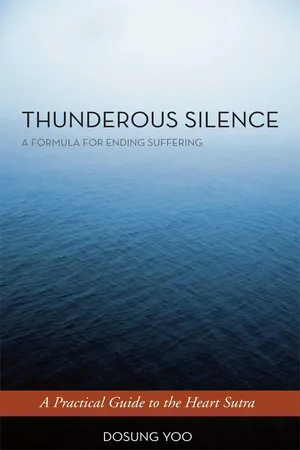
Thunderous Silence
eBook - ePub

Thunderous Silence

A Formula for Ending Suffering: A Practical Guide to the Heart Sutra

  1. 272 pages
  2. English
  3. ePUB (mobile friendly)
  4. Available on iOS & Android
eBook - ePub

Thunderous Silence

A Formula for Ending Suffering: A Practical Guide to the Heart Sutra

About this book

Thunderous Silence throws light on the Heart Sutra--a pithy encapsulation of the essence of Perfection of Wisdom literature--using stop-by-step analysis and an easy, conversational voice. Dosung Yoo examines the sutra phrase by phrase, using rich explanations and metaphors drawn from Korean folklore, quantum physics, Charles Dickens, and everything in between to clarify subtle concepts for the reader. This book invites us to examine the fundamentals of Buddhism--the Four Noble Truths, emptiness, enlightenment--through the prism of the Heart Sutra. Both those new to Buddhism and longtime practitioners looking to revisit a core text from a fresh perspective will find this work appealing.

Frequently asked questions

Yes, you can cancel anytime from the Subscription tab in your account settings on the Perlego website. Your subscription will stay active until the end of your current billing period. Learn how to cancel your subscription.
At the moment all of our mobile-responsive ePub books are available to download via the app. Most of our PDFs are also available to download and we're working on making the final remaining ones downloadable now. Learn more here.
Perlego offers two plans: Essential and Complete
  • Essential is ideal for learners and professionals who enjoy exploring a wide range of subjects. Access the Essential Library with 800,000+ trusted titles and best-sellers across business, personal growth, and the humanities. Includes unlimited reading time and Standard Read Aloud voice.
  • Complete: Perfect for advanced learners and researchers needing full, unrestricted access. Unlock 1.4M+ books across hundreds of subjects, including academic and specialized titles. The Complete Plan also includes advanced features like Premium Read Aloud and Research Assistant.
Both plans are available with monthly, semester, or annual billing cycles.
We are an online textbook subscription service, where you can get access to an entire online library for less than the price of a single book per month. With over 1 million books across 1000+ topics, we’ve got you covered! Learn more here.
Look out for the read-aloud symbol on your next book to see if you can listen to it. The read-aloud tool reads text aloud for you, highlighting the text as it is being read. You can pause it, speed it up and slow it down. Learn more here.
Yes! You can use the Perlego app on both iOS or Android devices to read anytime, anywhere — even offline. Perfect for commutes or when you’re on the go.
Please note we cannot support devices running on iOS 13 and Android 7 or earlier. Learn more about using the app.
Yes, you can access Thunderous Silence by Dosung Yoo in PDF and/or ePUB format, as well as other popular books in Theology & Religion & Eastern Philosophy. We have over one million books available in our catalogue for you to explore.
1
WHAT IS THE HEART SUTRA?
The buddhas have appeared in this world
to liberate all beings
by helping them realize the treasury of Buddha-Wisdom
that they are unaware they possess within themselves.
—The Lotus Sutra
ONE DAY a rabbit happened to discover a precious gem in the forest and brought it to a lion, who was king of the jungle. All the animals gathered together in order to see this gem. They marveled at its beauty and began to fear that the humans might steal it from them.
The lion said, “Why don’t we hide it deep in the jungle so that no humans can find it?” The rabbit, who had found the gem, said, “No, that is not a good idea. Humans are so clever that they will eventually find it. We are rapidly losing our forests to them.” All of the animals agreed with the rabbit.
The eagle, king of the sky, said, “I can hide that gem so high in the sky that no one will be able to see it.” A hawk said, “No, humans are very smart and they have made an iron bird called an airplane. They will eventually find the gem.”
The whale, king of the sea, said, “Why don’t we hide it deep in the sea where humans cannot go?” All the fish said, “No, humans have a machine called a submarine that can go deep into the ocean. The sea is not a safe place.”
The animals became very worried and pondered for a long time where to hide this gem. Finally, they all agreed to hide it “deep, deep, in the human heart, where humans never think to look too deeply.”
Studying the Heart Sutra means embarking on the journey to discover this gem, which is hidden very deeply within our hearts. It is the treasure of our authentic self, our buddha nature, our original nature, which has been lost for a long, long time.
The Heart Sutra is the treasure map to locate that gem.
When I first read the Diamond Sutra in my twenties, for some unknown reason my eyes flooded with tears. I felt as though I had found my true home, my source. The Heart Sutra is the picture of our true self, or the ultimate reality. It is the pathless path to reach our true home. It leads us toward the precious treasure called buddhahood.
The original title of the Heart Sutra is Maha Prajna Paramita Hridaya Sutra. Let’s look in detail at each of the words in that title.
…Maha Prajna…
There are three kinds of knowledge.
The first is borrowed knowledge. It is like the knowledge you attain from reading books or from listening to others speaking. It is not original. Like a plastic flower, it does not have a fragrance.
The second is wisdom. This is the knowledge that you acquire from your own experiences. It is not borrowed: it is yours.
The third is knowledge that comes from another level. It is called prajna, innate wisdom, which is inherent within all sentient beings. The Sanskrit word prajna has two components: pra- means “before” and -jna means “to know.”4 Prajna is neither borrowed nor acquired by experience. It is neither knowledge nor wisdom. It is inherent, innate awareness or consciousness that does not need to be honed or cultivated. It is something that is already there.
One day, Daesan, the Third Head Dharma Master of Won Buddhism, dispatched several Won Buddhist ministers and laypersons to search for a proper site for a retreat center on Jeju Island, Korea. They came back after several months and reported on what they thought was the best site. After listening to their opinions and seeing the pictures of the possible sites, Master Daesan asked them to buy the site that most people thought was the least desirable. The site was located a long distance from the main road, and the path to that site was very muddy. They obeyed him and bought the site, and then built several buildings for the retreat center. A few years later, an expressway was constructed by the local government, and the road from the expressway to the retreat center was paved. The retreat center became such an accessible and convenient place that its value soared, and many more people were able to use it.
Chwasan, the Fourth Head Dharma Master of Won Buddhism, is a celibate monk and does not have the experiences of marriage or raising children. However, he has written a great deal about prenatal education. Although he never studied this subject, the knowledge very naturally arose in his mind due to his advanced practice and meditation. When our practice deepens, prajna, our inner light, begins to be revealed.
Maha in Sanskrit means “great,” “big,” or “infinite.” Maha Prajna means “ultimate wisdom” or “supreme enlightenment.” It is the wisdom that a buddha, or one who is fully awakened, possesses.
Animals also have wisdom, but it is different from that of humans. The average person’s wisdom is different from the Buddha’s in its depth and brightness. A burning match has light, but its brightness differs from that of the sun. When the sun rises, the darkness of the whole world is dispelled. The wisdom or power of a completely awakened person is like the bright light of the sun, which shines on the whole world. Maha Prajna is the complete or ultimate wisdom. It is supreme enlightenment, the wisdom that a perfectly enlightened person attains.
…Paramita…
Paramita means “crossing over” or “going to the other shore.” This represents crossing from this world of suffering to the world of freedom, or nirvana, which is the ultimate goal of practice. This term originates from an ancient Indian tradition when nations were often divided by large rivers like the Ganges. When people felt unhappy or miserable in their country or in their situation—for example, women living in slavery—and they came to the shore of the river, the situation they saw on the other shore appeared far better. This shore is the land of suffering. That shore is the ideal world, nirvana, or the kingdom of God.
…Hridaya Sutra…
“Heart” is the translation of the Sanskrit hridaya, which means “center” or “essence.” The heart is the most vital of our internal organs. The Sanskrit word sutra means “scripture”—mostly referring to the canonical scriptures or the discourses of the Buddha. In ancient India, Hindu and Buddhist scriptures were made by binding leaves together. The word sutra is derived from the root verb siv-, meaning to sew (the English word suture has the same root). Sutra literally means “a thread that holds things together.” So “heart sutra” means the essential scripture, the essential path, or the summary of all dharmas, and “maha prajna paramita hridaya sutra” means the essential path (hridaya sutra) to go to the other shore (paramita) by means of complete enlightenment (maha prajna).
While many Chinese commentators interpret paramita to mean “the other shore,” another meaning of paramita is “perfection.” Using this interpretation, the Maha Prajna Paramita Hridaya Sutra means “the essential path or teaching that perfects innate wisdom,” or “the essential Dharma that perfects realization or enlightenment.”
When I worked at the Seoul Meditation Center in Korea, I counseled many young men and women. Many single people there said that they would like to meet and marry a good person. In addition, many married people told me that they would have preferred to remain single. It is important to understand that nirvana, or the other shore, is not the place or time when everything goes our way and our situation is perfect. Nirvana is where our minds become empowered and pure, and prajna, our true self, is revealed.
The Greek root of the word utopia means “nonexistence” or “the place that does not exist.” Materially or technologically, we have already reached an ideal place or state, but people are still unhappy. Nirvana, or utopia, is attained when people regain prajna and attain freedom of mind, regardless of what the circumstances may be. If we restore our true self and have the power and wisdom of our original mind, then our minds will not be disturbed by external causes and we will enjoy our lives, whatever the situation. When we have prajna, we also have the wisdom and power to change our environment and to gain blessings from any situation.
As the original title of the Heart Sutra, Maha Prajna Paramita Hridaya Sutra, implies, we cannot go to the other shore by making a lot of money, meeting an ideal spouse, or having a good job—in other words by changing our external environment. Only when we are awakened to our true self, only when we attain prajna can we go from this shore of suffering to the other shore, nirvana—from a deluded mind to an enlightened mind, from a dreamy state of mind to an awakened state.
In the Gnostic Gospel of Thomas, Jesus said, “If your leaders tell you, ‘Look, the kingdom [of God] is in heaven,’ then the birds of heaven will precede you. If they say to you, ‘It’s in the sea,’ then the fish will precede you. But the kingdom is inside you and it is outside you. When you know yourselves, then you will be known, and you will understand that you are children of the living father.”5
Consider the following tale:
A legend from ancient India tells of a musk deer who, one fresh spring day, detected a mysterious and heavenly fragrance in the air. It hinted of peace, beauty, and love, and like a whisper beckoned him onward. Compelled to find its source, he set out, determined to search the whole world over. He climbed forbidding and icy mountain peaks, padded through steamy jungles, trekked across endless desert sands. Wherever he went, the scent was there, faint yet always detectable. At the end of his life, exhausted from his relentless search, the deer collapsed. As he fell his horn pierced his belly, and suddenly the air was filled with the heavenly scent. As he lay dying, the musk deer realized that the fragrance had all along been emanating from within himself.6
People who try to change their environment without first changing their minds are like the person endlessly rowing a boat toward the horizon. In reality, the horizon is already under our boat. When we realize the reality of our selves, and prajna is fully revealed, then we understand that nirvana (the horizon) already exists here and now.7 As long as all people wish to become happy and free, which can only be possible when we attain prajna, what can be more imperative than awakening to our true selves?
There is a saying in the Zen tradition: “Cultivation of mind for three days will last as a treasure for a thousand years, but material things that were amassed for a hundred years will crumble into dust in one morning.” Discovering and restoring prajna is the path to liberation. It is the way to end suffering forever. That is why studying and contemplating prajna paramita literature is so beneficial. The Heart Sutra encompasses the wisdom of all prajna paramita literature.
In the Diamond Sutra, Buddha spoke about these merits:
Subhuti, if there be one who gives away in gifts of alms a mass of the seven treasures equal in extent to as many mighty Mount Sumerus as there would be in three thousand galaxies of worlds, and if there be another who selects even only four lines from this Discourse upon the Perfection of Transcendental Wisdom, receives and retains them, and clearly expounds them to others, the merit of the latter will be so far greater than that of the former that no conceivable comparison can be made between them.8
He also said:
Subhuti, if on the one hand a good man or a good woman sacrifices as many lives as the sand-grains of the Ganges, and on the other hand anyone receives and retains even only four lines of this Discourse, and teaches and explains them to others, the merit of the latter will be the greater.9
The chances of attaining the buddhas’ teachings are as slim as seeing the udumbara flower, which is said to bloom only once in three thousand years. According to the Diamond Sutra, the person who has attained the Buddha’s teachings and heard about the Heart Sutra or Diamond Sutra is one who has previously planted many meritorious seeds:
Subhuti said to Buddha: World-honored One, will there always be men who will truly believe after coming to hear these teachings [of the Perfection of Transcendental Wisdom]?
Buddha answered: Subhuti, do not utter such words! At the end of the last five-hundred-year period following the passing of the Tathagata,10 there will be self-controlled men, rooted in merit, coming to hear these teachings, who will be inspired with belief. But you should realize that such men have not strengthened their root of merit under just one Buddha, or two Buddhas, or three, or four, or five Buddhas, but under countless Buddhas; and their merit is of every kind. Such men, coming to hear these teachings, will have an immediate uprising of pure faith, Subhuti; and the Tathagata will recognize them. Yes, He will clearly perceive all these of pure heart, and the magnitude of their moral excellences.11
The ancient Korean Zen master Chinul said, “Since you have now arrived at the treasure house, how can you return empty-handed? Once you lose a human body, for ten thousand kalpas it will be difficult to recover. Be careful. Knowing that there is a treasure house, how can a wise person turn back and not look for it—and yet continue to resent bitterly his destitution and poverty? If you want the treasure you must throw away this skin-bag.”12 Since we have already arrived at the tr...

Table of contents

  1. Cover
  2. Title
  3. Copyright
  4. Dedication
  5. Contents
  6. Introduction
  7. The Heart Sutra
  8. 1. What Is the Heart Sutra?
  9. 2. Entering the Path of a Bodhisattva
  10. 3. Emptiness of Self
  11. 4. Anybody Home?
  12. 5. The Gateless Gate of Nonduality
  13. 6. Emptiness of Phenomena
  14. 7. Neither Appearing Nor Disappearing
  15. 8. When the Shoes Fit, One Forgets About Them
  16. 9. The Twelve Links of Dependent Origination
  17. 10. Emptiness of the Twelve Links
  18. 11. The Four Noble Truths
  19. 12. Emptiness of the Four Noble Truths
  20. 13. Sudden Enlightenment and Gradual Cultivation
  21. 14. The Ultimate Song of Freedom
  22. 15. You Are What You Seek
  23. Acknowledgments
  24. Notes
  25. Bibliography
  26. Index
  27. About the Author