The Numerical Discourses of the Buddha
eBook - ePub

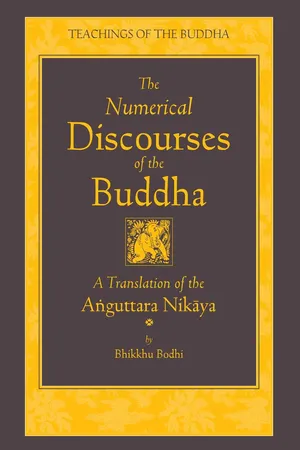
The Numerical Discourses of the Buddha

A Complete Translation of the Anguttara Nikaya

  1. 1,944 pages
  2. English
  3. ePUB (mobile friendly)
  4. Available on iOS & Android
eBook - ePub

The Numerical Discourses of the Buddha

A Complete Translation of the Anguttara Nikaya

About this book

Like the River Ganges flowing down from the Himalayas, the entire Buddhist tradition flows down to us from the teachings and deeds of the historical Buddha, who lived and taught in India during the fifth century B.C.E. To ensure that his legacy would survive the ravages of time, his direct disciples compiled records of the Buddha's teachings soon after his passing. In the Theravada Buddhist tradition, which prevails in Sri Lanka and Southeast Asia, these records are regarded as the definitive "word of the Buddha." Preserved in Pali, an ancient Indian language closely related to the language that the Buddha spoke, this full compilation of texts is known as the Pali Canon.At the heart of the Buddha's teaching were the suttas (Sanskrit sutras ), his discourses and dialogues. If we want to find out what the Buddha himself actually said, these are the most ancient sources available to us. The suttas were compiled into collections called "Nikayas, " of which there are four, each organized according to a different principle. The Digha Nikaya consists of longer discourses; the Majjhima Nikaya of middle-length discourses; the Samyutta Nikaya of thematically connected discourses; and the Anguttara Nikaya of numerically patterned discourses.The present volume, which continues Wisdom's famous Teachings of the Buddha series, contains a full translation of the Anguttara Nikaya. The Anguttara arranges the Buddha's discourses in accordance with a numerical scheme intended to promote retention and easy comprehension. In an age when writing was still in its infancy, this proved to be the most effective way to ensure that the disciples could grasp and replicate the structure of a teaching.
Frequently asked questions

Yes, you can cancel anytime from the Subscription tab in your account settings on the Perlego website. Your subscription will stay active until the end of your current billing period. Learn how to cancel your subscription.
At the moment all of our mobile-responsive ePub books are available to download via the app. Most of our PDFs are also available to download and we're working on making the final remaining ones downloadable now. Learn more here.
Perlego offers two plans: Essential and Complete
  • Essential is ideal for learners and professionals who enjoy exploring a wide range of subjects. Access the Essential Library with 800,000+ trusted titles and best-sellers across business, personal growth, and the humanities. Includes unlimited reading time and Standard Read Aloud voice.
  • Complete: Perfect for advanced learners and researchers needing full, unrestricted access. Unlock 1.4M+ books across hundreds of subjects, including academic and specialized titles. The Complete Plan also includes advanced features like Premium Read Aloud and Research Assistant.
Both plans are available with monthly, semester, or annual billing cycles.
We are an online textbook subscription service, where you can get access to an entire online library for less than the price of a single book per month. With over 1 million books across 1000+ topics, we’ve got you covered! Learn more here.
Look out for the read-aloud symbol on your next book to see if you can listen to it. The read-aloud tool reads text aloud for you, highlighting the text as it is being read. You can pause it, speed it up and slow it down. Learn more here.
Yes! You can use the Perlego app on both iOS or Android devices to read anytime, anywhere — even offline. Perfect for commutes or when you’re on the go.
Please note we cannot support devices running on iOS 13 and Android 7 or earlier. Learn more about using the app.
Yes, you can access The Numerical Discourses of the Buddha by Bhikkhu Bodhi, Bodhi in PDF and/or ePUB format, as well as other popular books in Theology & Religion & Buddhism. We have over one million books available in our catalogue for you to explore.

Information

THE BOOK OF THE ONES
(Ekakanipāta)
The Book of the Ones
I. Obsession of the Mind
1–10
II. Abandoning the Hindrances
11–20
III. Unwieldy
21–30
IV. Untamed
31–40
V. A Spike
41–50
VI. Luminous
51–60
VII. Arousal of Energy
61–70
VIII. Good Friendship
71–81
IX. Heedlessness
82–97
X. Internal
98–139
XI. Non-Dhamma
140–149
XII. Not an Offense
150–169
XIII. One Person
170–187
XIV. Foremost
188–267
XV. Impossible
268–295
XVI. One Thing
296–377
XVII. Qualities Engendering Confidence
378–393
XVIII. Finger Snap
394–574
XIX. Mindfulness Directed to the Body
575–615
XX. The Deathless
616–627
The Book of the Ones
Homage to the Blessed One, the Arahant, the Perfectly Enlightened One
I. OBSESSION OF THE MIND
1 (1)
Thus have I heard. On one occasion the Blessed One was dwelling at SāvatthÄ« in Jeta’s Grove, Anāthapiį¹‡įøika’s Park. There the Blessed One addressed the bhikkhus: ā€œBhikkhus!ā€
ā€œVenerable sir!ā€ those bhikkhus replied. The Blessed One said this:
ā€œBhikkhus, I do not see even one other form that so obsesses the mind17 of a man as the form of a woman. The form of a woman obsesses the mind of a man.ā€
2 (2)
ā€œBhikkhus, I do not see even one other sound that so obsesses the mind of a man as the sound of a woman. The sound of a woman obsesses the mind of a man.ā€
3 (3)
ā€œBhikkhus, I do not see even one other odor that so obsesses the mind of a man as the odor of a woman. The odor of a woman obsesses the mind of a man.ā€18 [2]
4 (4)
ā€œBhikkhus, I do not see even one other taste that so obsesses the mind of a man as the taste of a woman. The taste of a woman obsesses the mind of a man.ā€19
5 (5)
ā€œBhikkhus, I do not see even one other touch that so obsesses the mind of a man as the touch of a woman. The touch of a woman obsesses the mind of a man.ā€20
6 (6)21
ā€œBhikkhus, I do not see even one other form that so obsesses the mind of a woman as the form of a man. The form of a man obsesses the mind of a woman.ā€
7 (7)
ā€œBhikkhus, I do not see even one other sound that so obsesses the mind of a woman as the sound of a man. The sound of a man obsesses the mind of a woman.ā€
8 (8)
ā€œBhikkhus, I do not see even one other odor that so obsesses the mind of a woman as the odor of a man. The odor of a man obsesses the mind of a woman.ā€
9 (9)
ā€œBhikkhus, I do not see even one other taste that so obsesses the mind of a woman as the taste of a man. The taste of a man obsesses the mind of a woman.ā€
10 (10)
ā€œBhikkhus, I do not see even one other touch that so obsesses the mind of a woman as the touch of a man. The touch of a man obsesses the mind of a woman.ā€ [3]
II. ABANDONING THE HINDRANCES22
11 (1)
ā€œBhikkhus, I do not see even one other thing on account of which unarisen sensual desire arises and arisen sensual desire increases and expands so much as the mark of the attractive.23 For one who attends carelessly to the mark of the attractive, unarisen sensual desire arises and arisen sensual desire increases and expands.ā€
12 (2)
ā€œBhikkhus, I do not see even one other thing on account of which unarisen ill will arises and arisen ill will increases and expands so much as the mark of the repulsive.24 For one who attends carelessly to the mark of the repulsive, unarisen ill will arises and arisen ill will increases and expands.ā€
13 (3)
ā€œBhikkhus, I do not see even one other thing on account of which unarisen dullness and drowsiness arise and arisen dullness and drowsiness increase and expand so much as discontent, lethargy, lazy stretching, drowsiness after meals, and sluggishness of mind.25 For one with a sluggish mind, unarisen dullness and drowsiness arise and arisen dullness and drowsiness increase and expand.ā€
14 (4)
ā€œBhikkhus, I do not see even one other thing on account of which unarisen restlessness and remorse arise and arisen restlessness and remorse increase and expand so much as an unsettled mind.26 For one with an unsettled mind, unarisen restlessness and remorse arise and arisen restlessness and remorse increase and expand.ā€ [4]
15 (5)
ā€œBhikkhus, I do not see even one other thing on account of which unarisen doubt arises and arisen doubt increases and expands so much as careless attention.27 For one who attends carelessly, unarisen doubt arises and arisen doubt increases and expands.ā€
16 (6)28
ā€œBhikkhus, I do not see even one other thing on account of which unarisen sensual desire does not arise and arisen sensual desire is abandoned so much as the mark of the unattractive.29 For one who attends carefully to the mark of the unattractive, unarisen sensual desire does not arise and arisen sensual desire is abandoned.ā€30
17 (7)
ā€œBhikkhus, I do not see even one other thing on account of which unarisen ill will does not arise and arisen ill will is abandoned so much as the liberation of the mind by loving-kindness.31 For one who attends carefully to the liberation of the mind by loving-kindness, unarisen ill will does not arise and arisen ill will is abandoned.ā€32
18 (8)
ā€œBhikkhus, I do not see even one other thing on account of which unarisen dullness and drowsiness do not arise and arisen dullness and drowsiness are abandoned so much as the element of instigation, the element of persistence, the element of exertion.33 For one who has aroused energy, unarisen dullness and drowsiness do not arise and arisen dullness and drowsiness are abandoned.ā€34
19 (9)
ā€œBhikkhus, I do not see even one other thing on account of which unarisen restlessness and remorse do not arise and arisen restlessness and remorse are abandoned so much as pacification of the mind.35 For one with a pacified mind, unarisen restlessness and remorse do not arise and arisen restlessness and remorse are abandoned.ā€36
20 (10)
ā€œBhikkhus, I do not see even one other thing [5] on account of which unarisen doubt does not arise and arisen doubt is abandoned so much as careful attention.37 For one who attends carefully, unarisen doubt does not arise and arisen doubt is abandoned.ā€38
III. UNWIELDY
21 (1)
ā€œBhikkhus, I do not see even one other thing that when undeveloped is so unwieldy as the mind. An undeveloped mind is unwieldy.ā€
22 (2)
ā€œBhikkhus, I do not see even one other thing that when developed is so wieldy as the mind. A developed mind is wieldy.ā€
23 (3)
ā€œBhikkhus, I do not see even one other thing that when undeveloped leads to such great harm as the mind. An undeveloped mind leads to great harm.ā€
24 (4)
ā€œBhikkhus, I do not see even one other thing that when developed leads to such great good as the mind. A developed mind leads to great good.ā€
25 (5)
ā€œBhikkhus, I do not see even one other thing that, when undeveloped and unmanifested,39 leads to such great harm as the mind. The mind, when undeveloped and unmanifested, ...

Table of contents

  1. Cover Page
  2. Title Page
  3. Contents
  4. Preface
  5. Key to the Pronunciation of Pāli
  6. Abbreviations
  7. Introduction
  8. A Thematic Guide to the Anguttara Nikāya
  9. 1. The Book of the Ones
  10. 2. The Book of the Twos
  11. 3. The Book of the Threes
  12. 4. The Book of the Fours
  13. 5. The Book of the Fives
  14. 6. The Book of the Sixes
  15. 7. The Book of the Sevens
  16. 8. The Book of the Eights
  17. 9. The Book of the Nines
  18. 10. The Book of the Tens
  19. 11. The Book of the Elevens
  20. Notes
  21. Appendixes
  22. Pāli-English Glossary
  23. Bibliography
  24. Indexes
  25. About Wisdom Publications
  26. Copyright