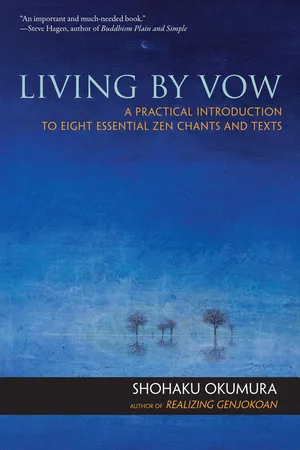
Living by Vow
eBook - ePub

Living by Vow

A Practical Introduction to Eight Essential Zen Chants and Texts

  1. 350 pages
  2. English
  3. ePUB (mobile friendly)
  4. Available on iOS & Android
eBook - ePub

Living by Vow

A Practical Introduction to Eight Essential Zen Chants and Texts

About this book

This immensely useful book explores Zen's rich tradition of chanted liturgy and the powerful ways that such chants support meditation, expressing and helping us truly uphold our heartfelt vows to live a life of freedom and compassion. Exploring eight of Zen's most essential and universal liturgical texts, Living by Vow is a handbook to walking the Zen path, and Shohaku Okumura guides us like an old friend, speaking clearly and directly of the personal meaning and implications of these chants, generously using his experiences to illustrate their practical significance. A scholar of Buddhist literature, he masterfully uncovers the subtle, intricate web of culture and history that permeate these great texts. Esoteric or challenging terms take on vivid, personal meaning, and old familiar phrases gain new poetic resonance.

Frequently asked questions

Yes, you can cancel anytime from the Subscription tab in your account settings on the Perlego website. Your subscription will stay active until the end of your current billing period. Learn how to cancel your subscription.
At the moment all of our mobile-responsive ePub books are available to download via the app. Most of our PDFs are also available to download and we're working on making the final remaining ones downloadable now. Learn more here.
Perlego offers two plans: Essential and Complete
  • Essential is ideal for learners and professionals who enjoy exploring a wide range of subjects. Access the Essential Library with 800,000+ trusted titles and best-sellers across business, personal growth, and the humanities. Includes unlimited reading time and Standard Read Aloud voice.
  • Complete: Perfect for advanced learners and researchers needing full, unrestricted access. Unlock 1.4M+ books across hundreds of subjects, including academic and specialized titles. The Complete Plan also includes advanced features like Premium Read Aloud and Research Assistant.
Both plans are available with monthly, semester, or annual billing cycles.
We are an online textbook subscription service, where you can get access to an entire online library for less than the price of a single book per month. With over 1 million books across 1000+ topics, we’ve got you covered! Learn more here.
Look out for the read-aloud symbol on your next book to see if you can listen to it. The read-aloud tool reads text aloud for you, highlighting the text as it is being read. You can pause it, speed it up and slow it down. Learn more here.
Yes! You can use the Perlego app on both iOS or Android devices to read anytime, anywhere — even offline. Perfect for commutes or when you’re on the go.
Please note we cannot support devices running on iOS 13 and Android 7 or earlier. Learn more about using the app.
Yes, you can access Living by Vow by Shohaku Okumura, Dave Ellison in PDF and/or ePUB format, as well as other popular books in Theology & Religion & Buddhism. We have over one million books available in our catalogue for you to explore.

Information

1
LIVING BY VOW:
THE FOUR BODHISATTVA VOWS
Sentient beings are numberless; I vow to save them.
Desires are inexhaustible; I vow to put an end to them.
The dharmas are boundless; I vow to master them.
The Buddha’s Way is unsurpassable; I vow to attain it.7
THIS VERSE, which states the four bodhisattva vows (shigu-seigan-mon), is one of the shortest we recite. It is also one of the most important and challenging to understand. It is difficult in part because the meaning of vow in this verse departs from the usual English meaning of “solemn promise” or “personal commitment.” In Buddhism vow has a much larger and more complex meaning. To understand it we need to consider Japanese Buddhist culture.
One of my experiences with the difficulties involved in translating from one cultural tradition to another took place in Kyoto, where I lived for a year in a Catholic convent. Although we were not part of the community, my family and I were given a small house inside the monastery. One day the abbess of the convent, Sister Cleria, visited our house. She was a very elegant old woman, an American. She had been in Japan for more than thirty years as a missionary and spoke fluent Japanese. She asked me to speak on the role of prayer in Buddhism at a gathering of the nuns in the convent. Because they had been so generous to us I couldn’t refuse. I began to think about prayer in Buddhism and realized that there is no prayer in Buddhism.8 That was how I started my talk for the Christian nuns. We don’t have prayer in Buddhism, but vow holds the same importance for Buddhists as prayer for Christians. So I talked about the four bodhisattva vows.
Prayer, inori in Japanese, is a Christian term that means communion, communication, or oneness with God. Today there are many Catholic priests who practice zazen. Before becoming a Catholic priest, Ichirƍ Okumura (no relation to me) practiced with the famous Rinzai master Sƍen Nakagawa Roshi. Nakagawa Roshi encouraged him to become a Catholic priest, and he has continued to practice zazen. At sixty he was the head of a Carmelite order in Japan. He traveled the world giving meditation instruction to Catholic communities and wrote a book about meditation practice in the Catholic faith. The title of his book is Inori (Prayer). An English translation (Awakening to Prayer) has been published.9
Father Okumura uses an expression from the Old Testament, “to be quiet in front of God,” to describe silent sitting practice. This communion with God without language is, he believes, the purest form of prayer. I think this is true in a Christian context, but for me, zazen is not a communication with God or with anything else. I don’t think of zazen as a form of prayer. This is a major difference between Buddhism and Christianity. There is no object in our zazen. We just sit.
When I looked in a dictionary of Japanese Buddhist terms, there is no entry for prayer (inori). There is a word, kitƍ, which can be translated into English as “prayer” but is actually quite different. Kitƍ is a Buddhist practice of the Shingon school, a Japanese Vajrayāna school. In India, Vajrayāna Buddhists adopted the practice of kitƍ under the influence of Hinduism. Hindu gods have an interesting habit. When priests recite special mantras and perform certain rituals, the gods are obliged to grant their requests. In Vajrayāna or ShingonshĆ« there is a similar practice. Believers sit in lotus posture, chant mantras, and enact rituals. The practitioner can then become one with the buddha or bodhisattva enshrined in front of him and his requests will be granted. This is the Shingon practice of kitƍ. Many Japanese temples practice kitƍ to insure traffic safety, success in school entrance examinations, easy childbirth, recovery from sickness, or success in business. This is one of the ways Japanese Buddhist temples make money. Sƍtƍ temples are no exception.
Originally, Buddhism had no such practice. From the beginning, however, especially in Mahāyāna Buddhism, vow is essential for all bodhisattvas. In fact, part of the definition of a bodhisattva is a person who lives by vow instead of by karma. Karma means habit, preferences, or a ready-made system of values. As we grow up, we learn a system of values from the culture around us, which we use to evaluate the world and choose actions. This is karma, and living by karma. In contrast, a bodhisattva lives by vow. Vow is like a magnet or compass that shows us the direction toward the Buddha. There are two kinds of vow: general vows, taken by all bodhisattvas, and particular vows for each person. Each bodhisattva makes specific vows unique to his or her personality and capabilities. The four bodhisattva vows are general vows that should be taken by all Mahāyāna Buddhist practitioners. We must live by these vows. That is our direction. Our sitting practice should also be based on these vows.
When I explained the four bodhisattva vows to the Christian nuns, I told them that I see a basic contradiction between the first and second half of each sentence. “Sentient beings are numberless; I vow to save them”: but if sentient beings are numberless, we cannot possibly save them all — this is a contradiction. “Desires are inexhaustible; I vow to put an end to them”: if they are inexhaustible, how can I put an end to them? That’s logically impossible. “The dharmas are boundless; I vow to master them”: if they are boundless, then we cannot completely master them. The “contradiction” in the fourth vow is subtler: “The Buddha’s Way is unsurpassable; I vow to attain it”: if it’s so transcendent, can we really expect to realize it? These contradictions are very important and have a profound practical and also religious meaning. But before I discuss them, I will explain each sentence of the verse.
Originally these four vows were connected to the four noble truths. The older version of the verse of four vows is as follows.
I vow to enable people to be released from the truth of suffering.
I vow to enable people to understand the truth of the origin of suffering.
I vow to enable people to peacefully settle down in the truth of the path leading to the cessation of suffering.
I vow to enable people to enter the cessation of suffering, that is, nirvana.10
The four noble truths are the basic teachings of Shakyamuni Buddha. The first is the truth of suffering or dissatisfaction (duងkha in Sanskrit; dukkha in Pāli). Human life is full of duងkha. The second is the truth of the cause of suffering: thirst or delusive desires. The third is the truth of the cessation of suffering: nirvana. The fourth is the truth of the path that leads us to nirvana.
The first bodhisattva vow is related to the first noble truth: “I vow to enable people to be released from the truth of suffering.” Perhaps “truth” is unnecessary. “I vow to enable people to be released from suffering.” “Suffering” here is the specific kind of suffering mentioned in the four noble truths. The Buddha said that our life is full of suffering, and so his teaching is often interpreted as being pessimistic. The suffering referred to here is not limited to the pain, suffering, unhappiness, or sadness brought about by the circumstances of our lives. The deeper meaning of duáž„kha or suffering is related to impermanence or egolessness. Everything is impermanent and always changing. As a result there is nothing substantial that we can grasp. And yet we continue to try. But since everything continues to change, we suffer. This suffering arises because we cannot possess or control anything. As long as we try to do so, we suffer and feel dissatisfaction. The fact that we cannot control the reality of our lives is the root of the suffering described by the Buddha, which is based on our delusions about and attachment to the ego. This is the second of the four noble truths.
The second bodhisattva vow is “I vow to enable people to understand the truth of the origin of suffering.” The origin of suffering is our delusive desire, which in this context is called bonnƍ. This Japanese word is a Chinese translation of the Sanskrit kleƛa, often rendered in English as “delusion,” although it actually refers to the hindrances, troubles, defilements, or passions that drive us to unwholesome action. According to the Yogacāra school, there are four fundamental bonnƍ or delusive ideas that defile our minds and our lives. The first, gachi, is ignorance of the Dharma, of the reality of impermanence and egolessness. The second is gaken, or egocentric views based on ignorance. We cling to established views of things around us. The third one is gaman, or arrogance. When we justify ourselves or try to be righteous we become arrogant. We put ourselves above others. The fourth is ga-ai, or self-attachment. Ai in Japanese is often used as a translation for “love,” with a positive meaning. But in Buddhism ai is more often a kind of attachment and carries a negative connotation. Gachi, gaken, gaman, ga-ai — ignorance, egocentric view, arrogance, and self-attachment — are the four basic desires (kleƛa). Perhaps “desire” isn’t the best word to characterize these things, but they are the cause of suffering and unwholesome karma. The second vow relates to this truth. Bodhisattvas vow to help people understand the truth of the origin of suffering. This is what the second vow means when it says, “Desires are inexhaustible; I vow to put an end to them.”
The third vow in the older verse is “I vow to enable people to peacefully settle down in the truth of the path leading to the cessation of suffering.” This is about the fourth noble truth, the truth of mārga, the path leading to nirvana. (The order of truths is different in the two versions.) The path referred to is our practice of the eightfold noble path: right view, right thinking, right speech, right action, right livelihood, right effort, right mindfulness, and right meditation. The third vow has to do with the fourth noble truth, to enable people to settle in the way of practice. It begins with “The dharmas are boundless.” Here the original word for “dharmas” is hƍmon (dharma gate), which means teachings about reality and about reality-based practice. “The dharmas are boundless; I vow to master them” means that we vow to study and settle down in the way of practice. That is the fourth noble truth and the third vow.
An older version of the fourth vow, “The Buddha’s Way is unsurpassable; I vow to attain it,” is “I vow to enable people to attain nirvana.” This vow is related to the third noble truth. In this context, “Way” is a translation of bodhi, or awakening, not of mārga, or path. “The Buddha’s Way” refers to the Buddha’s awakening or nirvana. So this vow says, “The Buddha’s awakening is unsurpassable, but I vow to attain it.”
This is the meaning of the four vows. It is important to understand that they are directly connected with the four noble truths, the fundamental teaching of Shakyamuni Buddha.
It is interesting to compare the older version of the four vows with the version we usually recite. Again, the older version is:
I vow to enable people to be released from the truth of suffering.
I vow to enable people to understand the truth of the origin of suffering.
I vow to enable people to peacefully settle down in the truth of the path leading to the cessation of suffering.
I vow to enable people to attain nirvana.
In this version of the four bodhisattva vows, “I” refers to a bodhisattva who has taken vows, been released from suffering, and understood the truth of the origin of suffering. This is someone who has already settled down in practice, in the four noble truths: someone who is already in nirvana. These vows are for someone who is already enlightened. However, the verse we usually recite is, once again:
Sentient beings are numberless; I vow to save them.
Desires are inexhaustible; I vow to put an end to them.
The dharmas are boundless; I vow to master them.
The Buddha’s Way is unsurpassable; I vow to attain it.
This person still has inexhaustible desires or delusions, and so still has something to study, something to learn. The person has not yet attained the Way. The person him/herself still has inexhaustible delusive desires, and therefore the person vows to eliminate them. This is not a vow to help others to be released from inexhaustible desires. The older version is the vow made by an already enlightened bodhisattva, someone who is above all deluded sentient beings, making a vow to help all people.
In the newer version, the one we now chant, we still suffer but vow to save all beings. We have inexhaustible desires but vow to put an end to them. “The dharmas are boundless
.” There are so many things to learn, and yet we vow to master them. We must make an effort to study the dharmas, the teachings, and practice, but we realize that practice is endless and so we resolve to practice endlessly. “The Buddha’s Way is unsurpassable.” We are not yet enlightened, but we vow to attain it. We are ordinary human beings and yet, if we take these four vows, we are bodhisattvas. In reality, we are ordinary human beings with inexhaustible desires. We have to study the teachings and practice endlessly, day by day, moment by moment, to attain the Buddha’s enlightenment. That is our vow. In making these four vows, we are bodhisattvas.
As we said, there is a contradiction inherent in these vows: we vow to do things that are impossible. This means that our practice is endless and that we cannot completely fulfill the four vows. Our practice and study are like trying to empty the ocean with a spoon, one spoonful at a time. It is certainly a stupid way of life, not a clever one. A clever person...

Table of contents

  1. Cover
  2. Title
  3. Contents
  4. Editor’s Preface
  5. Author’s Preface
  6. Introduction
  7. 1. Living by Vow: The Four Bodhisattva Vows
  8. 2. Awakening to Incompleteness: The Verse of Repentance
  9. 3. Final Shelter: The Verse of the Three Refuges
  10. 4. Cultivating the Virtuous Field: The Robe Chant
  11. 5. Continuous Circle of Offering: The Meal Chants
  12. 6. Sound of Emptiness: The Heart Sutra
  13. 7. All Is One, One Is All: Merging of Difference and Unity
  14. 8. Endless Practice Here and Now: The Verse for Opening the Sutra
  15. Notes
  16. Glossary of Names
  17. Glossary of Terms and Texts
  18. Index
  19. About the Author
  20. Also Available by the Author from Wisdom Publications
  21. About Wisdom Publications
  22. Copyright