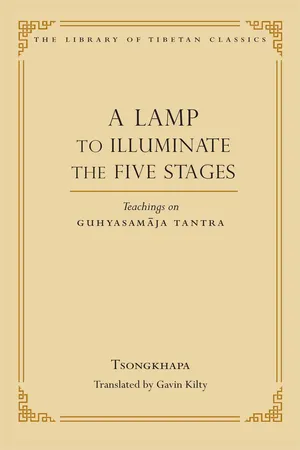
A Lamp to Illuminate the Five Stages
eBook - ePub

A Lamp to Illuminate the Five Stages

Teachings on Guhyasamaja Tantra

  1. 636 pages
  2. English
  3. ePUB (mobile friendly)
  4. Available on iOS & Android
eBook - ePub

A Lamp to Illuminate the Five Stages

Teachings on Guhyasamaja Tantra

About this book

Tsongkhapa's A Lamp to Illuminate the Five Stages (1419) is a comprehensive presentation of the highest yoga class of Buddhist tantra, especially the key practices - the so-called five stages (pancakrama) - of the advanced phase of Guhyasamaja tantra. Beginning with a thorough examination of the Indian sources, Tsongkhapa draws particularly from the writings of Nagarjuna, Aryadeva, Candrakirti, and Naropa to develop a definitive understanding of the Vajrayana completion stage. Whereas in the generation stage, meditators visualize the Buddha in the form of the deity residing in a mandala palace, in the completion stage discussed in the present volume, meditators transcend ordinary consciousness and actualize the state of a buddha themselves. Among other things, Tsongkhapa's work covers the subtle human physiology of channels and winds along with the process of dying, the bardo, and rebirth. This definitive statement on Guhyasamaja tantra profoundly affected the course of Buddhist practice in Tibet.

Frequently asked questions

Yes, you can cancel anytime from the Subscription tab in your account settings on the Perlego website. Your subscription will stay active until the end of your current billing period. Learn how to cancel your subscription.
At the moment all of our mobile-responsive ePub books are available to download via the app. Most of our PDFs are also available to download and we're working on making the final remaining ones downloadable now. Learn more here.
Perlego offers two plans: Essential and Complete
  • Essential is ideal for learners and professionals who enjoy exploring a wide range of subjects. Access the Essential Library with 800,000+ trusted titles and best-sellers across business, personal growth, and the humanities. Includes unlimited reading time and Standard Read Aloud voice.
  • Complete: Perfect for advanced learners and researchers needing full, unrestricted access. Unlock 1.4M+ books across hundreds of subjects, including academic and specialized titles. The Complete Plan also includes advanced features like Premium Read Aloud and Research Assistant.
Both plans are available with monthly, semester, or annual billing cycles.
We are an online textbook subscription service, where you can get access to an entire online library for less than the price of a single book per month. With over 1 million books across 1000+ topics, we’ve got you covered! Learn more here.
Look out for the read-aloud symbol on your next book to see if you can listen to it. The read-aloud tool reads text aloud for you, highlighting the text as it is being read. You can pause it, speed it up and slow it down. Learn more here.
Yes! You can use the Perlego app on both iOS or Android devices to read anytime, anywhere — even offline. Perfect for commutes or when you’re on the go.
Please note we cannot support devices running on iOS 13 and Android 7 or earlier. Learn more about using the app.
Yes, you can access A Lamp to Illuminate the Five Stages by Je Tsongkhapa, Thupten Jinpa, Gavin Kilty in PDF and/or ePUB format, as well as other popular books in Theology & Religion & Asian Literary Collections. We have over one million books available in our catalogue for you to explore.
PART 1
Divisions of Highest Yoga Tantra
2. The Two Types of Tantra
Presentation of the two types of tantras
1.Ways of naming highest yoga tantra
2.Division of tantra into two types in keeping with the meanings of the names
3.Specific explanation of method tantra
Ways of naming highest yoga tantra
There are many ways of categorizing highest yoga tantra into two. The Saáčƒvarodaya Tantra talks of yoga and yoginÄ« tantras:
The number of yoga tantras
is ascertained at 60 million;
Likewise, the number of yoginī tantras
is said to be 160 million.7
The Buddha Skull Tantra, Vajra Canopy Tantra, and others use the same terminology. The term yoga tantra applies to both method and wisdom tantras, but using yoga tantra for method tantras is to use the general for the specific. For example, the term child is the basis for the divisions “boy” and “girl,” but to use child for a boy is to use a general for a specific. The term ឍākinÄ« tantra is also often used for yoginÄ« tantras. Puáč‡ážarÄ«ka’s Stainless Light Commentary and others talk of method tantra and wisdom tantra. Nāgabodhi and CandrakÄ«rti also refer to mother tantra as “wisdom sutra.” Tibetan lamas who have taken the name “yoginÄ« tantra” and then created the terms mother tantra and father tantra are in keeping with the Ornament of Vajra Essence Tantra when it says:
The Ornament of Vajra Essence Tantra
is the grandmother of all ឍāka mother and ឍāka father tantras.8 [3]
Division of tantra into two types in keeping with the meanings of the names
1.Points of doubt
2.Individual assertions
Points of doubt
If highest yoga tantras are divided into method tantras and wisdom tantras, then are these two types of tantras those in which method and wisdom are nondual or not? If they are, this could not be correct because the meaning of the term method and wisdom tantras refers to tantras partial to either method or wisdom. Nondual tantras, on the other hand, are tantras that combine method and wisdom equally. If it is asserted that these two types of tantras are not tantras in which method and wisdom are nondual, that too would be wrong because the meaning of yoga in the term highest yoga as found in the Later Guhyasamāja Tantra is:
Method and wisdom in union
is what is meant by yoga.9
Thus it refers to method and wisdom equally combined without partiality to either. Therefore it has to be correct to say that highest tantras combining method and wisdom equally are nondual tantras. If this is the case, should it not be explained whether method and wisdom tantras on one hand and nondual tantras on the other are mutually exclusive or not?
Individual assertions
1.Others’ assertions
2.Our own position
Others’ assertions
Some Tibetan masters divide highest yoga tantras into three individual categories: method, wisdom, and nondual. They say that method and wisdom individually is what determines a tantra to be a method or wisdom tantra, whereas tantras that exhibit both are nondual tantras. They assert the Hevajra Tantra to be a nondual tantra because it says, “A tantra with the nature of method and wisdom,”10 and they also say that the fact that the Hevajra Tantra states that it is a yoginī tantra is not contradictory because a nondual tantra must also be a wisdom tantra. If that is the case, they would have to say that a nondual tantra also has to be a method tantra. Therefore they must explain how this does not contradict their own position of dividing highest yoga tantra into three separate categories and maintaining that method and wisdom individually determine method and wisdom tantras, whereas nondual tantras are those that exhibit both together.
Some Tibetan masters say that the “three-classification” tradition asserted that a tantra beginning with the words “This I have heard” was method tantra and one that began “Made joyful by the supreme secret”11 and so on was mother tantra, as asserted by Káč›áčŁáč‡Äcārya. Therefore, because the Hevajra root tantra contains the former, its explanatory tantra Vajra Canopy contains the latter, and its other explanatory tantra Saáčƒpuáč­a Tantra contains both, the Hevajra Tantra is a nondual tantra. In this way they are differentiating three kinds of tantras by the words they contain. [4] The Cakrasaáčƒvara root tantra,12 however, contains the latter phrase, while its explanatory tantras such as Later Exposition Tantra, begin “This I have heard,” and the Later Exposition Tantra actually contains both phrases. This would mean that Cakrasaáčƒvara also becomes a nondual tantra, in which case we must critically ask, “Where is the mother tantra?”
They reply that their position is that a tantra may teach from both the vast method aspect, the profound wisdom aspect, and so on, but that mother and father tantras are determined from a position of one of them being dominant. This means that they think the two types of tantra and nondual tantras are mutually exclusive and shows that there is no analysis of what exactly is the difference between the method and wisdom that is nondual, and the method and wisdom of father or mother tantras.
Other Tibetan scholars maintain that dividing highest yoga tantras into method, wisdom, and nondual is a provisional position, but that definitively all highest yoga tantras are nondual. They also say that a tantra exhibiting both of the criteria that establishes method and wisdom tantras individually, or exhibiting something that is neither of those two criteria, is a nondual tantra. If that is so, positing three differing criteria for the establishment of the three types of tantra, while at the same time asserting the definitive position that both method and wisdom highest yoga tantras are nondual, and positing as an example of a nondual tantra one particular tantra that you have strong liking for, is simply contradictory. If you do not accept mother and father tantras in your tradition, then this contradicts your own assertions as well as scripture. If you do accept them and say that these two types of tantra are not nondual, then that would contradict your assertion that these two tantras are nondual from a definitive position. If you accept them and say that they are nondual, then it would contradict positing three dissimilar criteria for the three types of tantra.
In all probability this thinking comes from believing nondual tantra to be superior to mother and father tantra, and to this end they forcefully establish the tantra they have the greatest liking for as nondual while positing all others as belonging to the two types of tantra.
Our own position
1.How to understand tantras of nondual method and wisdom
2.Understanding tantras of method and wisdom individually
How to understand tantras of nondual method and wisdom
1.Actual point
2.Resolving doubts
Actual point
In the terms tantras of nondual method and wisdom and tantras of method and wisdom individually, the phrase “method and wisdom” is the same. This has led to the error of believing the meaning of both terms to be the same also. Therefore, because of thinking there is only...

Table of contents

  1. Cover
  2. Title
  3. Copyright
  4. Contents
  5. General Editor’s Preface
  6. Translator’s Introduction
  7. Technical Note
  8. A Lamp to Illuminate the Five Stages: Core Teachings on the Glorious Guhyasamāja, King of Tantras
  9. Part 1. Divisions of Highest Yoga Tantra
  10. Part 2. The Path of Guhyasamāja
  11. Part 3. The Divisions of the Completion Stage
  12. Part 4. Body Isolation
  13. Part 5. Speech Isolation
  14. Part 6. Mind Isolation
  15. Part 7. The Conventional-Truth Illusory Body
  16. Part 8. The Ultimate-Truth Clear Light
  17. Part 9. The Stage of Union
  18. Part 10. Tantric Activities
  19. Colophon and Dedication
  20. Table of Tibetan Transliteration
  21. Notes
  22. Glossary
  23. Bibliography
  24. Index
  25. About the Contributors
  26. The Institute of Tibetan Classics
  27. The Library of Tibetan Classics
  28. Become a Benefactor of the Library of Tibetan Classics
  29. About Wisdom Publications