
- 160 pages
- English
- ePUB (mobile friendly)
- Available on iOS & Android
eBook - ePub
About this book
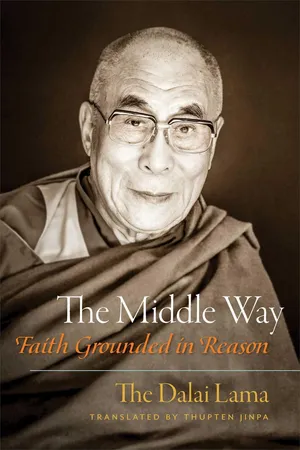
The Dalai Lama opens The Middle Way with an elegant argument for the power of compassion in cultivating a happy life. From there, he connects core ideas of Buddhist philosophy to the truths of our shared condition. His Holiness delivers a sparklingly clear teaching on how the Buddhist ideas of emptiness and interdependency relate to personal experience and bring a deeper understanding of the world around us.
In down-to-earth style, this book sets forth a comprehensive explanation of the foundational teachings of the Mahayana tradition based on the works of two of Buddhism's most revered figures. Using Nagarjuna's Middle Way, the Dalai Lama explores Buddhist understandings of selflessness, dependent origination, and the causal processes that lock us in cycles of suffering. He grounds these heady philosophical discussions using Tsongkhapa's Three Principal Aspects of the Path, presenting a brief explanation of how to put ethical discipline, wisdom, and compassion into practice.
Through these beautifully complementary teachings, His Holiness urges us to strive, "with an objective mind, endowed with a curious skepticism, to engage in careful analysis and seek the reasons behind our beliefs."
In down-to-earth style, this book sets forth a comprehensive explanation of the foundational teachings of the Mahayana tradition based on the works of two of Buddhism's most revered figures. Using Nagarjuna's Middle Way, the Dalai Lama explores Buddhist understandings of selflessness, dependent origination, and the causal processes that lock us in cycles of suffering. He grounds these heady philosophical discussions using Tsongkhapa's Three Principal Aspects of the Path, presenting a brief explanation of how to put ethical discipline, wisdom, and compassion into practice.
Through these beautifully complementary teachings, His Holiness urges us to strive, "with an objective mind, endowed with a curious skepticism, to engage in careful analysis and seek the reasons behind our beliefs."
Frequently asked questions
Yes, you can cancel anytime from the Subscription tab in your account settings on the Perlego website. Your subscription will stay active until the end of your current billing period. Learn how to cancel your subscription.
At the moment all of our mobile-responsive ePub books are available to download via the app. Most of our PDFs are also available to download and we're working on making the final remaining ones downloadable now. Learn more here.
Perlego offers two plans: Essential and Complete
- Essential is ideal for learners and professionals who enjoy exploring a wide range of subjects. Access the Essential Library with 800,000+ trusted titles and best-sellers across business, personal growth, and the humanities. Includes unlimited reading time and Standard Read Aloud voice.
- Complete: Perfect for advanced learners and researchers needing full, unrestricted access. Unlock 1.4M+ books across hundreds of subjects, including academic and specialized titles. The Complete Plan also includes advanced features like Premium Read Aloud and Research Assistant.
We are an online textbook subscription service, where you can get access to an entire online library for less than the price of a single book per month. With over 1 million books across 1000+ topics, weâve got you covered! Learn more here.
Look out for the read-aloud symbol on your next book to see if you can listen to it. The read-aloud tool reads text aloud for you, highlighting the text as it is being read. You can pause it, speed it up and slow it down. Learn more here.
Yes! You can use the Perlego app on both iOS or Android devices to read anytime, anywhere â even offline. Perfect for commutes or when youâre on the go.
Please note we cannot support devices running on iOS 13 and Android 7 or earlier. Learn more about using the app.
Yes, you can access The Middle Way by Dalai Lama, Thupten Jinpa in PDF and/or ePUB format, as well as other popular books in Theology & Religion & Eastern Philosophy. We have over one million books available in our catalogue for you to explore.
Information
PART I

An Exploration of Nagarjunaâs Fundamental Stanzas on the Middle Way
1. APPROACHING THE PROFOUND
TODAY, HERE in the twenty-first century, humanity has reached a highly advanced stage of material development and of knowledge of various fields, and we continue to progress in these areas. However, the demands on our attention are never-ending, and in such an environment, it is vital for the Buddhists to obtain genuine confidence in the Buddhadharma grounded in understanding and reason.
How do we go about obtaining a faith grounded in understanding? As I wrote in the colophon to Praise to Seventeen Nalanda Masters:
It is with an objective mind endowed with a curious skepticism that we should engage in careful analysis and seek the reasons. Then, on the basis of seeing the reasons, we engender a faith that is accompanied by wisdom.
Now, whenever we engage in an analysis, such as on the nature of mind or reality, if we proceed from the start already convinced that âIt must be so and so,â then due to our biases, we will be unable to see the actual truth and will instead see only our naĂŻve projection. It is therefore essential that the analyzing mind strive to be objective and not swayed by prejudices. What we need is a skeptical curiosity, our mind moving between the possibilities, genuinely wondering whether it is thus or some other way. We need to begin our analysis as objectively as possible.
However, if we maintain an objective stance unswayed by bias yet have no feeling or interest in the analysis, this too is incorrect. We should cultivate a curious mind, drawn toward all possibilities; and when we do, the desire to deeply investigate naturally arises. If this mind drawn toward possibilities is absent, we just abandon the inquiry and simply say, dismissively, âI donât know.â This way, then, brings no real benefit because we are not open to new insights.
Therefore, a curious skepticism is extremely important. For where there is such skepticism, constant inquiry also takes place. One of the reasons science progresses is because it persistently inquires and performs experiments on the basis of a genuine objectivity, âWhy is it like this?â with a curious mind that is drawn to all sorts of possibilities. In this way, the truth becomes clearer and clearer, allowing these truths to become correctly understood.
âCareful analysisâ indicates that a rough or incomplete analysis is not adequate. For example, in the method of analysis presented in Buddhist logic and epistemology texts, it is not adequate to rely on a proof that is based only on partial observation of a fact, on additional observation of the fact in a similar class, or on mere non-observation of the fact in any dissimilar class. To base your conclusion on such partial grounds is inadequate. Buddhist logic and epistemology texts emphasize the need for proving the truth of an assertion based on sound reasoning rooted in direct observation. With a careful analysis, our conclusions are more stable and sound.
As we become more aware and understand the reasoning presented in a text, these should be related back to our own personal experiences. Ultimately, the final proof is a direct valid experience.
Buddhist texts speak of four types or qualities of intelligence: great intelligence, swift intelligence, clear intelligence, and penetrating intelligence. Because we must analyze the subject matter carefully, we need great intelligence; because we cannot naĂŻvely conclude that something is the case except on the basis of a meticulous analysis, we need clear intelligence; because we need to be able to âthink on our feet,â we need swift intelligence; and because we need to pursue the full implications of a line of inquiry, we need penetrating intelligence.
By analyzing in such a manner and seeking what consequences and significance we can draw from our understanding, we will come to see those results. Here, we must first systematically organize the lines of reasoning presented in the texts and then correlate these with our own personal experience so that the reasoning is supported by direct observation and empirical evidence. When, on the basis of relating these lines of reasoning to our own personal experience, we feel âYes, they are truly helpfulâ or âThis is truly wonderful,â we have gained a decisive sense of conviction in the Buddhadharma. Such a confidence is called a faith grounded in genuine understanding.
SEQUENCE OF ANALYSIS
As for the actual sequence of engaging in analysis, in Praise to Seventeen Nalanda Masters, I wrote:
By understanding the two truths, the nature of the ground,
I will ascertain how, through the four truths, we enter and exit samsara;
I will make firm the faith in the Three Jewels that is born of understanding.
May I be blessed so that the root of the liberating path is firmly established within me.
Here, when we speak of practicing the Buddhadharma, we are speaking of observing the ethics of refraining from ten nonvirtues and cultivating compassion and loving-kindness within a context of seeking liberation. Merely refraining from the ten nonvirtues or cultivating of compassion and loving-kindness alone do not constitute a specific practice of the Buddhadharma; such practices of ethics and compassion are, after all, a feature of many spiritual traditions. When we speak of Buddhadharma in this context, the term Dharma (or spirituality) refers to the peace of nirvanaâliberationâand to definite goodness, a term that encompasses both liberation from samsara as well as the full enlightenment of buddhahood. We use the term definite goodness because the peace of nirvana is utterly excellent, pure, and everlasting. When practices such as avoiding unwholesome, harming actions and cultivating love and compassion are part of a quest for gaining liberation from cyclic existence, then they truly become Dharma in the sense of being Buddhist spiritual activity.
âLiberationâ here is defined as the cessation of the mindâs pollutants through the power of applying their corresponding antidotes. The main pollutant, the very root of our unenlightened existence, is the grasping at selfhood, at self-existence, and all the associated psychological and emotional factors that accompany and proceed from grasping at self-existence. The direct antidote to the self-grasping mind as well as its associated mental factors is insight into selflessness. Therefore, it is on the basis of realizing selflessness that we attain true liberation.
This is how the method of attaining definite goodness is presented, and the spiritual methods associated with the attainment of such liberation are the unique way of Buddhism. Therefore, I wrote, âMay I be blessed so that the root of the liberating path is firmly established in me.â
THE FOUR NOBLE TRUTHS
Now, to establish the root of the path to liberation firmly within ourselves, it is essential to understand the four noble truths.2 The four truths are like the foundation for all the Buddhaâs teachingsâboth sutra and tantra. When the Buddha first taught the Dharma to his earliest disciples, he taught the four noble truths.
If we reflect deeply upon the way in which the Buddha taught the four noble truths, we see that he first described their characteristics or nature, second their functions, and third the outcome that we will experience once they are realized directly. This is why, in Buddhist teachings, we often find discussions of the three main elements of ground, path, and result. The understanding of the nature of reality is the ground, the path is pursued based on the understanding of the ground, and finally the result is experienced as an effect of cultivating the path.
The Buddhaâs teaching on the four noble truths is a description of the actual nature of reality. When the Buddha taught the four truths, he began by describing their natures, saying, âThis is the noble truth of suffering, this is the noble truth of the origin of suffering, this is the noble truth of the cessation of suffering, and this is the noble truth of the path.â By declaring the truths in this way, the Buddha was making a statement about the way things exist; he was describing the nature of the ground.
Now, the âsufferingâ in the Buddhaâs first noble truth, in which he says âThis is the noble truth of suffering,â includes all the sufferings that plague us. Within this there are many different levels of subtlety, not just the manifest suffering of pain and hardship but also a deeper and more pervasive quality of our experiences. The statement âThis is the noble truth of s...
Table of contents
- Cover
- Title
- Contents
- Translatorâs Preface
- Prologue
- Part I: An Exploration of Nagarjunaâs Fundamental Stanzas on the Middle Way
- Part II: An Exploration of Tsongkhapaâs Three Principal Aspects of the Path
- Appendix 1: Three Principal Aspects of the Path
- Appendix 2: Praise to Seventeen Nalanda Masters
- Notes
- Bibliography
- Index
- About the Author
- Copyright