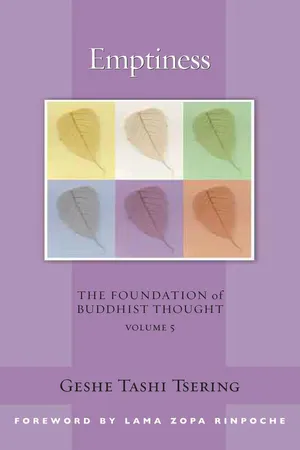
Emptiness
eBook - ePub

Emptiness

The Foundation of Buddhist Thought, Volume 5

  1. 184 pages
  2. English
  3. ePUB (mobile friendly)
  4. Available on iOS & Android
eBook - ePub

Emptiness

The Foundation of Buddhist Thought, Volume 5

About this book

In Emptiness, the fifth volume in The Foundation of Buddhist Thought series, Geshe Tashi Tsering provides readers with an incredibly welcoming presentation of the central philosophical teaching of Mahayana Buddhism. Emptiness does not imply a nihilistic worldview, but rather the idea that a permanent entity does not exist in any single phenomenon or being. Everything exists interdependently within an immeasurable quantity of causes and conditions. An understanding of emptiness allows us to see the world as a realm of infinite possibility, instead of a static system. Just like a table consists of wooden parts, and the wood is from a tree, and the tree depends on air, water, and soil, so is the world filled with a wondrous interdependence that extends to our own mind and awareness. In lucid, accessible language, Geshe Tashi Tsering guides the reader to a genuine understanding of this infinite possibility.
Frequently asked questions

Yes, you can cancel anytime from the Subscription tab in your account settings on the Perlego website. Your subscription will stay active until the end of your current billing period. Learn how to cancel your subscription.
No, books cannot be downloaded as external files, such as PDFs, for use outside of Perlego. However, you can download books within the Perlego app for offline reading on mobile or tablet. Learn more here.
Perlego offers two plans: Essential and Complete
  • Essential is ideal for learners and professionals who enjoy exploring a wide range of subjects. Access the Essential Library with 800,000+ trusted titles and best-sellers across business, personal growth, and the humanities. Includes unlimited reading time and Standard Read Aloud voice.
  • Complete: Perfect for advanced learners and researchers needing full, unrestricted access. Unlock 1.4M+ books across hundreds of subjects, including academic and specialized titles. The Complete Plan also includes advanced features like Premium Read Aloud and Research Assistant.
Both plans are available with monthly, semester, or annual billing cycles.
We are an online textbook subscription service, where you can get access to an entire online library for less than the price of a single book per month. With over 1 million books across 1000+ topics, we’ve got you covered! Learn more here.
Look out for the read-aloud symbol on your next book to see if you can listen to it. The read-aloud tool reads text aloud for you, highlighting the text as it is being read. You can pause it, speed it up and slow it down. Learn more here.
Yes! You can use the Perlego app on both iOS or Android devices to read anytime, anywhere — even offline. Perfect for commutes or when you’re on the go.
Please note we cannot support devices running on iOS 13 and Android 7 or earlier. Learn more about using the app.
Yes, you can access Emptiness by Tashi Tsering, Gordon McDougall in PDF and/or ePUB format, as well as other popular books in Theology & Religion & Eastern Philosophy. We have over one million books available in our catalogue for you to explore.

1 THE REVOLUTION OF SELFLESSNESS


The Uniqueness of the Buddha’s Concept of No-Self

TWO THOUSAND FIVE HUNDRED YEARS ago, philosophy flourished in India, and the teaching of Gautama Buddha was just one of many. Buddhism as such did not yet exist, and the ideas of the Buddha were just one part of the potpourri of Indian thought.
In many ways the Buddha’s teachings conformed to and developed from the existing orthodox lines of reasoning of Brahmanism, which would later develop into what we know as Hinduism, and the various religious movements that sprang up in relation to and reaction against Brahmanic orthodoxy, such as the Upanishadic, Jain, and Shramanic movements. In particular, the Buddha’s teachings hold much in common with Jainism. Many concepts are shared by all the movements: the law of cause and effect (karma), cyclic existence (samsara), liberation (moksha), as well as the guidelines for developing ethics and concentration. If we study the non-Buddhist Indian texts on these subjects we would find very little difference in the essence of what they teach. The general Indian public felt, as it still does, that Buddhism was part of the whole mix.
There is one area, however, where the Buddha diverted drastically from the established thinking and was a true revolutionary. Even today to hold such a view is to be truly radical. That view is selflessness.
How we cycle through existence was all explained within the major texts of both Jainism and Brahmanism. Due to karma we are locked in this round of birth, aging, sickness, and death, until we can finally break free and attain moksha or liberation. The Buddha was teaching nothing new when he explained these subjects.
Just who it is that cycles in samsara, however, is another matter. All philosophies concern themselves with who we are. For the other Indian philosophies, this was atman, the soul or self, but the Buddha declared that the reality of the self was anatman, no-self. This concept of selflessness has been a key point of Buddhist philosophy since then, whether it is called anatman, no-self, selflessness, or emptiness. (In general, I will use the term selflessness in the early chapters, where we look at the sources of what Tibetan Buddhism takes as the definitive view, and move to emptiness when we reach the higher philosophical schools. The difference is a very fine one and need not concern us here.)
When all the other topics within Buddhism are taken from the point of view of selflessness, they take on a richness that makes them truly Buddhist. Karma, for a Buddhist, is subtly different from the idea of karma for a follower of Jainism or Brahmanism, and therefore Hinduism. Applying the principle of no-self gives us one more layer of meaning, one that might take us closer to actually achieving the liberation we seek.
Seeing this unique quality of the Buddha’s teachings has inspired me on my spiritual journey. We should not think that Buddhism is superior to the other non-Buddhist philosophies, but nonetheless, if these teachings suit our disposition, they can make a profound difference to the way we view the world.

THE IMPORTANCE OF SELFLESSNESS

All philosophies and religions are designed to help us overcome our problems. The techniques used in the ancient non-Buddhist Indian religions were very effective at this. They recognized how our afflictive minds arise out of the three principal sources of attachment, aversion, and ignorance, and set about finding ways of eliminating these poisons. The art of concentration, in particular, was cultivated in India. Hinduism offers a complete guide to developing a focused mind, and includes all those stages recognized by Buddhism as necessary to achieve complete concentration. Were we to achieve complete shamatha, as it is called, we would go a long way toward reducing and temporarily eliminating our attachment and aversion.
But notice the qualification here. By cultivating concentration, we would almost destroy our deep-seated attachment and aversion, but not quite. Until we have completely eliminated the very seeds of the attachment, aversion, and ignorance from our mindstreams, those seeds can reactivate at a later time and grow, leaving us back at square one. The Buddha saw how if we really want to be completely free from suffering and its causes, eliminating the manifest negative minds is not enough. No matter how effective concentration is in dealing with the grosser delusions, it does not have the ability to destroy the root. It is like a set of scales: the more concentration, the fewer delusions; the less concentration, the more delusions. As our concentration comes and goes, so do our delusions. But, in the long run, lacking insight into emptiness, the delusions will win.
We need to investigate this for ourselves. Hopefully, if we investigate deeply enough we will see that anyone who seeks the total elimination of all suffering and the causes of suffering must completely uproot these three poisons. This requires a full understanding of how things exist, which is emptiness.
We currently perceive things as having intrinsic existence, where in fact they lack it. We see a chair and that seems to be that. It exists in and of itself, completely independent of causes and other factors, completely separate from the world in which it exists and the mind that apprehends it. This fundamental misreading of the nature of things and events is the cause of our suffering, because by means of this ignorance we are likely to develop attachment and aversion. As long as there is the slightest sense that things—especially our own sense of ā€œIā€ā€”exist independently and concretely, we will cling to that separateness. When something strengthens this sense of a real ā€œI,ā€ we develop attachment for it, and conversely, when something threatens it, we develop aversion to it. This is why a clear and deep understanding of emptiness is crucial if we are seriously seeking the complete elimination of all our suffering.
Therefore, we might ask whether Buddhism reaches a truth that the other Indian philosophies do not. In Brahmanism, it is taught that my karma is my own responsibility; the actions I did in the past determine what I experience now, and the actions I do now determine what I will experience in the future. In that, Brahmanism does not differ from Buddhism in its presentation of karma. The difference is that, according to Brahmanism, the ā€œIā€ā€”the person creating the cause or experiencing the result—has a ā€œBrahma nature.ā€ This atman that we all possess is Brahma in nature. It is not as if Brahma controls everything and we are powerless, but this Brahma-essence is at our core, an eternal and unchanging thing that goes from life to life.
Buddhism rejects this atman. This sense of identity is nothing more than a label placed on the ever-changing collection of the body and mind. Without a deep understanding of both concepts—selflessness and karma—it might seem that there is a contradiction. In fact, those who believe in an atman argue that the whole concept of karma would break down without the presence of some essential personal characteristic that continues through lifetimes. This has been a key sticking point in the debates between Buddhist and non-Buddhist scholars.
Most probably you are not a Brahmin philosopher. Debates between Brahmins and Buddhists might not seem exactly relevant to you and me here and now, but if we are honest and can glimpse a little of how we perceive ourselves, we’ll probably see that there is something in that glimpse we call the ā€œI,ā€ that we consider permanent and unchanging. Consciously or unconsciously, our worldview is formed by our environment, our culture, and possibly by our religion (or the echoes of the religion that still permeate our society). Whether it is Christianity, Judaism, Islam, or any other of the religious and secular philosophies that influence us, most of us live with a sense of self that is separate from our aggregates of body and mind. According to the assertions of Buddhism, this sense of an independent and permanent self is completely erroneous. These various concepts of self that we all live with are important to understand, and we will look at this in chapter 3.

Selflessness in the Sutras

DID THE BUDDHA INVENT SELFLESSNESS?

The Buddha and subsequent Buddhist masters have argued that without a realization of selflessness or emptiness it is impossible to completely overcome suffering and its origins. Selflessness is the vital tool to achieve ultimate happiness. Is selflessness therefore some sacred concept, introduced by the Buddha and made holy by veneration of its powers? Is it something to pay homage to because it is an invention of the Buddha for our liberation? The answer is no. Selflessness is nothing sacred, nothing new in the sense of being created by the Buddha or Buddhist masters. There are many references from the sutras and shastras that assert that selflessness is a natural condition of any phenomenon. The sutra Dasabhumikasutra (The Sutra on the Ten Grounds) says:
O son of the lineage, the dharmadhatu, the nature of all phenomena is like this: Whether buddhas are born or not, whether they reveal the true nature of phenomena or not, the dharmadhatu, the reality of all phenomena, abides as it is in being the lack of true existence.2
Similarly, the great Indian master Chandrakirti, in his Commentary on the Middle Way (Madhyamakavatara) says:
Whether Buddhas actually appear or do not appear,
The emptiness of all things
Is explained as the other entity.3
Indeed, you will find many quotes from the great masters about the natural condition of selflessness, as this is a crucial point that needs to be addressed when we begin to explore emptiness. Maitreya’s Ornament of Clear Realization (Abhisamayalamkara) and Sublime Continuum of the Mahayana (Uttaratantra) are also important references that clarify how emptiness is not a concept that the Buddha created, but a fact that he came to understand. What we perceive to be reality differs according to the different levels of understanding we gain, and so what the Buddha realized was not some new concept, but a new depth of understanding. He saw that we could not totally break free of our suffering until we, too, had come to that level of understanding. Selflessness or emptiness is reality, not a doctrinal belief created by the Buddha.
In his Ornament of Clear Realization, Maitreya says:
There is nothing to be taken away, there is nothing to be added on,
Whoever is able to see it as it is will be liberated.4
This verse clearly states that when we reach the final mode of existence of things and events, there is nothing we need to add to or subtract from that reality; simply realizing selflessness as it is will liberate us from all suffering and pain. We don’t need devotion, faith, or belief in the Buddha; we simply need to realize how things really exist. While this is nothing newly created by the Buddha, the depth of his understanding of reality is unique.

UNDERSTANDING REALITY AS IT IS

Probably one of the most difficult things we can ever do is to ā€œsimplyā€ understand reality as it is. We have countless mental imprints from this or previous lifetimes that habituate us to instinctively see the things and events of our world as existing truly and independently from their own sides. Because of that habituation, even though the final mode of existence of phenomena—their selflessness or emptiness—is there all the time, it is not that straightforward to understand.
To explore reality, we should use our most discerning wisdom, even though at this stage reality is so obscured that we must rely on what others say about it. That does not mean we should blindly accept the opinions of others, no matter how great they might be. The Buddha himself said this in a quote often cited by subsequent masters:
O bhikshus and wise men,
Just as a goldsmith would test his gold
By burning, cutting, and rubbing it,
So must you examine my words and accept them.
But not merely out of reverence for me.5
Lama Tsongkhapa quotes this toward the beginning of his Essence of True Eloquence (Tib: Drang-nges legs-bshad snying-po) to explain how to approach the understanding of the final mode of being of phenomena. Just as a goldsmith wouldn’t accept a lump of yellow metal as gold without doing a complete examination, at this stage of our journey we cannot discern the actual reality of how phenomena exist by our own logical reasoning alone. We need to depend on others, but the manner in which we go about this is crucial. We should rely on them not because they are famous, or charismatic, or even because they are the head of a religion, but only because we have made a thorough examination of their teachings. This is a very important point. To understand emptiness, we depend on people like the Buddha or other great masters, and we need to do that only after thorough examination. When we find that there is no fault or deception in what they teach, then we can follow their guidance.
The second step is to follow their line of argument through to its final conclusion until we ourselves can realize it fully with our own direct perception. In this context it is said in the Mahayana teachings that there are four reliances:
♦ reliance on the teachings and not the teacher
♦ reliance on the meaning and not on the words that express it
♦ reliance on the definitive meaning and not the provisional meaning
♦ reliance on the transcendent wisdom of deep experience and not on mere knowledge6
The first reliance, to rely on the teachings rather than the teacher, means to go beyond the teacher’s fame or charisma and investigate the essence of what he or she is teaching. This is important. Quite often, many of us simply follow teachers because of their names or personalities, or because someone has recommended them. That is not the right way. The teaching is the important thing, not the external faƧade, the personality of the presenter.
The second reliance, to rely on the meaning rather than the words that express it, means we need to delve even deeper, and go beyond the style of the teachings. How it is expressed is not the e...

Table of contents

  1. Cover
  2. Foreword
  3. Preface
  4. Editor’s Preface
  5. 1. The Revolution of Selflessness
  6. 2. The Prerequisites for Developing an Understanding of Selflessness
  7. 3. The Concepts of Selfhood
  8. 4. The Differences Between Svatantrika and Prasangika
  9. 5. Prasangika’s Unique Presentation of Emptiness
  10. 6. Establishing Emptiness
  11. 7. Emptiness and Dependent Arising
  12. Appendix
  13. Glossary
  14. About the Authors
  15. Bibliography
  16. Notes
  17. Index
  18. The Foundation of Buddhist Thought
  19. About Wisdom
  20. Copyright