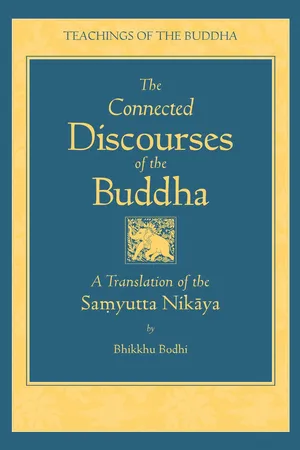
The Connected Discourses of the Buddha
eBook - ePub

The Connected Discourses of the Buddha

A New Translation of the Samyutta Nikaya

  1. 2,080 pages
  2. English
  3. ePUB (mobile friendly)
  4. Available on iOS & Android
eBook - ePub

The Connected Discourses of the Buddha

A New Translation of the Samyutta Nikaya

About this book

This volume offers a complete translation of the Samyutta Nikaya, The Connected Discourses of the Buddha, the third of the four great collections in the Sutta Pitaka of the Pali Canon. The Samyutta Nikaya consists of fifty-six chapters, each governed by a unifying theme that binds together the Buddha's suttas or discourses. The chapters are organized into five major parts.

The first, The Book with Verses, is a compilation of suttas composed largely in verse. This book ranks as one of the most inspiring compilations in the Buddhist canon, showing the Buddha in his full grandeur as the peerless "teacher of gods and humans." The other four books deal in depth with the philosophical principles and meditative structures of early Buddhism. They combine into orderly chapters all the important short discourses of the Buddha on such major topics as dependent origination, the five aggregates, the six sense bases, the seven factors of enlightenment, the Noble Eightfold Path, and the Four Noble Truths.

Among the four large Nikayas belonging to the Pali Canon, the Samyutta Nikaya serves as the repository for the many shorter suttas of the Buddha where he discloses his radical insights into the nature of reality and his unique path to spiritual emancipation. This collection, it seems, was directed mainly at those disciples who were capable of grasping the deepest dimensions of wisdom and of clarifying them for others, and also provided guidance to meditators intent on consummating their efforts with the direct realization of the ultimate truth.

The present work begins with an insightful general introduction to the Samyutta Nikaya as a whole. Each of the five parts is also provided with its own introduction, intended to guide the reader through this vast, ocean-like collection of suttas.

To further assist the reader, the translator has provided an extensive body of notes clarifying various problems concerning both the language and the mean
Frequently asked questions

Yes, you can cancel anytime from the Subscription tab in your account settings on the Perlego website. Your subscription will stay active until the end of your current billing period. Learn how to cancel your subscription.
At the moment all of our mobile-responsive ePub books are available to download via the app. Most of our PDFs are also available to download and we're working on making the final remaining ones downloadable now. Learn more here.
Perlego offers two plans: Essential and Complete
  • Essential is ideal for learners and professionals who enjoy exploring a wide range of subjects. Access the Essential Library with 800,000+ trusted titles and best-sellers across business, personal growth, and the humanities. Includes unlimited reading time and Standard Read Aloud voice.
  • Complete: Perfect for advanced learners and researchers needing full, unrestricted access. Unlock 1.4M+ books across hundreds of subjects, including academic and specialized titles. The Complete Plan also includes advanced features like Premium Read Aloud and Research Assistant.
Both plans are available with monthly, semester, or annual billing cycles.
We are an online textbook subscription service, where you can get access to an entire online library for less than the price of a single book per month. With over 1 million books across 1000+ topics, we’ve got you covered! Learn more here.
Look out for the read-aloud symbol on your next book to see if you can listen to it. The read-aloud tool reads text aloud for you, highlighting the text as it is being read. You can pause it, speed it up and slow it down. Learn more here.
Yes! You can use the Perlego app on both iOS or Android devices to read anytime, anywhere — even offline. Perfect for commutes or when you’re on the go.
Please note we cannot support devices running on iOS 13 and Android 7 or earlier. Learn more about using the app.
Yes, you can access The Connected Discourses of the Buddha by Bodhi in PDF and/or ePUB format, as well as other popular books in Theology & Religion & Asian Literary Collections. We have over one million books available in our catalogue for you to explore.
Part I
The Book with Verses (Sagāthāvagga)

Introduction

The Sagāthāvagga is so called because all the suttas in this book contain verses, at least one, usually more. The Vagga is divided into eleven saṃyuttas containing a total of 271 suttas. Most of these saṃyuttas are subdivided into several vaggas, usually of ten suttas each. In four saṃyuttas (3, 4, 6, 11), the last vagga contains only five suttas, half the standard number, and these are therefore called “pentads” (pañcaka). Four saṃyuttas are not divided into separate vaggas (5, 8, 9, 10), and thus may be considered as made up of a single vagga. I have numbered the suttas consecutively within each saṃyutta starting from 1, with the number within the vagga given in parenthesis. The recent PTS edition of the Sagāthāvagga (Ee2) numbers the suttas consecutively through the entire collection, from 1 to 271.
The number of verses varies from edition to edition, depending on differences in readings and on alternative ways of grouping pādas or lines into stanzas; for a sequence of twelve pādas might be divided into either two stanzas of six lines each or three stanzas of four lines each. Ee2 is the only one that numbers the verses, and this edition has 945; of these I have not included three (vv. 70, 138, 815), for reasons explained in the notes (nn. 53, 96, 573). Many of the verses occur several times within the Saṃyutta Nikāya, usually within the Sagāthāvagga, occasionally elsewhere, as can be seen from Concordance 1 (A). The verses also have extensive parallels elsewhere in the Pāli Canon. A large number are shared by such texts as the Thera- and Therīgāthās, the Suttanipāta, the Dhammapada, and the Jātakas, as well as by the other Nikāyas. They are also quoted in para-canonical texts such as the Milindapañha, the Peṭakopadesa, and the Nettippakaraṇa. A significant number have parallels in the vast corpus of non-Pāli Indian Buddhist literature, such as the Patna and Gāndhārī Dharmapadas, the Udānavarga, the Mahāvastu , and even the much later Yogācārabhūmi. All these “external” parallels are shown in Concordance 1 (B). Doubtlessly some of the verses were not original to the suttas in our collection but belonged to the vast, free floating mass of Buddhist didactic verse which the compilers of the texts pinned down to specific contexts by providing them with narrative settings such as those found in the Sagāthāvagga.
Of the eleven saṃyuttas in this Vagga, eight revolve around encounters between the Buddha (or his disciples) and beings from other planes of existence. Since we will repeatedly run across beings from nonhuman planes in the other Vaggas too, a short summary of the Buddhist picture of the sentient universe will help us to identify them and to understand their place in early Buddhist cosmology. (See Table 3, which gives a visual representation of this cosmology.)
TABLE 3
The Thirty-One Planes of Existence according to Traditional Theravāda Cosmology (see CMA 5:3–7)
The Formless Realm (4 planes)
(31) Base of neither-perception-nor-nonperception
(30) Base of nothingness
(29) Base of infinity of consciousness
(28) Base of infinity of space
Fourth jhāna plane: Five Pure Abodes
(27) Akaniṭṭha realm
(26) Clear-sighted realm
(25) Beautiful realm
(24) Serene realm
(23) Durable realm
Ordinary fourth jhāna plane
(22) Nonpercipient beings
(21) Devas of great fruit
Third jhāna plane
(20) Devas of steady aura
(19) Devas of measureless aura
(18) Devas of minor aura
Second jhāna plane
(17) Devas of streaming radiance
(16) Devas of measureless radiance
(15) Devas of minor radiance
First jhāna plane
(14) Mahābrahmā realm
(13) Brahmā’s ministers
(12) Brahmā’s assembly
The Sense-Sphere Realm (11 planes)
Seven good destinations
Six sense-sphere heavenly realms
(11) Paranimmitavasavattī devas
(10) Nimmānaratī devas
(9) Tusita devas
(8) Yāma devas
(7) Tāvatiṃsa devas
(6) Four Great Kings
Human realm
(5) Human realm
Four bad destinations
(4) Host of asuras
(3) Domain of ghosts
(2) Animal realm
(1) Hell realms
The early Buddhist texts envisage a universe with three principal tiers subdivided into numerous planes. The lowest tier is the sense-sphere realm (kāmadhātu), so called because the driving force within this realm is sensual desire. The sense-sphere realm (in the oldest cosmology) contains ten planes: the hells (niraya), planes of extreme torment; the animal realm (tiracchānayoni); the domain of petas or ghosts (pettivisaya), shade-like spirits subject to various kinds of misery; the human realm (manussaloka); and six sense-sphere heavens (sagga) inhabited by the devas, celestial beings who enjoy far greater happiness, beauty, power, and glory than we know in the human realm. Later tradition adds the asuravisaya, the domain of titans or antigods, to the bad destinations, though in the Nikāyas they are depicted as occupying a region adjacent to the Tāvatiṃsa heaven, from which they often launch invasions against the devas.
Above the sense-sphere realm is the form realm (rūpadhātu), where gross material form has vanished and only the subtler kinds of form remain. The realm is divided into four main tiers with several planes in each. The inhabitants of these planes are also devas, though to distinguish them from the gods of the sensuous heavens they are usually called brahmās. The life spans in the various brahmā planes increase exponentially, being far longer than those in the sensuous heavens, and sensual desire has largely abated. The prevalent mode of experience here is meditative rather than sensory, as these planes are the ontological counterparts of the four jhānas or meditative absorptions. They include the five “Pure Abodes” (suddhāvāsa), spheres of rebirth accessible only to nonreturners.
Beyond the form realm lies an even more exalted sphere of existence called the formless realm (arūpadhātu). The beings in this realm consist solely of mind, without a material basis, as physical form is here entirely absent. The four planes that make up this realm, successively more subtle, are the ontological counterparts of the four āruppas or formless meditative attainments, after which they are named: the base of the infinity of space, the base of the infinity of consciousness, the base of nothingness, and the base of neither-perception-nor-nonperception.
The suttas often compress this elaborate cosmology into a simpler scheme of five destinations (pañcagati): the hells, the animal realm, the domain of ghosts, the human realm, and the deva world. The last includes all the many deva planes of the three realms. The first three are called the plane of misery (apāyabhūmi ), the nether world (vinipāta), or the bad destinations (duggati ); the human realm and the deva planes are collectively called the good destinations (sugati). Rebirth into the plane of misery is the fruit of unwholesome kamma, rebirth into the good destinations the fruit of wholesome kamma. Beyond all realms and planes of existence is the unconditioned, Nibbāna, the final goal of the Buddha’s teaching.

1. DEVATĀSAṂYUTTA

Devatā is an abstract noun based on deva, but in the Nikāyas it is invariably used to denote particular celestial beings, just as the English word “deity,” originally an abstract noun meaning the divine nature, is normally used to denote the supreme God of theistic religions or an individual god or goddess of polytheistic faiths. Though the word is feminine, the gender comes from the abstract suffix -tā and does not necessarily...

Table of contents

  1. Cover Page
  2. Title Page
  3. Dedication
  4. Table of Contents
  5. Preface
  6. Key to the Pronunciation of Pāli
  7. Introduction
  8. Part I - The Book with Verses (Sagāthāvagga)
  9. Part II - The Book of Causation
  10. Part III - The Book of the Aggregates (Khandhavagga)
  11. Part IV - The Book of the Six Sense Bases (Saḷāyatanavagga)
  12. Part V - The Great Book
  13. Concordances
  14. Bibliography
  15. Abbreviations
  16. Pāli-English Glossary
  17. Index of Subjects
  18. Index of Proper Names
  19. Index of Similes
  20. Index of Pāli Terms Discussed in the Introduction and Notes
  21. About Wisdom
  22. Copyright