
- 256 pages
- English
- ePUB (mobile friendly)
- Available on iOS & Android
eBook - ePub
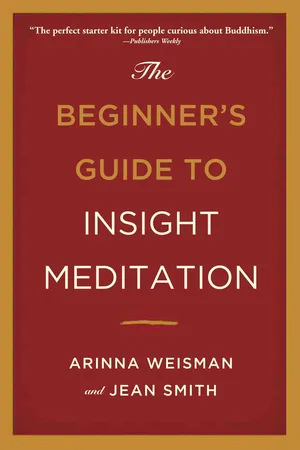
The Beginner's Guide to Insight Meditation
About this book
Arinna Weisman and Jean Smith combine clear explanations of the Buddha's teachings on freedom and happiness with their personal stories highlighting some of the challenges and insights of practice. The Beginner's Guide to Insight Meditation offers advice about going on retreat and help in choosing a teacher and a community to practice with. This is an enormously practical book that covers every aspect of the teachings a beginner needs to get started.
Frequently asked questions
Yes, you can cancel anytime from the Subscription tab in your account settings on the Perlego website. Your subscription will stay active until the end of your current billing period. Learn how to cancel your subscription.
At the moment all of our mobile-responsive ePub books are available to download via the app. Most of our PDFs are also available to download and we're working on making the final remaining ones downloadable now. Learn more here.
Perlego offers two plans: Essential and Complete
- Essential is ideal for learners and professionals who enjoy exploring a wide range of subjects. Access the Essential Library with 800,000+ trusted titles and best-sellers across business, personal growth, and the humanities. Includes unlimited reading time and Standard Read Aloud voice.
- Complete: Perfect for advanced learners and researchers needing full, unrestricted access. Unlock 1.4M+ books across hundreds of subjects, including academic and specialized titles. The Complete Plan also includes advanced features like Premium Read Aloud and Research Assistant.
We are an online textbook subscription service, where you can get access to an entire online library for less than the price of a single book per month. With over 1 million books across 1000+ topics, weâve got you covered! Learn more here.
Look out for the read-aloud symbol on your next book to see if you can listen to it. The read-aloud tool reads text aloud for you, highlighting the text as it is being read. You can pause it, speed it up and slow it down. Learn more here.
Yes! You can use the Perlego app on both iOS or Android devices to read anytime, anywhere â even offline. Perfect for commutes or when youâre on the go.
Please note we cannot support devices running on iOS 13 and Android 7 or earlier. Learn more about using the app.
Yes, you can access The Beginner's Guide to Insight Meditation by Arinna Weisman, Jean Smith in PDF and/or ePUB format, as well as other popular books in Theology & Religion & Eastern Philosophy. We have over one million books available in our catalogue for you to explore.
Information
chapter 1
The Possibility of Change: A Cinderella Story
When I was a child, the Cinderella story made me distinctly uncomfortable. So did Anne of Green Gables. Here were these images of people who were just too good to be true: They were generous, they were sweet, they were diligent, they worked hard, they were compassionate, they never seemed angry or judgmental or shaming or hating. At some level, I longed to be like them, but I felt that I was more like Cinderellaâs ugly sisters: They were jealous of each other, they were nasty, they were competitive, and they were social climbers. They thought that they were not good enough and yet they were self-consciously proud. Not until many years later did I learn that within the practice of Insight Meditation I could embrace such seemingly contradictory feelings with peace and even affection.
âAW
MANY PEOPLE experience this rift within themselves. Sometimes we feel anger, jealousy, envy, and desire as the ugly sisters, sort of âbadâ people eventually relegated to the dim kitchen in the Princeâs palace or a dark place in our hearts. At the same time, we yearn to have the qualities of Cinderella and the Princeâbeauty, virtue, generosityâand to live happily ever after. The good news is that no matter how powerfully we may feel torn between such conflicting emotions, the Buddhist tradition known as Insight Meditation, or Vipassana, invites us to heal that division.
Insight Meditation teachings do not demand that we live our lives as an eternal bliss trip by judging or cutting off what feels difficult or negative. That simply is not a realistic expectation for any human being. Instead, when energies such as anger, hatred, doubt, and anxietyâtraditionally called the hindrances in this practice (chapter 3)âarise, we can learn to recognize them and to hold them in our hearts with kindness and with acceptance. We acknowledge them and even honor them, saying, âAha, here are these energies inside me. May I hold them with kindness. May I hold them with softness.â That conscious relationshipâit is like Cinderella and the ugly sisters mergedâis where transformation happens.
If we could not envision how we would like to live and if we did not have the perseverance to make that vision a reality, no human being could change. One of our greatest advantages as human beings is that as long as we are alive, we can change.
âAW
dp n="14" folio="3" ?Even though we sometimes feel as if we are being clutched to the bosom of hurtful energies, the fundamentally good part of our nature is always there and can be awakened. The heart of Insight Meditation teachings is that there is a practice that calls upon our inner potential for wisdom, kindness, illumination, and a deep sense of connection to the beauty of all life. When this potential unfurls without obstructions, we are freeâfree of suffering, living with happiness that is not dependent on any particular thing, person, experience, or circumstance. This is our possibility. It is not just theoretical or something we are asked to accept on blind faith. We have proof of it in the lives of our spiritual teachers and people such as the Buddha, Mahatma Gandhi, Hildegard of Bingen, Nelson Mandela, Aung San Suu Kyi, and the Dalai Lama.
A passage varyingly attributed to Nelson Mandela and Marianne Williamson elegantly articulates an invitation to express our possibility.
Our deepest fear is not that we are inadequate.
Our deepest fear is that we are powerful beyond measure.
It is our light, not our darkness, that most frightens us.
We ask ourselves, Who am I to be brilliant, gorgeous, talented, fabulous?
Actually, who are you not to be?
You are a child of God. Your playing small doesnât serve the world.
Thereâs nothing enlightened about shrinking so that other people wonât feel insecure around you.
We are all meant to shine, as children do.
We were born to make manifest the glory of God that is within us.
Itâs not just in some of us; itâs in everyone.
And as we let our own light shine, we unconsciously give other people permission to do the same.
As weâre liberated from our own fear, our presence automatically liberates others.
THE NATURE OF SUFFERING IN OUR LIVES
Insight Meditation teachings recognize the challenges we face in living as human beings and the reality that we often experience pain and sometimes tremendous suffering. Suffering does not mean we are failures or awful people or that we should feel ashamed about what is happening to us. The process of healing begins when we acknowledge our suffering and explore it, when we admit what is happeningâand accept it.
As we open to our lives, we face the difficulty of illness. Some of us lose our health in a permanent way, for example, through cancer, heart disease, or arthritis. We all encounter the process of aging. Our bodies disintegrate in different ways and at different rates, but the changes due to aging are unavoidable and often painful. And we will all dieâa scary prospect for many of us.
For some of us our deepest challenges may not be physical but emotional, as psychic wounds keep opening up and bringing with them suffering. Perhaps no great difficulties are confronting us right now, but rather a general sense of dissatisfaction permeates our lives. We may believe things are going well, but we may not feel fulfilled, or we may sense we are not living our deepest purpose, or we may even feel that our life is out of control.
dp n="16" folio="5" ?The Buddha said that we cannot deny these difficulties. It would be foolish and unrealistic to even try, for we would just be repressing a part of ourselves. This practice is not about repression, nor is it about splitting ourselves off from ourselves or pretending to be some sort of perfect spiritual model that excludes half of our lives. Insight Meditation practice is about relating to ourselves as we are. It is about saying, âOkay, let me find a way to work with these difficulties. How do I do that?â The Buddha said, âThis is the way,â and he laid out teachings so that we could live with the challenges of life and still find happiness. They are not like some new-age teachings that push away whatever is difficult. Not at all. The Buddhaâs teachings are revolutionary because they acknowledge our difficulties and in doing so inspire us to embrace a spiritual practice that can bring us peace.
As we travel on this spiritual path to freedom, we increasingly understand the importance of clarifying our intentions for undertaking this journey. We see that what begins as an intention we may barely be aware of is in fact what activates all our thoughts, our words, and our actions. When we cultivate mindfulness of our intentions, we enable ourselves to transform the words and actions that cause us and others suffering into opportunities for happiness.
You may have picked up this book because your mate just died or you just lost a job that was very important to you or you have developed a chronic physical disability or experienced some other huge challenge in your life. You say to yourself, âI know I cannot pretend this did not happen. Of course it happened. But how do I live with this with some kind of peace and equanimity? How can I live with this in some kind of kindness to myself?â This book shows that within Insight Meditation practice there are answers to these kinds of questions.
Our first step together could be taking the Refuges.
dp n="17" folio="6" ?THE THREE REFUGES
After Siddartha Gautamaâs enlightenment, he became known as the Buddha (the âAwakened Oneââsee chapter 10). Over the centuries since then, many people seeking their own path of awakening have begun their commitment by a process known as taking the Three Refuges. But this practice is much more than homage to a historical ritual. It is an affirmation of our capacity to change. The refuges acknowledge that, first, there is a possibility of our awakening; second, there is a way of living or practicing that can create the conditions for this awakening; and third, we are not alone in this endeavorâwe are joined and supported by thousands of other beings and communities.
Some phrases for taking the refuges are:
May I take refuge in my capacity to awaken.
May I take refuge in the ways of living that bring about my freedom and happiness.
May I feel open to all those who can support me on this path of freedom.
Taking the first refuge means taking refuge in our fundamental Buddha-nature, with its potential for enlightenment. Taking the second refuge means taking refuge in the teachings that awaken this nature (known as the Dharma). Taking the third refuge means taking refuge in the community that practices together (known as the sangha), which provides a resting place that is safe, nourishing, and transformative.
We often find ourselves taking refuge in other things that we think are going to bring us happiness. We have been taught that happiness comes about through having, owning, and accumulating. If we have a serviceable car, we might still find ourselves desiring a better model. We may have wished for a new house, longer vacations in more beautiful places, better relationships. These things are not bad, but they do not bring lasting happiness. But there is the possibility of a lasting happiness that does illuminate our beingsâthat is present whether we have a nice car or not, better furniture or not, a longer vacation or not. This possibility of a lasting happiness that is not dependent on any thing or circumstance is called our fundamental nature, or Buddha-nature.
Taking the first refuge is acknowledging that we have the capacity to be happy in this way. It is a treasure we carry in our hearts more valuable, the Buddha said, than the most precious jewels in the world, than all the treasures of royalty. This happiness is not born of greed or hatred. It is not the kind of happiness someone might feel who has longed for something and through treachery finally gotten it. It is not the kind of happiness people feel who gain power over others and can make them do exactly what they want. This kind of happiness comes from deep kindness and respect for all beings and all life. It comes with a clear wisdom that always sees what is skillful, appropriate, timely, and true. This happiness lives in a heart that has no boundaries of âusâ and âthemâ but comes through our intimate connection with all of life. It is a happiness that expresses being at peace. It is a happiness that comes from being present in each moment. This happiness is our possibility, and the refuges remind us that we can find it.
The first refuge acknowledges the beautiful part of our being and encourages us to say, âNo matter what I have done, no matter what I have said, no matter what I have thought, no matter what my job is, no matter whether Iâm married or not, whether I have children or not, whether I think Iâm a failure or a success, no matter what, I have this capacity inside of me for transformation, and it can bring lasting happiness.â Immediately, our relationship to ourselves changes. We enter into a relationship of honor and respect with ourselves by affirming our fundamental nature. Each time we take the first refuge, we connect with the possibility of transformation.
The second refugeâtaking refuge in the Dharmaâis the refuge of training ourselves to see clearly how things are, to see Truth. In this clarity there is no conflict, confusion, or suffering. Just as a mirror reflects back the image in front of it at that moment without picking and choosing, we can train ourselves to see how things are without the personal distortions of our projections, desires, aversions, or stories. Insight Meditation calls this type of seeing wisdom, and wisdom is not distant or coldâthe space created when we let go of our attachments brings a heart that is vast in its kindness. Without our personal prejudices and attachments, we develop a natural friendliness and contentment toward all our experiences and for all beings. Taking refuge in the Dharma supports our development of wisdom and compassion.
The Buddha taught only what is helpful in finding the truth through this refuge. He was not interested in metaphysics or obtuse theories, so taking refuge in the Dharma is a straightforward practice of cultivating what brings happiness and renouncing what brings suffering. Through it, we can create the conditions for lasting transformation where all obstacles to freedom disappear.
Finally, the third refugeâtaking refuge in the sanghaâaffirms that we are not alone, that there are many thousands of beings like us who have the same questions and the same search, who are attempting to live in freedom. Originally the word Sangha referred to the disciples of the Buddha in his lifetime, but today, in this tradition, we refer to both formal and informal communities, including our teachers, as sanghas (see chapter 9).
We can also extend the word sangha to include all of life. When we are drinking a cup of tea, we are with sangha, with the water that nourishes us, the fire that heated the tea water, the earth where the tea was grown and from which the cup took form. The universe joins us in drinking the tea. We are all in communion. Walking along in a daydream, we hear a bird call and it brings us back to being present with ourselves, so we could say that the bird is also part of the sangha supporting our practice.
Silent meditation retreats usually begin with formally taking the Three Refuges, but part of our cultivating awareness of all our intentions can be taking the refuges e...
Table of contents
- Cover
- Dedication
- Preface
- Chapter 1 - The Possibility of Change: A Cinderella Story
- Chapter 2 - Meditation: The Path to Transforming Our Lives
- Chapter 3 - Difficulties in Meditationâand Life
- Chapter 4 - The Buddhaâs Basic Teachings: The Four Noble Truths
- Chapter 5 - The Eightfold Path: Wisdom
- Chapter 6 - The Eightfold Path: Morality
- Chapter 7 - The Eightfold Path: Mental Discipline
- Chapter 8 - Living Practice and the Divine Abodes
- Chapter 9 - Our Guides and Supports: Teachers, Sanghas, and Retreats
- Chapter 10 - The 2,500-Year Journey
- Chapter 11 - Frequently Asked Questions
- Epilogue
- Selected Texts
- Suggestions for Further Reading
- Insight Meditation Centers and Resources
- Glossary of Selected Terms in Buddhism
- Acknowledgements
- Index
- About the Authors
- About Wisdom Publications
- The Wisdom Trust
- Copyright