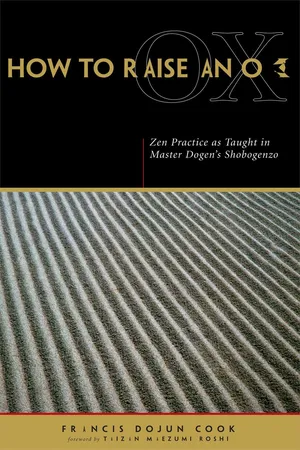
How to Raise an Ox
eBook - ePub

How to Raise an Ox

Zen Practice as Taught in Master Dogen's Shobogenzo

  1. 208 pages
  2. English
  3. ePUB (mobile friendly)
  4. Available on iOS & Android
eBook - ePub

How to Raise an Ox

Zen Practice as Taught in Master Dogen's Shobogenzo

About this book

The writings of Zen master Dogen are among the highest achievements not only of Japanese literature but of world literature. Dogen's writings are a near-perfect expression of truth, beautifully expressing the best of which the human race is capable. In this volume, Francis Cook presents ten selections from Dogen's masterwork, the Shobogenzo, as well as six of his own essays brilliantly illuminating the mind of this peerless master.

Frequently asked questions

Yes, you can cancel anytime from the Subscription tab in your account settings on the Perlego website. Your subscription will stay active until the end of your current billing period. Learn how to cancel your subscription.
No, books cannot be downloaded as external files, such as PDFs, for use outside of Perlego. However, you can download books within the Perlego app for offline reading on mobile or tablet. Learn more here.
Perlego offers two plans: Essential and Complete
  • Essential is ideal for learners and professionals who enjoy exploring a wide range of subjects. Access the Essential Library with 800,000+ trusted titles and best-sellers across business, personal growth, and the humanities. Includes unlimited reading time and Standard Read Aloud voice.
  • Complete: Perfect for advanced learners and researchers needing full, unrestricted access. Unlock 1.4M+ books across hundreds of subjects, including academic and specialized titles. The Complete Plan also includes advanced features like Premium Read Aloud and Research Assistant.
Both plans are available with monthly, semester, or annual billing cycles.
We are an online textbook subscription service, where you can get access to an entire online library for less than the price of a single book per month. With over 1 million books across 1000+ topics, we’ve got you covered! Learn more here.
Look out for the read-aloud symbol on your next book to see if you can listen to it. The read-aloud tool reads text aloud for you, highlighting the text as it is being read. You can pause it, speed it up and slow it down. Learn more here.
Yes! You can use the Perlego app on both iOS or Android devices to read anytime, anywhere — even offline. Perfect for commutes or when you’re on the go.
Please note we cannot support devices running on iOS 13 and Android 7 or earlier. Learn more about using the app.
Yes, you can access How to Raise an Ox by Eihei Dogen,Francis Dojun Cook in PDF and/or ePUB format, as well as other popular books in Theology & Religion & Eastern Philosophy. We have over one million books available in our catalogue for you to explore.
Translations
dp n="76" folio="64" ?dp n="77" folio="65" ?
Fukan Zazengi
GENERAL RECOMMENDATIONS FOR DOING ZAZEN
THE WAY is essentially perfect and exists everywhere. There is no need either to seek or to realize the Way. The Truth that carries us along is sovereign and does not require our efforts. Need I say that it excels this world? Who can believe that the expedient of [mirror-]wiping is necessary?32 Essentially the Truth is very close to you; is it then necessary to run around in search of it?
Even so, if there is the slightest error, there is a gulf as great as that between heaven and earth. If so much as a thought of agreeable or disagreeable arises, one becomes confused. For instance, you may feel proud in your comprehension, or you may feel prosperous in achieving satori. Even if you acquire satori in the blink of an eye, acquire the Way and enlighten your mind, feel as if you could assault heaven itself, and charge into the Dharma as if on a mere saunter, you may shortly lose the way of dropping off the body.
How may one perceive the traces of that one of Jetavana [the Buddha], who saw all things as they truly are with his own enlightened nature and yet still did zazen for six years? The fame of that one of Shao-lin Temple [Bodhidharma], who transmitted the mind-seal [from India] and who for nine years still sat facing a wall [in meditation], is being transmitted even now. If this was true of the ancient worthies, people of today must also exert themselves.
For this reason, you must suspend your attempts to understand by means of scrutinizing words, reverse the activity of the mind that seeks externally, and illuminate your own true nature. Mind and body will fall off spontaneously, and your original face will be revealed. If you wish to achieve such a thing, you must exert yourself in this matter at once.
For zazen, you will need a quiet room. Eat and drink in moderation. Forget about the concerns of the day and leave such matters alone. Do not judge things as good or evil, and cease such distinctions as “is” and “is not.” Halt the flow of the mind, and cease conceptualizing, thinking, and observing. Don’t sit in order to become a Buddha, because becoming a Buddha has nothing to do with such things as sitting or lying down.
In the room that you use for zazen, spread some thick mats and place a firm, round pillow on them. Sit on the pillow with your legs crossed either in the full-lotus position or in the half-lotus position. This means [in the full-lotus position] that you place your right foot on your left thigh, and your left foot on your right thigh. In the half-lotus position, you just put your left foot on your right thigh [with the right foot on the mat beneath your left thigh].
Loosen your clothes and belt and arrange them neatly. Next, place your right hand [palm up] on top of your left foot, and place your left hand [palm up] in the palm of your right hand. Both thumb tips should touch slightly.
Now regulate your posture so you are sitting properly, leaning neither to the left nor to the right, forward nor backward. [Looked at from the side], your ears and shoulders should be in a straight line, and from the front, your nose will be in a direct line with your navel. Place your tongue against the roof of your mouth, and keep your teeth and lips closed. Your eyes should be [slightly] open, and your breathing should be soft.
When your body posture is correct, breathe in and out [once, deeply]. Sway left and right [several times] and then sit firmly and resolutely. Think about the unthinkable. How do you think about the unthinkable? Non-thinking. These are the essentials of zazen.
That which we call zazen is not a way of developing concentration. It is simply the comfortable way. It is practice that measures your satori to the fullest, and is in fact satori itself. It is the manifestation of the ultimate reality, and in it you will no longer be trapped as in a basket or a cage. If you understand my meaning [and do zazen correctly], you will be like a dragon who has reached the water, or like a tiger who trusts in the mountain where he dwells. Know that the true Dharma itself is present [in zazen], and that confusion and distraction are eradicated right from the beginning.
When you get up from zazen, move quietly and slowly. Do not make violent movements. When we contemplate the past, we observe that transcending both the sacred and the profane, or such things as dying while in zazen or while standing [which the old Zen masters did] came about through this power. It is even more difficult to explain with words and analysis how the ancient masters could seize upon the crucial moment that brought about satori in a disciple by pointing a finger, using the tip of a pole, a needle, or a mallet, and give encouragement with the hossu,33 a fist, a stick, or a shout. How can supernatural powers explain practice and enlightenment? Practice and enlightenment are the majestic deportment of the body, beyond the sights and sounds [of this world]. What can they be other than the Dharma, which is prior to understanding and analysis?
Such being the case, there is no question here at all of being intelligent or stupid, nor is there any difference between the quick-witted and the dull. If you exert yourself single-mindedly, this is practicing the Way itself. Practice and realization leave not a trace of impurity, and the person who advances in the Way is an ordinary person.
This world or other worlds, India or China, all equally preserve the seal of the Buddha.34 One who adheres exclusively to the customs of Zen practices zazen only, doing nothing but sitting resolutely on the ground. You may hear of ten thousand distinctions or a thousand differences,35 but just do zazen earnestly and make an effort in the Way. You don’t need to abandon your own sitting place and just for amusement go to some other country. If you err by a single step, you lose the Way.
Now you have acquired the essential, which is a human form. Do not pass over from the light to the shadow [by pursuing other matters]. Take care of this essential instrument of the Buddha’s Way. Could you really be content with a spark from a stone [when the blazing sun is shining]? And that is not all; your body is like dew on the grass, your life is as brief as a flash of lightening. Momentary and vain, it is lost in an instant.
I entreat you who practice in the splendid tradition of Zen, do not grope around as if you were in a group of blind people or be in doubt when you see a real dragon.36 Just persevere in the simple Way that has been indicated for you so directly. Value those beings who have perfected their own practice and have finished what was to be done. If you conform to the satori of all the Buddhas, you will become an heir to the samādhi of all the [Zen] ancestors. If you practice like this for a long time, you will surely become like them. The precious treasury will open its doors all by itself, and the treasure will be yours to use as you wish.
dp n="81" folio="69" ?
Keisei Sanshoku
“THE SOUNDS OF THE VALLEY STREAMS, THE FORMS OF THE MOUNTAINS”
MANY ARE the Buddha ancestors who have transmitted the supreme Way to the highest enlightenment and who have taught the methods of practice. The traces still remain of our predecessors who broke their bones in learning the Way. You should study the life of the second ancestor Hui-k’o, who cut off his arm in order to receive the teaching,37 and do not be attached to even a single hair of your body. When you finally achieve the various liberations by doing zazen, everything that was withheld from you in the past because of your discriminating mind will be revealed to you at once. I do not understand this instant of revelation of reality, nor do you, nor does anyone else. Not even the Buddha vision sees it, so how can it be fathomed by human calculation?
There once lived a Chinese upāsaka [a lay adherent to the Buddhist precepts] named Tung-p’o,38 whose family name was Su and whose official name was Shih. His courtesy name was Tzu-chan. He was a very famous man, a real dragon in the ocean of letters. It was said he studied the dragons and nagas39 in the ocean of Buddhism. He sported freely in the depths [like a dragon] and rose up to the high-piled clouds. Once, on Mount Lu, he was enlightened when he heard the sound of valley streams flowing in the night. He composed a verse and presented it to Ch’an master Ch’ang Tsung. This was the verse:
The sounds of the valley streams are his long, broad tongue;
The forms of the mountains are his pure body.
At night I heard the myriad sutra verses uttered
How can I relate to others what they say?
When he presented this verse to Master Tsung, the master approved it. He was the Ch’an master Chao-hsüeh Ch’ang-tsung, who was the Dharma heir of Ch’an master Huang-lung Hui-nan. Hui-nan himself was the Dharma heir of the Ch’an master Tz’u-ming Ch’u-yüan.
Later, this upāsaka met the Ch’an master Liao-yuan and at that time Liao-yuan gave him the precepts and robes. Thereafter, the upāsaka always put on the robes and did zazen. He respectfully presented Liao-yuan with a sash decorated with priceless jewels. People of that time said, “This sort of thing is not possible for ordinary people like us to do, he must be very unusual.”
This being the case, how can we not consider the circumstances of Su Tung-p’o’s hearing the valley streams and becoming enlightened to be a great benefit extending down to the present time? It is deplorable, but it is almost as if something were lacking in people’s ability to understand the expounding of the Dharma in these boundless manifestations of the Buddha’s body. If this revelation of the Buddha’s body is the preaching of the Dharma, then how are people today to see the forms of the mountains and hear the sounds of the streams? Do they hear them as a single phrase? Are they just half a phrase? Are they myriad verses? How regrettable it is that there are sounds and forms in the streams and mountains that we cannot understand. Yet it is a matter for delight that we have the opportunity to acquire the proper conditions for experiencing the Way in these sounds and forms. The sounds are never stilled, and the forms never cease to exist. This being so, does this mean that when they are revealed the body is near and that when they are obscured the body is not near? Is it the whole body, or is it just half the body? Because the springs and autumns of former times have completely become mountains and streams, you cannot detect them in mountains and streams; because the times prior to this night have completely become mountains and streams, you can see them as mountains and streams. Today’s bodhisattva who practices the Way should begin his study of the Way in the knowledge that the mountains flow and the stream does not flow.
As for that night when Su Tung-p’o was enlightened, he had, on the previous day, asked Master Tsung about the saying that even insentient things preach the Dharma, and while he had had no really significant experience from hearing the master’s explanation, later that night when he heard the sound of the streams, it was as if the billowing waves touched the high heavens. When this occurred, the sound astonished the upāsaka. But should we say it was the sound of the streams, or should we rather say that it was the sound of Master Chao-hsüeh flowing? Perhaps Chao-hsüeh’s discussion of the idea of insentient things preaching the Dharma had not really stopped, but was imperceptibly mixed with the night sounds of the valley streams. Now, someone might say that it was “a single water,” or that it was the “ocean of oneness,” the oneness of the water of the Dharma and the water of the streams. If we examine the matter closely, was it the upāsaka who became enlightened, or was it the mountains and streams that became enlightened? If anyone has eyes to see, then certainly anyone is able to see the long, broad tongue and the pure body.
When the Ch’an master Hsiang-yen Chih-hsien was practicing the Way under Ch’an master Ta-wei Ta-yuan, Ta-wei said to him, “You are quite bright and seem to understand everything. Without any reliance on your learned treatises, from what you were before your parents conceived you, give me one single phrase concerning the Way.” Try as he might, Hsiang-yen could think of nothing to say in reply. He regretted his mind and body, and try as he might to find some clue in the books he had accumulated over many years, it was no use at all. So he set fire to all his precious books, saying, “A picture of rice cakes does not satisfy one’s hunger. I will no longer seek the Buddha Way in this present life, and my practice will be that of serving the rice to practicing monks.” So saying, he spent many years as a meal-serving monk. The expression, “meal-serving monk” refers to someone who serves rice and other food to the monks who are practicing.
One day, he spoke to Ta-wei: “My mind is clouded and I cannot speak; say something that will help me, Chief Priest!” Ta-wei replied, “Unfortunately, I cannot say anything for you; maybe later you would resent my having done so.” So the years passed, and Hsiang-yen traveled to Wu-tang Mountain searching for the whereabouts of the national teacher, Ta-cheng, and near the hermitage of the national teacher he built a grass hut, which he used as his own hermitage. He planted some young bamboo nearby and spent his days in its vicinity. One day, when he was sweeping the path, a pebble flew and struck the bamboo, and when he heard the sound it made, he suddenly had a great satori. He bathed and purified himself and then went back to Ta-wei Mountain, where he burned incense and paid homage. Then he spoke to Ta-wei: “Ta-wei, Chief Priest, if you had answered me on that other occasion, how would this thing ever have been possible? The depths of your kindness exceed even those of my own parents.” Then he composed this verse:
With one blow of the pebble, everything I knew perished.
What more is there for me to practice, what more to subdue?
Moving about with ease, I conduct myself in the ancient Way,
And I never feel any despondency.
Wherever I am, I leave no traces;
It is conduct apart from forms and sounds.
Those in all the directions who are enlightened in the Way
Are called “those of the highest talent.”
He presented this verse to Ta-wei, who said, “How thorough
you are.”
The Ch’an master Ling-yuan Chih-ch’in had practiced the Way for thirty years. Once, while wandering in the mountains, he paused at the foot of a hill and saw a place where people lived. It was spring, and when he saw the blossoms on a peach tree, he immediately became enlightened. He composed a verse and presented it to Ta-wei. It said,
For thirty years I have sought the swordsman.
How many times have the leaves fallen, or the branches broken off?
After once seeing the peach blossoms,
There is nothing more to doubt.
Ta-wei said, “The person who enters the Way according to circumstances never again regresses.” In other words, Ta-wei acknowledged the enlightenment. Is there ever anyone who is not enlightened by circumstances? Does anyone ever slide back? I am not saying this only with regard to Chih-ch’in. Chih-ch’in finally became the Dharma heir of Ta-wei. If the forms of the mountains are not the pure body [of the Buddha], how could this happen?
A certain monk who was a disciple of Chang-sha Ching-ch’en asked his master, “How can I unite the mountains, streams, and great earth within myself?” The master replied, “How can you unite yourself with the mountains, streams, and great earth?” What is meant here is that if you are not anything other than your true self, then whether you speak of yourself being united with the mountains, streams, and great earth, [or of the mountains, streams, and great earth being united with yourself], there should not be any obstacles between what unites and that with which one is united.
Huang-chao, who was also known as the great master Hui-chüeh of Lang-yeh Mountain, was a distant descendant of Nan-yüeh’s Dharma. Once, Tzu-hsüan, who gave lectures on the scriptures, asked him, “How does our pure, original nature instantly become mountains, streams, and the great earth?” Hui-chao tried to instruct him by asking him in turn, “How does our pure, original nature instantly give birth to the mountains, streams, and the great earth?” You must understand with regard to this that you should not mistakenly think that the original, pure nature as mountains, rivers, and the great earth, is the natural world of mountains, rivers, and the great earth. The person who just fumbles around in the sutras and has never heard this until now does not understand that the mountains, rivers, and the great earth are mountains, rivers, and the great earth. You must understand that if the pure nature, your original face, is not the forms of the mountains and the sounds of the valley streams, then the expounding of the Dharma by holding up a flower did not occur, nor did the acquiring of the marrow [of Bodhidharma] by Hui-k’o. Because of the merits of the forms of the mountains and sounds of the streams, the world and all sentient beings in it become enlightened at the same time, and like the Buddha himself, see the morning star and become all the Buddhas.
These sentient beings I have been speaking of were superior people whose spirit in seeking the Dharma was extremely profound. We of the present time ought to use their acts as models for our own efforts. In the present time, also, true followers of the Way should arouse such a spirit without regard for fame and fortune. In this time and place, so far from the land of Shakyamuni, true seekers of the Way are rare indeed. They are not non-existent, but one does not encounter them often. Even though they take their home departure and seem to be divorced from worldly ways, they are just using the Way in order to acquire fame and fortune. It is shameful, deplorable, that they traffic in evil karma because they have ignored time. Sometime, they may abandon [their wickedness] and acquire the Way. For the time being, they do not love the true dragon, even though they may meet a true teacher. Shakyamuni referred to such fellows as pitiful examples of humanity. Such fellows have reached this end because of the evil karma of previous lives. Because they lack the spirit to seek the Dharma for the sake of the Dharma, when they do meet the true dragon, they doubt whether they are seeing the real dragon, and are destroyed by it. Because their mind and body, their bone and flesh, have never been born in accordance with the Dharma, they consequently are not fit for the Dharma, and they cannot accept it. This Way has been transmitted from master to disciple over and over in this manner down to the present time.
Nowadays the mind that seeks satori is considered to be merely an ancient dream. How pitiful it is that, although you are born on the mountain of jewels, you do not know of these jewels or see them. How will you ever acquire the Dharma treasure? If you arouse the thought of seeking enlightenment, then afterward, even if you are born among the six destinations or in one of the four manners, the cause of your rebirth will be the practices and vows you made for the sake of satori. Thus, as it is said that just as the days and months of former times are all e...

Table of contents

  1. Title Page
  2. Foreword
  3. Preface
  4. Introduction
  5. Essays
  6. Translations
  7. Notes
  8. Genealogy Charts of Chinese Zen Masters
  9. Index
  10. About the Translator
  11. Wisdom Publications
  12. Copyright Page