
- 256 pages
- English
- ePUB (mobile friendly)
- Available on iOS & Android
eBook - ePub
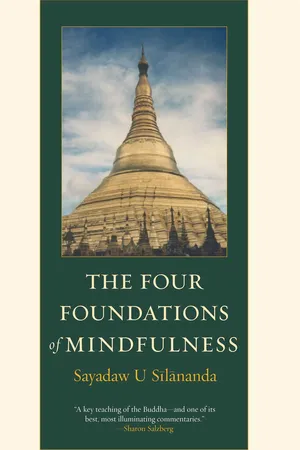
The Four Foundations of Mindfulness
About this book
An absolute essential of Buddhist thought and practice.In addition to practitioners of Insight meditation, those who engage in other meditation forms such as dzogchen, mahamudra, and zazen will find that The Four Foundation of Mindfulness provides new means of understanding how to approach and deepen their own practices.The entire Great Discourse is included here, coupled with a beautifully clear commentary from the great scholar-yogi, Venerable U Silananda.
Frequently asked questions
Yes, you can cancel anytime from the Subscription tab in your account settings on the Perlego website. Your subscription will stay active until the end of your current billing period. Learn how to cancel your subscription.
At the moment all of our mobile-responsive ePub books are available to download via the app. Most of our PDFs are also available to download and we're working on making the final remaining ones downloadable now. Learn more here.
Perlego offers two plans: Essential and Complete
- Essential is ideal for learners and professionals who enjoy exploring a wide range of subjects. Access the Essential Library with 800,000+ trusted titles and best-sellers across business, personal growth, and the humanities. Includes unlimited reading time and Standard Read Aloud voice.
- Complete: Perfect for advanced learners and researchers needing full, unrestricted access. Unlock 1.4M+ books across hundreds of subjects, including academic and specialized titles. The Complete Plan also includes advanced features like Premium Read Aloud and Research Assistant.
We are an online textbook subscription service, where you can get access to an entire online library for less than the price of a single book per month. With over 1 million books across 1000+ topics, weāve got you covered! Learn more here.
Look out for the read-aloud symbol on your next book to see if you can listen to it. The read-aloud tool reads text aloud for you, highlighting the text as it is being read. You can pause it, speed it up and slow it down. Learn more here.
Yes! You can use the Perlego app on both iOS or Android devices to read anytime, anywhere ā even offline. Perfect for commutes or when youāre on the go.
Please note we cannot support devices running on iOS 13 and Android 7 or earlier. Learn more about using the app.
Yes, you can access The Four Foundations of Mindfulness by U Silananda, Ruth-Inge Heinze in PDF and/or ePUB format, as well as other popular books in Theology & Religion & Eastern Philosophy. We have over one million books available in our catalogue for you to explore.
Information
PART ONE

Commentary

INTRODUCTION
T he Great Discourse on the Foundations of Mindfulness is important for those who practice vipassanÄ meditation, because all instructions are directly or indirectly based on the teachings contained in this sutta. If you are serious about vipassanÄ meditation, you should know this sutta well.
We will use a revised translation of the original MahÄ Satipaį¹į¹hÄna Sutta. I call it ārevised,ā because I used several translations and selected whatever was agreeable to me and combined my findings with my own translation. In this way, I came up with a somewhat new translation.
This exposition is based on the ancient commentary, the subcommentary, and the Burmese commentary written by the Venerable MahÄsi Sayadaw. At the invitation of the Insight Meditation Society in Barre, Massachusetts, he visited this country in 1979. The Venerable was a famous and successful meditation teacher, perhaps the best known Burmese meditation teacher in the West. Before he passed away in August 1982, he gave many talks on vipassanÄ meditation and other discourses of the Buddha. Records of his talks and some of his books have been translated into English and published in this country.
The full name of this sutta in PÄli is MahÄ Satipaį¹į¹hÄna Sutta, which means The Great Discourse on the Foundations of Mindfulness or The Setting Up of Mindfulness. In this sutta, the Buddha gave instructions on how to practice satipaį¹į¹hÄna vipassanÄ meditation. There are four foundations of mindfulness explained in this sutta and also in this exposition.
Whenever Buddhists undertake something, they first pay homage to the Buddha, the Dhamma, and the Sangha. Therefore, whenever people write about a Buddhist topic, they first put the words, NamÅ Tassa Bhagavato Arahato SammÄ-sambuddhasa, at the beginning of the book. We also will begin with āHomage to the Blessed One, the Worthy One, the Fully Enlightened One.ā
Thus have I heard.1
Every sutta in the Collection of Discourses is introduced with the words, āThus have I heard.ā The word āIā refers to the Venerable Änanda who was the first cousin of the Buddha. Änanda was his permanent personal attendant for twenty-five years. It is said that he was of the same age as the Buddha because he was born on the same day as the Buddha. The Buddha taught for forty-five years, but for the first twenty years had no permanent attendant. Sometimes, one bhikkhu served as his attendant and, at other times, another bhikkhu. From the twenty-first year onward, however, the Venerable Änanda became his permanent personal attendant.
It is interesting to learn how the Venerable Änanda was given this position. In the twenty-first year of his teaching, the Buddha announced that he needed a personal attendant. When he made this announcement, many of his chief disciples sought to become his attendant, but the Buddha refused to accept them. Then, in the assembly, some bhikkhus asked Änanda to offer his services to the Buddha, but Änanda said, āIf Buddha really wants me to be his attendant he will ask me himself. I will not offer myself unless I am asked by the Buddha.ā So, eventually, the Buddha asked Änanda to become his attendant.
Änanda replied that he would accept the position only on certain conditions. There were actually eight conditions. The first four we call ārejections,ā and the other four āacquisitions.ā The four rejections were: First, the Buddha must not give him any robes for being his attendant. Second, he should not be given good food received by the Buddha for being his attendant. Third, he should not be asked to stay in the Buddhaās fragrant cell or have a separate cell for himself. Fourth, if anyone should invite the Buddha to visit his house and partake of food, Änanda should not be included in the invitation. These are the āfour conditions of rejection.ā Venerable Änanda did not want in any way to materially benefit from his relationship to the Buddha.
The āfour conditions of acquisitionā are: First, he must have the right to accept any invitation for the Buddha, and, once Änanda had accepted the invitation, the Buddha must go to the place he had been invited to. Second, he should be permitted to bring to the Buddha, at any time, a devotee coming from a far-off place. Third, he should be permitted to place before the Buddha any problem as soon as it arose. If Änanda had any doubt about anything, he should have the right to approach the Buddha and ask him to remove his doubts. That means, Buddha must always be available to him to answer any questions. Fourth, the Buddha should repeat to him any discourse delivered in Änandaās absence. This last point is very important with respect to the words, āThus have I heard.ā
Because the Buddha agreed to these conditions and the Venerable Änanda became the personal attendant to the Buddha on these conditions, the Buddha always repeated to Änanda any discourse delivered in the latterās absence. Therefore, the Venerable Änanda knew all the discourses and teachings delivered by the Buddha.
In the book called Expositor, the commentary to the first book of the Abhidhamma, you find these words of praise for the Venerable Änanda:
The Elder was indeed of wide experience, a student of the Three Pitakas [the Three Divisions of the Buddhaās Teachings]. He could learn, recite and preach, as he stood [that means, in one standing, he could learn, recite or preach] one thousand and five hundred stanzas or sixty thousand feet, as easily as though he were gathering creepers and flowers. That was the Elderās single course of exposition. None but the Buddha was able to teach or attain the distinction of teaching, so that this Elder knew the actual text word by word.2
Änanda possessed a quick and keen intellect. The Buddha was the only person who could teach him, so, the Venerable Änanda came to know everything the Buddha taught.
These words, āThus have I heardā and the following were uttered by the Venerable Änanda at the First Buddhist Council, held about three months after the death of the Buddha. After the Buddha had died, the chief disciple, MahÄ Kassapa, decided to hold a council and chose five hundred arahats to participate. At that council, all teachings of the Buddha were collected and carefully scrutinized. Only when the assembly was satisfied that these were the authentic teachings of the Buddha were these teachings admitted to the collection and recited in unison. Reciting in unison indicated that the teachings had been accepted unanimously by the council to be the authentic words of the Buddha. Because, at that time, it was not the practice to write down the Buddhaās teachings, they were recorded by way of recitation.
Not only were the teachings recorded, but they were also classified into different collections. The most popular division was the division into Pitakas. These are the Vinaya Pitaka, the Division of Rules for Monks and Nuns; the Sutta Pitaka, the Division of Discourses; and the Abhidhamma Pitaka, the Division of the Higher Teachings. The MahÄ Satipaį¹į¹hÄna Sutta belongs to the Division of Discourses.
The collection of the teachings thus recorded was handed down from generation to generation by word of mouth until about five hundred years after the death of the Buddha when they were written down on palm leaves in Sri Lanka.
As mentioned above, at the First Buddhist Council, the Venerable MahÄ Kassapa raised questions about the authenticity of the Buddhaās teachings and there were two venerables who answered the questions of MahÄ Kassapa. For the Vinaya, Division of Rules for Monks and Nuns, the Venerable Upali gave the answers and it was the Venerable Änanda who responded for the suttas, the 84,000 sermons the Buddha taught.
When the Venerable MahÄ Kassapa posed questions about the MahÄ Satipaį¹į¹hÄna Sutta, the Venerable Änanda gave answers beginning with āThus have I heard.ā By saying, āThus have I heard,ā the Venerable Änanda effaced himself and bore witness to the Master. He finalized the Buddhaās words and established the Dhamma as the guide. When disclaiming that the words were his own invention and disclosing that he had previously heard these words uttered by the Buddha, he annihilated lack of faith in this Dhamma in gods and human beings. He instilled excellence of faith by saying: āThis was acquired by me in the very presence of the Blessed One, so there need be neither hesitation nor doubt about meaning or ideas or phrases or syllables.ā
Thus have I heard: At one time, the Blessed One was living in Kurus, where there was a market town of the Kurus, named Kammasadamma.
āAt one timeā: Although the exact time of delivering this sutta was known to the Venerable Änanda, for the sake of brevity he only said, āat one time.ā For him it is a saving of labor, perhaps, but for us who belong to another era, it is definitely not a blessing, because we do not know exactly when this sutta was taught, at what time and in what year. If the Venerable Änanda had mentioned all these details, we would be able to put this sutta and all the other teachings in chronological order, but now we cannot. We can only guess which suttas might have been taught before the others.
āIn Kurusā: āKurusā is the name of a district or a small country in India. The PÄli term requires that the word be in the plural. Originally, it was the name of the people who first inhabited this district. When the name later was applied to the district, the plural lingered on. So, although the district was only one, in PÄli it requires the plural, hence, kurusu, āin Kurus.ā
āWhere there was a market town of the Kurus, named Kammasadammaā: The market town was called āKammasadammaā because a cannibal king by the name of Kammasapada (āSpeckled Footā) was subdued there. Some preferred the spelling āKammÄsadhammaā and explained that it was called ākammÄsa-dhammaā because the traditional virtuous practice of the Kurus had been stained (kammasa).
There the Blessed One addressed the bhikkhus thus: āBhikkhus,ā and the bhikkhus replied, āVenerable Sir.ā And the Blessed One spoke as follows:
The Buddha always addressed the monks as bhikkhus. Bhikkhus were the excellent persons who accepted his teachings. But this does not mean that, in saying bhikkhus, other people who were not monks were not addressed. Moreover, anybody who accepts and follows the Buddhaās teachings can be called a bhikkhu (in PÄli). So, when the Buddha said, ābhikkhus,ā it must be understood that monks as well as nuns and lay people are addressed.
This is the only way, bhikkhus, for the purification of beings, for the overcoming of sorrow and lamentation, for the disappearance of pain and grief, for reaching the Noble Path, for the realization of nibbÄna, namely, the Four Foundations of Mindfulness.
āThis is the only wayā: To understand the explanation you should know the PÄli words for the āonly way.ā It is, in PÄli, ekÄyana. Eka means āone,ā and Äyana means āway,ā so ekÄyana means āone way.ā The word ekÄyana is explained in five ways.
The first explanation is that it is the āsingle wayā that does not branch off. There are no branches in this way, so that you can follow this way with assurance from beginning to deliverance.
The second explanation is that this way has to be trodden āalone.ā In practicing meditation, you are making this journey alone, without companions. You may be in a group, you may b...
Table of contents
- Cover
- Title
- Copyright
- Contents
- Foreword
- Part One: Commentary
- Part Two: The Great Discourse on the Foundations of Mindfulness
- Part Three: Meditation Instructions
- Notes
- Glossary
- Select Bibliography
- Index