
- 352 pages
- English
- ePUB (mobile friendly)
- Available on iOS & Android
eBook - ePub
About this book
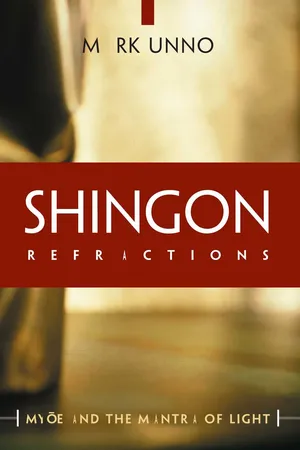
Shingon Buddhism arose in the eighth century and remains one of Japan's most important sects, at present numbering some 12 million adherents. As such it is long overdue appropriate coverage. Here, the well-respected Mark Unno illuminates the tantric practice of the Mantra of Light, the most central of Shingon practices, complete with translations and an in-depth exploration of the scholar-monk Myoe Koben, the Mantra of Light's foremost proponent.
Frequently asked questions
Yes, you can cancel anytime from the Subscription tab in your account settings on the Perlego website. Your subscription will stay active until the end of your current billing period. Learn how to cancel your subscription.
At the moment all of our mobile-responsive ePub books are available to download via the app. Most of our PDFs are also available to download and we're working on making the final remaining ones downloadable now. Learn more here.
Perlego offers two plans: Essential and Complete
- Essential is ideal for learners and professionals who enjoy exploring a wide range of subjects. Access the Essential Library with 800,000+ trusted titles and best-sellers across business, personal growth, and the humanities. Includes unlimited reading time and Standard Read Aloud voice.
- Complete: Perfect for advanced learners and researchers needing full, unrestricted access. Unlock 1.4M+ books across hundreds of subjects, including academic and specialized titles. The Complete Plan also includes advanced features like Premium Read Aloud and Research Assistant.
We are an online textbook subscription service, where you can get access to an entire online library for less than the price of a single book per month. With over 1 million books across 1000+ topics, weāve got you covered! Learn more here.
Look out for the read-aloud symbol on your next book to see if you can listen to it. The read-aloud tool reads text aloud for you, highlighting the text as it is being read. You can pause it, speed it up and slow it down. Learn more here.
Yes! You can use the Perlego app on both iOS or Android devices to read anytime, anywhere ā even offline. Perfect for commutes or when youāre on the go.
Please note we cannot support devices running on iOS 13 and Android 7 or earlier. Learn more about using the app.
Yes, you can access Shingon Refractions by Mark Unno in PDF and/or ePUB format, as well as other popular books in Philosophy & Buddhism. We have over one million books available in our catalogue for you to explore.
Information

PART I
INTELLECTUAL AND CULTURAL HISTORY: REFRACTIONS OF LIGHT
CHAPTER 1
THE MANTRA OF LIGHT, A TEXTUAL HISTORY
On abogya beiroshanÅ makabotara mani handoma jimbara harabaritaya un. The TathÄgata Vairocana, seeking to bestow the mudrÄ and the sanmaya, gave primacy to the divine dharma entity [i.e., cosmic truth, realized teachings]. Even though there are the various sins of all of the ten evils, five transgressions, and four grave offenses from past [lives], their embers are all extinguished. If sentient beings attain this baptism and mantra anywhere so that it reaches their ears just two, three, or seven times, then all evil hindrances will be eliminated.
If sentient beings commit the various sins of the ten evils, five transgressions, and four grave offensesāso many as grains of dust needed to fill the worldāthen their bodies will be broken, their lives will come to an end, and they will fall into the various evil paths [of rebirth]. [In that case], one should empower the sand with the mystic power of the mantra by repeating it one hundred and eight times, and the sand should be sprinkled on the corpses in the charnel grounds or on the graves of the deceased; one should sprinkle the sand wherever one encounters them.
The deceased may be in hell, in the realm of hungry ghosts, of angry gods, or of beasts. However, they will attain the body of light according to the needs of time and circumstance by means of the mystic power of the sand of the divine power of the Mantra of Light.... The karmic retribution of their sins will be eliminated, they will discard their suffering bodies, and they will go to the Western Land of Bliss [the Pure Land of Amida]. They will be reborn in the lotus blossom [of Amida] and will not fall back until they attain bodhi [awakening].
After many years and many moons come to pass, sentient beings may be stricken with frailty, illness, and myriad other hardships. This is the karmic retribution suffered by the ill due to [their actions in] past lives. If one sits before the stricken for one, two, or three days and intones this mantra one thousand and eighty times every day with a full voice, then the hindrance of illnesses from past karma will be destroyed.
Suppose one is tortured by a demonic spirit and loses oneās voice. Although one does not say a word, if one holds the hand of someone who maintains the mantra and rubs her face one hundred and eight times...then one can get rid of [the spirit]....
āBukong zhuansuo piluzhenafa daguanding guangming zhenyan jing
(Sutra of the Mantra of Light of the Baptism of Vairocana of the Unfailing Rope Snare)
ā¢
BACKGROUND OF INDIAN, CHINESE, AND KOREAN SOURCES
ALTHOUGH THE PRESENT STUDY focuses on the Mantra of Light as advocated and practiced by MyÅe in thirteenth-century Japan, the story would be incomplete without an account of its prior history.
There is much that remains unknown about the early practice of this mantra, but we do know that there were Sanskrit texts in India, probably composed in the first few centuries of the Common Era, advocating the practice of intoning the mantra and empowering the sand for the purpose of extinguishing sins, curing illnesses, and leading the practitioner to birth in the Pure Land of Amida. This cosmic buddha originated as two separate but closely associated buddhas in India: AmitÄbha, the Buddha of Infinite Light, and AmitÄyus, the Buddha of Eternal Life. Each cosmic buddha has his own buddha-land (buddhakį¹£etra). Amidaās is known as the Land of Bliss (Skt. SukhÄvatÄ«) or the Western Pure Land, so named because, in the cosmology of the MahÄyÄna, the buddha-land of Amida is trillions of miles to the west of the buddha-land of ÅÄkyamuni, which is our own solar system, as it were.
The origins of the myths that appear in MahÄyÄna sutras are often rather murky. There are those who are apt to think that the sutras are pure expressions of religious experience, and while such experience may be important and even central in some cases, we now know that many sutras were compiled over several centuries, reflecting various influences including climate, geography, culture, local politics, and indigenous pre-Buddhist beliefs. This does not preclude reading any given sutra as a sacred text in its entirety, with its own internal religious logic. However, the fact that a sutra may be interpreted in terms of its religious meaning should not lead blindly to any conclusions about its historical origins. Mythic or cosmic figures such as Amida and Maitreya, the future buddha, often appeared as secondary or auxiliary figures in sutras featuring other cosmic deities before they had their own sutras, perhaps like backup singers to a famous band before they made it big and had their own marquee shows.
Some agreement has emerged that, prior to the compilation of the first sutras devoted to AmitÄbha worship, the symbology of AmitÄbha is likely to have been shaped by ancient Indo-Iranian religion, in particular the Zoroastrian cult of Mithra, a deity of light closely associated with Sun worship, and eclectic cultural influences from the Kushan empire, which extended from central Asia and northern India into present-day Iran.1 Scriptures describing practices leading to birth in the SukhÄvatÄ« (Land of Bliss) of AmitÄbha belong among the earliest layers of Indian MahÄyÄna and pre-MahÄyÄna sutra literature2; the first full-fledged sutras devoted to AmitÄbha (and AmitÄyus) appeared around the beginning of the Common Era, the first being the Larger SukhÄvatÄ«vyÅ«ha SÅ«tra and the Smaller SukhÄvatÄ«vyÅ«ha SÅ«tra.3
Much of the research on the literature and practices of AmitÄbha worship has centered on Chinese and Japanese developments, where the majority of extant documents are found. The first extant record of AmitÄbha worship in Indian society is located in the pilgrimage reports of the Chinese monk Huizhi (d. 748)4, made long after practices had developed in the South Asian subcontinent. When Huizhi inquired about the most expedient means of seeing the Buddha, the reply he received was that he should seek the Pure Land.
As little as we know about practices involving AmitÄbha in early Indian Buddhism, there are some important clues. As Gregory Schopen suggests, there is evidence of the dissemination of SukhÄvatÄ« as a religious goal independent of any actual AmitÄbha-centered religious community of practice. This is indicated by a number of references to SukhÄvatÄ« in Sanskrit sutras that do not focus on AmitÄbha worship.5 Schopen hypothesizes that, in such instances, the idea of SukhÄvatÄ« functioned symbolically in a manner similar to that of Mount Sumeru, center of the MahÄyÄna universe. That is, such images have symbolic resonances that were useful in amplifying themes common to early Indian MahÄyÄna as a whole. Thus, Mount Sumeru signifies imperturbability, and SukhÄvatÄ«, as the land of enlightenment, exalts the virtues and rewards of the bodhisattva path to awakening.6 In addition to this, there may have been some sectarian concerns at work; due to the early prevalence of this cult, it may have been advantageous for various schools or cultic centers to incorporate the idea of SukhÄvatÄ«.7 In any case, the fact that references to AmitÄbha and SukhÄvatÄ« appeared independently in sacred literature predating the Pure Land sutras indicates their popularity.
Sutras expounding the Mantra of Light were a part of this history of devotion to AmitÄbha and SukhÄvatÄ«. The Sutra of the Mantra of Light of the Baptism of Vairocana of the Unfailing Rope Snare translated by Amoghavajra specifically advocates birth in the SukhÄvatÄ« of AmitÄbha and not other buddha-lands, even though the main deity is actually MahÄvairocana. This shows that practices leading to birth in AmitÄbhaās SukhÄvatÄ« constituted a substantial cult, so much so that worshippers of other buddhas and bodhisattvas may have sensed a need to recognize and institute practices leading to the realm of AmitÄbha even for their own followers.
It is difficult to go beyond anything more than speculation on this point, but the spread of devotional cults is an important issue because MyÅe appears to have advocated the Mantra of Light in part as a response to the rising popularity of Pure Land devotionalism in medieval Japan. MyÅe further complicated the picture by interpreting the available scriptural sources to convey an ambiguous or ambivalent message: According to the sutras he cites, the Mantra of Light is especially effective for attaining birth in Amidaās Pure Land, but he interpreted the scriptural sources to mean that one is not limited to birth there; the Mantra of Light could equally be the means to birth in other buddhalands. This ambiguity or ambivalence is manifest in MyÅeās own life. Although he devoted much of the last decade of his life to composing works on the Mantra of Light, he himself sought birth in yet another realm, the Tuį¹£ita Heaven of Bodhisattva Maitreya, the future buddha, which he rarely mentions in connection with the Mantra of Light. The problem of the relation between the Mantra of Light, MyÅeās own practice, and that of his religious community is one to which I will later return.
Although there are no Sanskrit texts extant, sutras describing the Mantra of Light practice can be counted among this early group of Indian MahÄyÄna scriptures. From the Chinese translations it appears that there were one or two primary sources, which were eventually redacted into several versions. From these texts it is also apparent that the basic elements of the ritual were in place from quite early on: the specific powers of the mantra, the use of the sand...
Table of contents
- Cover
- Title
- Contents
- Acknowledgments
- Abbreviations
- Notes on Romanization and Translation
- Introduction
- Part I: Intellectual and Cultural History: Refractions of Light
- Part II: Translations: Illuminating Texts
- Appendixes
- Bibliography
- Index
- Wisdom Publications
- Copyright