Opening the Eye of New Awareness
eBook - ePub

Opening the Eye of New Awareness

  1. 160 pages
  2. English
  3. ePUB (mobile friendly)
  4. Available on iOS & Android
eBook - ePub

Opening the Eye of New Awareness

About this book

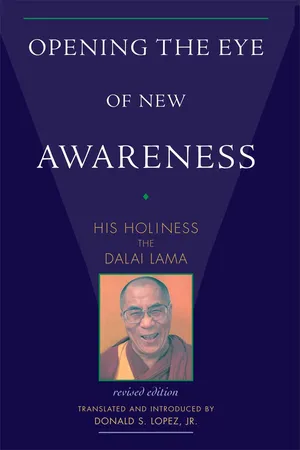
Opening the Eye of New Awareness is a succinct, thorough overview of the doctrines of Buddhism as they have been practiced for a thousand years in Tibet. The Dalai Lama here discusses the need for religious practice and the importance of kindness and compassion. Originally written for Tibetan lay people, this was the Dalai Lama's first book on Buddhist philosophy to appear in English, and Prof. Lopez's new introduction places these teachings in their proper historical context. This is an invaluable handbook for both personal use and academic study of the Buddhist path."Written for both Tibetan and Western readers, Opening the Eye of New Awareness is the Dalai Lama's first religious work. It is not an edited transcript of public lectures, but is His Holliness' own summation of Buddhist doctrine and practice. Completed in 1963, just four years after his escape from Tibet and four years after completing his religious education, it is a work of consummate scholarship by a twenty-seven year-old geshe, wise beyond his years. Nowhere in his many subsequent works does one find a more clear and concise exposition of the essentials of Buddhist thought. Indeed, all of His Holinesss's many publications are in some sense commentaries on this first book."
Frequently asked questions

Yes, you can cancel anytime from the Subscription tab in your account settings on the Perlego website. Your subscription will stay active until the end of your current billing period. Learn how to cancel your subscription.
At the moment all of our mobile-responsive ePub books are available to download via the app. Most of our PDFs are also available to download and we're working on making the final remaining ones downloadable now. Learn more here.
Perlego offers two plans: Essential and Complete
  • Essential is ideal for learners and professionals who enjoy exploring a wide range of subjects. Access the Essential Library with 800,000+ trusted titles and best-sellers across business, personal growth, and the humanities. Includes unlimited reading time and Standard Read Aloud voice.
  • Complete: Perfect for advanced learners and researchers needing full, unrestricted access. Unlock 1.4M+ books across hundreds of subjects, including academic and specialized titles. The Complete Plan also includes advanced features like Premium Read Aloud and Research Assistant.
Both plans are available with monthly, semester, or annual billing cycles.
We are an online textbook subscription service, where you can get access to an entire online library for less than the price of a single book per month. With over 1 million books across 1000+ topics, we’ve got you covered! Learn more here.
Look out for the read-aloud symbol on your next book to see if you can listen to it. The read-aloud tool reads text aloud for you, highlighting the text as it is being read. You can pause it, speed it up and slow it down. Learn more here.
Yes! You can use the Perlego app on both iOS or Android devices to read anytime, anywhere — even offline. Perfect for commutes or when you’re on the go.
Please note we cannot support devices running on iOS 13 and Android 7 or earlier. Learn more about using the app.
Yes, you can access Opening the Eye of New Awareness by Dalai Lama, Donald S. Lopez,Jeffrey Hopkins in PDF and/or ePUB format, as well as other popular books in Teología y religión & Filosofía oriental. We have over one million books available in our catalogue for you to explore.
OPENING THE EYE OF NEW AWARENESS
1 The Need for Religious Practice
HOMAGE TO THE FINAL EXALTED WISDOM that thoroughly differentiates phenomena.
At this time of the twentieth century, an era of chemicals and weaponry, during the phase of ethics among the ten periods of five hundred years1 in the teaching of the Fourth Leader, the Teacher [Shakyamuni Buddha],2 external material culture is continuing to develop and expand. At the same time, there is a vital need for similar development and expansion of inner awareness and attitude.
In the Buddhist way, internal culture is achieved through thought and meditation, and for that it is necessary to know how to think and how to meditate. Therefore, in accordance with the merit of those beings who do not have the leisure to study the great texts, profound and full of impact, I write this Opening the Eye of New Awareness, a treatise of few words, primarily for easy comprehension, to expand the illumination of the wisdom that thoroughly differentiates phenomena.
All beings are equal in that they want happiness and do not want suffering. This does not apply merely to us humans of higher intelligence; all, even dumb and obscure creatures, from the tiniest insect on up, only want happiness and do not want even a little suffering. [2] Therefore, everyone, ourselves and others, must find a method to cause happiness to arise and to keep suffering from arising. Without such a method, it is impossible for happiness to arise and for suffering to be eliminated merely by waiting with the great hope, “How nice it would be if I had happiness and did not have suffering!” Consequently, we must establish the causes from which happiness arises and abandon the bases of the arising of suffering.
The means for establishing the causes of benefit and happiness and for abandoning harm and suffering cannot be gained by any other way as fully and completely as through religious practice. Through religious practice we are able to bring about happiness and alleviate suffering in this and many future lifetimes—this life, the next life, the life after that, and so forth. [3]
Even in the case of this lifetime, nothing surpasses religious practice for bringing about happiness and abandoning suffering. For example, in cases of physical illness there is a very great difference between those who have and those who have not understood the essential meaning of religion in terms of the degree of their mental and physical suffering and their ability to alleviate that suffering. A person who has not understood the essentials of religious practice and who does not have any of the ambrosia of the magnificent impact of such practice has, in addition to strong feelings of physical sickness, the great suffering of not being able mentally to bear that illness; he or she is troubled by both physical and mental suffering with no opportunity for happiness.
However, if a person has understood the essential points of religious practice, he or she voluntarily accepts suffering with the thought, for example, that it is the fruit of bad deeds accumulated in the past and, seeing that suffering is the nature of cyclic existence, wishes to take responsibility for previous actions. As a result, mental suffering does not arise, and because it does not arise, the power of internal thought is able to suppress the external pain and suffering of the physical sickness. [4] The reason for this is that between body and mind, the mind controls the body, so to speak, and the body is as if under the control of the mind. Therefore, mental feelings of pleasure and pain are stronger [than those of the body].
Similarly, some people who desire the happiness of riches accumulate and guard their wealth, incurring great physical and mental fatigue. They suffer initially from the inability to amass as much wealth as they had hoped for. Even after gaining some wealth, they suffer in the meantime from the inability to stop it from being stolen by others, being lost, or destroyed, being squandered, and the like. In the end, they suffer because no matter what they do, their wealth becomes the property of others, and they themselves must part from it forever. All such sufferings related to wealth and resources result from not having understood the essential topics of religious practice. When they are understood, one sees that all wealth is as essenceless as the dew on the tip of a blade of grass [which evaporates quickly at dawn] and, consequently, one does not undergo any of the sufferings that are associated with the wearying accumulation and guarding of wealth and [the suffering of] being separated from it against one’s wish. [5]
In the same way, when unpleasant words of abuse, blame, slander, and so forth, are spoken by others about oneself, there arises a suffering like being pierced in the heart with a thorn. However, if we understand the essential topics of religious practice, then we see that all of these are essenceless, like an echo, and even slight suffering does not arise, as if mindless matter had been abused.
Similarly, in this lifetime, the suffering of not subduing enemies, the suffering of not keeping friends, the suffering of others winning and oneself losing, the suffering from terrifying warfare and mutual hostility between nations, which destroys the happiness of countless beings—in short, all the hopes and fears based on gain and loss, happiness and unhappiness, all physical and mental pain whatsoever—are due either to not understanding religious practice or not putting it to use despite understanding it. [6]
If religion is understood and practiced, all this suffering can be eradicated. Why? All such suffering arises only in dependence on such things as pride, miserliness, jealousy, and the three—desire, hatred, and obscuration.
By pacifying and overcoming these faults [which are mainly mental] through the power of religious practice, one achieves knowledge of contentment as well as self-concern, concern for others’ opinion of you, and conscientiousness; body and mind remain constantly in pleasant tranquility, whereby unbearable suffering does not arise. Therefore, if we want happiness and pleasure in this life and do not want suffering, it is very important to understand the essential topics of religion and then implement them in practice.
Doing so, however, we should not be satisfied merely with happiness in this life. No matter how great the happiness of this life may be, it lasts only until death—not more than a hundred years, since no one lives much longer than that. [7] Future lives are journeys of greater length, and thus we must secure that long-range interest; we must work for the means of gaining happiness and alleviating suffering in future lifetimes. Furthermore, there is absolutely no way to achieve such happiness through techniques other than religious practice.
REBIRTH
Here in the context of explaining the need to secure the welfare of future births, let us consider the opinions of certain people who do not know about the doctrine of rebirth or who know a little about it but do not fully comprehend the reasons for it. It might occur to them that the present mind depends exclusively on the body and that because they do not directly witness former and future lifetimes, they do not exist. Their idea is that if something exists, it must be seen directly.
Or, they might think that the mind is produced in dependence on the body, that the body arises in dependence on the four great elements [earth, water, fire, and wind], and therefore that former lifetimes do not exist; they thus might conclude that at death the body turns into the four elements, and the mind turns into space, like a disappearing rainbow. [8] Hence, they conclude that it can not be said that there are subsequent lifetimes.
Among those who think that mental awareness depends on the body, there are some who think that the mind is of the nature of the body, like beer and its capacity to intoxicate; others think that mind is an effect of the body, like a lamp and its light; and still others think that the mind is a quality of the body, like a wall and a mural on it. Thus, they basically think that a mind that was just produced in this life need not have been produced from an earlier mind of similar type but rather is produced from mindless elements, which are of dissimilar type, as is the case, for example, with the power of intoxication from beer or fire from a magnifying glass—in other words, the arising of an effect that does not accord with its cause.
Similarly, some mistaken logicians observe that there is no one who makes peas round, sharpens thorns, or colors the eyes of a peacock’s feathers. They observe that there are uncharitable misers who become wealthy, murderers who live long lives, and so forth, and, therefore, they assert with bogus reasons that there is no such thing as the cause and effect of actions (las, karma) [carrying over from one lifetime to another]. [9] There are also some with meditative absorption (snyoms ’jug, samāpatti) who use clairvoyance to see that a certain person who was miserly in a former life is born into a wealthy home in the next life and, due to this, assert that although there are former and later lives, there is no cause and effect of actions. Also, there are some who achieve a concentration (bsam gtan, dhyāna) or formless absorption (gzugs...

Table of contents

  1. Cover
  2. Title
  3. Copyright
  4. Contents
  5. Preface to the Second Edition
  6. Technical Note
  7. Introduction
  8. An Overview of Tibetan Buddhism
  9. Opening the Eye of New Awareness
  10. Glossary
  11. Notes
  12. Bibliography of Works Cited
  13. Index