Natural Perfection
eBook - ePub

Natural Perfection

Longchenpa's Radical Dzogchen

  1. 300 pages
  2. English
  3. ePUB (mobile friendly)
  4. Available on iOS & Android
eBook - ePub

Natural Perfection

Longchenpa's Radical Dzogchen

About this book

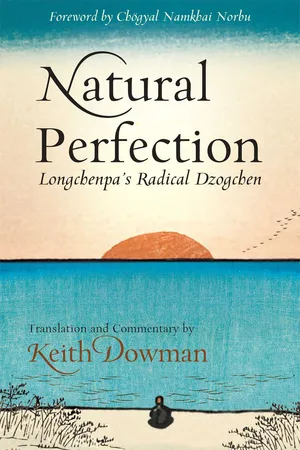
Dzogchen, or the "Great Perfection, " is considered by many to be the apex of Tibetan Buddhism, and Longchen Rabjam is the most celebrated of all the saints of this remarkable tradition. Natural Perfection presents the radical precepts of Dzogchen, pointing the way to absolute liberation from conceptual fetters and leading the practitioner to a state of pure, natural integration into one's true being.Transcending the Tibetan context or even the confines of Buddhist tradition, Longchen Rabjam delivers a manual full of practical wisdom. Natural Perfection is a shining example of why people have continued to turn to the traditions of Tibet for spiritual and personal transformation and realization. Keith Dowman's illuminating translation of this remarkable work of wisdom provides clear accessibility to the profound path of Dzogchen in the here-and-now.
Frequently asked questions

Yes, you can cancel anytime from the Subscription tab in your account settings on the Perlego website. Your subscription will stay active until the end of your current billing period. Learn how to cancel your subscription.
At the moment all of our mobile-responsive ePub books are available to download via the app. Most of our PDFs are also available to download and we're working on making the final remaining ones downloadable now. Learn more here.
Perlego offers two plans: Essential and Complete
  • Essential is ideal for learners and professionals who enjoy exploring a wide range of subjects. Access the Essential Library with 800,000+ trusted titles and best-sellers across business, personal growth, and the humanities. Includes unlimited reading time and Standard Read Aloud voice.
  • Complete: Perfect for advanced learners and researchers needing full, unrestricted access. Unlock 1.4M+ books across hundreds of subjects, including academic and specialized titles. The Complete Plan also includes advanced features like Premium Read Aloud and Research Assistant.
Both plans are available with monthly, semester, or annual billing cycles.
We are an online textbook subscription service, where you can get access to an entire online library for less than the price of a single book per month. With over 1 million books across 1000+ topics, we’ve got you covered! Learn more here.
Look out for the read-aloud symbol on your next book to see if you can listen to it. The read-aloud tool reads text aloud for you, highlighting the text as it is being read. You can pause it, speed it up and slow it down. Learn more here.
Yes! You can use the Perlego app on both iOS or Android devices to read anytime, anywhere — even offline. Perfect for commutes or when you’re on the go.
Please note we cannot support devices running on iOS 13 and Android 7 or earlier. Learn more about using the app.
Yes, you can access Natural Perfection by Lonchen Rabjam, Keith Dowman in PDF and/or ePUB format, as well as other popular books in Theology & Religion & Eastern Philosophy. We have over one million books available in our catalogue for you to explore.

image

I.1 The Disclosure of Absence

4. THE ABSENCE OF ALL CONCRETE REALITY

First let me tell you about “absence,”
the absence that is essentially emptiness:
in the super-matrix of pure mind that is like space
whatever appears is absent in reality.
Rigpa itself and everything appearing in its scope is utterly empty, lacking any identity, so with all proliferating projection and elaborating concepts undermined nothing ever comes into existence.
In the nirvana of indeterminate rigpa,
there is no proliferation, no substance or attribute.17
Despite appearances, form is emptiness and emptiness is form and there is no center inside nor any point of focus outside. The state of rigpa is unoriginated and there is no dualistic mind that proliferates ideas and creates an objective universe full of specific things.
image
The super-matrix of pure mind is the spaciousness of absence, likened to elemental space, in which material phenomena appear as intangible images of light:
image

5. A DEFINITIVE SIMILE FOR ABSENCE

In the universal womb that is boundless space
all forms of matter and energy occur as flux of the four elements,
but all are empty forms, absent in reality:
all phenomena, arising in pure mind, are like that.
Though all phenomena of all worlds seem to come into existence and perish in the sphere of elemental space, their appearance has no basis and thus, insubstantial, they are said to be absent. The four elements (earth, water, fire, and air) that comprise whatever appears, because they are not composed of discrete particles, never actually come into being and, therefore, never cease to exist. Neither the supported phenomena, therefore, nor the space that underlies them are actually established as existent. Likewise, both rigpa and all experience appearing within its scope are absent in reality.
Just as all worlds, inner and outer,
all forms of matter and energy,
the animate and inanimate,
all contained in space, are absent,
so is the vast field, the super-matrix of pure mind,
with its buddhas and sentient beings,
its crucible and contents, environment and life-forms:
in immaculate reality everything is nondual,
free of inflating or deflating conceptual projection.18
image
The hologram is a salient simile for our worlds and galaxies projected into cosmic space. Atoms, elemental components of matter, construed as “supports” of materiality are said to be “absent” insofar as their indivisibility precludes their application as building blocks of more complex structures. Once the fundament is discovered to be absent, “supported” material structures—planets, continents, animate and inanimate, flora and fauna—must also be absent.19 The absence of the material realm is employed as a simile for the status of all phenomena in the moment. The fundament, “the support,” is the pure space of rigpa, while the “supported” is all experience appearing in its scope. The ontological status of absent phenomena is nondual, free of all evaluation in terms of existence or nonexistence. This existential indeterminacy is termed “absence” or “ineffability.”
Rather than referring to the utter nonexistence of all and everything, absence implies the lack of any exterior or interior identity:
image

6. APPEARANCES IN THE NATURE OF MIND ARE INHERENTLY ABSENT

Magical illusion, whatever its form,
lacks substance, empty in nature;
likewise, all experience of the world, arisen in the moment,
unstirring from pure mind, is insubstantial evanescence.
All experience of the world and our outer environment and the beings that partake of its energy, the crucible and its contents, no matter what the form, all is as empty of inherent existence as a hallucination of a world with illusory inhabitants—nothing can move outside the space of pure rigpa.
No experience of the world, inner or outer, no matter or energy,
no event in samsara or nirvana, ever leaves pure mind.20
image
Pure rigpa is our original face of awareness where phenomena appear up-front like empty reflections on the surface of a mirror. Things seem to be there; but actually they are not. Everything is a momentary illusion in the nature of mind; nothing whatsoever stirs from or differs from the nature of mind.
Pure mind is the all-inclusive space-time of the dream—of both samsara and nirvana:
image

7. INSUBSTANTIAL APPEARANCES NEVER STIR FROM THE SCOPE OF TH...

Table of contents

  1. Cover
  2. Title
  3. Copyright
  4. Dedication
  5. Contents
  6. Foreword by Chögyal Namkhai Norbu
  7. Translator’s Introduction
  8. The Treasury of Natural Perfection
  9. The Commentary to the Treasury of Natural Perfection
  10. Prologue
  11. The Concise Exposition
  12. The Extensive Exposition
  13. The Conclusion of the Treatise
  14. Notes
  15. Appendix I: The Tibetan Text and Quotations
  16. Appendix II: Index of Similes
  17. Appendix III: List of Tibetan Headings in the Auto-commentary
  18. Glossary
  19. Selected English Bibliography
  20. Other Titles by Keith Dowman
  21. About the Author