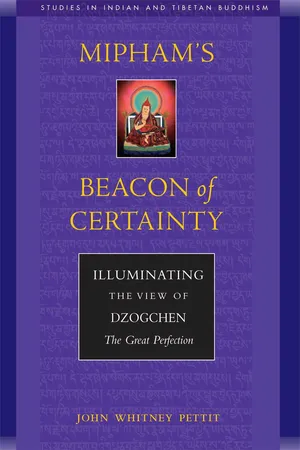
Mipham's Beacon of Certainty
eBook - ePub

Mipham's Beacon of Certainty

Illuminating the View of Dzogchen, the Great Perfection

  1. 592 pages
  2. English
  3. ePUB (mobile friendly)
  4. Available on iOS & Android
eBook - ePub

Mipham's Beacon of Certainty

Illuminating the View of Dzogchen, the Great Perfection

About this book

For centuries, Dzogchen - a special meditative practice to achieve spontaneous enlightenment - has been misinterpreted by both critics and malinformed meditators as being purely mystical and anti-rational. In the grand spirit of Buddhist debate, 19th century Buddhist philosopher Mipham wrote Beacon of Certainty, a compelling defense of Dzogchen philosophy that employs the very logic it was criticized as lacking. Through lucid and accessible textural translation and penetrating analysis, Pettit presents Mipham as one of Tibet's greatest thinkers.
Frequently asked questions

Yes, you can cancel anytime from the Subscription tab in your account settings on the Perlego website. Your subscription will stay active until the end of your current billing period. Learn how to cancel your subscription.
At the moment all of our mobile-responsive ePub books are available to download via the app. Most of our PDFs are also available to download and we're working on making the final remaining ones downloadable now. Learn more here.
Perlego offers two plans: Essential and Complete
  • Essential is ideal for learners and professionals who enjoy exploring a wide range of subjects. Access the Essential Library with 800,000+ trusted titles and best-sellers across business, personal growth, and the humanities. Includes unlimited reading time and Standard Read Aloud voice.
  • Complete: Perfect for advanced learners and researchers needing full, unrestricted access. Unlock 1.4M+ books across hundreds of subjects, including academic and specialized titles. The Complete Plan also includes advanced features like Premium Read Aloud and Research Assistant.
Both plans are available with monthly, semester, or annual billing cycles.
We are an online textbook subscription service, where you can get access to an entire online library for less than the price of a single book per month. With over 1 million books across 1000+ topics, we’ve got you covered! Learn more here.
Look out for the read-aloud symbol on your next book to see if you can listen to it. The read-aloud tool reads text aloud for you, highlighting the text as it is being read. You can pause it, speed it up and slow it down. Learn more here.
Yes! You can use the Perlego app on both iOS or Android devices to read anytime, anywhere — even offline. Perfect for commutes or when you’re on the go.
Please note we cannot support devices running on iOS 13 and Android 7 or earlier. Learn more about using the app.
Yes, you can access Mipham's Beacon of Certainty by John W. Pettit in PDF and/or ePUB format, as well as other popular books in Theology & Religion & Eastern Philosophy. We have over one million books available in our catalogue for you to explore.
1. Introduction
1.1. Mipham Rinpoche and the Beacon of Certainty
ALL MAJOR RELIGIONS have witnessed philosophical and theological transformations in their belief systems.4 This is an exploration of the critical philosophical approach of Tibetan scholasticism,5 especially its traditions of interpretation of Madhyamaka (Middle Way) philosophy, and the relationship of Madhyamaka to Dzogchen (rdzogs chen) or the Great Perfection, one of the most important and controversial Tibetan traditions of mystical philosophy and meditation practice. In particular, this study examines Mipham Rinpoche’s polemical defense of the Nyingma school’s Great Perfection teaching, his resolution of philosophical controversies that are historically associated with the Great Perfection, and the epistemological and gnoseological6 distinctions he uses to that end. Mipham’s brilliance in this undertaking, and his (historically speaking) privileged perspective on the similar efforts of those previous scholars renowned as emanations of the Buddha of Wisdom MaƱjuśrī—Rong zom Paį¹‡įøita (11th–12th century), Sakya (Sa skya) Paį¹‡įøita (1182–1231), Klong chen rab ’byams (1308–1362), and Tsongkhapa (1357–1419)—certainly merits his inclusion alongside the doctrinal systembuilders (shing rta, literally, ā€œcharioteersā€) of India and Tibet.7
Comparison, contrast, and reconciliation of different philosophical positions have always figured in Buddhist literature, especially in philosophical commentaries (śāstra, bstan bcos) written by Indian and Tibetan scholars. Comparative philosophical analysis is also important in Great Perfection literature, where it serves both pedagogical and polemical purposes. The main source for this study is a short verse text of recent origin, the Precious Beacon of Certainty (Nges shes rin po che’i sgron me), which utilizes both critical comparison and hermeneutical rapprochement in the service of teaching and defending the Great Perfection system of the Nyingma school.
The Beacon’s author, Mipham Rinpoche (’Jam mgon ’Ju Mi pham rnam rgyal, (1846–1912), was one of the greatest scholars of the Nyingma (rnying ma) or ā€œold schoolā€ of Tibetan Buddhism. Mipham’s ā€œrootā€ teacher (mÅ«laguru, rtsa ba’i bla ma), the incomparable scholar and visionary ’Jam dbyangs mKhyen brtse dbang po (1820–1892), entrusted him with the preservation of the Great Perfection teaching. Mipham was an indefatigable scholar, debater, and meditator. He mastered the major scholastic traditions of Tibetan Buddhism and composed commentaries and treatises (śāstras, bstan bcos) based upon them, and during numerous meditative retreats, he cultivated a profound experience of the Vajrayāna practices taught in both the older and newer traditions of Tibetan Buddhism. He also debated extensively with adherents of Tibet’s quintessential scholastic tradition, the Gelug (dge lugs). In the course of his writings, and due in no small part to these debates, Mipham developed the philosophical traditions of the Nyingma school to an unprecedented level of sophistication. The Beacon is a relatively short text, but it is a very complete expression of Mipham’s integrated approach to philosophy and meditative practice.8
1.2. Outline
The four chapters following the introduction provide biographical, historical, cultural, and philosophical contexts for the translations of the Beacon and its commentary. Chapter 2 introduces Mipham’s life, his most important writings, and the extraordinary teachers of the Eclectic Movement (ris med) of the nineteenth century who taught and inspired him. Chapter 3 identifies the philosophical and religious aspects of Indian Buddhism that were most significant in the development of Tibetan Buddhism and introduces the philosophical perspective (darśana, lta ba) of the Buddhist tantras. Chapter 4 discusses the historical, cultural, and literary background of the Nyingma and Great Perfection traditions and places the Beacon and its author in their intellectual-historical context. Chapter 5 examines hermeneutical, epistemological, and gnoseological issues that are points of contention for Mipham, Gelug scholars, and exponents of the extrinsic emptiness (gzhan stong) theory. Chapter 6 concerns the philosophical issues addressed in the Beacon. The first, third, and fourth topics, which exemplify Mipham’s interpretations of philosophical theory (darśana, lta ba), meditative practice (bhāvanā, bsgom pa), and ultimate reality (paramārthasatya, don dam pa’i bden pa) in the Nyingma and Great Perfection traditions, are the focus of discussion here. Chapter 7 considers the significance of Mipham’s thought—its unique contributions, historical significance, and relevance for understanding the roles and relationships of texts, reason, and personal experience in religious traditions.
Chapters 8 and 9 contain complete translations of the Beacon and its commentary by Khro shul ’Jam rdor (KJ). Chapter 10 is a translation of Mipham’s short text on extrinsic emptiness, The Lion’s Roar Proclaiming Extrinsic Emptiness, followed by explanatory diagrams and tables and a glossary.
1.3. The Beacon of Certainty: Context and Significance
1.3.1. Dialectical Philosophy and the Great Perfection
The Madhyamaka9 or Middle Way school of Indian Buddhist thought was first expounded by the philosopher Nāgārjuna (c. 1st–2nd centuries C.E.), who systematized the Buddhist philosophy of emptiness (śūnyatā, stong pa nyid) of the PrajƱāpāramitā (Perfection of Wisdom) scriptures and applied it as a rigorous critique of the metaphysical categories of Buddhist and non-Buddhist schools. Essentially, the Mādhyamika teaching of emptiness is that all phenomena (dharmāḄ) ultimately (paramārtheṇa, don dam par) have no intrinsic reality, no status as things-in-themselves. Conventionally (vyavahāreṇa, tha snyad du) they are dependently originated (pratÄ«tyasamutpanna, rten cing ’brel bar ’byung ba) and conceptually designated (prajƱapta, rten nas gdags pa). Because Mādhyamika logic negates any philosophical position that assumes an independent, self-existent entity through rigorous exhaustion of logical alternatives, Madhyamaka may be said to be the Buddhist dialectical philosophy par excellence. Madhyamaka employs exhaustive critical analysis to induce rational certainty ([vi]niścaya, nges pa or nges shes), which, combined with meditation, leads to enlightenment.
While Madhyamaka is concerned primarily with establishing the nature of reality, the tradition of Buddhist logic, pramāṇa, is concerned with how we know reality, in both its ultimate and relative senses. To that end the Buddhist logicians Dignāga (5th–6th centuries) and DharmakÄ«rti (6th–7th centuries) elaborated what would become the most elegant and influential system of valid cognitions (pramāṇāḄ) to appear in India. Unlike their Buddhist and non-Buddhist predecessors, they taught that sources of knowledge (pramāṇā) could be assimilated to two types: direct perception (pratyakį¹£a) and inference (anumāna). In addition they established the various subtypes of these valid cognitions, as well as the complex relationships between them, in the contexts of ordinary life, the Buddhist path, and forensic debate. Later Indian and Tibetan philosophers incorporated the Pramāṇa system of Dignāga and DharmakÄ«rti into their Madhyamaka exegeses. The Madhyamaka and Pramāṇa systems of Indian Buddhist philosophy are the most important sources for Mipham Rinpoche’s discussion of critical philosophy in the Beacon, and are discussed in chapter 3.
The Great Perfection teaching belongs to the tantric traditions of Buddhism. The revealed scriptures of esoteric Buddhism, or tantras, are understood to comprise a soteriological approach or conveyance (yāna), the Vajrayāna or ā€œIndestructible Vehicle.ā€ Though Vajrayāna is firmly rooted in the philosophical conventions of critical Buddhist philosophy, its texts epitomize mystical or speculative philosophy. Vajrayāna meditation is based on the principle of the immanence of ultimate reality, which is a coalescent continuum (tantra, rgyud) of gnosis (jƱāna, ye shes) and aesthetic form (rÅ«pa, gzugs, snang ba). Exoteric Buddhist scriptures (sÅ«tras) know this immanence as buddha nature or tathāgatagarbha, while tantric scriptures describe it as the pervasive, unfabricated presence of divine form, divine sound, and gnosis-awareness. For this reason, tantric meditation does not invoke the logical syllogisms of dialectical philosophy. Instead, it uses special methods that force normal conceptuality to subside and cause gnosis to manifest spontaneously.
In the Nyingma tradition, the Great Perfection is regarded as the most direct and powerful way to access the continuum (tantra, rgyud) of reality, and as the highest form of Vajrayāna practice. Though the personal instructions of a qualified teacher of the Great Perfection may on very rare occasions suffice to induce ā€œsudden enlightenmentā€ in a disciple, it has generally been practiced alongside more conventional forms of Buddhism. ā€œGreat Perfectionā€ variously indicates the texts (āgama, lung) and oral instructions (upadeśa, man ngag) that indicate the nature of enlightened wisdom (rdzogs chen gyi gzhung dang man ngag), the verbal conventions of those texts (rdzogs chen gyi chos skad), the yogis who meditate according to those texts and instructions (rdzogs chen gyi rnal ’byor pa), a famous monastery where the Great Perfection was practiced by monks and yogis (rdzogs chen dgon sde), and the philosophical system (siddhānta, grub mtha’) or vision (darśana, lta ba) of the Great Perfection.
The Great Perfection teaches that reality (dharmatā, chos nyid) is not an object of verbal expression or conceptual analysis. Reality and enlightenment are identical; in the final analysis ā€œbeingā€ and ā€œknowingā€ are the same. If one truly knows, there is no need to discuss or analyze philosophically how one knows, or what one knows. Great Perfection meditation is described as effortless, free of concepts (vikalpa, rnam par rtog pa) and subtle distortions (prapaƱca, spros pa); in this way it conforms to the radical immanence of ultimate reality taught in Vajrayāna. In the Beacon and elsewhere Mipham argues that all philosophical views, including the Great Perfection, are resolved in the principle of coalescence (yuganaddha, zung ’jug). Though coalescence is defined in different ways in different philosophical contexts, in essence it is the nonduality of conventional (saṃvį¹›tisatya, kun rdzob bden pa) and ultimate realities (paramārthasatya, don dam pa’i bden pa). Coalescence is the immanence of ultimate reality, which in Madhyamaka philosophy is known as the inseparability of saṃsāra and nirvāṇa.
In advocating nonconceptual meditation the Great Perfection might seem to contradict the Mādhyamika method of discerning reality through critical analysis and the contemplative enhancement of rational certainty (nges pa or nges shes) that analysis makes possible. The Great Perfection (and certain other traditions which have been practiced in Tibet, including Ch’an) has often been criticized by Tibetan scholars who thought it utterly incompatible with the critical philosophical approach of Madhyamaka. This perceived incompatibility is based on the assumption that the very different philosophical views (darśana, lta ba) and practical methods (upāya, thabs) that typify the subitist approach of the Great Perfection and the gradualist approach of the Madhyamaka cannot both access ultimate meaning (paramārtha, don dam). Mipham’s writings suggest that this perceived contradiction reflects a one-sided (phyog lhung) or impoverished (nyi tshe ba) understanding of the Mādhyamika philosophical view. In the Beacon, certainty (nges shes) mediates the causal connection between theory (lta ba in the critical philosophical context) and gnostic vision (lta ba as experience that is the result of successful practice), and between soteric methods (upāya, thabs) and the ultimate reality that those methods reveal (upeya, thabs byung). Thus, the Beacon teaches that certainty belongs to both reason and experience, to ordinary consciousness and sublime gnosis, and to Madhyamaka as w...

Table of contents

  1. Cover
  2. Title
  3. Copyright
  4. Table of Contents
  5. Foreword by His Holiness Penor Rinpoche
  6. Acknowledgments
  7. Source Abbreviations
  8. Annotations, Diacritics, and Transcription
  9. 1. Introduction
  10. 2. The Life and Works of Mipham Rinpoche
  11. 3. Indo-Tibetan Buddhism: An Overview
  12. 4. Tibetan Buddhist Traditions and the Great Perfection
  13. 5. Philosophical Distinctions of Mipham’s Thought
  14. 6. The Beacon of Certainty
  15. 7. Ascertainment (nges pa) and Certainty (nges shes): Some Conclusions
  16. 8. The Translation of the Beacon of Certainty
  17. 9. Stainless Light: A Commentary on the Beacon of Certainty
  18. 10. The Lion’s Roar Proclaiming Extrinsic Emptiness
  19. Appendix: Explanatory Diagrams and Tables
  20. Glossary of Technical Terms
  21. Notes
  22. Bibliography of Works Consulted
  23. Index