
- 288 pages
- English
- ePUB (mobile friendly)
- Available on iOS & Android
eBook - ePub
About this book
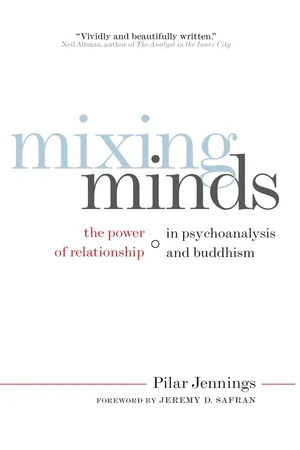
"We cannot find ourselves, or be ourselves, alone." - from Mixing Minds Mixing Minds explores the interpersonal relationships between psychoanalysts and their patients, and Buddhist teachers and their students. Through the author's own personal journey in both traditions, she sheds light on how these contrasting approaches to wellness affect our most intimate relationships. These dynamic relationships provide us with keen insight into the emotional ups and downs of our lives - from fear and anxiety to love, compassion, and equanimity. Mixing Minds delves into the most intimate of relationships and shows us how these relationships are the key to the realization of our true selves.
Frequently asked questions
Yes, you can cancel anytime from the Subscription tab in your account settings on the Perlego website. Your subscription will stay active until the end of your current billing period. Learn how to cancel your subscription.
At the moment all of our mobile-responsive ePub books are available to download via the app. Most of our PDFs are also available to download and we're working on making the final remaining ones downloadable now. Learn more here.
Perlego offers two plans: Essential and Complete
- Essential is ideal for learners and professionals who enjoy exploring a wide range of subjects. Access the Essential Library with 800,000+ trusted titles and best-sellers across business, personal growth, and the humanities. Includes unlimited reading time and Standard Read Aloud voice.
- Complete: Perfect for advanced learners and researchers needing full, unrestricted access. Unlock 1.4M+ books across hundreds of subjects, including academic and specialized titles. The Complete Plan also includes advanced features like Premium Read Aloud and Research Assistant.
We are an online textbook subscription service, where you can get access to an entire online library for less than the price of a single book per month. With over 1 million books across 1000+ topics, weâve got you covered! Learn more here.
Look out for the read-aloud symbol on your next book to see if you can listen to it. The read-aloud tool reads text aloud for you, highlighting the text as it is being read. You can pause it, speed it up and slow it down. Learn more here.
Yes! You can use the Perlego app on both iOS or Android devices to read anytime, anywhere â even offline. Perfect for commutes or when youâre on the go.
Please note we cannot support devices running on iOS 13 and Android 7 or earlier. Learn more about using the app.
Yes, you can access Mixing Minds by Pilar Jennings in PDF and/or ePUB format, as well as other popular books in Psychology & Eastern Philosophy. We have over one million books available in our catalogue for you to explore.
Information
1
a personal journey through buddhism and psychoanalysis
AFTER THE YOUNG PRINCE Siddhartha Gautama experienced enlightenment under the Bodhi tree some 2,500 years ago, he made no initial effort to translate his psychospiritual awakening into language. Having moved beyond the realm of discursive thought, he felt strongly that its very depth and complexity could not be adequately articulated. One could argue that his first challenge as an awakened being, a buddha, was to bring his altered consciousness back into relationship with those still awaiting enlightenment. Others wanted to know about this purported awakening, which was so dramatic as to change the very nature of his lived experience until his passing some forty-five years later.
After six days of silent meditation following six years of asceticism that had left him so malnourished as to be nearly dead, he had turned the swords of Mara, the embodiment of evil and delusion, into flowers. With unfettered composure, he had tolerated the seductive dance of Maraâs beautiful daughters, responding with neither aversion nor grasping. He had seen into the nature of the mind, with its profound struggle to find solid ground in which to cultivate a lasting identity.
Perhaps most importantly, the Buddha realized that relief from suffering is not a miraculous achievement unique to him, but our common birthright. What we most need is readily available to all by virtue of our very being. Contrary to his earlier views, turning our backs on the secular world in order to forsake all earthly pleasures misses the mark. Nor are we doomed to give in to the pull of desire, losing our awakened birthrightâour purest state of mind untouched by negative emotionâto the undertow that is perpetual grasping. There is a Middle Way, and he had experienced this for himself after a lifetime of living in both extremes. When asked if he might explicate this experience so that others could benefit from his insight, he was at first disinclined. It seemed to Siddhartha Gautama, the historical Buddha Shakyamuni, so named for being a sage (muni) of the Sakya clan to which his family belonged, that his internal explorations and ensuing realizations defied language. The transformation he had undergone was experiential, not theoretical. But after forty-nine days had passed and he was asked again by Brahma, the mythical chief of the three thousand worlds, if he might try for the sake of those with a readiness to hear his life-altering insight, he agreed. Thus began the transmission of Buddhist teaching, the giving of the Buddhaâs wisdom from one awakened being to another.
As we fast-forward to the early twenty-first century urban milieu in which I write, transmission from teacher to student remains a primary vehicle through which students learn the Buddhaâs spiritual, psychological, and philosophical teachings. Over the course of many years as a Buddhist practitioner, I have come to know that the relationship between Eastern and Western teachers and their primarily lay Western students can either facilitate or impede the successful transmission of the Buddhaâs teachings.
I have discovered both from personal experience and from the Buddhaâs example that this particular spiritual path does not typically progress toward the psychospiritual liberation that it promises outside the context of intimate, one-to-one, human relationship. The intimacy between teachers and their students acts as a kind of gestational container for the many challenges and gifts an authentic and committed Buddhist path ensures. It is potentially a place of dyadic creativityâa relationship that sparks discoveryâwhere sacred spiritual lessons may pass between two people with living psyches through which the Dharma is processed and integrated.
The Buddha modeled this relational path for the many who would seek his transformed relationship to reality. Before he began his first teaching, known as the first turning of the wheel of Dharma, which would spawn a new religious paradigm throughout the East and the West, he first sought his primary Hindu ascetic teachers in order to share with them the nature of his experience (Dalai Lama, 1995, pp. 9-14; Ray, 1994). After having done so, it was time to seek his original spiritual companions. These five ascetics had joined the twenty-nine-year-old Siddhartha Gautama after his initial departure from his childhood palace and from his wife and young son. They were his devoted students until he called into question the asceticism that had endangered his life through chronic starvation. When he began to move toward the Middle Way of spiritual practice, they lost faith in his mentorship and left. The separation, however, would be short-lived. After the Buddhaâs awakening under the Bodhi tree and his ensuing decision to share this experience with others, he sought their company in preparation for his very first teaching. Legend has it that they were so struck by his transformation, the joyful and steadfastly placid presence that was readily apparent, that they prepared his seat, lovingly washed his feet, and listened to what was the first of over 84,000 teachings that would follow. These companions became the first members of the Sangha, or community committed to following the Buddhaâs path.
Two centuries would pass before the Buddhadharma was recorded. During this time it was established as a religious tradition transmitted (offered and received) within the teacher/student pair. Eventually the Buddhaâs teachings were passed on through two main streams, one oral tradition and one written, referred to as the dharmadhara, or âholders of teachingâ (Cleary, 1994, p. 5). In the Western, postmodern setting in which I have come to practice Buddhism, both streams continue to be practiced. But despite the abundance of incisive literature available to those who wish to study Buddhist teachings, most committed practitioners of Buddhism eventually find themselves in relationships with teachers who transmit their own particular understanding and experience of the original Dharma. For this reason, the interpersonal dynamics of the teacher/student relationship drive my wish to discern what is most helpful to contemporary lay Westerners in their efforts to integrate the Buddhadharma into increasingly complex lives. If the studentâs (and the teacherâs) life experience and understanding of self and identity have changed over the past 2,500 years, I wonder how contemporary teachers are adapting the Dharma and transmitting it to students so that it can be received and woven into our lives.
My curiosity about how the studentâs psychic anatomy and spiritual needs may change depending upon their particular life circumstance has been shared by others since the very inception of Buddhist teaching. Historians have suggested that as the Buddha lay dying in his eightieth year, he told his faithful attendant Ananda that his followers could alter the Vinaya, a system of 250 rules governing monastic life, changing or dispensing with the less foundational rules to meet their changing needs (Fields, 1992, p. 9). The ripple effect of this instruction would have a powerful impact on the evolution of the Buddhaâs path.
During the First Council (ca. 480 BCE), held to clarify doctrine and discipline after the Buddhaâs passing, Ananda relayed this instruction to the five hundred monks gathered. There was disagreement over which of these rules could rightly be considered less foundational, which resulted in a decision to simply leave the teachings untouched. But during the Second Council (ca. 386 BCE), a group of monks felt that the monastic rules should indeed be altered to fit the specific circumstances of their sociocultural milieu. These monks, now numbering ten thousand or more, were eventually expelled from the initial order and formed their own order, which evolved into the various schools of Mahayana Buddhism (the vehicle of universal salvation). The monks who opted not to alter the Buddhaâs original teachings formed the vehicle of individual liberation, only one school of which, the Theravada school, or school of the Elders, survives.
Like so many of my fellow Western Buddhists, I have been influenced by both the Theravada and the Mahayana traditions. Divergent in practice and approach, each tradition has offered me a particular path into the Buddhadharma. In my early adulthood I was drawn to the practice of vipassana, or Insight Meditation, which is a Theravadan tradition. Historically, the Theravada path has emphasized the individual obtaining of wisdom, and it is exemplified by the Buddhist arhatâan enlightened being who achieves liberation through his or her own spiritual efforts (Fields, 1992, p. 10). In contrast, the Mahayana traditions, including Sakya Buddhism (one of four Tibetan lineages), which in more recent years has been my primary practice, emphasize compassion as exemplified by the bodhisattva, a being who chooses to take cyclic rebirth until all sentient beings are together free from suffering (Smith & Novak, 2003).
These two major families of BuddhismâTheravada and Mahayanaâwhen considered in tandem offer important insight into oneâs personal relationship to the Buddhist spiritual path. The Theravada tradition is based upon the Pali canon, a vast array of spiritual teachings recorded by the monks of Ceylon several hundred years after the Buddhaâs passing (Boucher, 1988, p. 18). Noted Insight Meditation teacher Joseph Goldstein suggests that a central motivation for those historical disciples of the Theravada path was the wish first to tend to their own minds and hearts as a necessary precondition for the ability to live the Buddhaâs teachings of compassion toward all beings (Goldstein, 2003, p. 116).
In contrast, the Mahayana tradition, which developed in northern India during the first and second centuries CE and is based on Sanskrit textsâespecially the Lotus Sutraâidentifies the key to oneâs own freedom and enlightenment as the very process of helping others. The bodhisattvaâs way puts relationship at the heart of spiritual practice. For in the Mahayana teachings it is said that the bodhisattva is as endowed with wisdom as the arhat but chooses to delay his or her entry into nirvanaâthat supreme state of mind where all afflictive emotions are cooledâin order to assist all sentient beings in their efforts at happiness and freedom from suffering (Boucher, 1988, p. 19).
The differences between these two traditions are extensive, giving rise to contrasting communities, teaching styles, and spiritual processes. The vipassana tradition in the West has in large part been carried by lay Westerners and thus lends itself to an approach that is in many ways secular in nature. Vipassana Buddhist centers are typically spare in decor, with a calming simplicity that is friendly to people of any religious tradition. The teachers are usually Western-born, educated, and professional (Coleman, 2001, p. 8). Often they are schooled in Western psychology and sensitive to the particular psychological experience of Westerners pursuing a Buddhist practice. Vipassana teachers in the West are also likely to be married or in romantic partnership. In this way their priorities and life experience may closely match those of their students who also work to balance and integrate their secular and spiritual lives.
In my experience each tradition has posed both gifts and potential pitfalls. The tradition of Insight Meditation provides what is in certain ways a more culturally neutral approach to the Dharma. Students may spend decades in vipassana centers, attending retreats, speaking with senior Western teachers, and cultivating a deep and abiding practice while remaining relatively unmoored to much of the history and/or cultural context out of which the Theravada tradition evolved. On the one hand, depending upon a given studentâs relationship to this neutrality, they may find themselves more easily integrating the basic and foundational Buddhist teachings because they are unobscured by some of the arcane traditions more commonly found in Mahayana practice. Or they may utilize this empty cultural space as a screen upon which to project their own particular spiritual and psychological needs (Coleman, 2001, p. 125; see also chapter 5). For this reason, I think it is not uncommon for Western Insight Meditation practitioners to imagine and erroneously anticipate that their spiritual practice will also effectively address their psychological condition and needs (ibid.).
The world of Tibetan Buddhism, often referred to affectionately as the âsmells and bellsâ tradition by Western adherents, is both more overtly âreligiousâ in nature (see chapter 2) and more clearly influenced by traditional Asian cultures. The teachers are frequently monastic and Tibetan- or Indian-born, and they may have left their families of origin in early childhood for entry into a Buddhist monastery. As a result, their priorities and overarching life experience tends to be dramatically different from those of their Western students. So too, the practice is composed of ornate rituals in foreign tongues that serve as a constant reminder to Western practitioners that they have embarked on a spiritual journey that did not originate within their own sociocultural milieu.
As in the world of Insight Meditation, there are clear riches and potential difficulties for Americans practicing Tibetan Buddhism. Abstruse teachings, made more challenging by language barriers and rituals that are often never fully explicated, may leave students with a murky understanding of the Buddhadharma. At the same time, these obvious challenges can inspire students to recognize the parameters of their Buddhist practiceâwhat it can and cannot addressâand to wrestle with teachings that may feel quite complex due to arcane ritual and the teacherâs decidedly non-Western communication style.
Throughout many years in the Insight Meditation tradition, I enjoyed a comfortable identification with fellow sangha members and teachers alike. I regularly attended vipassana retreats, and I practiced sitting meditation daily. The benefits were clear to me. An increased and deepened ability to listen with mindfulness and compassion seemed to elicit a depth of gratitude and trust from friends and family members that was both touching and meaningful.
dp n="26" folio="7" ?That said, during these many fruitful years I rarely experienced a visceral sense of personal communion with a vipassana sangha or with my teachers. While I recognize that this may have much to do with my lack of readiness for intimacy with a group and/or teacher, I also suspect that this more tepid emotional relationship was partially a response to the nature of the practice itself. The spiritual process, for me, was both an essentially private one and one that stayed within a particular range of emotional experience. In retrospect, I am inclined to attribute this more affectively contained experience to the relative absence of the teacher/student model in Western Insight Meditation sanghas.
Practicing vipassana outside the context of intimate relationship with a teacher made the Dharma feel easy on the psyche and spiritually malleable. There were no masters to defer to or to challenge my sense of spiritual identity or understanding of the teachings. (This, however, was not the case for people immersed in the Asian tradition from which Insight Meditation sprungâe.g., Sharon Salzburg, Joseph Goldstein, and Jack Kornfieldâwho studied in Thailand and Burma with the great masters.) Within this secular approach to Buddhism, my sense of privacy and anonymity remained firmly intact. The extent to which I might engage a particular teaching or method was entirely up to me.
During this time I was not uninterested in the more ritualized approach to the Dharma that I had encountered within Tibetan Buddhism. As someone with an essentially secular upbringing, I was intrigued by any religious gathering where âdeitiesâ were invoked, prayers were recited, or prostrations and bows were performed. I had no religious baggage to unload, no bitter or conflicted memory of prior religious training to avoid. Nonetheless, I sensed from my observation of numerous American devotees within this tradition that settling on a particular sangha was a decision that could not be made lightly. From the literature I had read throughout my earlier adulthood, and from my cursory anthropological assessments, I understood that commitment to a Tibetan Buddhist community was at its heart commitment to a teacher who would become my spiritual guide.

As I reflect on my previous relationship to Buddhism, it is clear to me that my spiritual interests and needs changed over the years. Like many Western Buddhists, I was initially attracted to the experience of meditation and the life-altering insight that one could choose to relate to oneâs own mind, including the stormy realm of affect, consciously and with a sense of loving discipline. This primary interest in meditation is one of the central attractionsâif not the central attractionâfor Western Buddhists. It is also the common ground between many of the Buddhist traditions, including Japanese and Korean Zen, Pure Land, Tibetan, and Insight Meditation. How meditation is taught, however, and whether it is linked to strictly personal transformation or included as a requisite part of a more inclusive path toward freedom, demarcates these divergent traditions.
Sociologist Daniel Capper, in his compelling exploration of a Tibetan Buddhist community in upstate New York, has found that in addition to meditation, American Buddhists are interested in moral systems, cognitive frameworks, mystical experience, and most importantly, relationships with teachers that are ameliorative and life-giving (Capper, 2002, p. 8). Given this broad spectrum of interests, it is understandable that American Buddhists (we currently total more than one million) would find themselves attracted to contrasting traditions that typically emphasize one particular method and spiritual approach to the Dharma; or, as was true in my experience, that we would seek out different traditions at different stages in our lives.
In a recent conversation with my Buddhist teacher, the Venerable Lama Pema Wangdak, a senior lama of the Sakya school of Tibetan Buddhism, we discussed the driving motivation behind the Western exploration of meditation and Buddhist teaching. With his characteristic combination of single-pointed attention and casual demeanor, he waved his hand and said that his American students âmostly just want to relax, not feel too stressed.â Initially this sounded right to meâwe Westerners are notoriously pain-averse and disinclined to sit with discomfort of any kind (Rubin, 1996, p. 91). We are also frequently overstimulated, living in environments that encourage a frenzied pace and a generalized fear of missing information or personal and professional opportunities.
On further reflection, I found myself considering the pervasive addiction, anxiety, and depression that permeate the urban setting that is my home. Despite our cultureâs great material wealth and educational and professional opportunity (albeit unevenly distributed based on race and social location), I have witnessed and experienced remarkable levels of basic unhappiness and distress. This sense of unsatisfactorinessâwhich the Buddha called dukkha, a word that evokes the experience of being out of sync, like a wheel out of alignment or an arm out of its socketâstrikes me as being something altogether more serious than the high stress levels that are commonly acknowledged by physicians and sociologists. What I have come to discern, both within my Buddhist community and among secular friends and family members, is a near desperation for some systemic manner of relief from a life that can so easily feel devoid of value and meaning. Carl Jung suggested, and I agree, that it is ultimately lack of meaning that leads to mental illness (1965, p. 340). He argued that the riches of the material wor...
Table of contents
- Cover
- Foreword
- Preface
- 1 - A Personal Journey Through Buddhism and Psychoanalysis
- 2 - Is Buddhism a Religion? Is Psychoanalysis a Scientific System?
- 3 - Asian Monastic Teachers and the Western Psyche
- 4 - Transmission and Transference: The Role of Idealization in Healing
- 5 - Culture and Suffering
- 6 - Desire and Aggression: Two of the Three Poisons
- 7 - When Analysts Meditate and Buddhists Analyze
- 8 - Healing Goals in Buddhism and Psychoanalysis Enlightenment and Integration
- Acknowledgements
- Bibliography
- Index
- About the Author
- About Wisdom Publications
- Copyright