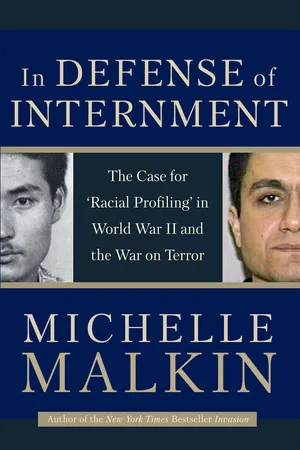
In Defense of Internment
eBook - ePub

In Defense of Internment

The Case for 'Racial Profiling' in World War II and the War on Terror

  1. 376 pages
  2. English
  3. ePUB (mobile friendly)
  4. Available on iOS & Android
eBook - ePub

In Defense of Internment

The Case for 'Racial Profiling' in World War II and the War on Terror

About this book

Everything you've been taught about the World War II "internment camps" in America is wrong:

  • They were not created primarily because of racism or wartime hysteria
  • They did not target only those of Japanese descent
  • They were not Nazi-style death camps

In her latest investigative tour-de-force, New York Times best-selling author Michelle Malkin sets the historical record straight-and debunks radical ethnic alarmists who distort history to undermine common-sense, national security profiling. The need for this myth-shattering book is vital. President Bush's opponents have attacked every homeland defense policy as tantamount to the "racist" and "unjustified" World War II internment. Bush's own transportation secretary, Norm Mineta, continues to milk his childhood experience at a relocation camp as an excuse to ban profiling at airports. Misguided guilt about the past continues to hamper our ability to prevent future terrorist attacks.In Defense of Internment shows that the detention of enemy aliens, and the mass evacuation and relocation of ethnic Japanese from the West Coast were not the result of irrational hatred or conspiratorial bigotry. This document-packed book highlights the vast amount of intelligence, including top-secret "MAGIC" messages, which revealed the Japanese espionage threat on the West Coast.
Malkin also tells the truth about:

  • who resided in enemy alien internment camps (nearly half were of European ancestry)
  • what the West Coast relocation centers were really like (tens of thousands of ethnic Japanese were allowed to leave; hundreds voluntarily chose to move in)
  • why the $1.65 billion federal reparations law for Japanese internees and evacuees was a bipartisan disaster
  • how both Japanese American and Arab/Muslim American leaders have united to undermine America's safety

With trademark fearlessness, Malkin adds desperately needed perspective to the ongoing debate about the balance between civil liberties and national security. In Defense of Internment will outrage, enlighten, and radically change the way you view the past-and the present.

Frequently asked questions

Yes, you can cancel anytime from the Subscription tab in your account settings on the Perlego website. Your subscription will stay active until the end of your current billing period. Learn how to cancel your subscription.
No, books cannot be downloaded as external files, such as PDFs, for use outside of Perlego. However, you can download books within the Perlego app for offline reading on mobile or tablet. Learn more here.
Perlego offers two plans: Essential and Complete
  • Essential is ideal for learners and professionals who enjoy exploring a wide range of subjects. Access the Essential Library with 800,000+ trusted titles and best-sellers across business, personal growth, and the humanities. Includes unlimited reading time and Standard Read Aloud voice.
  • Complete: Perfect for advanced learners and researchers needing full, unrestricted access. Unlock 1.4M+ books across hundreds of subjects, including academic and specialized titles. The Complete Plan also includes advanced features like Premium Read Aloud and Research Assistant.
Both plans are available with monthly, semester, or annual billing cycles.
We are an online textbook subscription service, where you can get access to an entire online library for less than the price of a single book per month. With over 1 million books across 1000+ topics, we’ve got you covered! Learn more here.
Look out for the read-aloud symbol on your next book to see if you can listen to it. The read-aloud tool reads text aloud for you, highlighting the text as it is being read. You can pause it, speed it up and slow it down. Learn more here.
Yes! You can use the Perlego app on both iOS or Android devices to read anytime, anywhere — even offline. Perfect for commutes or when you’re on the go.
Please note we cannot support devices running on iOS 13 and Android 7 or earlier. Learn more about using the app.
Yes, you can access In Defense of Internment by Michelle Malkin in PDF and/or ePUB format, as well as other popular books in History & World War II. We have over one million books available in our catalogue for you to explore.

Information

Publisher
Regnery
Year
2013
Print ISBN
9780895260512
eBook ISBN
9781621570981
Topic
History
Subtopic
World War II
Index
History
Chapter One
The Turncoats on Niihau Island
“Are you a Japanese?”
Those were the first English words spoken by downed Japanese fighter pilot Shigenori Nishikaichi on tiny Niihau Island, located about one hundred miles northwest of Honolulu.1 It was December 7, 1941. Nishikaichi had had a busy, bloody morning at Pearl Harbor. Now, with the aid and comfort of a Japanese American couple, Nishikaichi was about to make the lives of the Niihau residents a living hell.
Around 7:00 a.m., Nishikaichi boarded his Zero single-seat fighter plane and took off from the carrier Hiryu in the Pacific. The plane bore the rising sun insignia on each wingtip, top and bottom. Nishikaichi’s squadron, escorting nine level bombers, was part of the second wave of Japanese planes headed for the surprise attack on Oahu. An hour and a half later, the twenty-two-year-old Japanese pilot strafed planes, trucks, and personnel at Kanehoe Bay and Bellows Field. Headed for a rendezvous with his group, Nishikaichi and some fellow pilots encountered a group of American P36 fighter planes.
The Japanese quickly staved off the formation. During the air battle, Nishikaichi shot down one enemy plane, but his aircraft took several hits. One punctured the Zero’s gas tank. Nishikaichi steered the crippled plane toward the westernmost Hawaiian island: Niihau. The 19-mile-long tract was privately owned by the Robinsons, a Scottish ranching family. Fewer than two hundred residents, mostly native Hawaiians plus three laborers of Japanese descent and their families, called Niihau home. Nishikaichi’s superiors had mistakenly informed him that the land was uninhabited. In case of emergency, the Japanese planned to use the island as a submarine pickup point for stranded pilots.
Nishikaichi crash-landed the plane in a field near one of the ranch homes. The first to reach him was Hawila “Howard” Kaleohano, a burly native Hawaiian employed by the Robinson family. The island had no telephones. On that tranquil, late Sunday morning, with church services just letting out, none of the inhabitants was yet aware of the death and destruction that had just rained down on Pearl Harbor.
Nonetheless, Kaleohano wisely confiscated the dazed Nishikaichi’s gun and papers. Kaleohano, perhaps the most educated native Hawaiian on Niihau, had been keeping tabs on world affairs through newspapers supplied by ranch owner Aylmer Robinson (who paid weekly visits to the island and lived twenty miles away on Kauai). Wary but warm, Kaleohano brought the enemy pilot to his home. Along the way, Nishikaichi asked Kaleohano if he was “a Japanese.” The answer was an emphatic, “No.”
“The question was a gambit in what was to become a search for a confederate,” wrote Allan Beekman, a Hawaii-based historian who published the definitive account of the Niihau incident. Nishikaichi would find a yes-man soon enough.
After sharing a meal and cigarettes, Nishikaichi demanded that Kaleohano return his papers, which included maps, radio codes, and Pearl Harbor attack plans. Kaleohano refused. To make their communication easier, Kaleohano asked his neighbors to summon one of the island’s three residents of Japanese descent to translate for Nishikaichi. They first brought a Japanese-born resident and laborer, Ishimatsu Shintani, to the house. He reluctantly exchanged a few words with the pilot in Japanese, but the spooked Shintani left in a hurry—apparently sensing trouble and wanting nothing to do with his compatriot in name only.
The islanders then turned to Yoshio Harada and his wife Irene, both U.S. citizens, born in Hawaii to Japanese immigrants. Harada had moved from Kauai to California as a young man and lived there for seven years before relocating to Niihau with his wife in 1939. The hardworking and unassuming parents of three ran the Robinson ranch’s company store. Nishikaichi was cheered by the Haradas’ presence. “Oh, you’re a Japanese!” the enemy fighter pilot exclaimed when Yoshio Harada addressed him in their native tongue. Instantly at ease with the Nisei couple, Nishikaichi dropped the bombshell news about the attack on Pearl Harbor. The Haradas did not inform their neighbors.
That night, the hospitable Niihau residents—still in the dark about the atrocity at Oahu—treated Nishikaichi to a festive luau. They roasted a pig and swapped songs. Silently, Nishikaichi despaired. He had lost hope that he would be rescued.
Later that night, the islanders apparently learned about the Pearl Harbor attack on the radio. They decided to confine the pilot in the Haradas’ home until help arrived.
Exploiting their common ethnic ties and urging loyalty to the emperor, Nishikaichi won over the Haradas. They enlisted the other resident of Japanese descent—the skittish Shintani—in a conspiracy to retrieve Nishikaichi’s papers from Kaleohano. On the afternoon of December 12, a reluctant Shintani visited Kaleohano and asked for the enemy pilot’s papers. He offered his neighbor a wad of cash. Kaleohano refused. Shintani desperately told him to burn the papers. It was a matter of life and death, Shintani pleaded with Kaleohano. Japan made him do this, Shintani insisted. Kaleohano again refused.
An hour later, Nishikaichi and the Haradas launched a campaign of terror against the islanders. They overtook the guard on duty and locked him in a warehouse. Mrs. Harada cranked up a phonograph to drown out the commotion. Yoshio Harada and Nishikaichi retrieved a shotgun from the warehouse and headed to Kaleohano’s home. Kaleohano, who was in the outhouse, saw them coming and hid while Nishikaichi and his collaborators unsuccessfully searched for the pilot’s papers. They recovered Nishikaichi’s pistol and headed toward his grounded plane. Harada watched as the enemy pilot tried in vain to call for help on his radio.
dp n="41" folio="4" ?
Meanwhile, Kaleohano fled from the outhouse and ran to the main village to warn his neighbors of Nishikaichi’s escape. He returned to his house to retrieve the papers, hid them in a relative’s home, and set out with a strong team of islanders in a lifeboat toward Kauai to get help. They rowed for fourteen hours before reaching shore, where they informed their boss, Aylmer Robinson, and military officials of the intruder Nishikaichi and the treachery of the Haradas. That night, Harada and Nishikaichi set both the plane and Kaleohano’s home on fire. They fired off their guns in a lunatic rage and threatened to kill every man, woman, and child in the village. After gathering for a prayer meeting, many residents escaped to a mountaintop with kerosene lamps and reflectors in an attempt to signal Kauai. Others weren’t so fortunate.
On the morning of December 13, Harada and Nishikaichi captured islander Ben Kanahele and his wife. It was a fateful choice that Harada and Nishikaichi would live to regret. Kanahele was ordered to find Kaleohano. In their own “Let’s Roll” moment of heroism, the gutsy Kanaheles refused to cooperate. When Nishikaichi threatened to shoot Kanahele’s wife, fifty-one-year-old Ben lunged for the enemy’s shotgun. The young Japanese fighter pilot pulled his pistol from his boot and shot Kanahele three times in the chest, hip, and groin. Mrs. Kanahele pounced at Nishikaichi; her once-peaceful neighbor Harada tore her away.
Angered, the wounded Kanahele summoned the strength to pick up Nishikaichi and hurl him against a stone wall, knocking him unconscious. Quick-thinking Mrs. Kanahele grabbed a rock and pummeled the pilot’s head. For good measure, Ben Kanahele took out a hunting knife and slit Nishikaichi’s throat, ensuring his death. A desperate Harada turned the shotgun on himself and committed suicide.
The Kanaheles’ harrowing battle against a Japanese invader and his surprising collaborator was over.
On Sunday afternoon, an army expedition party arrived with Kaleohano at the village and took Shintani and Mrs. Harada into custody. The next evening, the rest of Hawaii finally got wind of the nightmare on Niihau. Radio station KTOH in Kauai broadcast a news bulletin on the ordeal. The Honolulu Star Bulletin published a follow-up account the next day.2 Shintani was sent to an internment camp and later returned to Niihau; he became a U.S. citizen in 1960.3 Irene Harada was imprisoned for nearly three years in Honouliuli. In 1945, after she was released, she asked for permission to bring the bodies of both Harada and Nishikaichi to Kauai for a funeral. Mrs. Harada was never charged with treason or any other crime.
Forgotten in today’s history books, the bravery of Howard Kaleohano and Ben Kanahele was justly rewarded at the time. Kanahele received the Purple Heart and Medal of Merit; Kaleohano received the Medal of Freedom and an $800 award from the army to pay for belongings that had been damaged or destroyed in the fire set to his home by Nishikaichi and Harada.
The significance of the Haradas’ stunning act of disloyalty and Shintani’s meek complicity in collaboration with Nishikaichi was not lost on the Roosevelt administration. “The fact that the two [sic] Niihau [ethnic] Japanese who had previously shown no anti-American tendencies went to the aid of the pilot when Japan domination of the island seemed possible, indicates likelihood that Japanese residents previously believed loyal to the United States may aid Japan if further Japanese attacks appear successful,” noted Captain Irving Mayfield, then district intelligence officer for the Fourteenth Naval District, after a naval intelligence investigation on the Niihau takeover in January 1942.4 Lieutenant C. B. Baldwin was more emphatic. The facts of the case “indicate a strong possibility that other Japanese residents of the Territory of Hawaii, and Americans of Japanese descent . . . may give valuable aid to Japanese invaders in cases where the tide of battle is in favor of Japan and where it appears to residents that control of the district may shift from the United States to Japan,” he said.5
Unbeknownst to Mayfield and Baldwin, at least one high-ranking Japanese naval intelligence officer apparently concurred. In November 1941, less than one month before the Pearl Harbor attack, Lieutenant Commander Suguru Suzuki met with Admiral Isoroku Yamamoto’s chief of staff, Matome Ugaki, to discuss conditions in Hawaii. If Japan were to invade Hawaii, Suzuki informed Ugaki, local ethnic Japanese probably would cooperate with the occupying forces.6
dp n="43" folio="6" ?
The Haradas were neither radical nationalists nor professional spies. They were ordinary Japanese Americans who betrayed America by putting their ethnic roots first. How many other ethnic Japanese—especially on the vulnerable West Coast—might be swayed by enemy appeals such as Nishikaichi’s? How many more might be torn between allegiance for their country of birth and kinship with Imperial invaders? These were the daunting questions that faced the nation’s top military and political leaders as enemy forces loomed on our shores.
dp n="44" folio="7" ?
Chapter 2
The Threat of the Rising Sun
As President Franklin D. Roosevelt sat down to deliver his White House fireside chat on the night of February 23, 1942, a Japanese submarine rose up from the Pacific Ocean. The 384-foot vessel emerged off the coast of Goleta, California, not far from Santa Barbara. Unaware of the enemy lurking in their midst, diners at the Wheeler’s Inn in neighboring Ellwood gathered around the radio to hear FDR’s update on progress in the war against the Axis powers. “We know now that if we lose this war it will be generations or even centuries before our conception of democracy can live again,” Roosevelt warned from the Oval Office.1 On the opposite side of the country, Imperial Navy Commander Kozo Nishino ordered five of his sailors to train their I-17 submarine’s deck gun on the Ellwood oil fields. Above the mundane din of silverware clinking, food sizzling, and diners murmuring, FDR’s message crackled over the airwaves, “The broad oceans which have been heralded in the past as our protection from attack have become endless battlefields on which we are constantly being challenged by our enemies.”2
About fifteen minutes into the speech, the diners in Ellwood—many of them workers at the local oil refinery—felt two violent blasts that unwittingly punctuated the president’s distant words. Witnesses saw bright flashes light up the oil fields. J. J. Hollister III, a boy of ten at the time who lived in a nearby canyon home, heard “a whistling noise and a thump as a projectile hit” the grounds bordering his house. Following the flashes came “an eerie whistling and caterwauling,” Hollister recounted. “It was a sickening sound.”3
And so began the first foreign attack on the U.S. mainland since the War of 1812.
Commander Nishino’s men fired up to two dozen shells on the coast. They scored a direct hit on an oil derrick and damaged a pier. “My God, all the sirens went off and the blackout happened and there were searchlights all over the skies,” remembered Santa Barbara resident Joan Martin, who was twenty-two-years-old at the time of the shelling.4 A besieged refinery worker, answering a phone call from the town police inquiring about damage, retorted, “I don’t know. I’m too busy dodging shells.”5
“War for a moment seemed very real for the first time and indeed closer than we ever thought it could be,” observed sixth-grader Joan Churchill, who wrote an eyewitness report of the shelling for her schoolmates.6
This little-known attack on the tranquil California coast lasted less than half an hour; the I-17 snuck away untouched. Army captain Bernard Hagen, an artilleryman, was wounded while deactivating the fuse of what he thought was a dud shell. It exploded and shrapnel embedded itself permanently in Hagen’s thigh. He later received the Purple Heart for his wounds.7 While no one else was injured or killed and property damage was minimal, the Imperial Navy claimed yet another psychological victory against fearful Americans still reeling from the Pearl Harbor attack two months earlier. In Japan, Radio Tokyo boasted, “Sensible Americans know that the submarine shelling of the Pacific Coast was a warning to the nation that the Paradise created by George Washington is on the verge of destruction.”8

THE WEST COAST UNDER SIEGE

Critics of the WWII evacuation and relocation contemptuously dismiss the Roosevelt administration’s homeland defense measures as the result of unequivocal “wartime hysteria.” It is true that there were many phony rumors of sabotage and erroneous reports of attacks. The most infamous pieces of misinformation were the tall tales of Hawaiian farmers of Japanese descent aiding Imperial bombers by cutting arrows in their sugarcane fields in advance of the Pearl Harbor attack9 and the so-called “Battle of Los Angeles” two days after the Ellwood oil field shelling. Panicky American antiaircraft gunners stationed at Fort MacArthur fired more than fourteen hundred shells into the southern California skies during what they mistakenly thought was a Japanese air raid.10
But for every false alarm, there were many more real and unsettling forays along our shores that, when added to Japan’s shocking military triumphs abroad, rightfully heightened America’s anxiety.
In and around Hawaiian waters, Japanese submarines roamed free. At almost the same moment as the Pearl Harbor blitz, a Japanese submarine, the I-26, torpedoed and sank the SS Cynthia Olson, an unarmed U.S. army-chartered steam schooner, about one thousand miles northwest of Honolulu. All thirty-three members of the crew, plus two army passengers, died.11 On December 11, another Japanese sub, the I-9, sank the freighter SS Lahaina off Honolulu. Four crewmembers died. Thirty survivors were stranded at sea for more than a week before washing ashore on the island of Maui.12 Six da...

Table of contents

  1. Title Page
  2. Dedication
  3. Epigraph
  4. A Note to the Reader
  5. Introduction
  6. Chapter One - The Turncoats on Niihau Island
  7. Chapter 2 - The Threat of the Rising Sun
  8. Chapter 3 - Sympathizers and Subversives
  9. Chapter 4 - Spies Like Us
  10. Chapter 5 - The MAGIC Revelations
  11. Chapter 6 - The Internment of Enemy Aliens
  12. Chapter 7 - The Rationale for Evacuation
  13. Chapter 8 - Executive Order 9066
  14. Chapter 9 - The Myth of the American “Concentration Camp”
  15. Chapter 10 - Reparations, Revisionism, and the Race Card
  16. Chapter 11 - The “Puffery” Defense
  17. Chapter 12 - Damning America
  18. Conclusion
  19. Appendix A - Richard Kotoshirodo
  20. Appendix B - MAGIC Cables
  21. APPENDIX C - Intelligence Memos
  22. Appendix D - The Kenji Ito Case
  23. Appendix E - The Coram Nobis Cases
  24. Appendix F - The Camps And Centers
  25. A Note on Research and Sources
  26. Acknowledgments
  27. Index
  28. Copyright Page