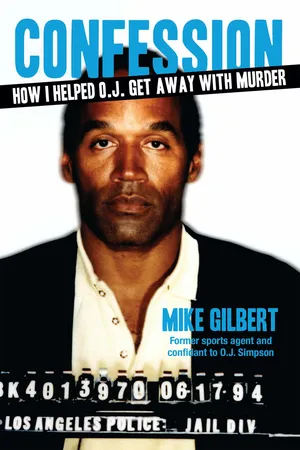
How I Helped O.J. Get Away With Murder
eBook - ePub

How I Helped O.J. Get Away With Murder

The Shocking Inside Story of Violence, Loyalty, Regret, and Remorse

  1. 232 pages
  2. English
  3. ePUB (mobile friendly)
  4. Available on iOS & Android
eBook - ePub

How I Helped O.J. Get Away With Murder

The Shocking Inside Story of Violence, Loyalty, Regret, and Remorse

About this book

You Don't Know the Full Truth About O.J. Simpson and the Murders that Gripped a Nation. But Mike Gilbert does, and after nearly two decades of being O.J. Simpson's sports agent, business advisor, and trusted confidant, Gilbert is breaking his silence and telling the full story of the man he idolized, but now despises. Gilbert's shocking tale is unlike anything you've read before; it isn't his "version" of what happened--it's the unvarnished truth. The truth about O.J., the murders, and the infamous trial. Not as Gilbert imagined or would like it to be, but how it actually was. Gilbert doesn't spare anyone, not even himself--he helped deceive the jury and feels deeply responsible for the "Not Guilty" verdict.
Frequently asked questions

Yes, you can cancel anytime from the Subscription tab in your account settings on the Perlego website. Your subscription will stay active until the end of your current billing period. Learn how to cancel your subscription.
No, books cannot be downloaded as external files, such as PDFs, for use outside of Perlego. However, you can download books within the Perlego app for offline reading on mobile or tablet. Learn more here.
Perlego offers two plans: Essential and Complete
  • Essential is ideal for learners and professionals who enjoy exploring a wide range of subjects. Access the Essential Library with 800,000+ trusted titles and best-sellers across business, personal growth, and the humanities. Includes unlimited reading time and Standard Read Aloud voice.
  • Complete: Perfect for advanced learners and researchers needing full, unrestricted access. Unlock 1.4M+ books across hundreds of subjects, including academic and specialized titles. The Complete Plan also includes advanced features like Premium Read Aloud and Research Assistant.
Both plans are available with monthly, semester, or annual billing cycles.
We are an online textbook subscription service, where you can get access to an entire online library for less than the price of a single book per month. With over 1 million books across 1000+ topics, we’ve got you covered! Learn more here.
Look out for the read-aloud symbol on your next book to see if you can listen to it. The read-aloud tool reads text aloud for you, highlighting the text as it is being read. You can pause it, speed it up and slow it down. Learn more here.
Yes! You can use the Perlego app on both iOS or Android devices to read anytime, anywhere — even offline. Perfect for commutes or when you’re on the go.
Please note we cannot support devices running on iOS 13 and Android 7 or earlier. Learn more about using the app.
Yes, you can access How I Helped O.J. Get Away With Murder by Mike Gilbert in PDF and/or ePUB format, as well as other popular books in History & North American History. We have over one million books available in our catalogue for you to explore.

Information

Publisher
Regnery
Year
2008
Print ISBN
9781596985513
eBook ISBN
9781596980648
CHAPTER ONE
BE CAREFUL WHAT YOU WISH FOR
People always ask me what I miss the most about the golden years, as agent to one of the most iconic American athletes of all time. The five-star hotels? Flying first class? Being treated like a rock star wherever we went? The women?
All of that was intoxicating, and I enjoyed it more than I would like to admit. But what I miss the most dates back much earlier, to when I was a kid, in the eighth grade. That was just before the leap into real life, when my dream world still governed me. Like every other American kid at that age, I had a hero. Mine happened to be O.J. Simpson.
I watched his every game. I knew his every move. He was one of four people in the world I dreamed of one day meeting.
I can remember the smell of the black magic marker and the thrill I felt as I carefully drew the number “32” on the back of my white T-shirt from JC Penney, stretched against the kitchen table. Those of you who remember O.J. from before all this know that 32 was his number. I wore that T-shirt constantly in our local football games, yelling: “I’m O.J. Simpson!” There was nobody on earth I admired more, or wanted to be more. We played football constantly in my neighborhood, Highland Drive, in Hollister, California, until long after dark most days, every weekend, every holiday, every chance we got. We drove our mothers crazy—we just wouldn’t come home. In my case, my mother was actually my stepmother, but I think of her as my true mother.
My birth mother had us three kids when she was just a teenager, and simply couldn’t cope. I was the first one she gave up—deposited on the stoop of my grandparents’ house, and that was it. She kept my sisters a little while longer, but soon came and dropped them off too. I guess there’s a lot I don’t know. It’s not a subject we like to discuss in my family. In any case, things stabilized after my mother left us. My father remarried, happily, and I became a fairly normal suburban kid.
My birth mother came to see me once in the eleventh grade when I was competing in a track meet for Hollister High. Somebody told her where I would be competing and she just showed up. My buddy Ray Sanchez said, “Hey Gilbert, there’s a lady here looking for you who says she’s your mother.”
I said, “What does she look like?”
He said, “She kind of looks like you.”
I looked over his shoulder, and saw her walking toward us. I stiffened, but I was glad to see her. We talked for a while. She took me to have a hamburger, then asked if she could drive me home, which I agreed to. I was quiet and a bit distant during the two-and-a-half-hour ride, which seemed like an eternity.
I didn’t see her again for many years, until my grandfather’s funeral, when my mother came over to give me a hug and to thank me for being there.
With biting sarcasm, I introduced my sisters, her daughters: “Surely you remember your daughter Sondra and your other daughter Debbie?”
She looked at me quizzically and said, “Of course I do.”
dp n="16" folio="7" ?
I didn’t let up. I said, “Do you even remember my birthday?”
“November 3,” she said quietly.
“I didn’t get a birthday card from you for my entire childhood, that’s why I asked.”
She fell silent. A few moments later, when my anger had passed, I started to regret what I had said, as I so often do. It’s always like this: my anger flares and I say something cutting that I later regret. I wish I had just returned her simple gesture and kept my mouth shut.
I’m sure she did what she felt was best for my sisters and me. As an adult I’ve come to love her, and always will.
At a young age, one way I learned to conquer hardship, or at least escape it momentarily, was through sports. Once I discovered football, I was free. I loved everything about it: the excitement, the clarity, the suspense, the heroics, the perpetual chance at instant redemption. At center stage of my dream world was O.J. Simpson: flying, defying gravity. He was an amazing athlete. He had everything—speed, strength, grace, agility, the ability to turn on a dime, and an uncanny gift of acceleration. That was his most exceptional talent, I think, if I had to pick one—acceleration. He could go from standing still to top speed in four steps. He was just faster than everybody else on the field—they couldn’t catch him. He did things on the field that I thought were physically impossible. He could run over you, he could run around you, he could run past you. His coach at USC said he was not only the greatest running back, but the best college football player he had ever seen. Had he not chosen football, O.J. could easily have been an Olympic track star—he was that fast. In fact, he and his teammates set the world record of 38.6 seconds for the 4 x 110 relay,1 in Salt Lake City, Utah, in 1967.2
dp n="17" folio="8" ?
In January 1969, I took USC against Ohio State in the Rose Bowl for twenty-five cents, in a bet with my aunt. O.J. played brilliantly, but USC lost. I was crushed, and paid up the twenty-five cents. Stung, I promised my aunt, “One day I’m going to meet O.J. Simpson and get my twenty-five cents back.”
Sometimes I wonder if God punished me for being so greedy about that quarter. But of course it wasn’t the money—it was the emotion of losing. Twenty years later, when I was his agent and we were sitting on the patio by his pool, I told O.J. that story. I asked him for the quarter. O.J. did have a great sense of humor.
“No,” he said. “Fuck you, Mike. I’m not giving you the money. Twenty-five cents? Fuck no. What the fuck do you want me to do? It wasn’t my fault we lost. I had a great game and Ohio State had an unbelievable defense that year.” O.J. ran 171 yards and scored a touchdown in that game.
In 1992, Skip Taft, O.J.’s business attorney and longtime friend, sent me a Christmas present. It was a check from O.J.’s bank account for twenty-five cents. It was itemized as: “Repayment of gambling loss on 1969 Rose Bowl.”
I still have it.
I have been a sports marketing agent since the mid-1980s. I was never one of those agents who only watched the bottom line—I was always emotionally attached, more than the average agent. My childhood experiences made me form fierce attachments, and to fear abandonment above all else.
In my heart I identified with the fans; I was a fan. Even when I was moving among the elite, representing the athletes, I still felt my strongest affinity not with them but with the fans—who believed in something.
My career as an agent began accidentally, in my sophomore year in high school, in 1971. A bunch of us took a Chevy Suburban to the coliseum at Cal Berkeley to watch a Raiders-Rams pre-season game. We got there at halftime. After the game we went over to the locker rooms, hoping for autographs. I spotted one of the players—Ben Davidson—and I had an inspired idea.
“Uncle Ben!” I hollered, not quite loud enough for Ben Davidson to hear but just loud enough for the security guards to hear. The guards stepped away and I followed “Uncle Ben” into the locker room. I scored my first batch of football autographs that day.
Soon after that I started to understand and tap into the immense power that athletes have to do good. A friend of my brother’s had been paralyzed from the waist down in a car accident. I called the Raiders office and made arrangements for a few players to come to a fund-raiser. They did. Very quickly and simply, we raised several thousand dollars for the family’s medical costs. One of the players even visited him in the hospital, which gave him inspiration and made him extremely happy. In that moment, I saw both the power of celebrity and the power of athletes to give back. They are given so much because of a God-given ability—because they can run a little faster or jump a little higher than everybody else.
By the mid-1980s, I was continuing to do work with the Raiders players, and my reputation was growing. Before long, I signed my first superstar client—Marcus Allen.
O.J. and Marcus were uncannily similar in their career paths. Both were running backs, both were alums of USC, both won the Heisman in their senior year of college,3 both were picked in the first round of the NFL draft, both were expected to make immediate impacts on their NFL teams, and both were later inducted into pro football’s Hall of Fame. They also shared a tragic passion for the same woman: Nicole Brown Simpson. I’ll return to that later.
dp n="19" folio="10" ?
I was Marcus Allen’s marketing manager for about a decade in both Los Angeles and Kansas City. Marcus and I had a great personal and professional relationship; we were true friends and I thought the world of him. Before I started representing O.J., Marcus was my number-one star client. He gave me instant credibility in the industry. I handled public appearances, endorsements, and the merchandising of collegiate and NFL memorabilia for Marcus. This was when my own life began to change, in the late 1980s. Suddenly, I became a member of the elite. No more flying coach, no more Best Westerns, no more Denny’s. Once I was representing Marcus, everything was five-star and first-class. I had money, I had influence, I had tickets to every game, backstage passes to concerts—whatever I wanted. Before long, I started to buy into that lifestyle, to believe that I “deserved” it, and to resent anything that fell short of my expectations. I realize, looking back, that this was also the time when all sense of innocence started to become eroded and lost.
Before long, part of my job for Marcus included creating smokescreens that allowed him to more easily cheat on his lovely wife, Kathryn. I would leave false messages on his answering machine at his request—asking him to appear in fictional contexts, to give him an alibi and cover for his trysts with other women.
I did it not only for him but for other athletes. I created alternate worlds for these guys to live in. My loyalty and honesty was to the athlete—not the wife. I didn’t like that part of the job, but I did it, very well. It started to become depressing. I remember I used to tell people that we created illusions in the world of professional sports—that from the outside it’s like The Wizard of Oz before Dorothy looks behind the curtain. I wanted people to think that my clients were witty, charming, intelligent, sensitive people, because that was the image that Nike or Reebok or American Express wanted to portray. That’s what we do in sports marketing. We create illusions. I want little Jimmy to go to McDonald’s, and on the way I want him to be drinking a Coke, bouncing a basketball with a Nike logo on it, while wearing a Nike jogging suit and sneakers, dreaming that he’s his favorite ball player. In sports marketing, we create that dream—that illusion—and then sell it, sell it, sell it.
Pretty soon, I became an illusion myself. I started cheating on my own wife, even though I loved her more than anything in the world. I started thinking the only thing that mattered was not what I did, but whether I got caught doing it. I got caught up in the power trip. At the same time, I also started to like myself a little less every day. The less I liked myself, the more I had to prop up the image, to distract myself and others from what I had become. I started thinking I was better than and different from “ordinary” people. I moved among the gods, and although I wasn’t one myself, I was still among the elite.
002
There were four people in the world I truly idolized and had wanted all my life to meet: Muhammad Ali, Clint Eastwood, Elvis Presley, and O.J. Simpson. To me they embodied perfection in the American male. Each, in his own way, was a hero, an icon, one who defied all expectations and rose above all the forces that threaten to drag us down in this life, make us ordinary, make us blend into the crowd and live and die without distinction. That frightened me more than anything—being ordinary. I respected only the extraordinary.
I wound up meeting three of the four: Muhammad Ali, Clint Eastwood, and O.J. Meeting O.J., though, transcended my wildest dreams.
Here’s how it all began: Marcus Allen had said on a few occasions, “I can set you up with O.J., you know.” Marcus was good friends with O.J., and had been mentored and guided by him professionally. I told him I would be thrilled if he could make the introduction, but I didn’t press the issue.
In 1989, late one night, I got a call. It was about 11:00 PM. I wondered: Who would call me at this hour? I answered the phone and a deep voice said, “Mike, this is O.J. Simpson.”
I thought Marcus was playing a joke. “Fuck you, Marcus,” I said.
“No, really,” the voice said. “This is O.J. Simpson. Marcus suggested we might do some work together.”
Then I heard Marcus laughing in the background and saying, “Mike, this is Marcus. I am here with O.J., but you are talking to him.” I froze. I put on my best professional voice and said, “O.J., I apologize. I would be happy to discuss the possibility of representing you.”
O.J. was very friendly and charming. He said he’d heard that I was one of the best, and he liked to hire only the best people.
We set a date and time. The plan was for me to meet O.J. and his assistant, Cathy Randa, at his office in Brentwood a week later. I was excited, starstruck, and a little nervous. As the time approached, Cathy Randa called me and said O.J. wanted me to meet him at his house instead, at Rockingham. I got directions.
“One thing, Mike,” she said before we signed off. “He is very, very protective of his image. You have to be extremely careful. He can’t stand letting people down, so you mustn’t ever book him for anything if there is even the slightest chance he won’t be able to make it. Everything has to be checked and double checked. His image is everything to him.”
“Understood,” I said.
Cathy had been with him forever, and was extremely devoted to him. Sometimes it seemed she was even more protective of his image than he was. In Cathy’s eyes, the world revolved around protecting O.J.
When I arrived at Rockingham, I followed Cathy inside the gate, and we walked around to the back of the house. Within seconds, O.J. walked out, and int...

Table of contents

  1. Title Page
  2. Dedication
  3. PROLOGUE
  4. CHAPTER ONE - BE CAREFUL WHAT YOU WISH FOR
  5. CHAPTER TWO - JUNE 12, 1994: THE END OF THE WORLD AS WE KNEW IT
  6. CHAPTER THREE - DANCE MACAB RE
  7. CHAPTER FOUR - BLOOD BROTHERS
  8. CHAPTER FIVE - THE SHOW MUST GO ON
  9. CHAPTER SIX - O.J. IN JAIL
  10. CHAPTER SEVEN - THE GREATEST SHOW ON EARTH
  11. CHAPTER EIGHT - THE ONE WHO GOT AWAY
  12. CHAPTER NINE - NICOLE AND ME
  13. CHAPTER TEN - THE VERDICT AND HOMECOMING
  14. CHAPTER ELEVEN - HE DID IT
  15. CHAPTER TWELVE - SELLING O.J. PIECE BY PIECE
  16. CHAPTER THIRTEEN - A BRIEF INTERLUDE: O.J.’S LIES SIMPLIFIED
  17. CHAPTER FOURTEEN - GOODBYE TO ALL THAT
  18. CHAPTER FIFTEEN - FEAR AND LOATHING IN LAS VEGAS
  19. CHAPTER SIXTEEN - REFLECTIONS
  20. Acknowledgements
  21. APPENDIX I - HOW IT ALL WENT DOWN
  22. APPENDIX II - TIMELINE OF THE NICOLE BROWN SIMPSON AND RON GOLDMAN MURDERS, ...
  23. APPENDIX III - THE SIMPSON TRIAL TIMELINE
  24. APPENDIX IV - MEMO BY DETECTIVE MARK FUHRMAN ON 1985 DOMESTIC DISPUTE AT ...
  25. APPENDIX V - NICOLE BROWN SIMPSON’S UNDATED LETTER TO O.J.
  26. APPENDIX VI - O.J.’S SUICIDE LETTER
  27. APPENDIX VII - PEOPLE AND PLACES GLOSSARY
  28. INDEX
  29. Copyright Page